by Mark Smiley
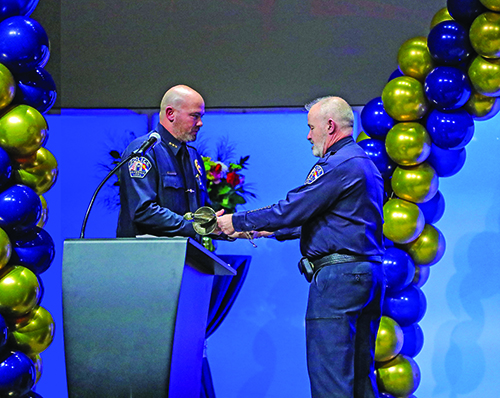
Retired Glendale Police Chief Joe Haskins (right) passes along a ceremonial sword bearing the engraved names of past chiefs to new Glendale Police Chief Justin Haynes, an enduring tradition that has remained in the chief’s office for decades. Photo credit: Colton Strickler
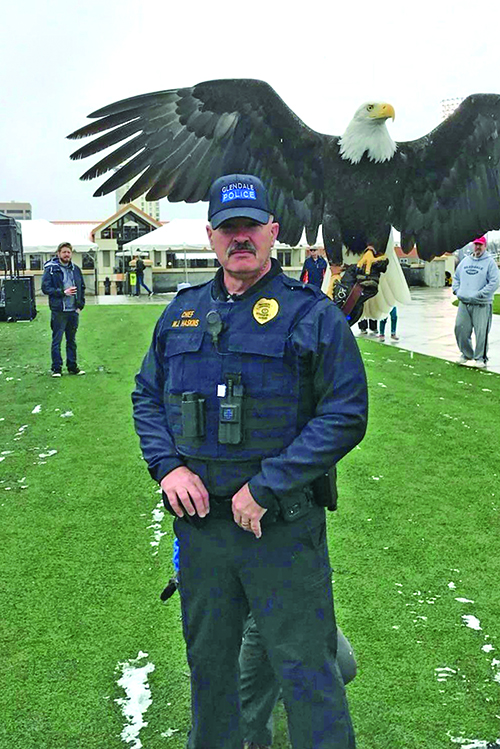
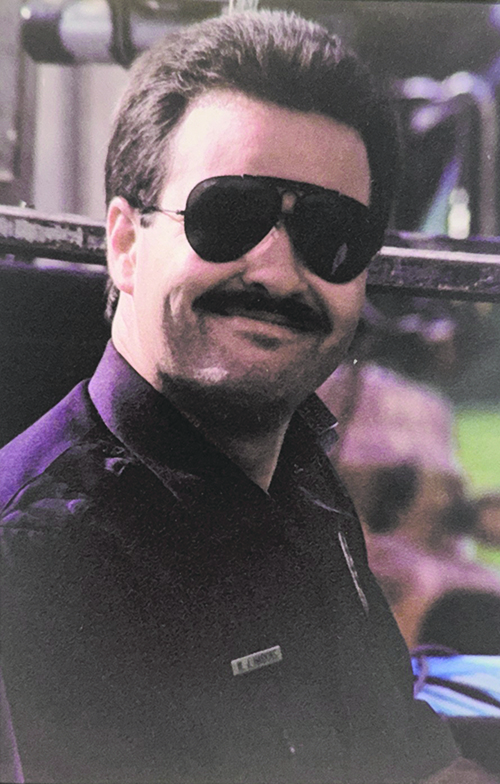
Retired Glendale Police Chief Joe Haskins is pictured in vintage photos, remembered for his decades of service and leadership in the Glendale community.
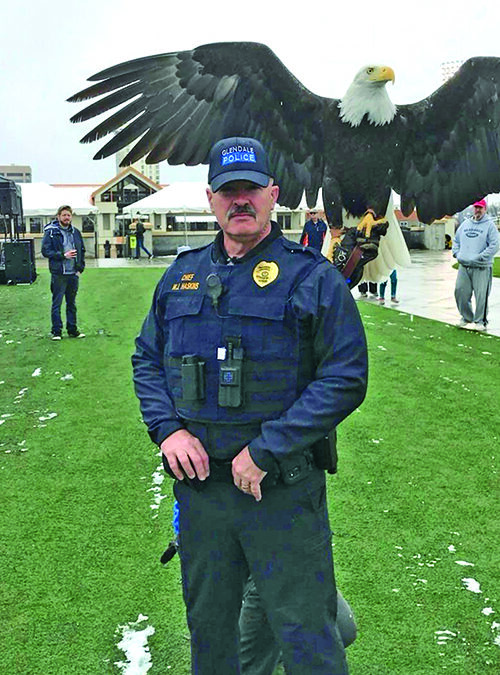
 After 38 years in law enforcement, including almost 13 years as Glendale’s police chief, Joe Haskins is stepping away from the badge, leaving behind a department he helped fundamentally reshape and a legacy defined by service, accountability, and cultural change.
Haskins’ career with the Glendale Police Department began in 1994, after six years with the Sheridan Police Department. Like many officers of his era, he entered policing with what he describes as an “enforcement-first” mindset, an approach that would later evolve in response to a pivotal moment in the department’s history.
In October 1999, Glendale police were involved in a serious incident during a contact with a man believed to be intoxicated in his vehicle. The situation escalated, and the individual was assaulted by an officer who was later convicted of a crime and permanently removed from law enforcement.
“That incident made it really clear, to the mayor, City Council, and certainly to the police department, that things needed to change,” Haskins said. “We recognized there was a big shift that had to happen.”
The department began moving away from an enforcement-first philosophy toward a model emphasizing judgment, restraint, and decision-making under stress. That cultural shift, Haskins said, did not happen overnight.
“It took years,” he said. “By 2006 or 2007, we were really well on our way, but this is never something that’s ‘done.’ You’re always working at it.”
As he rose through the ranks, promoted to sergeant in 2002, lieutenant several years later, and ultimately police chief in 2013, Haskins became closely involved in training and policy reforms. One of the initiatives he helped pioneer was Glendale’s force-continuum training program, a hands-on simulation designed to replicate the stress and unpredictability officers face in real-world encounters.
“You can teach policy in a classroom and pass a written test,” said Haskins. “But how are you really going to act at three o’clock in the morning when no one is watching?”
The program placed officers in realistic scenarios using protective gear and non-lethal training weapons, allowing supervisors to observe how officers responded under pressure and intervene with retraining when necessary.
“That was one of the key things about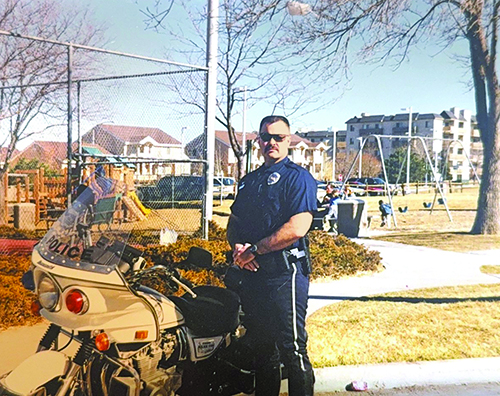 changing the culture,” Haskins said.
In 2013, following the resignation of then-Chief Ross, Haskins was appointed interim chief and later named permanent chief by City Council. His tenure would become the second-longest in department history.
Despite leading a relatively small department, Haskins emphasized that Glendale officers face big-city challenges, from high call volumes to nightlife related incidents, and that proactive policing has long been a hallmark of the department.
“Our officers are busy,” Haskins said. “I’d put their activity level up against anyone in the metro area. They’re proactive, not just waiting for the radio to go off, but making contacts, trying to solve problems, and figuring out whether someone needs help or accountability.”
Throughout his career, Haskins often returned to the idea of policing as a calling rather than a job.
“I’ve always believed law enforcement is a noble profession,” he said. “The nobility comes from the self-sacrifice. You give up some of your rights. You place the will of the public ahead of your own.”
As chief, he reminded officers that the uniform itself symbolized service over self.
“I take away your first name. Your first name is ‘officer,’” he said. “Because it’s not about you, it’s about the service you’re providing.”

Barret O’Brien (left) poses with retired Glendale Police Chief Joe Haskins, lifelong friends whose bond has remained strong through the years of service and community involvement.
While Haskins is retiring as chief, he is not fully stepping away. He plans to continue consulting for the city and police department, offering institutional knowledge built from decades of experience.
“I don’t want to just abandon the cops over there,” Haskins said. “I care deeply for the department and every single member of staff.”
More than anything, Haskins said retirement will allow him to make up for time lost with his family, particularly his wife, Rochelle, who endured years of late nights and constant worry.
“Every night I went to work, she had a pit in her stomach until I got home,” he said. “She lived that life with me.”
Reflecting on his career, Haskins expressed gratitude rather than pride.
“I was trusted with an incredible responsibility,” he said. “It was always a privilege, and I tried very hard to live up to that.”