
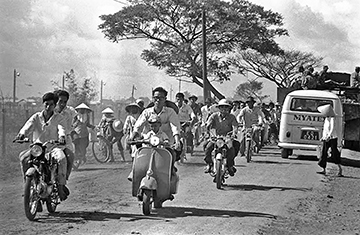
The Life in Saigon in the 1960s, by François Sully
Seldom, if ever, has Denver’s progressive Mayor and the majority of the City Council annunciated that the solution to a problem in the city is to let the “free market decide.” But now, all of the sudden, they have advocated that the solution to parking woes in Denver is henceforth to let the free market decide. For future developments or redevelopments there will be no city mandated parking minimums. Developers will be the ones to decide what, if any, parking is necessary or advisable for their projects.
What has caused this sudden change of philosophical outlook? The answer is obvious. The powers to be believe that many preternaturally greedy and short-sighted Denver developers will elect to provide the least amount of parking possible hoping to cannibalize off neighboring businesses or on-street parking. That will make automobile use in the city even more problematic.
But why do Denver’s planners and political class dislike cars? They believe, inter alia, automobiles are a major source of carbon dioxide contributing to climate change which will eventually destroy the planet. They also believe that automobile-oriented societies adversely affect the poor who can’t afford a car or drive cars that necessarily reflect their socio-economic status.
Cars also facilitate urban sprawl. Progressives correctly note the densely packed areas tend to be far more likely to lean left and favor increased governmental solutions to societal problems. Cars also provide a certain degree of personal freedom for people to travel where and when they wish. Individual freedom, however, is not a value prized by progressives.
An advantage to Denver’s approach to parking is that the city is looking to let an ever-increasing number of city employees go. Traffic engineers whose job it is to make car traffic flow more easily are now expendable as the city wants to make traffic more congested. As hard as that is to believe in some respects it is obviously exactly what is being planned. The number of traffic lanes on major thoroughfares in the city such as Colfax and Broadway are being reduced. On neighborhood streets, bollards and striping are intended to be “traffic calming devices” making traffic flow more difficult.
In turn dedicated bicycle lanes are expanding across the city. It appears the vision for urban transportation are buses, bicycles, and walking. For those old enough to remember, that was the transportation mode for Saigon, Vietnam, circa 1965.
Do most people want to live in or visit a city whose transportation plan reflects that of 1965 Saigon? Tax revenues for Denver have been steadily dropping but the city does not appear to care. The city depends on Coloradans coming to shop and recreate. By making the city less friendly for cars it makes it less likely people will come visit.
City planners indicate they would like to see Denver be a place where the concept of a “15-minute city” becomes a reality. In such a place daily necessities are all accessible by a 15-minute walk or bike ride from home. The peasants in Germany and the serfs in Russia in the 12th century lived in 15-minute communities. American coal miners were forced to live in company towns in the late 19th century.
Throughout history so-called utopian communities turned out to be lousy places to live. Denver’s city planners may be doing the same to Denver in their quest to make it a “15-minute city.” Only time will tell.
— Editorial Board