by Amber Wyatt
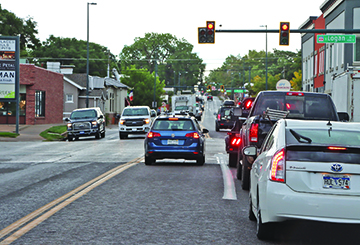
Intersection at Alameda and Franklin westbound where two lanes expand into four lanes.
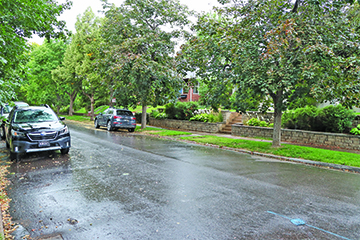
Neighborhoods west of Alameda between Corona and Downing.
Residents of the Washington Park area are voicing strong opposition to a city plan that would reduce traffic lanes on Alameda Avenue. The proposal, spearheaded by Denver’s Department of Transportation and Infrastructure (DOTI), aims to reconfigure the busy corridor between Downing Street and Franklin Street. But neighbors argue the changes will worsen congestion, harm local businesses, and push traffic deeper into residential streets.
At the heart of the plan is a major reconfiguration of Alameda’s lanes. Currently, the road has two lanes in each direction. DOTI intends to cut that down to a single lane each way, adding dedicated left-turn lanes in certain stretches and installing medians with bollards to restrict some left turns altogether.
“They’re going to take out two traffic lanes,” explained Jill, a member of the grassroots coalition Act for Alameda. “So it will be one lane, east and west. And then with the space they gain in some places, they’re going to put left turn lanes.”
The city’s rationale is safety. By slowing traffic and streamlining turn lanes, DOTI believes the project will reduce accidents. But residents say the plan ignores how much traffic Alameda carries — especially as a vital east-west connector to and from I-25.
“This is a super heavy section,” Jill said. “When they’re taking traffic lanes out, it is going to be a lot busier. So you’re going to have a lot more cars squeezed into one lane. We’re basically worried that congestion will get significantly worse.”
The Act for Alameda group formed in May after learning of the project, which was initially scheduled to begin in June but has since been delayed to September. The group’s website includes a letter for residents to sign, directed to the mayor, outlining their concerns.
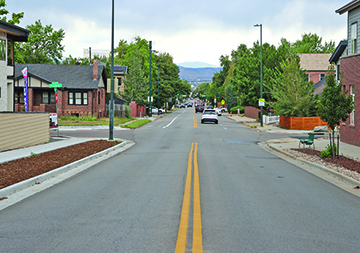
Preexisting turn lanes on Alameda between Logan and Franklin.
One major worry is neighborhood traffic diversion. If Alameda becomes choked with cars, drivers may opt for narrower residential streets. “We’re very worried about the number of cars that’ll be diverting through the neighborhoods,” Jill said. “Maybe Alameda itself gets slightly safer, but you’re shifting the safety problem into these narrow streets where you’ve got a lot of dogs and kids.”
Safety for emergency responders is another concern. “There’s a fire station right on the northeast corner of Wash Park,” Jill noted. “We’re worried that if Alameda just becomes gridlock during peak times, it also makes those emergency response times a lot slower.”
The group isn’t opposed to all aspects of the plan. In fact, they welcome certain safety improvements. “We are all for better school zone markings. They want to lower the speed limit — we’re fine with that. They want to put in a flashing crosswalk. All of those things directly point to making pedestrians safer,” Jill said. “It’s really the removal of the lanes, reducing road capacity, that just does not compute for us.”
Adding to frustrations, residents point out that the stretch of Alameda west of Broadway is already under heavy construction, with lane reductions and bike lanes being installed. Business owners in both areas worry that prolonged projects will drive customers away.
Jill suggested that if DOTI wants to spend its bond dollars, it should focus further west, where accident rates are higher. “This section of Alameda is considered part of the high injury network, but it is in the lower tier,” she said. “The higher risk, less safe areas are further west. We would love to see them do stuff there.”
Complicating matters is Denver’s rapid growth. A massive residential project is already underway on the site of the old Bed Bath & Beyond at Cherry Creek Mall, with plans for roughly a thousand apartments. “It’s not like there are signs there’s going to be fewer people needing Alameda,” Jill said. “It’s going to be more drivers in five years, not less.”
For long-time residents like Jill, who has lived in Wash Park for nearly 20 years, the plan feels like déjà vu. She recalled that the city tried a similar lane reduction about 15 years ago, only to quickly reverse course. “They have tried to make changes in this area before,” she said, “but it’s essentially been the way it is now.”
With construction looming, Act for Alameda continues to push for dialogue. “We have not heard directly from DOTI,” Jill said. “The only indication we have that they’re hearing us is that they’ve already delayed the project once.”
For Wash Park neighbors, the fight is far from over. As Jill put it, “We just think that it’s too significant of a constriction of the road to actually make things safer. They’re going to spend all this money, make all these changes, and just create new safety issues.”