by Amber Wyatt
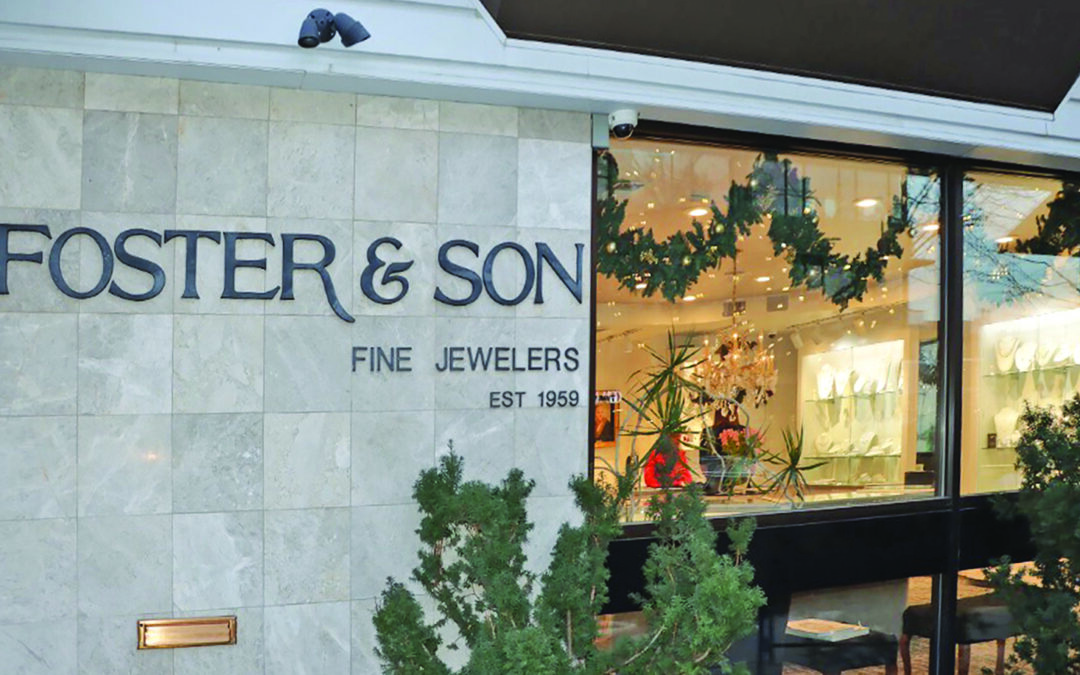
The iconic facade of Foster & Son Jewelers where craftsmanship, heritage, and brilliance meet.
By any measure, Cherry Creek North has changed dramatically over the past decade. New mixed-use developments rise where parking lots once sat, national brands rotate in and out, and office foot traffic ebbs and flows with rapidly growing technology. Yet tucked between luxury storefronts and minimalist façades are artisans who have quietly shaped the district’s character for decades. Their stories reveal not just resilience, but a deep commitment to community.
Few businesses in Cherry Creek can trace their roots as deeply as Foster & Son Jewelers, a family-owned institution that has been serving the neighborhood since 1959. Long before Cherry Creek became a nationally recognized retail destination, Patricia Foster, known to most as Patty, opened a small jewelry shop in Cherry Creek called “The 14 Karat,” an ode to the 1859 Gold Rush to the Rockies. At the time, the area was still defining its identity, and Patty’s shop quickly became a trusted fixture for craftsmanship, honesty, and glamour.
As Cherry Creek grew, so did the business. Patty’s son, Brien Foster, joined the team in 1987, bringing a new generation of expertise, with his wife Cindi. Together they worked hard to preserve the values that built the shop’s reputation like reliability, community-involvement, and elegance. With the duo’s involvement, the store evolved into Foster & Son Jewelers, a name that reflects both its family roots and its long-standing commitment to quality. Today, Brien’s son Tucker and his wife Katie Foster continue to lead the business, the third generation of the Foster family to work behind the counter.
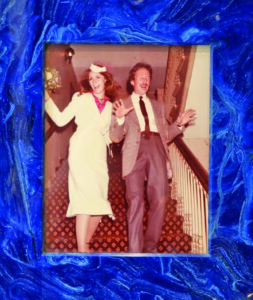
Brien and Cindy Foster on their wedding day.
Last week, I spent about an hour catching up with Tucker Foster at Foster & Son Jewelers, along with his wife, Katie, and it was one of those conversations that reminds you how much heart and history live inside a family business. Tucker lit up talking about his specialty, Cuban link chains and studded-out grills, and even showed me a few custom pieces he’s currently crafting for a local celebrity whose name, of course, could not be disclosed. A testament to how times have changed.
We also talked about the importance of lineage and carrying the Foster legacy forward, a tradition that has shaped the brand for generations. The couples’ daughter Sadie proudly holds the title of dynasty princess for now, but Tucker assured me that role is only temporary and that an heir to the Foster throne is very much in the plans. Katie shared many of the family anecdotes with me, like the tale of Brien assembling the glistening centerpiece of the store, a chandelier Patty ordered in China which came entirely with Chinese instructions.
Tucker not only has a hand in shaping the business, because, “In many ways,” he admits, “the business shaped him.” Tucker shared stories from his childhood that felt like something out of a movie: making bows for the gift-wrapped jewelry pieces customers bought for their loved ones, then sneaking around the corner to the old Wizard’s Chest location to hunt for Pokémon cards. Today, he and Katie are building their own chapter of the Foster story keeping both the craftsmanship and the family tradition alive but adapting effortlessly to the changes 67 years in the making.
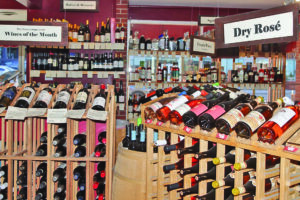
An eclectic selection of wines.
 In an era when many jewelry purchases are made online or through national chains, Foster & Son remains a traditional, full-service jeweler, offering custom design, repairs, appraisals, and fine jewelry curated with care. “While it’s awesome to go to Tiffany and Co and the blue box is absolutely stunning,” Tucker said, “you can get a better experience that’s more personalized and less expensive working with a family jeweler.” Their relevance lies not only in longevity, but in relationships. Many customers have been coming to the store for decades returning for engagement rings, anniversary gifts, family repairs, and milestones that span generations.
“In the past, value was in effort. Today, it’s in a brand name,” Tucker says. Oftentimes that brand is a symbol of something. People who shop with Foster and Sons wear the symbol of community, importance of family, and supporting a legacy. Brands like Tiffany & Co, however, charge customers substantial amounts just to wear the name.
That sense of trust has allowed Foster & Son to adapt as Cherry Creek’s retail landscape has shifted. While the neighborhood has seen luxury brands come and go, the Foster family has remained anchored by personal service and expertise that cannot be replicated online. Their in-store experience emphasizes conversation, education, and comfort, values that resonate in a district increasingly focused on experience-driven retail.
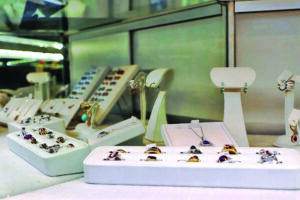
Front counter display of various jewelry types.
Foster & Son’s continued presence also reflects Cherry Creek’s evolution from a neighborhood shopping area to a dynamic cultural district. Through decades of development, economic shifts, and changing consumer habits, the store has remained a constant, quietly shaping the character of the area as much as responding to it.
The story of The Vineyard Wine Shop begins with its founder, Robbie Wilson, who established the shop in 1971 after falling in love with wine while living in California. As Clif Louis explains, “Robbie Wilson was the original owner, he got moved over to San Francisco, fell in love with wine, came back to Denver and said, ‘I want to open a wine store!’”
What began as a modest basement operation, accessible only through an alley, quickly became something special. “In 1971 to get to the front door, you’d come down the alley, go through the door, and down the stairs. It was only 500 feet of space to put wine,” Louis recalls, adding that Wilson’s wife Val handcrafted the stained glass windows and shelving that remain in the shop today. From the start, The Vineyard offered a thoughtful, intimate environment focused on discovery and quality rather than convenience.
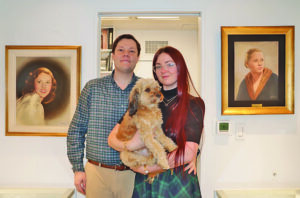
Tucker, Katie, and Sadie Foster.
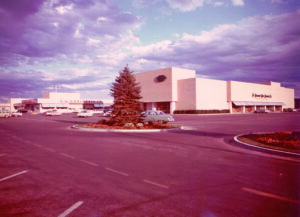
The Cherry Creek Mall photographed around 1960.
The second chapter of The Vineyard’s history began when a young Clif Louis entered the picture in the early 1980s. Driven by a lifelong appreciation for wine sparked by his father who “was stationed over in France, he fell in love with French wines, we always had wine at dinner, and dad let me pick the wine.”
Louis approached Wilson looking for work. “I said, ‘I’ll do anything. I just want to learn about wine.’ So he hired me as the stock boy for $4 an hour,” Louis says, noting how quickly he realized how much there was to learn about the industry. After just a year, Wilson offered a life-changing opportunity. “He said, ‘Clif, why don’t you buy me out?’ and I bought him out slowly over three years.” Louis explains.
From that point on, Louis carried forward the same philosophy of accessibility, warmth, and expertise that Wilson had built. “We weren’t the big box mentality. We didn’t want to force customers to buy a $100 bottle when a $20 bottle was just as good,” he says. “We weren’t snooty wine people. We like to sell wine to drink it.”
Under Wilson and Louis’ leadership, The Vineyard became deeply rooted in Cherry Creek’s retail culture as a staple of high society. Louis’ wife Rosella owned The Brass Bed for decades, and today their children continue the multi-generational tradition with White Peacock just down the street. “We both got into retail, and then my kids got into retail, so it really became a family thing here in Cherry Creek,” Louis shares.
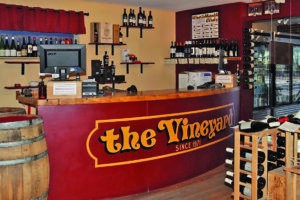
The Vineyard Wines original front counter.
Today, The Vineyard remains anchored by the kind of personal service that can’t be replicated online. “Everyone who works here is taking wine classes, they’re trying to get their degrees in wine,” Louis explains. “When a customer comes in, they talk to somebody. We help them find exactly what they like.” And despite assumptions about Cherry Creek pricing, value remains central. “People think we only sell $100 bottles of wine, and that’s not the case. Most of our wines are around $20,” he says, emphasizing the shop’s commitment to quality at every price point.
That personal connection has helped The Vineyard weather major shifts in retail, including grocery stores entering the wine market. “When they passed the law allowing wine in grocery stores, that hit our sales pretty bad, probably down 30%,” Louis admits, yet he remains confident in what sets The Vineyard apart: “In the big box stores you just pull wine off the shelf. Here, everyone’s an expert. We talk, we educate, we connect.”
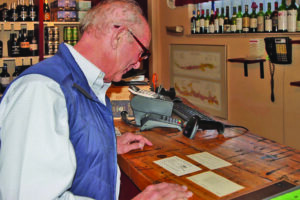
Clif Louis looks back on old mailers the company distributed.
Despite evolving development and competition, Louis has no plans to leave. After more than four decades, what keeps him rooted isn’t foot traffic or trends, it’s loyalty, history, and relationships built bottle by bottle. “We’ve had very loyal customers. A lot of them know my first name,” he says simply.
As Cherry Creek continues to modernize, The Vineyard stands as proof that progress doesn’t have to erase craftsmanship. Behind its shelves of carefully curated wine is a legacy built on curiosity, community, and conversation, one that continues to carry forward the spirit Robbie Wilson first poured into a small basement shop back in 1971.
Below: Current heiress of the Foster family business, Sadie Foster, daughter of Tucker and