by Amber Wyatt
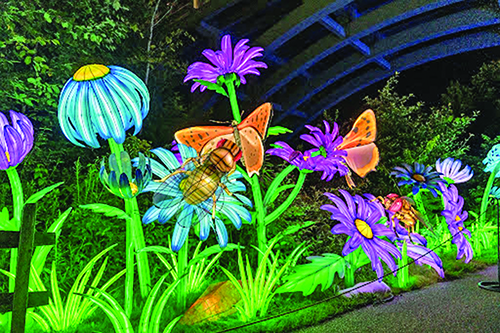
Large-scale intricately designed sculptures crafted by hand.
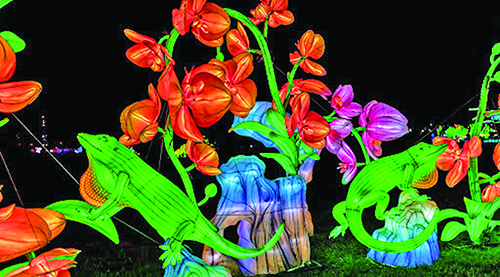
From the Houston Lanterns installation.
When Bright Nights illuminates Four Mile Historic Park, visitors enter a world of glowing color, towering forms, and intricate displays. Yet behind the spectacle is another story, one measured not only in lights, but in hundreds of hours of skilled human labor.
Produced by Tianyu Arts & Culture, the large-scale illuminated installations are the result of a painstaking process that combines a centuries-old Chinese lantern-making tradition with modern engineering and contemporary artistic design.
Long before the lights are switched on, artisans begin with hand-developed concepts that must ultimately work within a real landscape. Designs move from sketches into steel-frame construction, followed by electrical wiring, fabric application, detailed painting, and final assembly. According to Tianyu, a single display can require more than 200 hours of work and involve approximately 25 skilled artists.
The result is an art form that remains strikingly dependent on human hands at a time when automation and digital tools are transforming creative industries. Among the artists carrying that tradition forward is Jiang Guanghong, a Tianyu master artisan with more than two decades of experience in lantern design, fabrication, artistic direction, and international project leadership.
For Jiang, creating an illuminated installation involves far more than reproducing a drawing at a larger scale. Artists and fabricators must understand how a structure will appear from different angles, how fabric will behave when stretched across a steel framework, and how light will change the colors and details once the sun goes down. Those skills are only developed through years of hands-on practice.
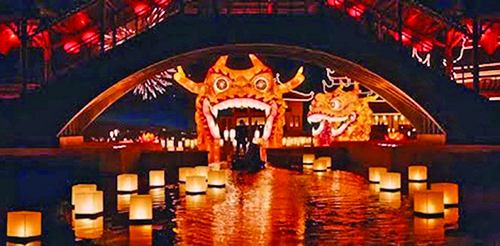
The casino scene in James Bond’s Skyfall featuring Jiang Guanghong’s work.
The tradition at the center of Tianyu’s work is closely associated with Zigong, China, a city internationally known for elaborate lantern-making. While the materials and technology used in modern installations have evolved, the process still draws heavily on skills passed from one generation of artisans to the next.
Today, those techniques are being applied to installations created for audiences far beyond China. Tianyu’s projects have appeared across the United States, Europe, and Asia, requiring artisans to consider not only artistic traditions but also the architecture, terrain, and character of each location. That means a display created for a historic Denver landscape may require different artistic and structural choices than one installed in a European garden or a modern urban setting.
Jiang’s career illustrates how far the tradition has traveled. His international work has included major installations on several continents, and one of his award-winning lantern creations was selected for use by the art department of the James Bond film “Skyfall.”
Despite that international reach, the underlying process remains intensely physical. Steel must be shaped into complex forms. Electrical components must be carefully integrated. Fabric must be fitted to perfectly engineered frames, and painted details must hold their visual impact before and after illumination. It is a balance of art and engineering, with technology supporting rather than replacing the craft of the artisan.
That balance may be part of what gives Bright Nights its appeal. Visitors experience the finished displays as immersive environments, but each glowing figure represents countless individual decisions made by designers, welders, electricians, fabric artists, and painters. At Four Mile Historic Park, the spectacle offers Denver audiences an opportunity to encounter a tradition that has crossed generations and continents while continuing to evolve.
Bright Nights may ultimately be remembered for what visitors see after dark. But behind every illuminated structure is something less visible: a network of skilled craftsmen keeping a living cultural tradition alive, one piece of steel, stitch of fabric, stroke of paint, and flash of light at a time.