Editorial —
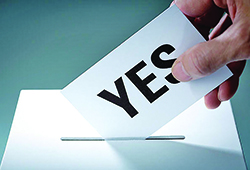
Voter’s hand holding a YES vote ballot, inserting the vote card into the ballot box. Concept image of democracy and the election process for corporate election, board election, and governmental or business policy decisions. Voters making their selection and voting through a proxy ballot. Photographed in horizontal format.
The 2026 ballot will be arriving in registered voters’ mailboxes in a few weeks and a “beast” of a ballot it is. Voters will have many elective offices to fill from governor, attorney general, secretary of state, etc., to state house and state senate seats. Voters must also choose whether or not to retain various judges. In some jurisdictions there will be municipal and county offices to fill.
After completing the section on political and judicial offices the voter will have just begun his or her voting task. There are a record number (14) of ballot measures, 13 of which were proposed by citizen initiatives, as well as, one placed on the ballot by the state legislature.
The Colorado Blue Book is sent out to voters which is supposed to be an official, nonpartisan guide on ballot measures, purportedly to give voters neutral and clear information. But like all things involving humans, it has been corrupted over time, but what else is new?
The bilingual version (English/Spanish) of the Blue Book runs 260 pages. It looks more like a paperback version of the 19th century novel War and Peace than a concise voters’ guide.
We are not fans of ballot elections, but we feel sorry for any voter who goes to the polls to vote in person who isn’t already sure of how he or she is going to vote.
Partisan-oriented voters have, in the past, often simply voted all “Yes” if they are Democrats, as ballot measure in the past have tended to grow government and its revenues, while Republicans have voted “No” hoping for the opposite.
No such luck this year. Both liberals and conservatives have placed measures on the ballot including ones that are in effect mirror opposites.
Denver voters will be voting on a proposed mil levy increase for area schools, placed on the ballot by the dysfunctional Denver Board of Education, which tax is opposed even by The Denver Post. Both Denver and Glendale residents will vote whether to have a sales tax increase to support Colorado Front Range’s “train to nowhere” known as CoCo.
Who knows what mood voters will be in by the time they get to the energy measures (2K in Denver and 2B in Glendale) asking voters in those two municipalities to approve 20-year franchises with Xcel Energy to use municipal rights of way and streets for energy lines.
There is almost no opposition to either measure in either town. Glendale’s City Council voted unanimously to send the measure to its voters while Denver City Council passed theirs by an overwhelming 10-2 margin. Both city councils fought hard to extract concessions from Xcel on issues important to their citizens. Both cities will, over the terms of the agreements, receive millions of dollars they can use to underground power lines, upgrade parks and open space, and various other important city programs.
We suggest that once you get your ballot you turn to the municipal section and vote “Yes” on 2K in Denver and 2B in Glendale. You can then begin the long slough through the rest of the ballot.
Here’s hoping that the two measures that virtually everyone agrees should pass, do in fact pass.
— Editorial Board