by Mark Smiley | Nov 23, 2015 | Main Articles
50-Year Park Hill Tradition Lights Up The Neighborhood
by Megan Carthel
Between 19th and Montview Boulevard on Leyden Street is an average Park Hill neighborhood. Trees line the block while the sounds of children playing fill the air. But, this neighborhood has a unique tradition.
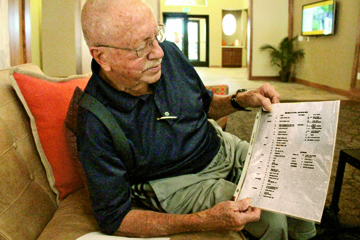
 For every child’s birthday on the block, 86-year-old Hal Weber grabs his ski poles, a pouch full of cards and makes the march around Leyden, placing a personalized birthday card on all of the 15 homes, specific for each of the 23 children and one dog. He then lights up a “celebration tree” in honor of each birthday, a tradition he’s had since 1965.
The tradition began after Hal and his wife, Lois, purchased a pine tree and planted it in their yard. During Christmas of 1964, they colored the tree with lights — the first of many lightings of the celebration tree. Though they didn’t know it at the time, this would become an important tradition for the whole block.
“We like celebrating. We like color. We like lights. We like fun,” Weber said. “So after Christmas, it seemed foolish to me to have to wait another 11 months before we got that tree lit up out there.”
So the Webers decided to light the tree up any time their family was celebrating an occasion. When their daughter’s friend, Wendy, had a birthday in February 1965, Hal decided to light up the tree. Since then, Hal has made sure every child on the block has a special birthday.
“It was all by accident,” Weber said. “It pretty much just evolved.”
His accident has touched the hearts of many of his neighbors, including Chris Wester who has three kids. Weber has lit the tree every year for each child. Wester has kept every single card Weber has given her children. Weber normally stops the cards at age 16, poking fun at the new teen drivers, but for Wester’s youngest child James, Weber has kept the tradition alive. James has a mental disability and does not understand the concept, but Weber makes his day special every year.
 “I have to believe that somewhere inside of him, that is just a warm fuzzy for him,” Wester said. “It has to be.”
James loves basketball and plays every year in the Special Olympics with the Denver Parks and Recreation Department. Weber personalized his last birthday card with a basketball theme.
“Hal is just the most humble man, but he is so special, thoughtful, kind and gentle,” Wester said.
Wester recalls a special moment when her daughter Annie was 10. The family walked down to the celebration tree the evening of her birthday and sang happy birthday to her.
“It was so cool. I mean, how sweet can that be,” Wester said.
Wester said Weber is like a grandfather on the block — an extension of the family. Weber keeps a categorized list of every child on the block. The children are divided by months and a note on the side indicates the year they were born. However, Weber and his wife moved out of the neighborhood this fall and into a senior living facility — difficult news for many on the block. Weber broke the news in typical Hal fashion, a note placed on each door.
“It just kind of broke my heart,” Wester said with tears in her eyes. “I am sure he heard from every single one of us how important this has been to us. Every time I see that card on the door, I just smile.”
But Weber does not plan on ending his tradition. He plans on surprising the neighborhood with his birthday cards, ensuring that the memory of the celebration tree is still glowing bright. The tree is gone now, but he’s premade many of the birthday cards, halfway through January.
“In December it’s going to be Luke, he was born in ’99. It’s going to be his last year. He’s going to be a driver,” Weber said. “Then Jack who’s a baseball fan, so I’ll have something relative to that, then his sister. Then it’ll be Rebecca, Becky.”
Weber’s simple act of celebrating birthdays has brought the entire block together.
“There’s just something about if your kid is celebrating a birthday, and I’m driving down the street, I’m going to wave and go happy birthday,” Wester said.
The entire block has a list of each other’s names, phone numbers and email addresses. Many families have lived on Leyden for over 10 years. The new family on the block has been there for three.
“I don’t think there’s another block in Park Hill like this,” Wester said. “It’s the nicest feeling of family in a neighborhood that I could ever imagine.”
Indeed, Weber has seen many of the kids grow up.
“I’ve seen them when they were a pouch of water in their mother to a point when several of them are in college and maybe out of college by now,” Weber said.
Weber has worked and been around kids his entire life. Working as a pediatric audiologist, he started the Colorado Department of Health’s state-wide hearing program, which helps kids with hearing loss solve their problems. In a way, Weber said, overcoming obstacles has always been his direction.
“I love life,” Weber said.
Weber has made sure the card and celebration tree continued, even after having two hip replacements and a pinched nerve in his back. To this day, Weber has a recumbent bike he still rides.
“He just makes me want to be a better person and keep going,” Wester said.
And for his birthday, how does he celebrate?
“Nothing special,” Weber said.

by Mark Smiley | Nov 23, 2015 | Main Articles
Neighborhood Groups Begin To Flex Their Muscles
by Charles Bonniwell
As the Denver City Council is increasingly looked at by some as a tainted and dishonest political entity that ignores the concerns and wishes of residents in favor of powerful real estate developers, many people in Denver have increasingly turned to neighborhood associations and Denver’s Inter-Neighborhood Cooperative (INC) to represent their interests.
INC is the umbrella organization for Registered Neighborhood Organizations (RNOs) which have special legal status in the City and County of Denver. Under the Denver Municipal Code starting in 1979, RNOs have been statutorily required to be notified of and given participation opportunities related to proposed zoning amendments, landmark designation applications as well as planning board and boa rd of adjustment hearings.
Established in 1975 INC was a part of the national neighborhood movement of the 1970s which was originally formed to help revive and conserve older neighborhoods by demanding the right to participate in governmental decisions which affected those neighborhoods.
As a 501(c)(3) non-profit INC is also engaged in charitable as well such as educational activities. The organization was a relatively benign group for many years perhaps best known for its Neighborhood Awards and its awards dinner held every year. But that began to change in the spring of 2012 when Larry Ambrose became the group’s president. A few months earlier Mayor Michael Hancock began his term as 45th mayor of the City and County of Denver with his election orchestrated by real estate developer Pat Hamill and his business associates.
Ambrose, a businessman and lawyer, is today an affiliate faculty member at Metropolitan State University of Denver teaching classes in marketing and advertising. He is the owner of Ambrose Consulting, LLC which advises businesses in small business development and related fields.
It soon became apparent that Hancock was little more than a figurehead mayor while Hamill and his real estate developer friends assumed control. Hamill installed Janice Sinden as Hancock’s chief  of staff so he could know everything that was going on in the mayor’s office without having to ask Hancock himself. Sinden had been Hamill’s executive director at the business advocacy group Colorado Concern when he was chairman of the board.
Neighborhoods began to be overrun by high density projects with developer friends of the mayor seizing land with the help of the city including parks, open space and even church properties. Neighborhood destroying projects were moved through the
planning process as well as final City Council approval with incredible rapidity one after the other including Lowry Vista, Hentzell Park, City Park Zoo Gasification Project, Sloan’s Lake, Mount Gilead/Crestmoor Park, Buckley Annex and West Highlands.
City Council meetings would go late into the night with citizen after citizen begging the Council to take a closer look at the effect of these projects on their neighborhoods only to get vapid bored looks from councilmembers and overwhelming votes in favor of the developers.
INC became the one place families could go to have their concerns at least heard and Larry Ambrose became a hero to many who felt the system to be corrupt and unresponsive.
Ambrose began to give real voice to the citizens’ concerns. When Brad Buchanan, the highly controversial executive director of Denver’s Community Planning and Development Department (DPCD) went to T he Denver Post to extol the virtues of these high density projects, Ambrose declared to The Post, “It’s very easy for Brad to come into the city and shove this high density down our throats and then drive home to his ranch.” The embarrassed and humiliated Buchanan was unable to publicly respond.
In the case of a gasification plant that the Denver Zoo wanted to build at City Park, Ambrose wrote a letter on behalf of INC demanding the City Council hold a hearing on many of the concerns that it had failed to address in its previous unanimous approval. This resulted in a scathing editorial by The Denver Post calling the opposition “misguided and, frankly way too late.” Ambrose wrote a stirring rebuttal that was published by The Post.
Less than two-weeks later to the absolute mortification of The Post’s editorial board the Zoo announced, in effect, that the opponents of the project had been right all along and the project was being ditched. The editorial board groaned in a follow-up editorial — ”What a fiasco.” Ambrose’s reputation and standing reached new heights among Denver residents.
Ambrose and INC have come up with an eight page 2,769 word platform document whereby residents and RNOs would have a great deal more to say in how the city is developed including having the mayor and other city officials appoint representatives of RNOs to city boards and commissions.
Among other major reforms the platform envisions is that higher density zoning would not be approved unless any adverse impacts on traffic or parking can be mitigated.
The degree of increased influence that INC has achieved is reflected by the fact that
Buchanan’s DPCD publicly declared that it had reached out to INC to ask for the final zoning/planning platform document and that it shared “INC’s overreaching goals of transparency, partnership and meaningful public involvement … all toward our shared goal of building community.”
The statement of DPCD bought gales of derision from resident activists. Jennifer James noted, “Buchanan and his believably sleazy co-horts at DPCD think they can placate Larry and INC with some verbal jujitsu. There would have been no need for the platform in the first place if DPCD was not a moral and ethical cesspool. The adoption of the platform by INC is itself a repudiation of what the mayor and Buchanan have done to our neighborhoods. If there was any justice in the city there would be a full and thorough criminal investigation of the planning process in the City and County of Denver. Maybe someday there will be, but it will probably be too late to save many portions of the city.”
As for Ambrose himself he claims no overriding ambitions. “I just want to give voice to the residents that the government of the City and County of Denver is ignoring,” said Ambrose. “The average citizen is the last person the city listens to unfortunately.”
But many other people note that he garnered over 2,300 write-in votes in the 2015 mayoral election which is said to be the highest number of write-in votes in the history of the city. This is all the more remarkable in that Ambrose did not participate in the effort or campaign and all the work was done by admirers of Ambrose.
Members of INC, in their individual capacities, helped elect four members to the Denver City Council in the election this last spring who they believe will not be co-opted by real estate developers. Some of those hard-charging individuals want to look at electing a new mayor in 2019.
Mayor Hancock had no organized opposition in 2015 but already there are increasing numbers of politically savvy people in Denver who are stating that “Ambrose for Mayor 2019” is making more and more sense.

by Mark Smiley | Nov 23, 2015 | Feature Story Bottom Left
 First off I hope you have a joyful holiday month. I know this time of year can be pretty taxing if life is throwing you a curve ball or if you’re without a companion or family. If you are struggling remember things change, and nothing lasts forever so stay positive and keep working toward creating a better situation for yourself.
And if, God forbid, you are going through a holiday breakup take some advice from Mrs. Claus in the following poem. Go out, have fun, keep it light and move toward finding your own happiness again. The rest will figure itself out. Life doesn’t have to be so serious…
With that thought in mind and apologies to the Christmas classic song, “Here Comes Santa Claus,” I give you my yearly December Christmas poem…
Here Comes Mrs. Claus
Here comes Mrs. Claus, Here comes Mrs. Claus
She’s single and dating again,
Vinny and Johnny met her on Tinder,
Along with plenty more men,
Her phone is a ringin’, texts are a dingin’,
She’s searching for love for the night,
So she puts on her stockings in hope of
body rocking,
Mrs. Claus has a hot date tonight.
Here comes Mrs. Claus, Here comes Mrs. Claus,
She’s single and dating again,
She’s got a bag that’s filled with toys,
Not the kind for girls and boys,
When she walks she jingle jangles,
Oh what a beautiful sight,
So jump in bed and cover your head,
’Cause Mrs. Claus is single tonight!
Here comes Mrs. Claus, Here comes Mrs. Claus
She’s single and dating again,
She doesn’t care if you’re rich or poor,
Because she just got back in the game,
Mrs. Claus, a single white female with no children,
Just wants to date and keep it light,
So if you wanna get with Mrs. C you better have
dinner and beer,
’Cause Mrs. Claus is looking for a date tonight!
Here comes Mrs. Claus, Here comes Mrs. Claus
She’s single and dating again,
She’ll come back around when the night runs out,
Oh no not the walk of shame again,
If you play your cards right she might give you a call,
Tonight could be your night,
So let’s give thanks to Santa for neglecting
Mrs. Claus,
Because now Mrs. Claus is single tonight!
Have a very Merry Christmas and keep someone warm, your pal Sheik.

by Mark Smiley | Nov 23, 2015 | Editorials
 If one was wondering how sleazy and dishonest the Hancock Administration has become, one need look no further than the appointment of former City Councilman Chris Nevitt to the city position of Manager of Transit-Oriented Development (TOD). Nevitt ran for the citywide post of Auditor and lost notwithstanding raising from real estate developers, and their lawyers and lobbyists, over 10 times the amount raised by his opponent Tim O’Brien. Even his supporter, former Auditor Dennis Gallagher, expressed his disgust with Nevitt the day after the election saying, “I haven’t seen such a bad campaign since Mark Udall.”
Nevitt managed to lose by being seen by the voters as little more than a cheap shill for the very worst real estate developers doing business in Denver. He confirmed the people’s low opinion of him when in one of his last meetings before leaving office he gave a speech declaring every part of the city must sacrifice in order to make room for extremely high density rather than risk the horrors of possible suburban sprawl. The speech was too much even for The Denver Post who blasted him in its editorial pages making him a persona non grata throughout the City and County of Denver.
But Nevitt had done the bidding of Mayor Hancock and his real estate buddies ever since Hancock had taken office. Hancock even indicated, prior to Nevitt’s election loss, that Nevitt might make a good successor to him as mayor. After his election loss, Nevitt at age 52 faced difficult job prospects. He was totally devoid of any skills which would make him employable in the private sector and thus it was believed he was only suited for working for the government.
It was extraordinary however, that city department after city department refused to even consider him. An exasperated Hancock was forced to create a whole new job position within the morally bankrupt Department of Community Planning and Development run by the highly controversial Brad Buchanan. Buchanan is considered the only individual in Denver government that the citizens of Denver consider being as or more unethical than Nevitt.
Buchanan’s Department publicly announced, to the guffaws of city insiders, that Nevitt won the job of Manager of TOD “after a competitive hiring process.” Garnering only a $120,000 position in the Hancock administration demonstrated how far Nevitt had fallen. Buchanan knew that Nevitt coming aboard his Department would not be welcomed by his highly demoralized staff who do not like being viewed by the public as simply tools for real estate developers. He put out an internal memo attempting to justify Nevitt’s hiring and the position he would occupy as Manager of TOD.
The job apparently is to be in charge of coordinating city efforts to encourage development along transit stops. Of course as massive development of high-rise apartments in Cherry Creek North showed that developers couldn’t care less about building projects along light rail stops and they control the city government and not the other way around.
Buchanan declared in the memo that Nevitt was “uniquely suited for this position based on experience working with private sector constituencies [i.e. real estate developers] involved with land development” not quite understanding that Nevitt’s job as a city councilman was actually not to work with developers but rather to represent his actual constituents and sit in a quasi-judicial capacity to vote up or down projects that came before the City Council. Buchanan was in essence implying that Nevitt might have been engaged in what some might consider illegal activity with developers.
The fact that this so-called “job” had heretofore never existed is indicative of how necessary it actually is. Luckily Nevitt is well known for his incredible laziness as his losing Auditor race demonstrated. Thus in some ways he is a perfect fit as a no-work politician being matched up with a no-work government job. He will lunch and cocktail with real estate developers he knows and others while they get approved building where they want to build in the city which is normally not next to light rail stations.
But is this the end of Chris Nevitt as a public figure in Denver buried in the belly of the government beast? It turns out that being too incompetent to qualify for an actual mayoral appointment has its real advantages. Unlike Rocky Piro as Planning Director or Lauri Dannemiller as Parks Director Nevitt can’t simply be fired by this mayor or any future mayor. He has full civil service protection. He can spend his next decade and a half or so doing little or nothing while pulling in six figures and a hefty pension. Upon a well-deserved retirement from arduous public service Nevitt can wander down to Florida or Arizona and vegetate until his ultimate demise.
Sure it is not much of a life for a person with talent and ambition but Nevitt never had the talent part anyway. The media, including this paper, will of course miss him as a figure to kick around and make fun of. Surely he will be tempted at some point to try to revive his mayoral ambitions, but he is better suited living the sleepy government apparatchik life. But should he someday unwisely decide to leave his sinecure for a more public role we in the media will certainly be there to greet him with open arms.
— Editorial Board

by Mark Smiley | Nov 23, 2015 | General Featured
So You Think You Can Dance is on the road for the Season 12 tour
December 8 | 8 p.m.
Paramount Theatre | 1621 Glenarm Pl, Denver, CO 80202
The Season 12 tour lineup includes the show’s following Top 10 finalists: Team Street’s Megan “Megz” Alfonso, Eddie “Neptune” Eskridge, Virgil Gadson, Jessica “JJ” Rabone and Jana “Jaja” Vankova; and Team Stage’s Gaby Diaz (Season 12 winner), Edson Juarez, Jim Nowakowski, Hailee Payne and Derek Piquette.
The tour features some of this season’s most popular routines from both Team Stage and Team Street, along with original pieces created specifically for the tour.
Tickets start at $45 and can be purchased by clicking below:
http://www.altitudetickets.com/event/so-you-think-you-can-dance-4096/
For more information on the tour, click here

Gaby Diaz is America’s Favorite Dancer on the Season Finale of SO YOU THINK YOU CAN DANCE