
by Mark Smiley | Nov 13, 2026 | Travel
City Safeguards Fail Security Test As Airport Employees Use Unapproved Artificial Intelligence Tools
by Mark Smiley
AI Oversight Concerns: A Denver audit found that employees at Denver International Airport were using seven unreviewed or unapproved artificial intelligence tools more frequently than the airport’s approved Microsoft Copilot platform. Auditors warned that the airport lacks a comprehensive AI governance framework.
As artificial intelligence rapidly transforms government operations, a new audit has revealed significant weaknesses in how the City and County of Denver and Denver International Airport oversee the emerging technology, raising concerns about data security, employee accountability, and the protection of sensitive information.
The audit, conducted by Denver Auditor Timothy M. O’Brien, found that the city has failed to fully implement safeguards governing artificial intelligence, while Denver International Airport has yet to establish a comprehensive framework for managing the technology. The findings are particularly troubling as government agencies increasingly rely on AI tools to improve efficiency, communicate with residents, and manage daily operations.
“We’re one of the first in the country to audit a municipality’s artificial intelligence use,” O’Brien said. “AI is evolving so quickly it is tough to keep pace. Both Denver and Denver International Airport have adopted AI. And both need to catch up to ensure AI use on their systems is safe, ethical, and secure.”
City’s AI Security Measures Fail Audit Test
Among the audit’s most concerning discoveries was a failure in Denver’s existing data-protection measures. Auditors successfully entered simulated prohibited information into a publicly accessible artificial intelligence system without triggering the security warning that city officials said should have appeared.
Technology Services personnel attributed the failure to a deployment problem that prevented security updates from reaching all city-owned computers. The incident demonstrated a potentially significant vulnerability in the city’s ability to prevent employees from inadvertently sharing confidential or sensitive information with outside AI platforms.
The audit also found that Denver lacks a centralized inventory of the artificial intelligence systems being used across city government. Instead, information about those systems is maintained in multiple disconnected locations, making it more difficult for officials to identify potential security threats, monitor performance, and ensure consistent oversight.
Although the city monitors the accuracy and performance of Sunny, its AI-powered chatbot designed to help residents navigate Denver’s website, auditors found no evidence that comparable monitoring practices were consistently applied to other AI systems.
Beyond the technical shortcomings, Denver has not formally incorporated artificial intelligence into its existing technology risk-management policies. While Technology Services officials have worked with the City Attorney’s Office to address regulatory concerns, those efforts have not been fully integrated into the city’s established information technology oversight procedures.
City technology leaders acknowledged that budget limitations and competing demands on staff time have delayed the development of more comprehensive AI policies.
“Once the city adds artificial intelligence rules in its IT policies, Technology Services can ensure there is meaningful AI oversight and city staff will have better clarity around allowable and safe AI use,” O’Brien said.
Airport Employees Using AI Tools Without Formal Approval
The findings at Denver International Airport revealed an even more fundamental problem: The airport’s Business Technologies Division has not established a formal artificial intelligence governance framework.
Despite Microsoft Copilot being the airport’s approved AI platform, auditors discovered that it ranked only eighth among AI tools used on the airport’s network. Seven other tools, which had not been reviewed or approved, were being used more frequently.
The discovery raises questions about what information airport employees may be entering into outside AI platforms and whether sufficient safeguards exist to protect sensitive airport operations and data.
Without a formal process to monitor the use of publicly available AI applications, airport officials have limited ability to identify potentially risky employee activity or prevent unauthorized information from being shared. Auditors warned that the absence of adequate oversight increases the possibility of security incidents involving the airport’s network.
The audit did not establish that a data breach had occurred. Rather, it identified weaknesses that could make such incidents more difficult to prevent or detect.
Airport officials also have not established consistent performance measurements to determine whether AI systems are functioning properly or delivering their intended benefits. Without those benchmarks, the airport may struggle to recognize operational problems, evaluate the effectiveness of AI investments, or identify emerging technological risks.
AI Expansion Planned
Despite Oversight Concerns
The timing of the audit is particularly significant because Denver International Airport intends to expand its use of artificial intelligence in the coming years.
According to the airport’s 2025 Vision 100 strategic plan, officials anticipate implementing additional AI technologies over the next three to five years. However, auditors found that the airport has not established the policies and procedures necessary to adequately evaluate the risks associated with that expansion.
Airport technology leaders have focused on developing guidelines describing acceptable AI use rather than creating a comprehensive governance program. Those guidelines, according to the audit, do not provide a formal process for evaluating AI-related risks.
The airport also lacks documented policies governing how outside vendors use artificial intelligence, potentially creating additional vulnerabilities when third-party companies interact with airport technology systems.
“Artificial intelligence is evolving too quickly for Denver International Airport to take years to adopt more AI tools and learn how to responsibly govern them,” O’Brien said. “I trust our recommendations help the airport move more quickly to minimize risks and better protect information.”
City And Airport Agree To Make Changes
Despite the shortcomings identified in the audit, both Denver’s Technology Services agency and Denver International Airport agreed with all recommendations issued by the Auditor’s Office.
The recommendations call for stronger oversight, more comprehensive policies, improved monitoring, and formal procedures to identify and manage risks associated with artificial intelligence.
The Auditor’s Office plans to conduct follow-up reviews to determine whether the agencies have implemented the recommended improvements.
The findings highlight a growing challenge facing municipal governments nationwide. Artificial intelligence offers opportunities to streamline public services, reduce administrative workloads, and improve communication with residents. However, adopting the technology without appropriate safeguards can introduce new security, privacy, and accountability concerns.
For Denver, the audit underscores the importance of establishing clear rules before artificial intelligence becomes even more deeply embedded in government operations.
The question now is whether city and airport officials can strengthen their oversight quickly enough to keep pace with a technology that continues to evolve.

by Mark Smiley | Oct 20, 2026 | Uncategorized
By Mark Smiley
The Zac Brown Band brought its signature blend of country, rock, and Southern soul to Red Rocks Amphitheatre on M onday night, October 19, delivering an outstanding performance filled with familiar hits, classic rock covers, and impressive musicianship.
With the spectacular red sandstone formations providing the backdrop, the Grammy Award-winning group demonstrated why it remains one of the most entertaining live acts in music.
Opening the evening was powerhouse vocalist Grace Potter, whose blues-infused rock sound and commanding stage presence provided a fitting introduction to the headliners. Potter returned later in the evening to join the Zac Brown Band for an electrifying rendition of the Rolling Stones classic “Paint It Black,” one of the night’s highlights.
The band delighted longtime fans with hits including “Chicken Fried,” “Toes,” and “Knee Deep.” The latter featured video footage of the late Jimmy Buffett on the venue’s large screens, providing a fitting tribute to the legendary singer whose laid-back musical style shared so much in common with the band’s own.
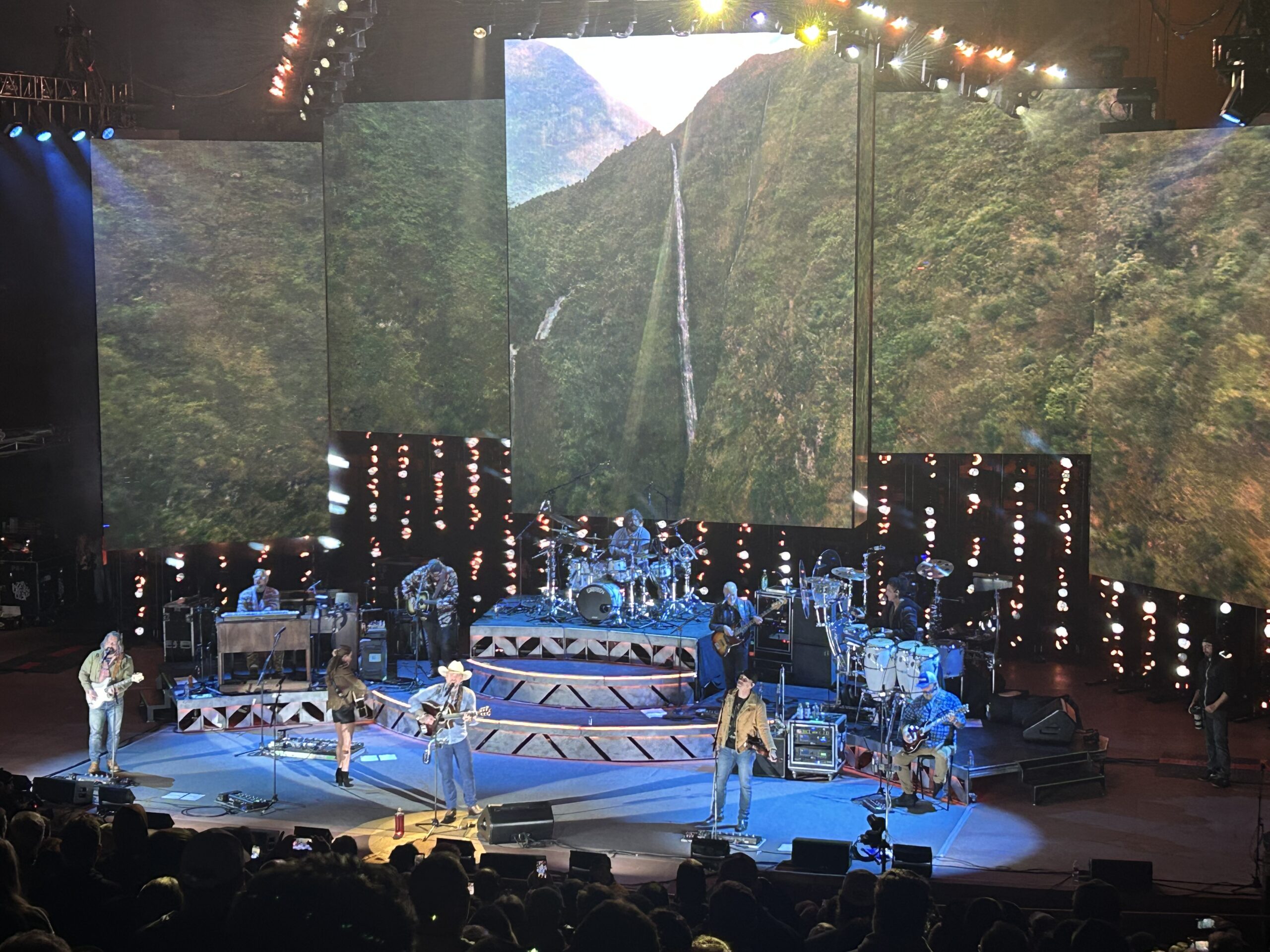 Another standout moment came with the band’s remarkable combination of its hit “Free” and Van Morrison’s classic “Into the Mystic.” The seamless blending of the two songs was nothing short of spectacular, showcasing the group’s extraordinary musical versatility and ability to reinvent familiar material.
### An Encore to Remember
The evening concluded with an entertaining encore that gave individual band members an opportunity to step into the spotlight, each singing portions of classic rock favorites.
Among the selections were John Mellencamp’s “Pink Houses,” Lynyrd Skynyrd’s “Free Bird,” and the Eagles’ “Heartache Tonight.” The rotating vocal performances demonstrated that the Zac Brown Band is far more than a talented frontman surrounded by backing musicians. Each member contributed a unique style and personality, turning the encore into a celebration of classic American rock.
Frontman Zac Brown led the ensemble with his trademark easygoing confidence, while the band’s tight harmonies, instrumental versatility, and enthusiasm kept the audience engaged throughout the evening.
Few venues complement the Zac Brown Band’s sound as naturally as Red Rocks. The combination of acoustic instrumentation, soaring harmonies, Southern rock influences, and the venue’s breathtaking surroundings made for a memorable concert experience.
Monday night’s performance was a reminder that great live music doesn’t fit neatly into musical categories. The Zac Brown B

and may be considered a country act, but its Red Rocks performance was every bit as much a rock concert.
From the collaboration with Grace Potter to the Jimmy Buffett tribute, the brilliant “Free”/”Into the Mystic” mashup, and the crowd-pleasing encore, the band delivered an unforgettable evening at one of America’s most iconic concert venues.

by Mark Smiley | Oct 19, 2026 | Uncategorized
By Mark Smiley
 Disney brought its signature brand of music, dancing and family entertainment to Denver’s Ball Arena on Thursday, October 15, as the Worlds Collide Concert Tour united three popular Disney franchises for an energetic arena production.
Featuring music from Descendants, ZOMBIES and, for the first time, Camp Rock, the concert offered a colorful combination of elaborate choreography, dazzling special effects, costume changes and familiar songs that appealed to young fans and nostalgic parents alike.
The talented cast included Malachi Barton, Liamani Segura, Dara Reneé, Mekonnen Knife, Hudson Stone, Swayam Bhatia, Kiara Romero and Alexandro Byrd. Together, the performers brought the Disney Channel universe to life with lively musical numbers and impressive dance routines.
The tour’s musical lineup included fan favorites such as “Rotten to the Core,” “Queen of Mean,” “BAMM,” “Someday” and “This Is Me.” Creative mashups blended songs from the three franchises, while acoustic selections and original music from cast members provided a change of pace from the high-energy production numbers.
One of the show’s strengths was its ability to bridge generations. Younger concertgoers could celebrate their favorite Disney characters and songs, while parents who grew up watching Camp Rock had an opportunity to revisit some familiar music.
Although the emphasis on newer material and individual performances may not have satisfied every longtime Descendants or ZOMBIES fan, the production delivered the kind of polished, family-friendly spectacle audiences have come to expect from Disney.
For Denver families, Worlds Collide offered more than a traditional concert. It was a celebration of Disney music and storytelling, demonstrating that the magic of these franchises extends well beyond the television screen.

by Mark Smiley | Oct 19, 2026 | Editorials
Office Vacancies Approach 40 Percent Downtown As Cherry Creek North Attracts New Development And Commands Premium Rents
by Mark Smiley

Downtown Challenges: Downtown Denver’s skyline remains impressive, but its office market faces significant challenges. Vacancies reached 38.6 percent during the second quarter of 2026, leaving property owners searching for tenants and alternative uses for aging buildings.
While downtown Denver struggles to fill empty office towers, Cherry Creek North is experiencing a building boom. Just a few miles southeast of downtown, developers are planning new office buildings, luxury residences, and retail projects in one of the region’s hottest commercial districts.
The contrast is striking. According to commercial real estate firm CBRE, downtown Denver’s office vacancy rate reached 38.6 percent during the second quarter of 2026. Meanwhile, figures presented by JLL in September placed vacancy in Cherry Creek’s most sought-after office market at just 2.2 percent, with asking rents approaching $94 per square foot. Although the figures reflect different market definitions, they illustrate the dramatic difference between the two areas.
A Building Boom Continues
One of Cherry Creek’s latest proposed developments is a five-story office and retail building at 2701 E. Third Avenue, near Clayton Street. Known as 3rd & Clayton, the project would include approximately 54,000 square feet of office space, ground-floor retail, and three levels of underground parking.
The proposal is one of several projects transforming Cherry Creek North from a boutique shopping district into a major employment, residential, and entertainment destination.
The approximately $500 million Cherry Lane development is expected to add hundreds of apartments, new retail space, and offices. Meanwhile, Oasis Apartments at 299 Milwaukee Street is expected to feature 177 apartments and approximately 26,000 square feet of retail space. Its retail space was reportedly fully leased ahead of the project’s anticipated 2027 opening.
Why Cherry Creek Is Winning
Building Boom: Construction cranes tower over Cherry Creek North as developers continue adding office buildings and luxury properties. The neighborhood’s thriving commercial real estate market stands in sharp contrast to downtown Denver’s struggling office sector.
The shift toward remote and hybrid work has fundamentally changed Denver’s office market. Businesses are seeking smaller, modern spaces surrounded by amenities that appeal to employees and clients.
Cherry Creek offers upscale restaurants, shopping, hotels, and convenient access to affluent residential neighborhoods. Its proximity to Glendale, Hilltop, and Belcaro makes it especially attractive to business owners and executives living nearby.
Investors are paying extraordinary prices for that convenience. CBRE reported that an office property at 255 Fillmore Street sold for approximately $941 per square foot, setting a record and highlighting the neighborhood’s appeal.
However, rapid growth comes with challenges. Increased traffic, limited parking, construction disruptions, and rising rents threaten the neighborhood character that helped make Cherry Creek successful. Smaller independent businesses may find it increasingly difficult to compete with national retailers and larger companies.
Downtown Faces An Uphill Battle
Downtown Denver’s office market is not without hope. CBRE reported 66,000 square feet of positive net absorption during the second quarter of 2026, along with the first quarterly decline in total vacancy since 2024.
Landlords are offering competitive rents and incentives, while some older office towers are being considered for conversion into residential buildings. Still, with nearly four out of every 10 office spaces vacant, downtown faces a difficult recovery. Lower rents alone may not be enough to persuade businesses to return.

by Mark Smiley | Oct 19, 2026 | Main Articles
Denver Audit Questions City Oversight, Bidding, And Contract Practices During Massive Downtown Renovation
by Mark Smiley
Unexpected Discovery: A historic brick sewer discovered beneath Denver’s 16th Street contributed to construction delays and an $18 million settlement with PCL Construction Services. Denver auditors found the sewer had not been adequately considered during planning for the massive downtown renovation. Photo courtesy of PCL Construction.
A historic brick sewer buried beneath Denver’s 16th Street added $18 million in unexpected costs and nearly a year to the downtown corridor’s massive renovation project, according to a new audit that also raises questions about City Council oversight and the city’s handling of the construction contract.
Denver Auditor Timothy M. O’Brien’s office found that the discovery ultimately resulted in an $18 million settlement with contractor PCL Construction Services and extended the project schedule by 301 calendar days.
But the sewer itself was only part of the problem identified by auditors.
The audit found that contract changes involving millions of dollars took effect before the Denver City Council was notified. Auditors also raised concerns about the Department of Transportation & Infrastructure’s competitive bidding process, its oversight of subcontractors, and its enforcement of contract provisions.
Denver City Council initially approved $149 million in renovation costs for the 16th Street project in 2021.
What Was Under The Street?
The trouble began in 2022 when PCL crews encountered a brick sewer beneath 16th Street, bringing construction to a halt.
According to the audit, the city had con- ducted an environmental assessment as part of the federally funded project, but had not adequately investigated the sewer system during project planning.
Transportation & Infrastructure limited its investigation of underground utilities after consultants advised that a more extensive examination would require removing pavers and rerouting shuttle service.

Long Road To Completion: Construction crews work along Denver’s 16th Street during the multi-year renovation of the downtown corridor. The discovery of an underground brick sewer extended the project schedule by 301 days, according to the Denver Auditor’s Office.
Complicating matters, Denver does not have a comprehensive map showing the location of all of the city’s historic brick sewers.
The potential for problems involving brick sewers was also not disclosed when the city solicited proposals from contractors, according to the audit.
PCL subsequently sought changes to its contract to cover the additional work and delays associated with the sewer. The city initially resisted, maintaining that the contractor had assumed those risks under the agreement.
The dispute eventually resulted in a settlement and an $18 million change order covering additional costs and schedule impacts.
“Because the city did not consider the sewer while planning the 16th Street Improvement Project, businesses on 16th Street had construction lingering outside their doors for nearly a year longer than expected,” O’Brien said.
The audit did not examine the economic impact of the prolonged construction on businesses along the corridor.
Council Left Out Of The Process
Auditors also questioned how such a significant financial change could occur without prior City Council approval.
According to the audit, council members were not notified about the increased costs and delays until after the changes between the city and PCL had already taken effect.
The City Attorney’s Office maintained that council approval was unnecessary because the agreement was handled as a “change order” rather than an amendment to the contract.
Transportation & Infrastructure said City Attorney guidance recommends change orders for changes involving scope, time, or budget unless the alteration represents a “cardinal change” to the original contract.
The department said the PCL agreement resulted from delays and a contractor dispute rather than a fundamental change in the project’s scope.
O’Brien warned that the distinction could create a loophole allowing expensive changes to major city contracts to escape council scrutiny.
“If there is no mechanism allowing change orders to become amendments, construction projects can continue circumventing City Council review for costly contract alterations,” O’Brien said. “When strong oversight is absent, budget transparency is reduced, and public trust in responsible city spending is lost.”
The Auditor’s Office recommended creating a process under which sufficiently significant change orders could become contract amendments and therefore receive additional review. Transportation & Infrastructure disagreed with the recommendation.
Questions About Bidding
The audit also found problems with the process Denver used to select a contractor.
Auditors said Transportation & Infrastructure did not maintain sufficient documentation to demonstrate a transparent competitive bidding process, making it unclear why PCL was selected over another company.
Three contractors initially participated, but one dropped out after becoming aware of potential utility issues, leaving two bidders.
The audit also criticized the city’s oversight of subcontractors. Transportation & Infrastructure took the position that because its agreement with PCL was a lump-sum contract — with a fixed scope and price — it had limited ability to obtain information about subcontractors.
As a result, auditors said the city has little documentation concerning companies that performed subcontracted work on the project.
$1 Million In Damages Waived
Another finding involved more than $1 million the city could have collected for missed completion deadlines.
According to the audit, Transportation & Infrastructure leaders chose to waive $1.03 million in damages associated with delays because they wanted to support the city’s relationship with PCL.
Auditors recommended stronger documentation of quality-control procedures and contract compliance. The department disagreed with that recommendation as well.
Transportation & Infrastructure did, however, accept several recommendations.
The department agreed to formalize what information about major projects should be provided to the City Council beyond what is legally required. It also agreed to maintain documentation of each step in the competitive bidding process for capital projects and develop a strategy for dealing with unexpected underground discoveries on future federally funded construction projects.
O’Brien said the findings do not mean the city’s overall project management system is ineffective, but they demonstrate areas where additional safeguards are needed.
“Our audit found that— while the city’s project management is generally effective — it can be strengthened,” O’Brien said. “I hope the Department of Transportation & Infrastructure implements our recommendations to make improvements. We will follow up in a later audit to see what they achieve.”
For a project intended to remake one of Denver’s most prominent public spaces, the audit provides a costly reminder that some of the biggest construction problems can be the ones no one sees until the street is torn open.