by Mark Smiley | Oct 19, 2026 | Glendale City News
Festival Moves Outdoors For The First Time As Colorado Breweries Bring Home National Honors
by Mark Smiley
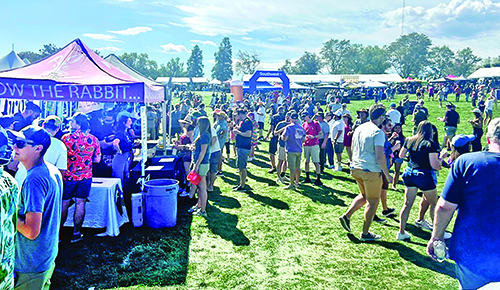
Beer Festival Under The Sun: Craft beer enthusiasts enjoy sunny skies while sampling beers from breweries across the country at the 2026 Great American Beer Festival.
The Great American Beer Festival traded convention center walls for Colorado sunshine this year, marking a dramatic change for one of the nation’s most celebrated craft beer events. Held October 10 and 11, 2026, at Denver’s Levitt Pavilion, the festival moved from its longtime home at the Colorado Convention Center to an outdoor setting featuring live music, craft beer, and a more relaxed atmosphere.
The change represented one of the most significant transformations in the festival’s history. Rather than navigating the enormous exhibit halls of the convention center, attendees experienced a festival designed around the outdoor venue, with an emphasis on connecting directly with the brewers behind their favorite beers.
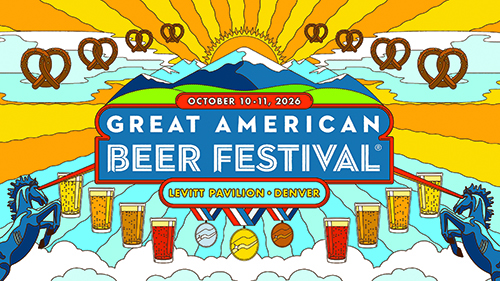
A New Era For The Great American Beer Festival: The official artwork for the 2026 Great American Beer Festival celebrates the event’s move to Levitt Pavilion in Denver’s Ruby Hill Park. Held October 10–11, the festival embraced Colorado’s outdoor culture while showcasing award-winning craft beers from across the country.
The Brewers Association, which organizes the event, said the move was intended to create a fresh experience that better reflected Colorado’s outdoor culture. “Taking the festival outdoors lets us reimagine what’s possible,” said Ann Obenchain, vice president of marketing and communications for the Brewers Association, when the new location was announced.
Colorado Breweries Strike Gold
While the venue attracted considerable attention, Colorado breweries once again demonstrated why the state remains one of the country’s premier craft beer destinations. The competition attracted 7,267 beer and cider entries evaluated by 225 judges over three days. Nationally, 243 breweries and cideries earned a combined 336 medals.
Among the Colorado winners was Glendale’s own Bull & Bush Brewery, which captured a gold medal for its Pineapple 3 Way in the Belgian-Style Fruit Beer category. The recognition adds another prestigious national honor to the longstanding brewery’s accomplishments.
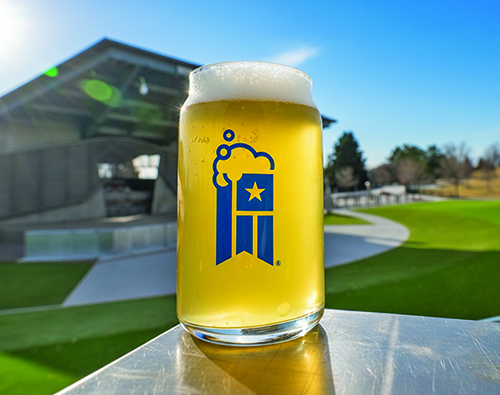
A New Home For Beer Lovers: A glass bearing the Great American Beer Festival logo overlooks Denver’s Levitt Pavilion, the festival’s new outdoor home at Ruby Hill Park. The 2026 event marked a major departure from its longtime location at the Colorado Convention Center.
Other Colorado gold medal winners included Los Dos Potrillos Cervecería in Parker for Agua Fresca in the American Fruit Beer category, Cannonball Creek Brewing Co. in Golden for Mindbender in the American-Style Strong Pale Ale category, and Verboten Brewing in Loveland for Grow Old With You in the Barley Wine or Wheat Wine category.
Denver’s Sandlot Brewery at Coors Field earned gold for Calamansi Wheat in the Fruit Wheat Beer category, while The Empourium Brewing Co. took gold for Honey Panda in the Specialty Beer category.
Bent Barley Brewing Company in Aurora also captured gold for its Dry Irish Stout, and Dostal Alley Brewpub & Casino in Central City won gold for Jacob Mack Mild Ale in the Craft Malt Beer category.
More Colorado Breweries
Earn Recognition
Colorado’s success extended beyond the gold medals. New Belgium Brewing in Fort Collins earned silver for Trippel, while Avery Brewing in Boulder took silver for White Rascal in the Belgian-Style Witbier category. River North Brewery in Denver received bronze for Quandary, and Golden’s Cannonball Creek added a bronze medal for Trump Hands in the Session India Pale Ale category.
Colorado cider producers also enjoyed success. Aurora’s Haykin Family Cider captured gold and silver in the Experimental, Barrel-Aged or Specialty Cider category, while Snow Capped Cider in Austin, Colorado, swept all three medals in the No/Low Tannin Cider category.
A New Chapter For A Denver Tradition
Founded in 1982, the Great American Beer Festival has grown into one of the country’s most prestigious beer competitions and tasting events. Its annual gathering has helped establish Denver’s reputation as a national center for craft brewing.
The 2026 festival also reflected changes in the industry, introducing competition categories for rice lager, hop water, and additional gluten-free beer styles.
Moving outdoors was a bold departure from the familiar convention center experience, but it also gave organizers an opportunity to rethink the event’s format and create a stronger connection between brewers and attendees.

by Mark Smiley | Oct 19, 2026 | Travel
Two million pounds of ice will transform the Aurora resort into a frozen wonderland beginning November 20.
by Mark Smiley

Christmas At Gaylord Rockies: The annual holiday celebration returns to Gaylord Rockies Resort & Convention Center in Aurora from November 20, 2026, through January 3, 2027. This year’s festivities feature the debut of ICE! inspired by Disney Tim Burton’s The Nightmare Before Christmas, along with a variety of seasonal attractions and family-friendly entertainment.
The magic of the holidays is taking shape at Gaylord Rockies Resort & Convention Center in Aurora, where 40 master ice artisans from Harbin, China, have arrived to create a spectacular frozen attraction inspired by Disney Tim Burton’s The Nightmare Before Christmas.
The elaborate display, known as ICE!, will feature more than 2 million pounds of ice carved into larger-than-life sculptures depicting memorable characters and scenes from the popular film. The attraction opens November 20, 2026, and continues through January 3, 2027, as part of the resort’s annual Christmas celebration.
Creating the 17,000-square-foot frozen wonderland is no small undertaking. Over five weeks, the artisans will spend more than 12,000 hours transforming approximately 6,000 massive blocks of ice into intricate sculptures, some towering more than 30 feet high.
Armed with chainsaws, grinders, handsaws, chippers, and other specialized tools, the artists will bring the film’s distinctive characters and settings to life with remarkable detail.
“This is one of the most exciting moments of the year at Gaylord Rockies, as the arrival of our ice artisans marks the beginning of the transformation into our Christmas experience,” said Matt Marshall, general manager of the resort. “This year is especially exciting because guests will experience Disney Tim Burton’s The Nightmare Before Christmas in ice! for the very first time.”
The artisans traveled more than 5,700 miles from Harbin, a city internationally recognized for its spectacular ice and snow sculptures. Often called China’s “Ice City,” Harbin is home to the renowned Harbin International Ice and Snow Sculpture Festival, one of the world’s largest winter celebrations.
Frozen Holiday Magic: Jack Skellington takes center stage in ICE! featuring Disney Tim Burton’s The Nightmare Before Christmas at Gaylord Rockies Resort & Convention Center in Aurora. The spectacular attraction features more than 2 million pounds of hand-carved ice and opens November 20, 2026, running through January 3, 2027.
Gaylord Hotels has partnered with artisans from Harbin since 2001, bringing their specialized skills to holiday attractions across the United States.
Each member of the team has a particular role in the creative process. Some use chainsaws to shape enormous blocks of ice, while others carefully carve delicate details by hand. Working from an extensive 300-page design book, the artisans create everything from tiny decorative elements to massive, towering displays.
Visitors to this year’s attraction will enter beneath the mischievous grin of Jack Skellington before making their way through the hauntingly whimsical world of Halloween Town. Familiar characters, including Sally, Zero, Dr. Finkelstein, The Mayor, and the mischievous trio Lock, Shock, and Barrel, will appear throughout the frozen experience. The Halloween Town Band will also be represented in ice.
The attraction is maintained at a chilly 9 degrees Fahrenheit to preserve the sculptures throughout the holiday season. Guests will also have an opportunity to watch ice-carving techniques at the Artisan Demonstration Showcase, offering a closer look at the craftsmanship behind the elaborate display.
ICE! is the centerpiece of Christmas at Gaylord Rockies, which features additional seasonal entertainment and holiday activities for families and visitors of all ages. The attraction opens November 20 and runs through January 3, 2027, at Gaylord Rockies Resort & Convention Center in Aurora.
Tickets, hotel packages and additional information are available at ChristmasatGay lordRockies.com.

by Mark Smiley | Oct 19, 2026 | General Featured
by Mark Smiley
For TruSox owner Dave Banning, the idea seemed simple: donate socks and gloves his company could not sell to people who needed them. Instead, he says, Colorado tax rules made giving the merchandise away more expensive than throwing it in the trash. The experience became one example of the regulatory frustrations that eventually prompted him to move his company’s Colorado operations to Kentucky.
TruSox makes premium performance socks with proprietary grip technology designed to keep athletes’ feet stable inside their shoes. Its products are used by professional and other high-level athletes. The socks retail for about $55 a pair, or $70 for a wool version, and Banning insists that customers receive flawless merchandise.
During manufacturing, heat can reveal imperfections in the knitted socks. Banning estimates that 3% to 4% of merchandise becomes unsuitable for retail sale. The company also had excess ski gloves, including perfectly usable sizes retailers no longer wanted. Rather than discount those products and potentially undermine his brand, Banning wanted to donate them to homeless shelters.
That is where he encountered Colorado’s use-tax rules. TruSox purchases socks as inventory intended for resale, without paying sales tax at that stage. According to Banning, when the company removes merchandise from inventory to donate it, the state treats that as a taxable use. Discarding the same merchandise, he says, would not trigger the additional tax.
The distinction struck Banning as absurd. His company had already lost its investment in products it could not sell. Donating them could add a tax bill to that loss. “Why would I pay additional tax?” he asked. “I’m losing every penny I have in this product.”
Banning understands why rules prevent businesses from buying goods tax-free and then using them for their own benefit. But he questions applying the same treatment to unsellable goods handed to a nonprofit. “No one could explain what ‘use’ my business received for goods that we were wanting to donate,” he said in a follow-up email. “We were losing 100% of our investment to begin with, much less an additional ‘use’ tax levied by the state.”
He sought help from state Sens. Jeff Bridges and Lisa Cutter. Banning stresses that both lawmakers took his concerns seriously and worked diligently to find an answer. Over roughly a year and a half, he says, they communicated with the Colorado Department of Revenue, trying to clarify the rules and identify a practical solution.
“They were really good about trying to figure out what and why all this,” Banning said. He does not consider the dispute partisan and does not blame either senator for the outcome.
Instead, he says the experience raised a larger question about accountability in state government. “One of the central issues is elected officials not being able to get results from unelected bureaucrats that are writing and imposing regulations that were passed by the same elected officials,” Banning wrote. “It appears these bureaucrats have more power than the elected officials.”
Banning said he was told the state collected more than $1 million annually through this category of taxation and was reluctant to surrender that revenue. He also recalls Bridges recognizing the irony: public programs may spend money securing socks and gloves for shelters while a company offering similar goods for free faces a tax consequence.
One proposed workaround, Banning said, was to accumulate $10,000 worth of seconds before donating them. But storing that much unsellable merchandise would consume warehouse space. He wanted to deliver a box or two to a shelter as items accumulated, not stockpile pallets waiting to meet a threshold.
“I wanna drop a box once a week at the shelter when they need it,” he said. He wasn’t seeking a special financial benefit, he added, only a way to keep useful products out of landfills and get them to people who could use them.
The tax dispute was not the sole reason TruSox left Colorado. Banning cites an accumulation of regulations and employment costs that made competing with companies in other states increasingly difficult. He does not necessarily oppose measures such as paid family leave in principle, but says their costs matter to businesses competing nationally.
By Banning’s estimate, 99.9% of TruSox’s business was outside Colorado. He kept operations here largely because he grew up in the state. Ev
entually, that personal connection was not enough. About two years ago, he moved production to Kentucky. TruSox now has no Colorado employees.
The departure eliminated approximately 15 to 20 local jobs, many of them entry-level production and shipping positions. B
anning knows one small company’s move will not dramatically alter the state’s economy. His concern is what happens when many employers make the same calculation.
“The state’s not gonna miss my 15 or 20 dinky little jobs,” he said. “But if there’s enough people like me that say, ‘We’re done, we’re out,’ you’re gonna start seeing it.”
Unlike restaurants or repair shops that depend on local customers, manufacturers serving national markets can relocate production and shipping. Banning believes policymakers should consider the cumulative consequences of those decisions.
“It’ll be 20 here and 40 there and 10 here and five there,” he said. For TruSox, the decision is final. “I finally had enough.”

by Mark Smiley | Oct 19, 2026 | Featured Stories & Advertisers

by Mark Smiley | Oct 19, 2026 | Featured Stories & Advertisers