by Jessica Hughes | Oct 20, 2025 | Glendale City News
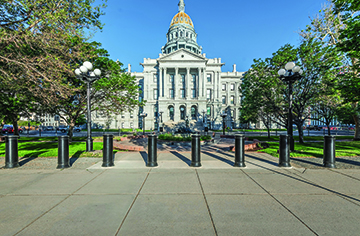
Photo taken by Jessica Hughes with Mountain Light Photography Denver City Council approved the Vibrant Denver bond package and will appear on the November ballot.
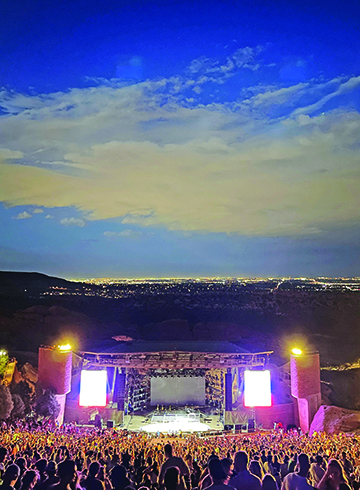
The Vibrant Denver Bond addresses infrastructure needs to some of the city’s most iconic places such as Red Rocks Amphitheatre. Photo taken by Jessica Hughes with Mountain Light Photography
by Jessica Hughes
In November, Denver voters will be able to vote on the $950 million “Vibrant Denver” bond package that was recently approved unanimously by the Denver City Council.
Mayor Mike Johnston’s ambitious bond is the largest bond ever put forward in the city’s history and proposes “to repair and improve Denver’s infrastructure and community space — including roads, bridges, parks, playgrounds, recreation centers, and libraries.”
This comes on the heels of several recent moves to improve Denver’s downtown, including the 16th Street Mall Project, which celebrated its completion this summer, as well as rejected city improvements, such as Governor Polis’s $29 million pedestrian bridge project. At the same time, Trump threatens to decrease federal funding for some programs, the city also faces massive budget cuts worth $250 million, which recently included firing nearly 170 employees and eliminating hundreds of vacant positions. But when you add all of this up, can the city really afford nearly $1 billion in debt?
Johnston says the bond would be fully funded from property tax income, without adding any new taxes. “The Vibrant Denver bond package allows us to come together to decide our priorities for our neighborhoods and families,” said Mayor Johnston. “This bond will help us build the Denver of the future, without raising taxes, while also ensuring the protection and preservation of critical infrastructure already in place. It will also allow us to control our own destiny by creating a local funding source for needed local projects.”
According to the City of Denver, they “set general obligation (GO) bond programs intentionally every 4-10 years so that as previous bonds are paid down, new bonds can be issued without new taxes — allowing the city to keep pace with infrastructure improvements.”
Th
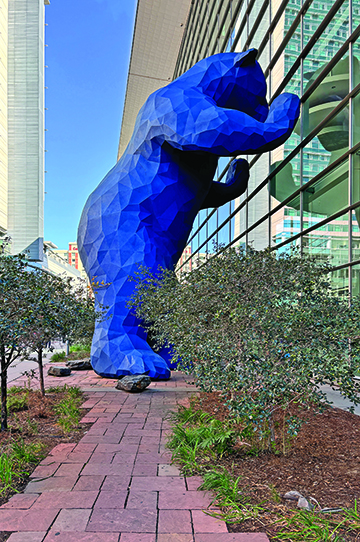
The Vibrant Denver Bond is the largest bond ever proposed in the city’s history. Photo taken by Jessica Hughes with Mountain Light Photography
e mayor’s office said each of the approximately 60 projects can be completed over the next six years within the city’s existing bond capacity, since previous bond programs are almost complete. According to the city’s 2024 comprehensive financial report, the city has about $1 billion in existing debt from previous bond packages voters approved, including the Elevate Denver, a 10-year, $937 million general obligation bond program approved by voters in 2017, and RISE Denver, a five-year, $260 million general obligation bond program approved by voters in 2021.
“In North Denver over the past several years, we’ve seen improvements to recreation centers, parks, fire stations, libraries, playgrounds, and less noticeable but equally important infrastructure like irrigation, street repairs, and bridges. Almost all the infrastructure we rely on daily is built or maintained through our bond programs — critical investments that do not raise taxes but create lasting, tangible benefits for our communities,” said City Council President Amanda P. Sandoval. “General Obligation Bonds allow us to build and maintain the spaces that define our city, ensuring Denver’s legacy of strong, community-driven infrastructure continues for generations to come. The 2017 GO Bond included funding for pedestrian safety improvements along Federal Boulevard, an issue I advocated for, to make one of our city’s busiest corridors safer for everyone. I look forward to working with residents to shape our next bond program and invest in the future of our neighborhoods.”
But before Denverites vote no to avoid adding more debt, it’s important to note the city can only use property tax revenue to fund GO bonds and pay off bond debt. If Vibrant Denver isn’t approved, the city will have a surplus of property tax revenue in the coming years, since it’s on schedule to pay off its current debt, and bonds cannot be used to pay for any operational costs like staffing or services, only for the construction of public infrastructure and facilities. Ultimately, the city would be left with a surplus of money that they couldn’t use for any other cause. So, while it may seem like bad timing, the City of Denver is keeping up the pace of regularly scheduled bond issuance and maintenance.
Each of the bond projects is categorized into five separate sections, which voters will be able to approve or reject. Nearly half of the funding will be allocated toward transportation and mobility, including streets, bridges, and traffic safety improvements. Here is a snapshot of the five categories voters will get to vote on, with the top few most expensive projects within each category.
Transportation and Mobility —
the largest category by far at $441 million
- 8th Avenue Viaduct & Multimodal Improvements | $89,200,000 — The most expensive item on the ballot at almost $90 million is the repairs to the 8th Avenue bridge near Burnham Yard. Despite the City of Denver’s claims that repairs are long overdue, it seems coincidental with the recent rumors of the new home of the Denver Broncos stadium.
- Globeville Elyria-Swansea Connections: Marion Underpass | $75,000,000 — this plan completes the final connection linking Globeville to Elyria and Swansea. It also provides Globeville direct access to the RTD N Line station and several other structural improvements.
- 6th Avenue Viaduct Repairs & Mobility & Access Improvements | $50,000,000 — This project addresses one of the busiest roads in Denver, 6th Avenue, by completing the critical structural repairs, additional access points and a complete re-design for the future replacement of the bridge.
City Facilities
- First Responder & Public Safety Training Center | $75,000,000 — This project would combine the sheriff, fire, and police training needs into one facility to provide greater efficiencies in training recruits, expand the number of trained public safety personnel, and bring training resources up to competitive standards.
- Red Rocks Backstage Expansion and Accessibility Improvements | $35,100,000 — The backstage renovation and expansion would address ADA accessibility (which has been a hindrance to growth for Red Rocks in recent years), additional parking, as well as facility improvements backstage.
Parks and Recreation
- Park Hill Park Buildout | $70,000,000 — After the city announced, earlier this year, its plans to acquire the former Park Hill Golf Course, it comes as no surprise that there is a proposal to build out the park’s new facilities. The plans include steps to ready the park with proper irrigation, landscape, walkways, and parking lots.
- Southeast Recreation Center & Skate Park | $20,000,000 — Money for this project would support acquisition ONLY for the SE Skate Park Hub, which would provide access to skateboarding, roller-skating, etc., to the existing DPR Sports Complex. Development of the recreation center would require additional funding.
Housing and Sheltering
- Affordable Housing Project Development | $45,000,000 — Money for this project allows the city to invest in land, buildings, and/or site preparation to provide affordable housing and to mitigate displacement.
Health and Human Services
- Denver Health Sam Sandos Westside Family Health Center Replacement | $20,000,000 — If approved, the money would support construction of a new clinic in the Westside neighborhood that will increase access to healthcare for the people of Denver. This comes as the Big Beautiful Bill is set to slash healthcare funding in Colorado. The bond is only expected to provide funding for a portion of the entire project.
For more about what’s included in the Vibrant Denver bond, visit Denvergov.org

by Jessica Hughes | Jul 24, 2025 | Main Articles
by Jessica Hughes
New gathering areas were added to the pedestrian corridor to encourage a social atmosphere.
The 16th Street Mall gets a revamp and rebrand as part of a $175 million project. But as the project nears its completion, will this much-needed makeover resurrect a once “ghost town” in the middle of the Mile High City?
Since roughly 2019, the 16th Street Mall has developed a reputation for crime, high rent prices, and dwindling crowds, becoming a shadow of its former self. What was once a bustling pedestrian promenade lined with packed restaurants and steady foot traffic had turned quiet — abandoned storefronts, growing concerns over safety, and a pandemic-era slowdown left locals and tourists alike steering clear.
Now, the Mile High City is betting big with a $175 million renovation and rebranding project to bring the street back to life. As the extensive renovation project nears completion this fall, the city isn’t just rebuilding a street — it’s rebranding it, hoping to shift perceptions, welcome back businesses, and offer Denverites a public space they can safely enjoy.
The project, which broke ground in April 2022, spans from Market Street to Broadway on 16th Street, with the full project set to complete this fall. The city’s hope is that the reimagined space will show off 16th Street as a hub for live music, outdoor recreation, sports culture, sidewalk sales, and more.
Britt Diehl, Senior Director of External Affairs and Marketing at the Downtown Denver Partnership (DDP), says it’s all about creating an experience. “Highlights of the renovations include an installation of new granite pavers in a similar rattlesnake design by renowned architect I.M. Pei to what was previously on the corridor, but with better drainage and greater surface friction to improve pedestrian safety,” says Diehl. “Plus, moving transit lanes to the center of 16th, eliminating the median that runs between the buses on some blocks and creating wider pedestrian walkways and new amenity zones for leisure, commerce, entertainment, and tourism. And expanding the number of trees on 16th from about 150 today to more than 200 at completion with a variety of species offering varying degrees of shade and color throughout the year.”
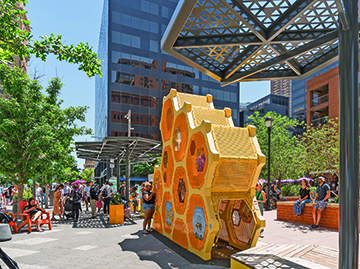
A beehive climbing structure, between Larimer and Lawrence, is just one of many new additions to 16th Street’s upgrade.
Other improvements meant to foster a sense of community and updated public gathering spaces also include more than 20 new patios installed near 16th Street businesses. Plus, new experiences and family-friendly amenities including the Howdy Trouty — three “climbable” trout, including one donning a western “troutfit!,” a beehive-themed children’s climbing structure, and many other interactive and artful installations.
“These are little moments of joy,” Diehl says — small but meaningful invitations for people to engage, linger, and play.
But 16th Street’s revival isn’t just about its looks. At its core is a full-scale identity reset, which includes a new name. “The Downtown Denver Partnership, in partnership with the City & County of Denver and the 16th Street Mall project team, announced last summer the appointment of DNCO, a renowned international place branding agency, to lead the repositioning of Denver’s iconic 16th Street Mall,” says Diehl. “The repositioning work introduces a new visual identity to usher the space into its next chapter. Part of the work to positively rebrand 16th Street involved creating a new message and visual identity to highlight 16th Street’s distinct sense of place.”
In a deliberate departure from its original “mall” branding when it opened in 1982, the city has now dropped the antiquated term and is now simply 16th Street or what Diehl says is now “The Denver Way.”
“With the concept, ‘The Denver Way,’ it’s about experiencing what our city has to offer and embracing openness, originality, and uniqueness,” says Diehl. “This repositioning work — from the mark honoring street signs and downtown murals to a color palette inspired by Colorado’s natural landscape, to icons illustrated by local artist YAMZ (Brayan Montes) — has been crafted to capture our city’s spirit and provide everyone a platform to experience this world-class public space, The Denver Way.” In the immediate term, windows of vacant retail spaces have come alive with three-dimensional installations inspired by “The Denver Way” designed by local creative agency Cultivator.
Yet even as new life returns to the corridor, it’s still easy to find empty offices and storefronts along the street as a result of increased rent prices, crime, and business closures during construction and the pandemic. Restaurateur Lon Symensma, chef and owner of ChoLon Restaurant Concepts, closed two of his restaurants along the street, including the short-lived Bistro LeRoux and most recently YumCha, which later reopened as the YumCha Beer Garden in Central Park. While other businesses, like Trompeau Bakery, whose second location on 16th Street struggled, hung on, and remain open for business. To help, Deihl says the Downtown Denver Partnership and Denver Economic Development (DEDO) have been co-leading a retail recruitment strategy to fill ground-floor vacancies, an effort that will continue in years to come.
But none of this really matters if these changes don’t translate to a safer street. So, in April this year Mayor Mike Johnston announced a new downtown safety plan. In conjunction with the DDP, the plan involves a newly formed 10-officer unit for downtown and a kiosk at the corner of 16th and Arapahoe Streets for Denver Police officers.
Will all these changes make a difference? Only time will tell.
Work on 10 of its 13 blocks has been completed, with plans to complete the remaining blocks this fall. And with nearly $2 million from the Denver City Council, the DDP will open additional play areas, fund public art, and schedule musical acts. And for the remainder of the summer, the Downtown Denver Partnership has planned 90+ days of activities and events along 16th Street that include live music, vendor markets, and hosting the Skyline Beer Garden at 16th and Arapahoe this summer and will continue to bring art, music, and other “surprises and delights” to the space year-round.
Crime Challenge
The corridor, of course, became known for public drug use, homelessness, and at times violence. Police now focus on keeping the street safe by using a 10-member team of bicycle and horse-mounted officers. They now parole the strip between 14th and 18th street, from Union Station to Broadway.
Stabbing along the strip in January — prior to reopening of 16th Street — made city officials and the Denver Partnership uneasy. Denver Police Chief Ron Thomas and Mayor Mike Johnston said they were committed to increasing the number of police patrols and police presence. Thomas said more officers were being added to the department’s District 6. He suggested the department had also added additional uncommitted resources that would be used to “provide an extra layer of safety.”
Between 2020 and 2024 the strip saw 464 aggravated assaults, five murders, and 203 robbery reports. Violent property and drug crimes on 16th Street, however, dipped in 2024, according to police records. Furthermore, it was the lowest number of property crimes in the last 10 years. For the balance of this year and into 2026, the best crime will be the crime that was prevented.
by Jessica Hughes | Jun 20, 2025 | Travel
By Jessica Hughes
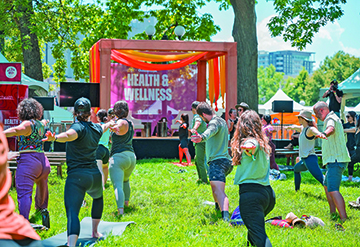
120 yogis attend the first guided yoga class at the UCHealth Health and Welleness Zone. Photo provided by Outside.
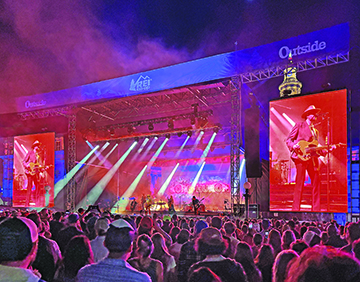
Lord Huron closed out the second Outside Festival and Summit in Denver. Photo by Jessica Hughes
Austin has South by Southwest — now Denver has the Outside Festival and Summit. Any lingering doubt that Colorado is the epicenter of the outdoor industry was put to rest last month, as the Outside Festival and Summit returned to downtown Denver, doubling both its attendance and presence.
Founded by Outside Interactive Inc. and presented by Capital One and REI Co-op, the Outside Festival and Summit exceeded expectations with 35,000 attendees over the weekend — far surpassing the anticipated 25,000 and nearly doubling last year’s debut turnout. The event didn’t just grow in attendance; it also expanded its footprint, with the Outside Summit taking place across two locations and offering 11 sessions and two workshops.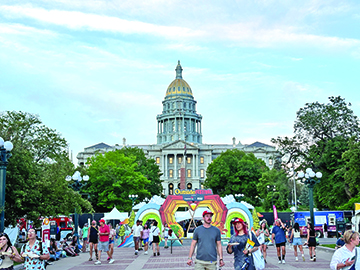
This year’s four-day event — two days focused on outdoor industry professionals and two days of public festival programming at Civic Center Park — kicked off with the debut of Outside Ignite, a national startup pitch competition. New to the festival, the competition drew nearly 200 applicants, from which five finalists were selected to pitch live to a panel of five judges. The grand prize, valued at $100,000, was awarded to Carbondale-based Raide Research, while Campfire Ranch took runner-up honors and won the audience-voted People’s Choice Award. “This is the Shark Tank of the outdoors,” said Jessica McGee, Director of Marketing at Outside. “These participating contestants — from hospitality to gear — are helping reshape the industry.”
Following Outside Ignite; the Outside Summit welcomed 900 attendees to 15 sessions featuring 46 speakers. Highlights included insights from Conor Hall of Colorado’s Outdoor Recreation Industry Office; Mary Beth Laughton, president and CEO of REI Co-op; and Netflix co-founder Reed Hastings, who shared his latest vision for Powder Mountain, a project aiming to disrupt the ski industry.
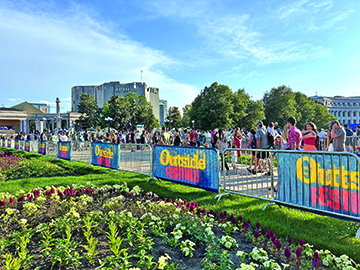
The second Outside Festival doubled in attendance at Civic Center Park. Photo by Jessica Hughes
The Outside Festival took over Civic Center Park on Saturday and Su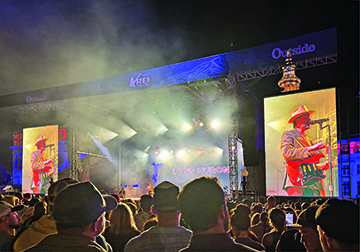 nday with a dynamic mix of programming. Industry icons like Alex Honnold headlined presentations, while 500 climbers scaled The North Face climbing wall and over 100 walkers joined Diana Nyad and Bonnie Stoll for the EverWalk session on Sunday.
Attendees also heard “Tales from the Trails” from seasoned backpackers, sharing stories from their outdoor journeys. Between sessions, a standout lineup of 12 musical acts kept the energy high, with headliners including Trampled by Turtles, Sylvan Esso, and Lord Huron. New this year was the UCHealth Health and Wellness Zone, where 120 yogis greeted the day with sunrise salutations, and the Ultimate Basecamp where industry professionals and athletes engaged audiences in inspiring conversations about adventure and the outdoors.
“This year’s Outside Festival and Summit proves that we’re building something much bigger than an event… we’re fostering deeper connections and bringing the outdoor community together,” said Robin Thurston, CEO of Outside Interactive. “The Outside Summit rethinks the traditional outdoor trade show model and brings leaders in the industry together to discuss new ideas, successes, and challenges that top outdoor businesses are facing today. The Outside Festival is where we see huge potential for more engagements at t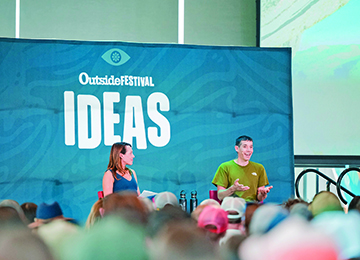 he event, continuing to celebrate outdoor culture and attract fans of music, film, wellness, and adventure. We hope to keep growing this event and adding value for years to come.”
The timing of the Outside Festival feels especially significant, as Colorado’s position as a leader in the outdoor industry was called into question following the Outdoor Retailer trade show’s 2022 departure from Denver back to it roots in Salt Lake City. But with Outside Inc. relocating its headquarters from Santa Fe to Boulder, the company has forged a strong partnership with the state — paving the way for the creation of this new, uniquely Colorado event, says McGee.
Denver responded to the moment, launching a festival that not only attracts industry professionals but also directly engages outdoor enthusiasts, bridging a gap that hadn’t been crossed before.
“Outside brings a South by Southwest approach to the outdoor space,” says McGee. “We’re not trying to be another expo,” McGee adds. “We want people to come for the connections, the conversations, and the fun. Brands benefit, too connecting with both their industry peers and with consumers in one vibrant space.”
For those in the industry, McGee emphasizes the importance of building community and fostering dialogue about where the outdoor world is heading. For consumers, the mission is simple: get people outside. That’s why the festival is free for kids 12 and under — to make it as accessible as possible and inspire the next generation of outdoor lovers. “It’s all about kicking off the summer season and getting people excited about the outdoor lifestyle.”
With plans already underway for a third year — scheduled for the weekend after Memorial Day — the Outside Festival is quickly establishing itself as the unofficial launch of summer. “We’re committed to growing this event year after year,” says McGee. “The goal is to keep the momentum going and build the go-to gathering place for the entire outdoor community — professionals and consumers alike.”
by Jessica Hughes | Jun 20, 2025 | Main Articles
Will It Be Worth It?
by Jessica Hughes
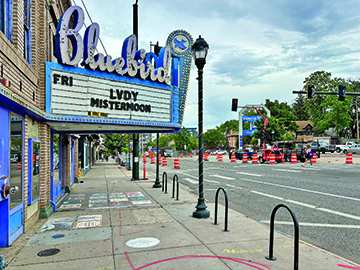
Unique Business Corridor: Colfax Avenue is known for its various small businesses such as the Bluebird Theater. Some wonder how many such businesses will be able to survive the disruption of the many months of renovation of much less a street with the number of automotive lanes cut in half.
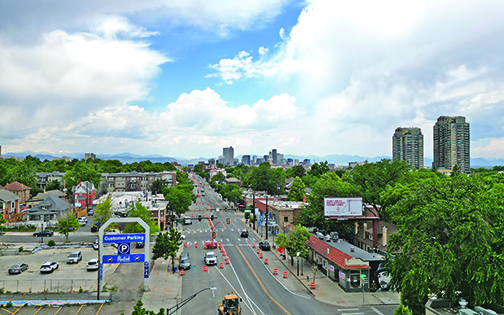
Bird’s Eye View: Looking west down Colfax Avenue from Adams Street.
One of Denver’s most historic streets gets a modern facelift that threatens the very businesses that make it so special. The construction for the East Colfax Rapid Bus Transit project has recently claimed the lives of several local businesses in the last few months including Middleman, a neighborhood gem that also operates the James Beard Award-nominated Misfit Snack Bar — closed last month.
This is just one of many stories people have shared in response to the BRT project. The nearly 10-mile project, which only began in October 2024, is already causing local businesses to struggle, some even closing. As disruptions continue, many business owners are left questioning how they’ll survive through the project’s projected completion in 2027. And if they do survive, will the reconfigured Colfax help the street boom or destroy it as a business district?
The Bus Rapid Transit (BRT) systems — a train-like system that offers fast and reliable transportation without the high cost of building a rail system — have become popular solutions to public transportation in larger cities. But at what cost? There might be an easier flow of traffic, but for some local business owners, they don’t see the long-term benefit. Like Libby Anglin, owner of Base6Fitness at 3805 E Colfax Ave., who says since COVID, she’s seen a constant stream of construction along Colfax and thinks the BRT project won’t be worth it in the end for local businesses. “The constant construction over the last four years on Colfax has been an unmitigated drag on our business. In the end I hope I am wrong, but I do not see how it will be good for the city or worth it for businesses or residents.”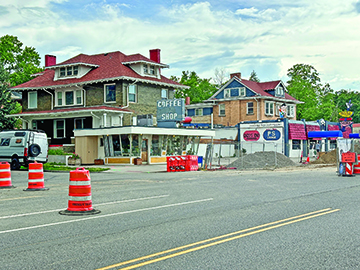
Over the past several decades, Denver has steadily worked to change Colfax from a former federal highway into a lively neighborhood main street. As part of this transformation, the city has introduced bike and bus lanes to modernize transportation along the corridor, and now most recently the BRT system. But while these upgrades signal progress, they’re also creating new challenges — particularly for the local businesses that are the heartbeat of Colfax and Denver. “Keeping these businesses alive, keeps the soul of the city alive,” says Don Novak of the Bluebird Business Improvement District.
The biggest issue for business o
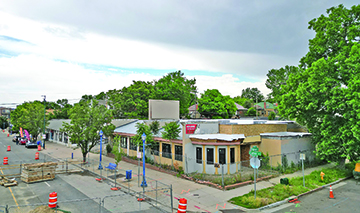
Closed For Business: The once popular Pete’s Greektown Café at Filmore and Colfax has been closed down and no new tenant is likely until the Colfax Avenue renovations are fully completed.
wners, Novak says, is people avoiding Colfax because of the construction. “Traffic has been pushed to nearby streets, so there aren’t as many people driving in front of the businesses.” He says the most difficult points are the bus stations in the middle of the street, which construction on these started in 2025. “Some of these businesses are completely covered with no access to their entrance. It looks like a barracked war zone,” says Novak referencing the long-time local businesses such as Tommy’s Thai, PS Lounge, Enzo’s, and Lulu Rose, who currently sit behind a fence.
While the Denver Economic Development & Opportunity department has $15,000 grants available to businesses to keep them open, you have to apply and prove a 20% loss in revenue. But for these businesses, they say it’s often too late at that point. In addition, some businesses claim that $15,000 does not keep them open mo
re than a few more days or one week in total. “In the meetings I have attended, most businesses feel that if they are down 20%, they are already in the red and closing their doors,” says Spero from Hooked on Colfax.
Anglin of Base6Fitness, also points out the city should fully acknowledge the majority of brick-and-mortar businesses depend on ease of access and people being on site. “All brick-and-mortar businesses thrive best with ease of access,” says Anglin. “So perhaps rather than making businesses prove loss of business, perhaps it should just be a given.”
The Colfax construction isn’t the only hardship contributing to hard times for local businesses since COVID. Unfortunately, the planned construction didn’t, and coul
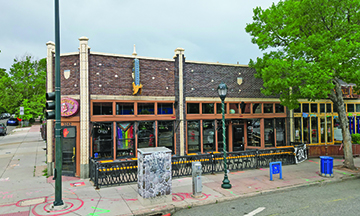
Goosetown Tavern: Successful operations such as Goosetown Tavern at Adams and Colfax have been hurt by the East Colfax renovation. The impact is not as severe since their frontage is not blocked.
dn’t, account for the global issues businesses face today having to adapt to not only local concerns but global concerns as well. “Things are getting increasingly difficult for Mile High businesses in the last few years with minimum wage going up in Denver, but nowhere else in the state, plus with the addition of tariff-talk, when you add in a massive construction project, it doesn’t help,” says Novak. “While we have been talking about this project for over a decade, we unfortunately didn’t plan for things going to shit.”
For Spero, owner of Hooked on Colfax coffee for the past 20 years, the last five years have been the most challenging by far. “All costs have spiked, from property taxes to delivery fees to the cost of coffee beans. We only have front door street access, so the BRT project has made it incredibly difficult to receive product deliveries. And customers who used to park out front and grab a coffee on their way to work can no longer do so because the parking spaces have been removed.”
So, local neighborhood associations and committees are stepping up to help local businesses weather the storm. The Bluebird Business Improvement District — a community organization funded by taxes from those in the district — works to support the businesses and aesthetic of the nine-block area between St. Paul Street and Colorado Blvd., especially during times like these. “We represent and offer overarching support for business owners and neighbors in the Bluebird District,” says Novak. “We are to work with the city of Denver and the BRT project to help businesses thrive, especially during times like these.”
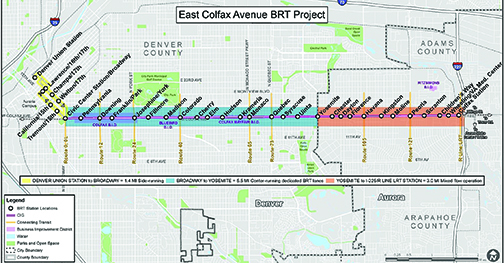
Colfax BRT: East Colfax Avenue from Union Station to 1-225, is undergoing ten miles of major renovation featuring a Bus Rapid Transit Corridor which replaces two automotive lanes with bus lanes. There will no longer be on street parking along Colfax. While it will assuredly increase bus ridership, some believe it will destroy the businesses along Colfax Avenue, it is purportedly designed to help.
One of which was an effort to provide a temporary parking solution by working with the owners of the parking lot at the corner of Colfax and Adams Street — previously occupied by Paradise Cleaners, where they have “paved Paradise to put up a parking lot.”
“We see non-monetary support options from both the city and the local Bluebird Business Improvement District,” says Patrick Brown of Twist and Shout Records. “Internal solutions are being implemented with local businesses, like Paradise Cleaners at the corner of Adams and Colfax, that the BID is providing, opening up its parking lot for all customers along Colfax.”
Regardless of these temporary band-aids, are they enough to weather the storm? “The issue really comes down to businesses renewing their leases, or not,” says Novak. “The result of this project could be amazing, but the survival right now is way more challenging.”
Other business owners who have recently spent a lot of time and money updating and renovating, like Gwen Campbell, owner of the Lost Lake Lounge and Goosetown Tavern, which she just bought in March 2024, are now faced with unexpectedly slow business because of the construction. “We invested a lot into updating the business, putting in a new kitchen, bringing on a new chef, and developing a new menu with BBQ, bar bites, and burgers.”
Famous for its dive bars and historic restaurants, Colfax is home to legacy businesses and a bustling community that prides itself on the number of independent businesses in the area. And so their main concern is keeping the legacy businesses, like the Goosetown Tavern, in place. “These businesses are our culture here in Denver. We are dedicated to keeping these legacy businesses in place,” says Novak.
“The Bluebird District on East Colfax is special, it’s known for live music, local art, quirky shops, diverse restaurants, unique bars, and a counterculture vibe,” says Campbell. “This has evolved to where it is today over time. If businesses don’t make it, it will take at least a generation to revive.” Despite what feels like an agonizingly slow death, Novak reiterates that the goal is to have construction complete within 18 months from now. So, the trade-off: two years of construction that threatens to wipe out the culture of a neighborhood that would take a generation to revive.
“I am hopeful that once the project is completed, it will improve the aesthetics on Colfax and business will get back to normal,” said Campbell. “I truly hope when this is completed, there will be solutions for parking because p
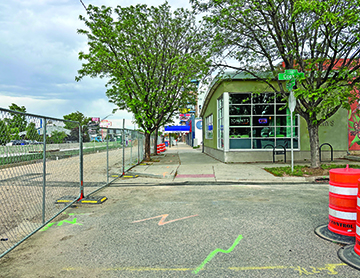
No Parking: Various retail businesses along Colfax have been cordoned off from their customers.arking is critical for retail shops, hair salons, and food & beverage.” Unfortunately, the Johnson Administration is not inclined to promote parking. In fact, it is inclined to do the opposite.
If small businesses close, who comes in their place? Of course, it’s always the fear of big box chains and restaurants — the ultimate death and destruction of any local community. “What has always made Colfax is the unique nature of the businesses along the street,” says Brown. “Chain stores and restaurants erase the local character of their cities into a homogeneous sameness, and Colfax has a long-standing tradition of having locally owned small businesses as the dominant flavor.” “It’s been proven time and again that small businesses have a greater positive net impact on their communities and Colfax is evidence of that — from hiring locally, to keeping tax dollars in the community, to diversifying the neighborhoods, to reacting to community needs.”
One thing all these business owners agree on is that Colfax is the heartbeat of Denver. Colfax is as central to our city’s transportation as it is to our memories as Denverites, whether it’s catching a show at the Bluebird Theatre, getting a free rose at the PS Lounge, or grabbing a bite at Goosetown Tavern, everyone in the city has a story about Colfax.
“Colfax deserves a glow up,” says Spero. “I am excited for the curbs to be repaired and the potholes to be filled. Added trees will be lovely. I suppose only time will tell if the new bus stops will be beneficial and encourage more people to ride the 15.”
Campbell, like many other business owners, wants to remind people Colfax is still open. “Once a month, try a new restaurant or tavern on East Colfax, go see a concert, grab a drink at one of the quirky, cozy bars.” Plus, a chance to show your support in September with the Bluebird Bodega, a big music and food showcase to support the area businesses along Colfax.
by Jessica Hughes | May 16, 2025 | Glendale City News
by Jessica Hughes
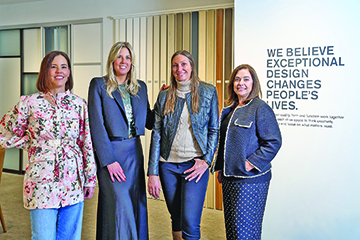
At California Closets with Mary Gelwick, Alexandra Sandberg, Kristin Becker, and Jena Brenneman (from left to right).
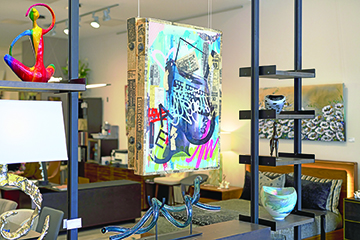
Cherry Creek Design Collective event at TOWNhouse.

Element Home hosted Jarred de Palo aka Mr Depalakua at their Cherry Creek store.
Just in time for the annual spring refresh we all look forward to in our homes, the Cherry Creek North neighborhood held its first ever Cherry Creek Design Day. Hosted by the Cherry Creek Design Collective, the inaugural event brought together the area’s top design retailers for a full day of networking, hands-on experiences, and inspiration from Cherry Creek’s design community.
Event organizers, Kristin Brown of Rocky Mountain Shutters and Kristine Vanacker of Ann Sacks, are also the brains behind the newly-formed Cherry Creek Design Collective — a group that aims to unite the neighborhood’s top design retailers that have flocked to the high-end Denver neighborhood over the last few years.
The idea came shortly after Vanacker moved her tile and stone showroom from Denver’s Design District to Cherry Creek, “She asked if there was a design group in Cherry Creek of like businesses and I said no but there should be,” says Brown. “Ever since that first meeting, we have been working with the Cherry Creek Chamber to build this group. This idea truly was to bring awareness to the public and professionals the great design and home furnishings offerings in Cherry Creek.”
Ann Sacks Tile & Stone showroom finds itself in good company with newer high-end design retailers moving into the Cherry Creek North shopping area in the past few years, including TOWNhouse and Joybird. As Cherry Creek North continues to expand its offerings of design retailers, Brown and Vanacker felt inspired to create a central event that highlighted these industry experts that reside in their backyard.
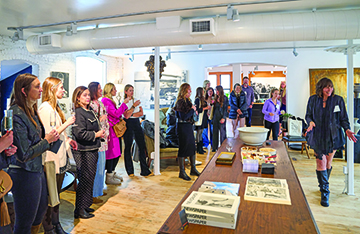
“We wanted to host an event that brought professionals into the neighborhood and got them exposure to the wonderful design and home furnishing offerings in Cherry Creek North,” says B
Attendees visit Ann Sacks Tile + Stone at the first annual Cherry Creek Design Collective.
rown. “This first event was focused on providing an introduction to the businesses a part of the collective, while our next event we plan to have a consumer day as well.”
Brown says the collective includes members from the Cherry Creek Chamber, members that work in the design and home furnishings in the Cherry Creek area, which can be retail locations in the neighborhood or professionals who want to work in the area.
Attendees began their journey at Rocky Mountain Shutters, Shades & Closets, where they enjoyed mimosas and breakfast treats, and explored offerings from Hunter Douglas Window Fashions and The Designery. The day continued with visits to various showrooms opening their doors, including organizing tips and tricks at California Closets, non-toxic interior design at Interior Define, with Uniquely You Decor, on-Budget Design Service at The Brass Bed, and more.
“The idea is that as a group we can get our individual businesses in front of the eyes of our consumers whether for professionals or direct to homeowners, and bring awareness to the wonderful home furnishing and design options in Cherry Creek North,” says Brown.
The Collective also commissioned local artist Michael Dowling to conclude the event with a meet-and-greet happy hour at TOWNhouse. “A wonderful addition to the event was from artist Michael Dowling. He donated a beautiful design featured on our swag bags, which he signed for each participant.”
As the Cherry Creek Design Collective looks to the future, they are excited to have the event grow in the number of businesses participating as well as people attending. “We hope to have a professional and a consumer day next year and we are excited to have this continue to be an annual event,” says Brown. “As a collective we will also be hosting more events throughout the year, including a walk with the owners and managers of these businesses this summer for the Cherry Creek Summer concert series, as well as a CEU day for design professionals and many more!”
To learn more about the Cherry Creek Design Collective follow them on Instagram @cherrycreekdesigncollective.
Photos provided by Cherry Creek Design Collective.