by Jessica Hughes | Dec 16, 2022 | General Featured
by Jessica Hughes
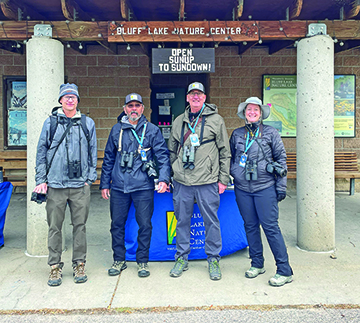
Bird walk leaders at Bluff Lake Nature Center. Pictured from left to right: Jason Bidgood, George Ho, Steve Hebert, and Lisa Pera.
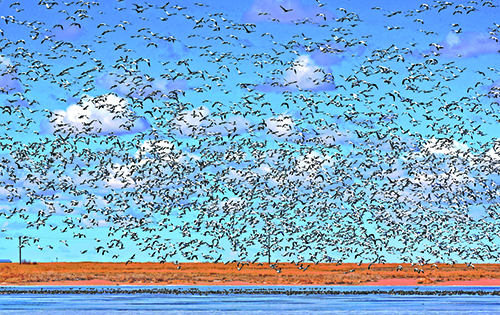
Thousands of snow geese flock to the reservoirs and farmland of the Eastern Plains. Photo by Jessica Hughes
Colorado is home to over 400 species of birds that either live here year-round or pass through during seasonal migrations. But when is the best time to see them? While most think of birding during warm-weather months, birdwatching is a year-round activity, with winter being one of the best times for viewing.
“Colorado winters are full of sunny, mild days which allow birders to enjoy the outdoors. Plus, the lack of leaves on the trees allows for better viewing of the birds,” says George Ho, Bluff Lake Nature Center Bird Volunteer/Monthly Bird Walk Leader. “Winter is great for birding.”
“There are plenty of ducks, geese, and raptors that migrate south to our parks and lakes to spend the winter in our (relatively) warm climate,” says Ben Jacques, Bluff Lake Nature Center Outdoor Explorers Program Coordinator. Also, since they must keep their bodies warm, they spend a lot of time moving around searching for food. This makes them easier to spot and hear through the bare foliage.”
“Plus, with shorter sunlight hours, good winter birding doesn’t require a 4 a.m. alarm,” says Jacques.
So, what should you expect to see? From the admired bald eagle to song sparrows, there is a variety of winter fowl to catch your eye. “Bald eagles are more plentiful in the winter here in Colorado because they come south to us from the north. Waterfowls like ducks are abundant in winter as well,” says Ho. “Winter sparrows are also popular to see. These include the white-crown sparrows and the juncos as well as the year-round song sparrows.”
He also says birds of prey are abundant, including owls like the great horned owls, hawks like the ferruginous, and the year-round red-tailed hawks, plus falcons like the prairie falcons and the American kestrels.
The best part is you don’t have to travel too far to see these beautiful birds in flight. Below are a few places close to home that make a great afternoon outing or a fun family day trip.
Bluff Lake Nature Center
Within Denver’s city limits, Bluff Lake Nature
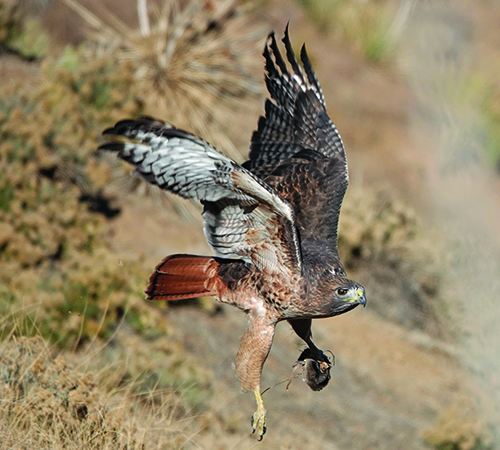
A Red Tail Hawk swooping in on its prey. Photo by George Ho at Bluff Lake Nature Center
Center is one of the best places for birdwatching in Denver. The 123-acre nature preserve has spotted 226 different species of birds according to their active community of birders who record their encounters.
For the beginners and families, the center offers bird walks throughout the year. Led by an expert guide, discover how and where to spot certain birds and learn about the different species you can find in Colorado. The walks are free, but you need to sign up in advance on their website. Download their printable birds of Bluff Lake checklist and keep track of what you spot.
Visit their birding page to learn more at www.blufflake.org/birdwatching
Cherry Creek State Park
Cherry Creek State Park is one of Colorado’s most popular parks due to its plethora of summer activities, but most may not think of it as a top birding spot. There are plenty of birds you can see year-round but in winter, soaring bald eagles perch high in cottonwood trees, while gulls meet around the marina and swim beach area. The reservoir eco-system also attracts raptors species including golden eagle, red-tailed hawk, northern harrier, and ferruginous hawk. Because the reservoir typically remains un-frozen throughout the winter, waterfowl and shorebirds are popular to see as well.
Barr Lake State Park
With more than 350 species of birds spotted, Barr Lake State Park is the metro area’s premier birding lake. About 30 miles northeast of Denver, Barr Lake offers one of the best set-ups for winter birdwatching. Walk the 8.8-mile trail that circles the lake, with several wildlife viewing stations and the wildlife refuge at the southern end of the lake. The lake’s large number of bald eagles, including a pair that nests there every year, are what draw in the birding crowds, both amateurs and experts.
Eastern Plains
Beyond Denver and the Front Range, the Eastern Plains create the ideal environment for bird watching in Colorado. The High Prairie and surrounding areas welcome over 40
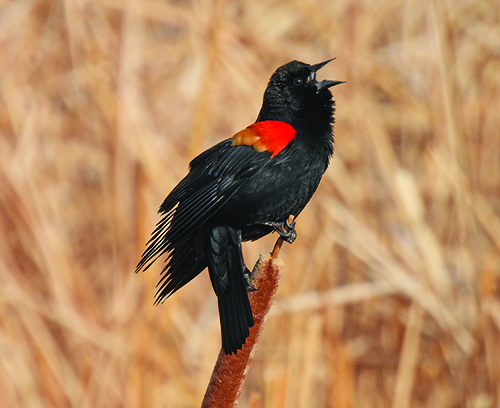
The Red-winged Blackbird is just one of many birds to spot this winter. Photo by Lisa Pera
0 species of birds including warblers, snow geese, grosbeaks, mountain plovers, and buntings. They make their homes amongst the grasslands, craggy outcrops, isolated ponds and reservoirs, plus rivers lined with cottonwoods and willows. There are 20 birding trails on the Eastern Plains featuring a variety of sites where you can view wildlife.
One of the most significant annual migrations in the state is the Snow Goose migration. Every winter, in January and February, the wind-swept plains and open-water reservoirs near Lamar, Colo., turn white, not with snow, but a swirl of 200,000+ snow geese descending upon the High Plains of Colorado. By way of the Western Central Flyway, the annual migration lasts up to two weeks and can be seen within state wildlife areas, local reservoirs, and area farms where they stop to feed.
High Plains Snow Goose Festival
In celebration of this migration, Lamar County hosts the annual High Plains Snow Goose Festival, taking place Feb. 3-5, 2023. As one of the largest birding festivals in Colorado, the event hosts a variety of programs, tours, and seminars that highlight the area’s landscape and unique birding heritage. Sign up for birding tours, shop the local craft fair, and listen to lectures to learn more about the migration and other local fowl. The event is free but tours and lectures require an advanced purchased ticket. For more information visit highplains snowgoose.com.
Birding Tips
The bird walk leaders at Bluff Lake Nature center say the best time to see birds is when they are most active, at dawn and dusk, when they are feeding. Patience and a good pair of binoculars are essential to get the most out of bird watching. “Plan your bird watching around a bird’s basic survival needs (food, water, and shelter) and you’re bound to get some birds in your binoculars,” says Jacques.
Jacques also suggests if you are new to birdwatching there are many beginner-friendly groups around Denver to join. The Denver Field Ornithologists, Denver Audubon, Bluff Lake Nature Center, Tuesday Birders, and multiple bird feeding stores run free bird walks in the area. Or download the free Merlin bird ID app by Cornell Lab for a great field guide on your phone.
by Jessica Hughes | Nov 17, 2022 | Travel
by Jessica Hughes
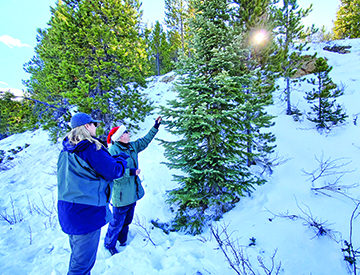
Local tree cutters assess the perfect Christmas tree.
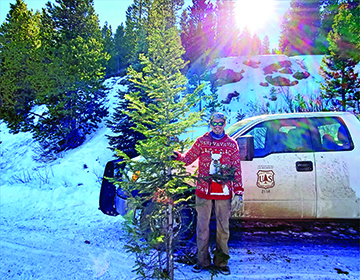
For many Coloradans, cutting down their own Christmas tree has become a time-honored tradition over the years. It is not only a favorite holiday activity for families to enjoy together, but it’s economical and you can take pride in knowing you’ve played an active role in managing your national forests.
Dating back to the 1930s when the Christmas tree was defined as “a tree displaying a short internode combined with a symmetry of form that is pleasing to the eye,” according to a 1930 Eldorado National Forest report on cutting Christmas trees. Since then, the National Forest Service has played an important role over the years in the business of Christmas trees, including harvesting, selling, and permitting the cutting of trees.
So, how does it work exactly? The U.S. Forest Service allows the cutting of trees in certain districts throughout Colorado with the purchase of a permit. There are several Forest Service cutting areas near and along the Front Range, with each district regulating its permit system a little differently.
Permit holders are responsible for understanding where it is legal to cut a tree and should spend some time reviewing the information and maps provided on the Forests’ webpage. While you can purchase your permit at designated ranger district offices or at some local vendors, the best and easiest is to purchase your permit online at recreation.gov.
 The Denver/Front Range Christmas Tree Cutting areas include the Arapaho & Roosevelt National Forests, Pike National Forest, and the White River National Forest. Each is broken out down below:
Denver/Front Range Christmas
Tree Cutting area Forest Offices:
Pike and San Isabel
National Forests
South Platte Ranger District
(Buffalo Creek)
303-275-5610
The South Platte Ranger District is closest to Denver. Permits in this district apply to specific cutting areas (Buffalo Creek, Sugar Creek, and Camp Fickes) and specific dates for cutting. Permits are limited and may sell out.
Permits: $20 per tree
Cutting dates: Nov. 25 – Dec. 11
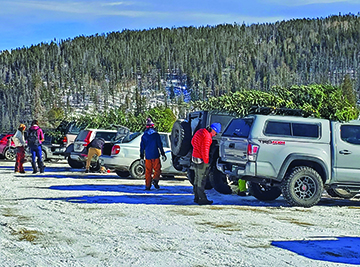
Tree cutters line up with their cars to haul off their hand-picked Christmas trees.
South Park Ranger District
Fairplay, CO 80440
719-836-2031
The South Park Ranger District is closest to the towns of Fairplay, Jefferson, Como, and Lake George along Hwy. 285. This area is another great option for Front Rangers and those living in the Denver metro area. Most of the district is open for cutting. Unlike the South Platte District, there is no tree quota, so permits will not sell out.
Permits: $20 per tree
Cutting dates: Oct. 13 – Dec. 31
Pikes Peak Ranger District
Colorado Springs, CO
719-636-1602
The Pikes Peak Ranger District is closest to Colorado Springs with specific cutting areas near Woodland Park. There is not a limit on permits, so no need to worry about selling out.
Permits: $20 per tree
Cutting dates: Nov. 25 – Dec. 18
Leadville Ranger District
Leadville, CO 80461
719-486-0749
The Leadville Ranger District is closest to the town of Leadville with most of the area open for cutting. Again, there is no quota, so permits won’t sell out.
Permits: $10 per tree
Cutting dates: Nov. 10 – Dec. 31
San Carlos Ranger District
Canon City, CO 81212
719-269-8500
The closest towns the San Carlos Ranger District serves are Canon City, Westcliffe, and La Veta. Most of the area is open for cutting and permits will not sell out.
Permits: $10 per tree
Cutting dates: Nov. 10 – Dec. 31
Salida Ranger District
Salida, CO 81201
719-539-3591
The Salida Ranger District serves the nearby towns of Salida and Buena Vista. Most of the district is open for cutting. There is not a quota, so permits will not sell out.
Permits: $10 per tree
Cutting dates: Nov. 10 – Dec. 31
Arapaho and Roosevelt National Forests
Permits to cut your own Christmas tree on the Arapaho and Roosevelt National Forests are on sale now on recreation.gov and remain available through January 7. Permits must be purchased in advance and cost $20 each.
Sulphur Ranger District
Granby, CO 80446
970-887-4100
For other Christmas tree cutting area forest offices throughout the state visit fs .usda.gov.
The Forest Service recommends downloading forest service maps onto your phone through Avenza before heading out. This app works even when there isn’t cell service and will help you make sure you don’t cut trees on private property or prohibited areas. Most roads will be closed to motor vehicles after Nov. 15, but snowmobiles or skis may be used to access some areas. Make sure the Forest Service Road you plan to drive is open using our Road Status Tables.
For more tips on what to bring, how to plan your trip, and helpful cutting tips be sure to visit recreation.gov/tree-permits.
Photos taken by Cora Marrama. All images were provided by the Arapaho and Roosevelt National Forest
by Jessica Hughes | Sep 30, 2022 | Main Articles
by Jessica Hughes
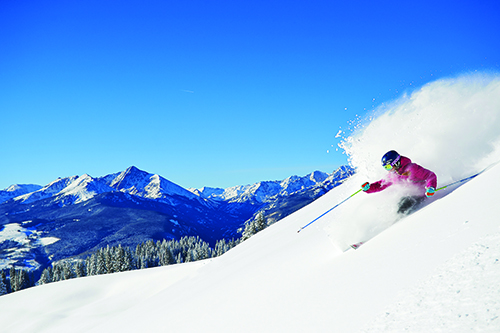
Skiing the fresh powder at Vail Mountain. Photo: Andrew Maguire, Breckenridge Ski Resort
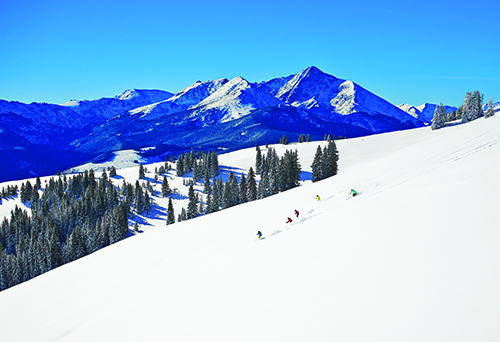
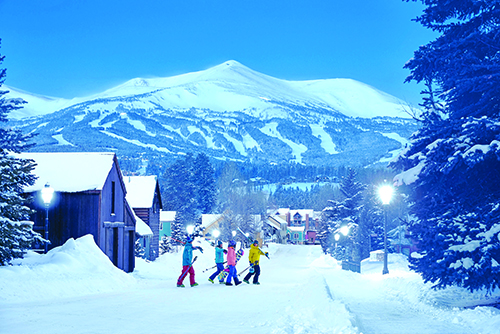
Ski runs at Breckenridge along the Tenmile Mountain Range. Photo: Andrew Maguire, Breckenridge Ski Resort
It’s that time of year again, when fall signals the anticipatory announcements of opening day for Colorado ski resorts and the race to be the first to open begins.
On August 22, 2022, Vail Resorts announced their opening dates of its five Colorado resorts including Vail Mountain, Beaver Creek, Breckenridge, Keystone, and Crested Butte. The season begins with Keystone Resort set to be the first to open in mid-October and ending with the closing of Breckenridge running well into May, making this one of the longest seasons in the country for its Epic Pass Holders.
The race to the top is tight with Keystone Resort planning to be the first to open in all of Colorado on October 21, rivaling Arapahoe Basin which is set to open on October 22. Historically, the average opening date for the upcoming ski season has been October 22.
In addition, to the opening dates, the company shared it will limit lift ticket sales throughout the season in an effort to manage potential overcrowding. “We care deeply about our guests’ experience at our resorts,” said James O’Donnell, president of Vail Resorts’ Mountain division.
“Limiting lift tickets throughout the season, alongside the big investments we’re making at our resorts, and in our team members, will help us provide our guests with an Experience of a Lifetime this winter.”
Much of this came in response to issues the resort has experienced in past years with long lift lines and overcrowded runs. Pre-purchased passes, including the Epic Day Pass, are not limited, and if tickets are sold out online, guests will not be able to purchase at the window.
Downtown Breckenridge rests near the base of the resort. Photo: Andrew Maguire, Breckenridge Ski Resort
Aside from opening dates announcements, the winter 22/23 season ushers in exciting news from Colorado’s 26 ski areas and resorts with notable milestones, upgrades, and new additions.
Vail Resorts is investing $300 million in the guest experience this season, with new lifts at Vail and Breckenridge, a restaurant expansion at Keystone, and exciting events at all five resorts.
Vail Mountain will unveil its new two-lift project, introducing the Sun Down Lift, a new high-speed 4-person chair that will connect the bottom of Sun Down Bowl to Wildwood, allowing for a smoother connection between Lionshead Village and the Seven Legendary Back Bowls. The lift in Game Creek Bowl will also be upgraded to a new high-speed six-person lift.
Steamboat Resort continues to move forward with its second phase of a multi-million, multi-year transformation of its base area, including an ice-skating rink and new food and drink hall, while World Cup downhill racing returns to Aspen Mountain this spring.
North America’s highest-elevation restaurant re-opens at Arapahoe Basin as the completely renovated and expanded il Rifugio, a European-inspired full-service eatery, while down the road Loveland Ski Area will launch a guided snowcat operation offering backcountry trips for intermediate level and above skiers and snowboarders beginning in January of 2023.
Colorado’s oldest ski area in continuous use since 1915, Howelsen Hill in Steamboat, will open a new snow tubing area and lift to debut this December. This season also marks a few historic milestones. Telluride Ski Resort and Copper Mountain will celebrate their 50th anniversaries, and Eldora Ski Area and Vail Mountain will celebrate their 60th anniversaries.
Opening dates for the winter 22/23 season in Colorado*:
Keystone: October 21, 2022
Arapahoe Basin Ski Area: October 22, 2022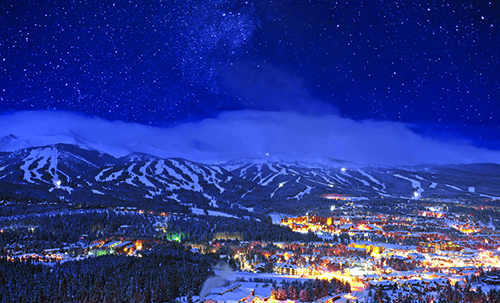
Wolf Creek Ski Area: October 29, 2022
Loveland: October 29, 2022
Aspen Snowmass: November 10, 2022
Breckenridge: November 11, 2022
Vail: November 11, 2022
Winter Park: November 17, 2022
Eldora Mountain Resort: November 18, 2022
Purgatory: November 20, 2022
Copper Mountain: November 21, 2022
Beaver Creek: November 23, 2022
Crested Butte Mountain Resort: November 23, 2022
Aspen Mountain: November 24, 2022
Telluride: November 24, 2022
Steamboat: November 26, 2022
Powderhorn: December 03, 2022
Ski Granby Ranch: December 9, 2022
Aspen Highlands: December 10, 2022
Cooper: December 10, 2022
Monarch Mountain: December 10, 2022
Howelsen Hill: December 10, 2022
Echo Mountain: December 10, 2022
Buttermilk: December 17, 2022
Sunlight Mountain Resort: December 17, 2022
Silverton Mountain: December 24, 2022
*all dates are subject to change based on weather conditions.
Source: https://www.onthesnow.com/colorado/projected-openings
by Jessica Hughes | Sep 28, 2022 | Travel
by Jessica Hughes
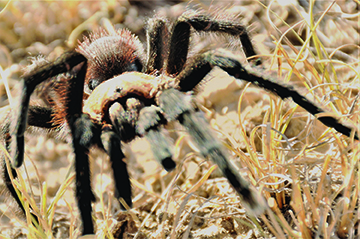
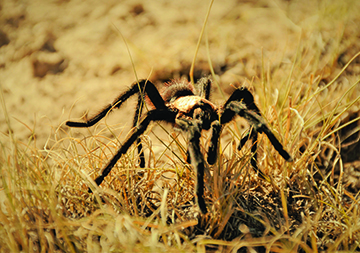
Up close, tarantulas seem larger than life reaching up to two inches in length.
This autumn, while many will head out west to see the state’s fall foliage, take the time to travel east for a change of scenery to see the Tarantula Trek. Beginning in September and through the month of October, many tarantulas scurry across the southeast portion of Colorado’s Eastern Plains near La Junta.
While there are numerous species of tarantulas, the Oklahoma Brown Tarantula is the one you are most likely to spot. This dark brown to black species is common here because its females prefer to make their burrows in the plentiful quiet prairies on the Comanche National Grasslands of Southeast Colorado.
While this phenomenon has always been called a migration, it is actually an annual mating ritual performed by male tarantulas. “We have traditionally called it a migration,” says Pamela Denahy, the director of tourism for the city of La Junta. “We are currently in the process of re-branding to call it the Tarantula Trek.”
The Comanche National Grassland creates the perfect habitat for mating tarantulas. Visit La Junta photos
The process for seeking out a mate begins when male tarantulas reach maturity at the age of eight to 10 years old. Prior to this, the males have not left the grasslands at all, until they reach mating age. During mating season, you are likely to spot one at a time, but you may be lucky enough to see a group of these males using their sense of touch and vibration to locate the females.
The tarantula can grow up to two inches in length with a leg span of up to five inches.
They can travel as far as 20 miles and oftentimes are in groups searching for a mature female. Males who have reached sexual maturity will travel up to a mile to find a mate, and once he finds one, he’ll perform a courtship dance. Certain body language cues and rituals are used for mating. One of these is “drumming” or “tapping,” which a tarantula may use to indicate interest in a potential partner.
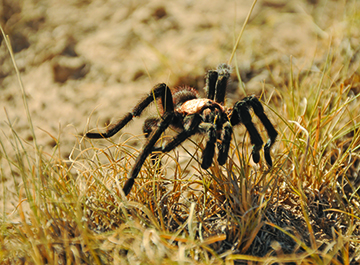
A male tarantula treks through Vogel Canyon near La Junta.
Using the 443,000-plus acres of the Comanche National Grassland, the male tarantulas roam far and wide looking for their mates. But there are certain areas accessible to visitors for easy viewing. Popular places include Vogel Canyon (15 miles from La Junta), Sierra Vista & Timpas Picnic Area (about 20 miles from La Junta along Hwy. 350), and Delhi (36 miles from La Junta on Hwy. 350).
A short drive from La Junta, Vogel Canyon is the most popular destination for viewing the tarantulas because of its accessibility. Plus, it has something for everyone — with four hiking trails that take you to the mesa top or canyon floor, plus quiet picnic areas, making this an ideal day trip for visitors.
Denahy says a great driving route to consider is La Junta to Timpas (on Hwy. 350), east on County Road N, south on County Road 25, east on Forest Service Road 2200, north on Hwy. 109 back to La Junta.
The best time for viewing is an hour before dusk during mid-September thru October and even into early November — depending on the weather. September is peak season, starting mid-month. They don’t really like it too hot, and they don’t like to be out after the first freeze.
But the common question everyone asks Denahy says is “is it safe?” “Yes, it is safe to view them. Tarantulas are much more terrified of you than you are of them. Despite common misconceptions, they are not aggressive. In fact, they are more likely to flee from a larger-than-life human being,” assures Denahy.
Join the city of La Junta for the Tarantula Festival, October 7 & 8, 2022, with fun activities and educational facets for the entire family to enjoy.
Contact the Comanche National Grassland Resource Office for additional ideal viewing locations in and around La Junta at 719-384-2181 or info@visitlajunta.net for additional information.
by Jessica Hughes | Aug 26, 2022 | Main Articles
by Jessica Hughes
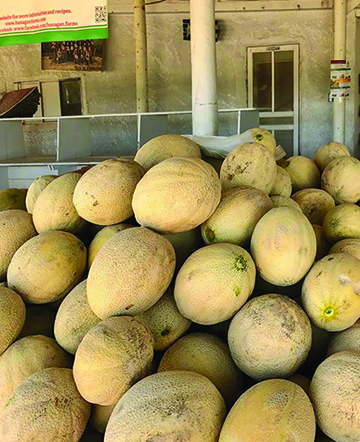
Rocky Ford Cantaloupes are famous for their sweet and flavorful taste.
The famous Rocky Ford melons have hit the shelves at big box grocery stores and local farmers markets across Colorado and this season is one of the sweetest yet. This season’s crop yielded some of the sweetest melons in years, particularly the cantaloupe.
Rocky Ford, Colo., lies in the Lower Arkansas River Valley, about an hour east of Pueblo. It is famous for producing some of the best cantaloupe, watermelon, and honeydew melons in the state and the world. The area is well-known for its melons due to its ideal climate, which includes large temperature swings — from hot and dry during the day, to much cooler evenings (which helps stimulate the sugars in the melon), the ideal soil composition, and right elevation.
“In my opinion, we produce the world’s best cantaloupe. The sweetest tasting and most flavorful,” says Eric Hanagan, owner of Hanagan Farms.
In fact, the region is so coveted that Rocky Ford Cantaloupes are trademarked. Just like how wine can’t be called Champagne if is produced outside the Champagne region of France, there is a defined area of where Rocky Ford melons can be grown and labeled as “Rocky Ford melons.”
Eric Hanagan, his wife, their children, and workers, who have been with them for nearly 30 years, run Hanagan Farms in Swink, just a few minutes east of Rocky Ford. The Centennial farm has been in business for generations growing produce in the Arkansas Valley for nearly 115 years. While their mainstay is now Rocky Ford cantaloupe, melons, and watermelons, they also produce vegetables such as peppers, pumpkins, and tomatoes.
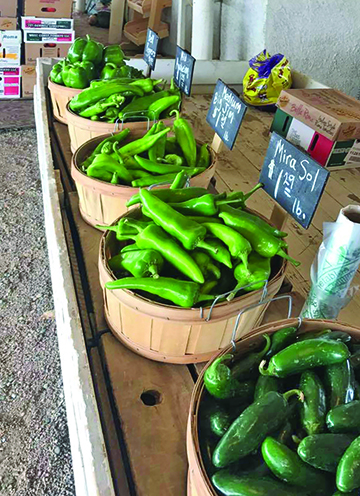
Hanagan Farms produces other plentiful crops such as peppers.
“We have diversified over the years,” says Hanagan. “As the industry changes, so do we. In agriculture, if you aren’t changing, you are dying,” Hanagan expresses. For example, the introduction of drip irrigation technology at his farm has yielded high-producing crops over the years and helped to save 70% of their irrigation water usage. In fact, all his melons are raised on drip irrigation.
Despite a near 20-year drought the eastern plains and a lot of the country is experiencing, this doesn’t affect their melon crop much. “We don’t really need a lot of rain. In fact, we like it hot and dry but we need adequate snowfall in the winter so we can irrigate with mountain run-off from the Arkansas River,” says Hanagan. No hail is nice too!
So, where can you buy Rocky Ford melons? While some, like Hanagan Farms, sell mostly retail, direct to consumer at their farm, a good portion are packed and shipped by Hirakata Farms to grocery stores like King Soopers.
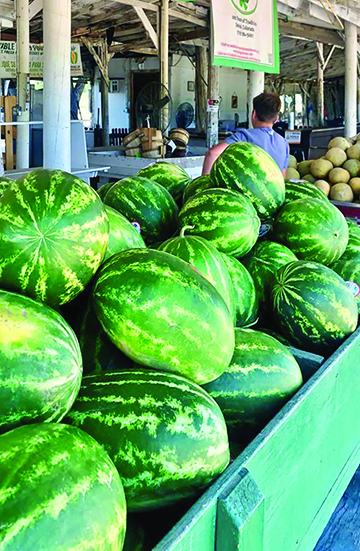
Watermelons are another popular crop grown in the Arkansas Valley.
Hanagan also suggests getting to know your farmer by visiting local farmers markets. “When you get to know your farmer, you get to know your food,” says Hanagan. “We wouldn’t sell anything we wouldn’t serve to our own family.” There are several farmers markets in the Rocky Ford region in which to buy fresh melons, along with plenty of roadside stands where the farmers are selling directly to their customers.
Despite the fact there are only five or six farmers that actually grow melons in the region, albeit very large farms, the future looks bright with generational possibilities on the horizon to keep the farms going. “We are still cranking out more melons than ever,” says Hanagan.
To learn more about Rocky Ford melons and harvest season visit rocky-ford-grow ers-association.mandccommunications.com. And to stay updated with happenings at Hanagan Farms, follow them on Facebook @hanaganfarm
All images are provided by Hanagan Farms via Hanagan Farms Facebook