
Bull & Bush


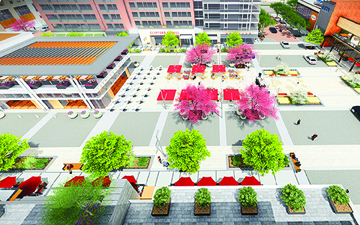
Developments Blurred By Ownership Changes; New Mall Encounter: 300 Small Shops Opening
by Glen Richardson
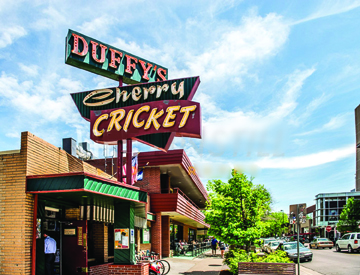
Chopped Hamburger: Unico Properties has acquired four-properties on the north side of 2nd Ave. including the Cherry Cricket restaurant building. With a long-term lease the popular eatery isn’t expected to be touched. Major changes are expected for two buildings along Clayton St.
Don’t look for that deluge of cranes and construction zones symbolizing the changing face of Cherry Creek to vanish anytime soon. Why? The entire west end of Cherry Creek North — including the Cherry Creek Shopping Center’s western portion — is getting set to undergo sudden and unforeseen adjustments and revision.
The changing ownership of properties, moreover, is making the entire equation increasingly complicated. Consider these twist and turns: Brookfield Asset Management just closed on its acquisition of OliverMcMillan, the redeveloper of the Clayton Lane development anchored by Whole Foods Market and Crate & Barrel. Moreover, of course, Amazon purchased Whole Foods since OliverMcMillan acquired the property.
Another company, Unico Properties, has simultaneously acquired a four-property portfolio on the north side of 2nd Ave. from Clayton St. to the corner at Columbine where The Thirsty Lion is located. The Cherry Creek Inn — the hotel located next to the cluster of properties Unico recently purchased and is considering shaking up — could also be in for a dramatic jolt. Although BMC Investments — the firm behind the Halcyon and Moxy Hotel plus a half-dozen mixed-use projects in the district —has submitted a concept plan for the Cherry Creek Inn to the city they could easily change before actual work begins next year.
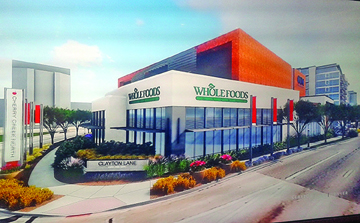
Whole Lot Of Change: Original plans called for Whole Foods Market to be relocated to the southwest corner of 1st Ave. and University. Now both Whole Foods Market and the redeveloper of Clayton Lane have changed owners.
It seems just as likely as not that CEO Matt Joblon will hatch a plan to bring the Unico properties into play for a much bigger development on the west side of Clayton, to include the floral shop and tailor.
Clayton Lane Confusion
Readers will recall that San Diego-based OliverMcMillan bought the retail portion of the six-building Clayton Lane development, located along East 1st and 2nd Ave. between Josephine and Detroit in 2016. They planned to redevelop the site into a mixed-use community, incorporating apartments above a shopping and dining experience.
The former Sears building, currently sitting vacant, was to be demolished and replaced with a pedestrian-friendly street running throughout the project, connecting the various uses, retailers and dining destinations. The Whole Foods Market was to be relocated to the southwest corner of 1st Ave. & University.
Out of the blue Calgary-based Brookfield Residential Properties Inc. has closed on its acquisition of OliverMcMillan. In a prepared statement about the amalgamation of the two companies as this issue of the Chronicle went to press, Denver’s Clayton Lane wasn’t talked about despite considerable dialogue about properties in Houston, Atlanta, and Nashville. According to the release, “OliverMcMillan will continue to design and build mixed-use development and will continue to manage its existing real estate assets.”
Change At The Mall
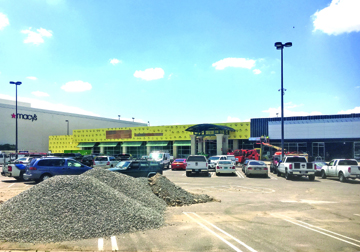
East End Construction: Construction work is nearing completion on the east end of the Cherry Creek Shopping Center along both 1st Ave. and Steele St. where Safeway and Rite Aid were previously located. Macy’s Furniture Gallery and the Container Store are being relocated from the west end of the mall.
On the south side of 1st Ave. change is also beginning to shroud the Cherry Creek Shopping Center. Renovation work is currently nearing completion on the east end of the mall where Safeway and Rite Aid were previously located. Macy’s Furniture Gallery and The Container Store are being relocated at this juncture from the west end where they are currently the two largest tenants subsequent to the move by Bed Bath & Beyond to Glendale last November.
International shopping center experts suggest that the future of the Cherry Creek Shopping Center hinges on one key factor: it has always been Denver’s top tourist attraction. Therefore they reason local mall management and Taubman will turn it to an advantage by creating a destination center offering shoppers and visitors a comprehensive Rocky Mountain travel-shopping adventure.
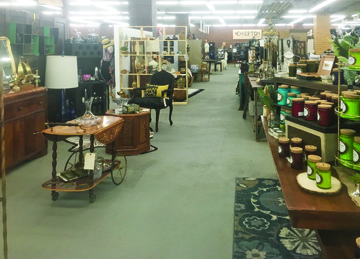
Shopping Showcase: Shoppers this month can browse two floors and 62,000 sq. ft. of independent shops. The Shopping District with 300 small shops has opened on the west end of the Cherry Creek Shopping Center.
Anchor tenants that drive traffic will still be a marketing key, but new emphasis will be placed on a mix of smaller stores that add a sense of novelty to the mall offering. This is expected to be especially critical in Cherry Creek because developers are driving most of the small, independent retailers out of the 16-block shopping district on the north. Additionally, consideration may be given to making greater use of temporary, flexible spaces that can accommodate different stores over time. Pop-up stores, showroom spaces and kiosks provide customers with a sense of the unexpected and give them a reason to treasure hunt.
Small Shops Go Big
They would be right: This month 300 local makers and small businesses are joining together to create a new kind of shopping experience in the Cherry Creek Valley. Opening in the old Bed Bath & Beyond space on the west side of the mall, the group’s goal is to provide local vendors a place to showcase. The new concept combines the best of the popular pop-up marketplaces; free standing boutique shops, and street markets in one place and open every day.
It is a local merchant movement that runs counter to today’s mega-store closures. A place where people can browse two floors and 62,000 sq. ft. of small independent shops and buy unique products direct from local makers, artisans, and small shop owners. The difference: Shopping offering new discoveries, exciting finds, and huge depth of local talent around every corner.
The space is divided into seven shopping districts: A Vintage District selling repurposed and up-cycled vintage finds including new and upscale furniture and décor; The Boutique District: Shops offering the latest in fashion, accessories and jewelry; A Spa District: Selling a selection of locally sourced, locally made or make it yourself spa products. Plus there’s a section known as The Little’s District where kid entrepreneurships offer product
Clayton Lane At Crossroads: Canada’s Brookfield Asset Management has just acquired San Diego’s OliverMcMillan, the redeveloper of Cherry Creek’s Clayton Lane. The redevelopment plans pictured are now in doubt.
s for the little ones.
Also shoppers will discover a Gentlemen’s District: Products for guys ranging from candles and beard oils, to leather wallets and lamps; A Food District offers locally sourced and made culinary treats from sauces and salt to meats plus grab and go beverages and snacks. Finally there’s a Beer, Wine & Spirits area selling local craft beer, wine and spirits. The new space also has a lounge, barber, photographer and licensed chiropractor. Information: 720-641-6648.
Huge Tax Hike Crushing Dreams Of Small Business Owners
by Glen Richardson

Art Activist: Paula Colette Conley, Owner and Director of Arts at Denver on Old South Gaylord, is looking for the easiest expenses to cut so she can stay in business.
Socked with huge tax hikes this summer, uncertainty is swirling among neighborhood business owners, many concerned they may not be able to afford their increased tax bill plus rising rents. Additionally, community advocates worry the hikes will increasingly destabilize many of the Valley’s established neighborhoods.
The median projected commercial property value increase in Denver is 20% as the residential property tax rate has been reduced under the Gallagher amendment to 7.2% for the property tax years 2017 and 2018. Commercial property taxes, unlike those for most residential properties, are passed on to tenants. When commercial buildings are sold for big profits as in Denver, property taxes increase. Plus a substantial bump in the value of one property can raise the cost of business for a company occupying another building — even if it’s across town.
The bottom line: while the average commercial property value shot up 20%, many individual property assessments plus increased rents are doubling, tripling, or quadrupling. That’s encouraging many business owners to unload properties, adding to the already ferocious upward price spiral.
Growing Tax Gap
Taxes on commercial spaces are from four to 10 times higher than residential. In Cherry Creek, for example, the owner of a $2.5 milli

Crafting Change: Dramatic property tax increase is among reasons Show of Hands Gallery is moving after 18 years in its current location, Owners Katie Friedland and Mandy Moscatelli firmly believe keeping gallery in Cherry Creek is vital to their success and are relocating later this month.
on home pays about $3,500 in taxes. The tax bill for a small one-story commercial building in the district is more than $33,000. That’s an enormous difference.
Most Denver leases stipulate that the landlord will pay the taxes and then bill the tenants for the expense. Usually the monthly rent bill includes base rent plus an estimated amount for taxes. Once the landlord receives the tax bill for the previous year, they reconcile it and either refund or collect the difference between the estimate and actual taxes due. In recent years, values and taxes have been going up so fast that there are never refunds, but only more taxes due.
Colorado properties are reassessed every odd year based on the prior two years sales. The last couple of years have seen huge appreciation gains throughout the Valley. Those gains are now flowing through as the latest assessed values. These increases are massive for a small business already facing the challenge of rent, red tape, parking and online competition.
Impact On Gaylord
On Old South Gaylord — the second ol

Cost Composition: Arts at Denver — ranked second among 93 Denver galleries — has seen cost of retail space increase 48% this year; 22% due to property tax increase plus a 26% jump in the rent.
dest shopping district in Denver — retail on the street is being replaced with home desig
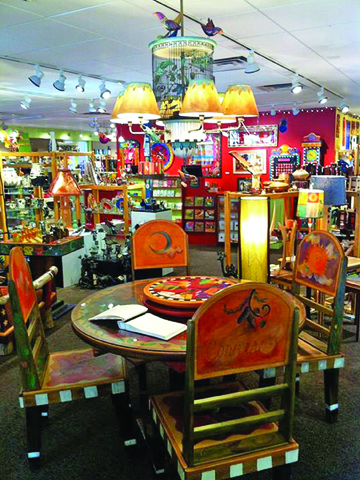
Cozy Craft: Show of Hands will display one-of-a-kind art, unique gifts and handmade art in a smaller store beginning mid-July. Craft shop is relocating to mixed-use retail space between 2nd and 3rd Ave. at 250 Columbine St.
n, financial services and other monetarily productive businesses. Moreover, spaces along the street are turning over far more frequently.
Arts at Denver — ranked second among 93 art galleries in Denver last year — is one of the street’s most popular retail shops. The gallery exhibits only original paintings, specializing in representational work in impressionist, traditional and contemporary styles. Art lovers will find landscape, still life, animals and figurative works. Most of the permanent gallery artists are established painters with strong show, award and collector biographies.
Paula Colette Conley, Owner and Director of the Gallery, tells the Chronicle rent for her space has increased 48%; 22% of that increase is from the property tax plus a 26% jump in rent. Since she moved into the space nine years ago her rent has increased 105%. To cut costs and stay in business she is looking for the easiest expenses to cut.
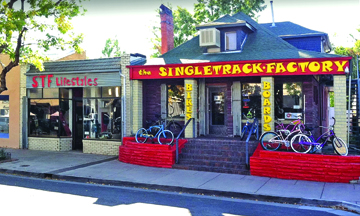
Bulldozing Building: The new owner of this Old South Gaylord bike shop wants to bulldoze the building and build a two-story corporate headquarters for financial firm in this favorite Wash Park neighborhood.
“I ended my window washing service plus a few others like trash service. I’ve also eliminated or decreased some of my favored customer discounts. Plus, I also decreased my only employee’s hours a bit.” She notes, however, that Ray Lucero and his son Daniel who have been taking care of her windows since she opened are still cleaning them as a thank you for having employed them for so many years. “They are great guys she says,” and recommends them for anyone needing a window washing service.
Business Takeover?
Just as the historic district lures shoppers, the casual neighborhood where employees can take walks, find parking, have coffee and lunch is attracting businesses. That lure already has one Cherry Creek-based financial firm seeking to put down roots on Old South Gaylord’s historic street.
The new owner of a former bike shop along Old South Gaylord — near the corner of Gaylord and Tennessee — wants to bulldoze the historic building and build a new two-story structure. Martorello Holdings LLC paid $1.4 million for the lot that bike shop owner Brian Isakson paid $400,000 for in 1999.
The LLC is registered to Raphael Martorello, managing partner at LotusGroup Advisors, a Cherry Creek financial firm. According to a Lotus web post, “We are in the midst of building a new HQ in the heart of Denver’s favorite neighborhood. There will be an open floor plan, energy efficient construction, many spaces for collaboration, and improved parking over Cherry Creek. We plan to open our new doors in Q2/2019.”
Crunch In Creek
In the Cherry Creek North shopping district, Show of Hands Gallery is downsizing and relocating this month after 18 years in its current location. Why? Because they can no longer afford the space they are in.
“After six years of endless construction, a down sales market, and a dramatic increase in property taxes, which gets passed onto us, we can no longer afford to remain in the space we are in,” owners Katie Friedland and Mandy Moscatelli announced on their website.
Like most locally owned businesses, Show of Hands isn’t just a store; it’s a fun place where shoppers can find that unique gift or card for someone special. The products are not mass-produced, shipped from overseas, or the same item you see in every other store. Instead, items sold are made by Valley artists as well as craftsmen from across the USA. Mid-July the store is moving from the 6,384-sq.-ft. space at 210 Clayton St. to a cozy but much smaller 1300-sq.-ft. location at 250 Columbine, Suite 145.
Concerns Bubbling Up
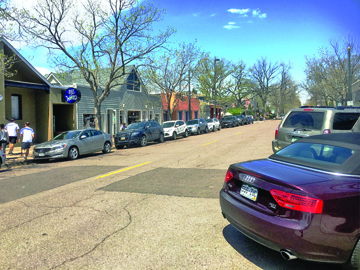
Changing Landscape: Property tax boost is altering Valley neighborhoods. Along Old South Gaylord — the second oldest shopping district in Denver — spaces are turning over frequently and retail is being replaced by financially productive businesses.
In localities such as Congress Park, Capitol Hill, Cherry Creek, the Golden Triangle, Wash Park and so many more, concerns are bubbling up. Shoppers in these popular areas prize their walkability. They enjoy having easy access to a variety of restaurants, services and shops, especially those that are unique and locally owned. Many if not most of these smaller ventures likely cannot survive faced with higher and higher property tax rates plus rising rents.
When property taxes go up, homeowners can find other homeowners willing to fight for relief. Big businesses, too, can flex their muscles. But small businesses are often left behind, mainly because they are, well, small.
Neighborhood advocates offer this word of warning: “This tax increase will affect all property owners and their tenants and drastically alter neighborhoods where many owners are unable to absorb the huge increase in cost. This will lead to large transitions of neighborhoods throughout the metro area.”