by Mark Smiley | Jun 20, 2024 | Main Articles
by Mark Smiley

Connecting: Two Pals & A Pup has had good traffic during the first month of the Glendale Farmers Market. They have also made good connections with other vendors. Visit www.twopalsandapup.com for more information.
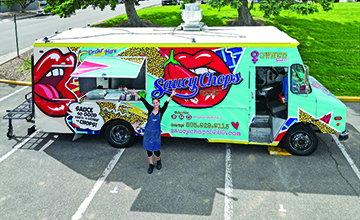
Saucy: Saucy Chops Food Truck is a Colorado born Food Truck that provides everyone’s classic favorites such as a chicken parmesan sandwich doused with scratch made sauces. Visit www.saucychops5280.com for more information.
Inaugural Year: The new Glendale Farmers Market has attracted a crowd of enthusiasts each weekend and it will run every Saturday through August 31, 2024.
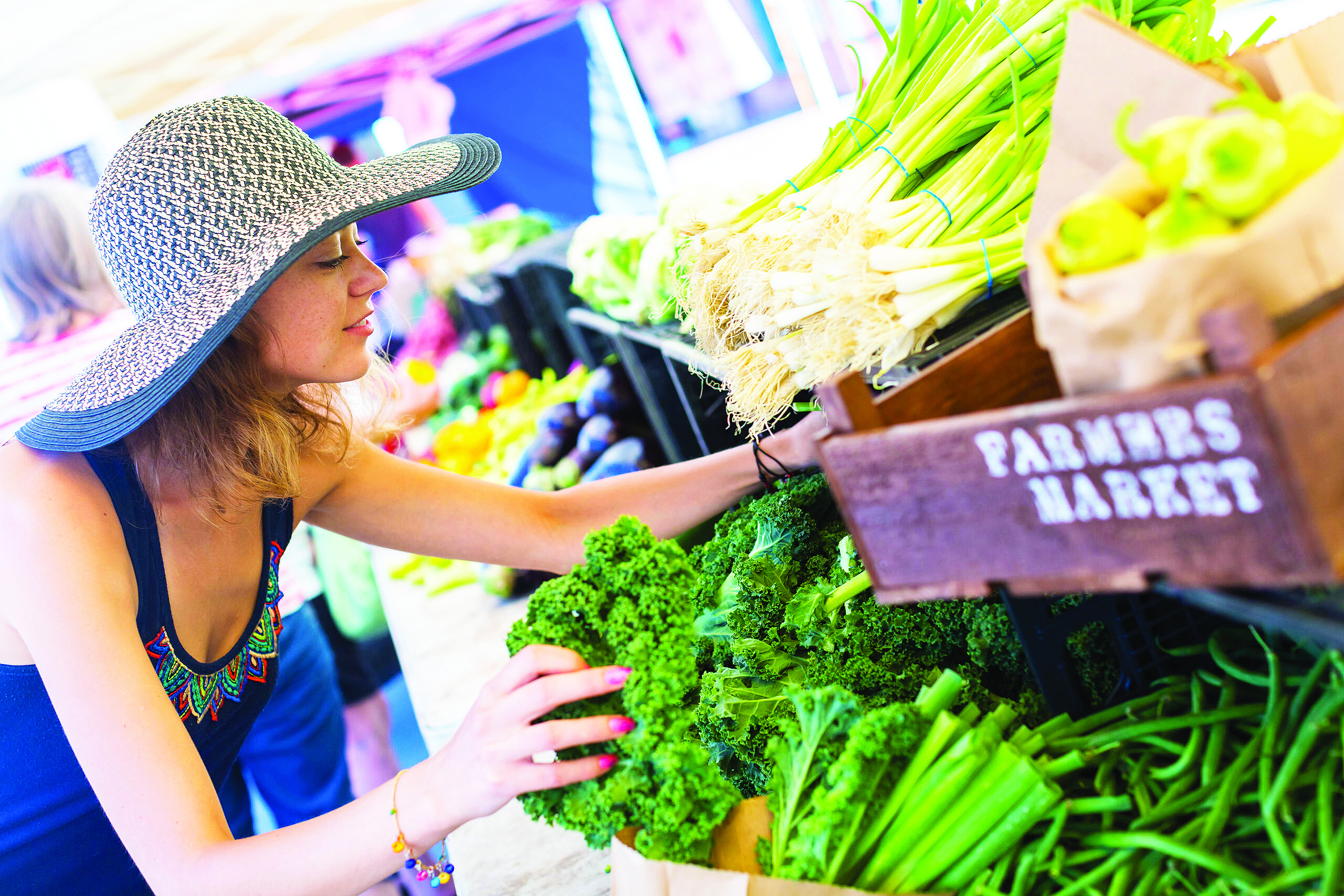
The Hispanic Restaurant Association, in cooperation with the City of Glendale and the Greater Glendale Chamber of Commerce, started a farmers market in Glendale and the first month was a huge hit.
The farmers market is located at 4601 E. Kentucky Avenue in Glendale (the P1 parking lot near Infinity Park). It runs every Saturday through August 31 from 8 a.m. to 1 p.m. The market is touted as an experiential farmers market, catered by the Hispanic Restaurant Association’s own chefs and different from the usual farmers markets around the area.
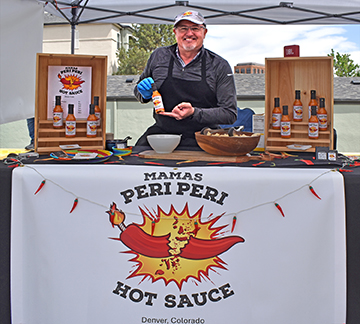
Hot Sauce: Mamas Peri Peri Hot Sauce is one of the vendors at the Glendale Farmers Market each Saturday. The sauce is an ancient family recipe carefully blended in a time-honored tradition of Portuguese culinary excellence. Learn more at www.mamasperiperi.com.
“The Glendale Farmers Market is fabulous,” said Kim Umbarger, Glendale City Councilmember. “It has a lot of variety. I am a farmers market enthusiast so I was expecting it to be tiny. But it had all the things. You have all of the really good produce, fruits, and there were games for my kids which I was not expecting. And there was music. I didn’t realize but the hill is shaded so you can sit on the grass and eat your snacks. I highly recommend it. It is a great market.”
The Glendale Farmers Market features multiple chef demonstrations, a Taylor Swift booth for the kids to dance, plenty of locally sourced sauces, vegetables, and more. The vendors are also pleased with the Saturday market. “We are pleased to be part of this farmers market in its inaugural year,” said Stacey Bennett, co-owner of Two Pals & A Pup. “We have had good traffic at our booth each weekend and we are appreciative for the opportunity the Glendale Chamber and the Hispanic Restaurant Association provided us. We look forward to the rest of the summer.”
Since USDA’s Agricultural Marketing Service began tracking farmers’ markets in 1994, the number of markets in the United States has grown to 8,720, an increase of about 7.07 percent from 2013. Total annual sales at U.S. farmers’ markets are estimated at $1 billion. On an average market day, 916 households shopped across markets in the U.S. and spent $14,547 per farmers market. The Hispanic Restaurant Association is well positioned to make the Glendale Farmers Market one of the most popular and unique in the Cherry Creek Valley.
Visit www.glendalefarmersmarket.com for more information and to explore the vendors lined up for the summer.
by Mark Smiley | Jun 20, 2024 | General Featured
by Mark Smiley
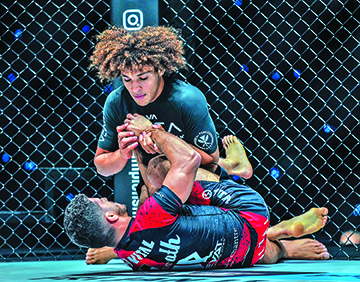
Kade Ruotolo defends his title against fellow American Mikey Musumeci in ONE 160 at Ball Arena on September 6, 2024.
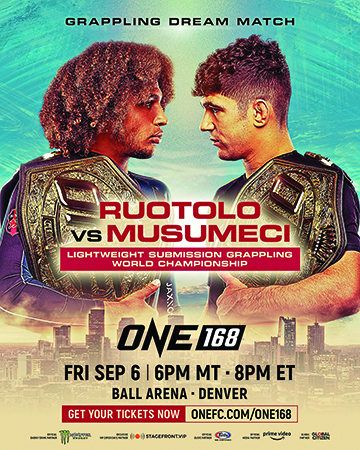 ONE Championship is the world’s largest martial arts organization, ranking among the world’s top five sports properties for viewership with a cumulative reach of over 400 million fans, according to Nielsen. ONE produces and distributes events across more than 190 countries, featuring martial artists and World Champions from over 80 nations and all styles of martial arts including MMA, Muay Thai, kickboxing, Brazilian Jiu-Jitsu, and more. ONE can be viewed on many of the largest global free-to-air and digital broadcasters, including Prime Video, Sky Sports, and many others.
Cherry Creek Valley residents can see these athletes compete at Ball Arena on September 6, 2024. ONE 168 will feature many contests in an atmosphere compared to a rock concert.
“We were here [1stBank Center] last May for our first event in the U.S.,” said Rich Franklin, ONE Vice President. “We had such a great event with a sold out crowd and a great reception from the fans, that we decided to return and do two events in the U.S. Denver and Atlanta.”
Franklin became the UFC Middleweight World Champion in 2005 and was inducted into the UFC Hall of Fame. He became ONE Vice President in 2014, supporting key strategic initiatives for the company.
Some of the key matchups on September 6 include: Mikey Musumeci vs. Kade Ruotolo, and Liam Harrison vs. Seksan. Added to Fight Card, Joining Stamp vs. Xiong Jing Nan, and Jonathan Haggerty vs. Superlek. “I’m excited for this one [Haggerty vs. Superlek],” said Franklin. “Superlek is called the kicking machine. And Jonathan Haggerty is known for his elbows. He can close distance with an elbow like most people could with a long kicking leg. This is going to be a fun one to watch.”
In addition, two contests have been added to the stacked ONE 168 fight card. First, two of the top pound-for-pound grapplers on the planet will collide when ONE Lightweight Submission Grappling World Champion Kade Ruotolo defends his title against fellow American Mikey Musumeci in a must-see matchup. “We do a really good job matching up our submission grappling matches,” said Franklin. “Typically they are really fast paced. I expect this one to be really exciting.”
As the reigning ONE Flyweight Submission Grappling World Champion, Musumeci is looking to become the first two-division submission grappling titleholder in ONE history.
In addition, striking icon Liam Harrison of the United Kingdom will face Thai fan favorite Seksan Or Kwanmuang in a 140-pound catchweight Muay Thai bout. “Seksan is legendary in Tailand,” said Franklin. “His name in Tai translates to the man who yields to no one.”
ONE 168: Denver will also feature ONE Women’s Atomweight MMA World Champion Stamp Fairtex, who will attempt to become a two-division titleholder when she challenges Xiong Jing Nan of China for the ONE Women’s Strawweight MMA World Title. And in a battle between two of the greatest strikers, reigning two-sport ONE World Champion Jonathan Haggerty of the United Kingdom will put his ONE Bantamweight Muay Thai World Title on the line against current ONE Flyweight Kickboxing World Champion Superlek Kiatmoo9.
Stage Front VIP, the exclusive U.S. VIP experience partner of ONE, will continue to provide fans with access through immersive VIP experiences that include premier seating, premium hospitality offerings, athlete meet-and-greets, event collectibles, and more. You can sign up for more information on Stage Front’s VIP packages at stagefrontvip.com/one-denver.
Amazon Prime members can watch these matches live monthly and all 167 matches are archived for those who want to become more familiar with the sport. To learn more or to purchase tickets, visit www.onefc.com/events/one168.

by Valley Gadfly | Jun 20, 2024 | Valley Gadfly
July is a hot date to sing songs hailing the Land of the Free, as we embrace freedom on America’s birthday, July 4, 1776. Fireworks will roar across the sky like the thunder in July.
It’s summertime and the weather’s hot, but at least there’s no snow. With its days of blue skies and time that seemingly stands still, we’re in a spell that connects us to good times.
To help you seize summer, here are our spirited choices for shopping, dining, and entertainment, to get you rockin’ into July’s festivals, parades, fireworks, and barbecues:
For a fabulous summer stroll with the family, head to Cherry Creek North for the juried Cherry Creek Arts Festival, July 5-7. District streets will be filled with art, plus food & entertainment, starting at 10 a.m. Information: 303-355-2787.
Enjoy an evening of music under the stars as the Colorado Symphony plays Mozart at McGregor Square July 10, 7 p.m. Information: 303-623-7876.
For French fun featuring artists, shopping, and cuisine, go to Bastille Day at Cherry Creek’s Fillmore Plaza July 12-14, 4-9 pm. Information: 720-447-7961.
Swallow Hill’s Four Mile Park summer concerts end with Sugar Britches tribute to songwriter John Prine July 10. Then Shakedown Street salutes Grateful Dead Band’s eclectic style July 17, 6:30 p.m. Information: swallowhillmusic.com.
Get barbeque for the 4th, and year around at AJ’s Pit Bar-B-Q, given the “Bib Gourmand” title for high quality at a good price. Unfussy S. Delaware St. dine-in or take out spot is 29th on Yelps Top 100 BBQ list. Information: 720-851-5571.
Jazz-soul vocalist Tatiana Mayfield sings music of Aretha Franklin, other jazz-soul artists at the Arvada Center July 15, 7:30 p.m. Information: 720-898-7200.
Cherry Creek North retailers, restaurants, art galleries, fitness studios, and more offer markdowns at Sidewalk Sale, July 18-23. Information: 303-394-2904.
It will make you laugh, cry, and think, so take the family to see the musical Wicked playing at the Buell Theatre, July 24-25. Information: 720-865-4220.
See art, plus multiple stages of performers at the Global Dance Festival in the Stockyards Event Center, July 26-27, 5 p.m.-1 a.m. Information: 720-707-0670.
View the work by 150 artists and craftsmen displaying their work at the Cheesman Park Art Fest, July 27-28, 9 a.m.-5 p.m. Information: 505-373-7363.
Rumble, reel, rave, and party at the Roaring ’20s Gala July 13-14 to help a local non-profit working to create change. Dress in Roaring ’20s attire for dinner, live auction, and dancing followed by Casino Night at the Hyatt Regency Convention Center, beginning at 6 p.m. and lasting until midnight July 14. You’ll be helping Hope Connection & Community give a helping hand to fulfill hopes, dreams, and goals of families and children in need. Information: 303-386-6232.
Named after Julius Caesar, July marks the midway point of the year. For the big party on the fourth, America consumes around 150 million hot dogs to celebrate our independence.
As we March into July to a John Philip Sousa tune, the Dave Matthews Band’s hit song “American Baby” gives us a source of optimism and hope, even when times are tough.
Kaboom: Watch Glendale’s jaw-dropping fireworks — considered the Valley’s premier display — July 2. What will lightning say to annual fireworks? “You stole my thunder!”
— Glen Richardson
The Valley Gadfly can be reached at newspaper@glendalecherrycreek.com.
by Ashe in America | Jun 20, 2024 | Feature Story Bottom Left
 The primary is happening now, so be sure to get out and vote. so is the race for petition signatures. Election season is in full swing, and it’s not just candidates and campaigns fighting for your support in November. It includes many lobbies and their ballot initiatives as well.
It’s rumored that the November 5 ballot is going to be as thick as a book, with an overwhelming number of issues coming before Centennial State voters. Ballot initiatives can hit the ballot one of two ways: The People or the General Assembly.
The People
If the people craft an amendment, get it through the Title Board, and gather enough signatures, then their initiative will be included on the ballot.
Two such populist ballot initiatives have already qualified, with many still in the signature gathering stage.
- Abortion Access and Funding (Constitutional Amendment): Amends the state’s constitution to enshrine abortion into law and removes a constitutional ban that prevents state money from going to abortion services. Because this measure is adding text to the constitution, it will need at least 55% to pass.
- Property Tax Cap: A proposed cap on property taxes that kicks in whenever property tax revenues are expected to grow faster than 4% per year for the entire state. Critics of the cap are concerned about inequities as property tax rates vary from city to city and county to county.
Many other groups are still gathering signatures for a wide range of initiatives. For example, there are three proposed Constitutional Amendments focused on preserving caucus and banning ranked choice voting and jungle primaries. Learn more at ColoradoCounts.com, and be sure to sign the petitions so that Colorado voters can decide how we want our elections administered — rather than billionaire special interests.
The Legislature
In addition to the people’s initiatives, there are also seven referred by lawmakers during the last legislative session, which are summarized here below from CPR reporting and the Bill Text on the Colorado General Assembly website.
- Changes to Election Deadlines (Constitutional Amendment): This constitutional amendment, requiring 55% to pass, designates earlier deadlines for various election activities to give the Secretary of State and county clerks more time to finalize the ballots. There are tradeoffs, including that the People will now have less time to collect signatures.
- Removing the Same-Sex Marriage Ban (Constitutional Amendment): The initiative would strike a portion of the state constitution that reads: “Only a union of one man and one woman shall be valid or recognized as a marriage in this state.” Because the measure removes, rather than adds, to the state constitution, it only needs a simple majority of voter support.
- No Bail for First Degree Murder Defendants (Constitutional Amendment): Requiring 55% to pass, this constitutional amendment would make first-degree murder suspects ineligible for bail. This change stems from an unintended consequence of Colorado’s repeal of the death penalty in 2020, which states that only people charged with “capital offenses” can be denied bail — and first-degree murder no longer meets that criterion.
- New Judicial Discipline Board (Constitutional Amendment): Following a string of judicial scandals, this amendment establishes a new independent judicial discipline board, made up of judges, attorneys and members of the public. Requiring 55% to pass, the referred constitutional measure cleared the legislature nearly unanimously.
- Expanding Veteran Access to Property Tax Exemptions (Constitutional Amendment): Currently, what’s known as the homestead exemption is limited to veterans with a service-related disability rated as 100% permanent. If 55% if voters agree, eligibility will expand to cover around 3,400 more veterans. The constitutional amendment cleared the state legislature unanimously.
- New Tax on Guns & Ammo: A 6.5% excise tax on gun and ammunition sales, to be paid by gun dealers, gun manufacturers, and ammunition vendors (and likely passed through to customers). The money raised by the tax would supposedly fund behavioral health and gun violence prevention.
- TABOR Exemption for Sports Betting: Asks voters to let the Colorado government keep and spend all of the tax revenue it collects from sports betting, originally estimated to yield about $29 million each year. State economists now believe the 10% tax will bring in significantly more than that in coming years, and state officials are addicted to spending.
There will likely be additional measures following the signature deadline in August. Colorado voters need to pay attention this election season and vote their values, or we may have a whole new state constitution soon.
Either way, this year’s ballot is going to be a beast.
Ashe in America is a writer and activist. Find all her work at linktree.com/asheinamerica.