
by Amber Wyatt | Apr 1, 2026 | Editorials
by Amber Wyatt

The cast as Jimmy learns the importance of honesty.
At the Denver Children’s Theatre, whimsy is not simply a stylistic choice, it is a philosophy. This spirit was on full display in the recent production of Pete the Cat, a vibrant, 50-minute musical that blended imagination, mentorship, and community into a singular theatrical experience. Presented under the umbrella of the Mizel Arts and Culture Center, the show exemplifies how youth-focused performance can be both playful and profoundly impactful.
Directed by Matthew Zambrano, Pete the Cat leaned into creative minimalism. In a bold artistic decision, the production featured limited physical props. Many times, actors relied entirely on pantomime, miming instruments, books, and even telephones, inviting young audiences to co-create the world unfolding before them. “Theatre for Young Audiences is some of the bravest
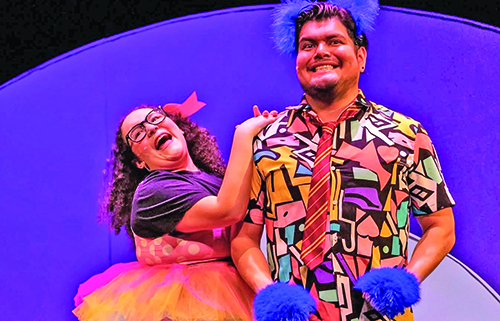
Guzman and Enriquez in one of the show’s final scenes.
work being done,” Zambrano noted, emphasizing that when the goal is to inspire empathy rather than chase reviews, the results can be transformative.
That transformation begins with the performers themselves. Brandon Guzman, who plays Pete in the production, brings both technical precision and heartfelt enthusiasm to the stage. Guzman’s journey into theater began at Florida’s Manatee School for the Arts, where an encouraging teacher first recognized his potential. From portraying Bernardo in West Side Story to earning a BFA in musical theater from the University of Tampa, his path has been marked by dedication and adaptability from the start.
After an early stint in New York was interrupted by the pandemic, Guzman found renewed momentum in Denver. Since arriving in 2025, he has built an impressive résumé, with performances ranging from On Your Feet! at Town Hall Arts Center to Frozen at the Arvada Center. Yet it is his work in Theatre for Young Audiences that seems to resonate most deeply. Having toured bilingual productions across multiple states, Guzman understands the importance of representation. “It allows kids to see themselves in the story,” he shared, underscoring the inclusive power of performance.
Equally compelling is the journey of Izzy Enriquez, who plays Olive, a warm and supportive sibling character in Pete the Cat. A recent graduate of Texas State University, Izzy discovered her passion for theater through a blend of storytelling and visual art. Initially hesitant about the vulnerability required in dramatic acting, she found confidence through musical theater’s structure and discipline.
Her move to Denver marked a turning point. While working as a stagehand at Elitch Gardens, she discovered the audition for Pete the Cat through the Colorado Theatre Guild. For Izzy, Theatre for Young Audiences is more than performance, it is access to profound influence. “It’s about meeting audiences where they are,” she explained, reflecting on the importance of making theater approachable and meaningful for all children. Her portrayal of Olive captures the show’s central themes of belonging and acceptance, offering young viewers a character who embodies kindness and encouragement.
Behind the scenes, the production is part of a larger mission driven by leaders in the community like Tim Campbell. Through his work with the Mizel Arts and Culture Center, Campbell helps bring cultural programming to nearly 100,000 people each year. His vision is rooted in connection: creating spaces where diverse communities can come together through shared artistic experiences.
Entire cast of Pete the Cat at Mizel’s Denver Children’s Theatre.
“Live theatre invites audiences into something communal and alive,” Campbell said. “For children especially, it opens the door to creativity, learning, and confidence.” With programs like Pete the Cat, that door is flung wide open, welcoming first-time theatergoers and seasoned patrons alike to a crash course in performance art.
What makes this production particularly memorable is its ability to balance entertainment with intention. From pre-show activities that encourage children to guess mimed objects, to post-show “encore talks” that demystify lighting and sound design, the experience extends beyond the stage. It becomes educational, interactive, and deeply human.
At its heart, Pete the Cat is a story about friendship, courage, and saying “yes” to new experiences. But in the hands of this talented cast and creative team, it becomes something more: a celebration of imagination and a testament to the enduring power of live performance.
In a city rich with artistic offerings, productions like this remind us that sometimes the most meaningful stories are the simplest ones, told with heart, creativity, and just a touch of whimsy where all generations can meet with a smile.
by Amber Wyatt | Feb 18, 2026 | Editorials
by Amber Wyatt

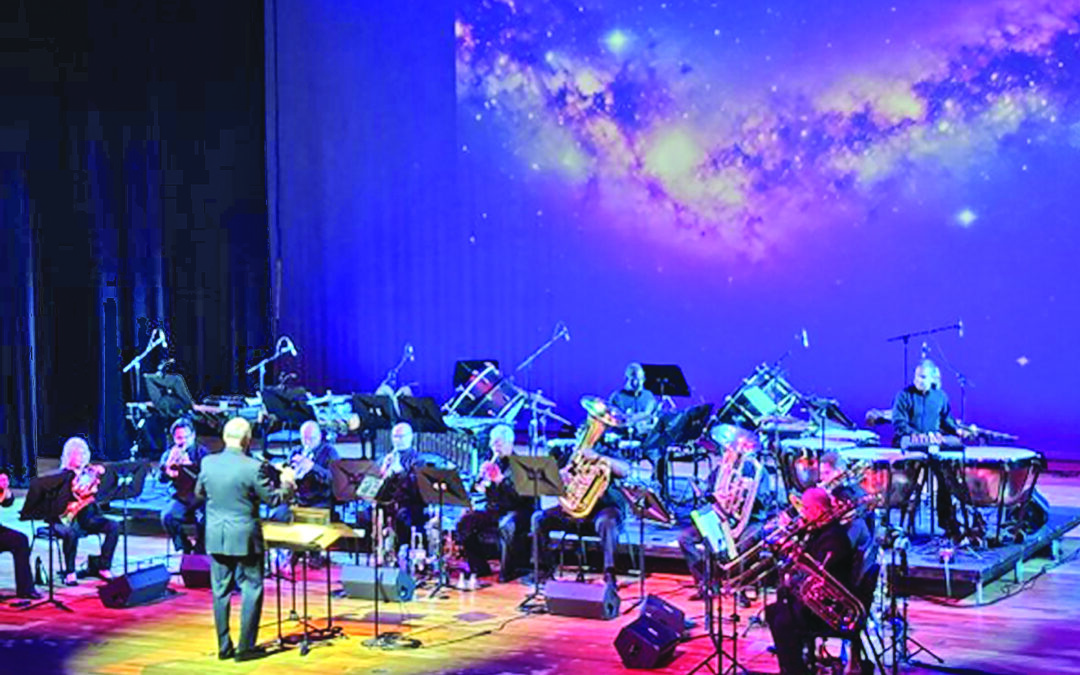
Second from left, Susan McCullough playing French Horn.
By any measure, Rhythms of the Cosmos is not your typical brass concert. Presented by the Denver Brass, the multimedia performance blends bold brass sonorities, percussion, lighting, and cosmic imagery into an immersive experience that feels as much like a journey as it does a concert. For a group celebrating more than four decades of music-making, the show is a striking reminder of why Denver Brass continues to captivate audiences across the Front Range.
Founded in 1981 by Kathy Brantigan and her husband, both tuba players, the ensemble was born from a simple desire to make music together. “We founded Denver Brass because we both played tuba,” Brantigan recalled with a laugh. “We wanted to play together. So we had to multiply out from two tubas, how many trumpets do you need to balance out? How many trombones? How many horns?” That playful curiosity ultimately grew into one of the region’s most distinctive musical organizations.
Brantigan believes the ensemble’s longevity stems from both its sound and its spirit. “Brass players have kind of a unique fraternity,” she said. “We all have similar personalities, and we love the power and the heroic sounds that brass makes. It’s really special to play with all brass, it’s a unique sound.” Far from being one-dimensional, she emphasizes that the ensemble  can move seamlessly from delicate and romantic to bold and triumphant. “I’ve always said goosebumps are guaranteed,” she added. “There are moments at our shows you don’t forget when you go home.”
One of the musicians who has experienced the entire arc of the ensemble’s history is French horn player Susan McCullough, the only remaining original member. “As long as we’ve been in existence, around 45 years,” she said when asked how long she’s played with the group. McCullough describes Denver Brass concerts as constantly evolving. “Everything we do is completely different from the last. One show it’s classical, the next time it’s jazz, then funk. What style is your show? Everything,” she shrugs.
That stylistic freedom is on full display in Rhythms of the Cosmos, which features music inspired by space, time, and motion. Trumpeter and composer Sean Schaffer Hennessey contributed original works to the program, including Guardians of Time. “It’s a tough show,” he admitted. “Brass players get tired, but it went really well.” For Hennessey, the appeal of Denver Brass lies in its emotional breadth. “Each show is kind of a roller coaster through emotion,” he said. “There’s a heart to this group. We take music that’s often orchestral and bring it into a whole different realm.”
The concert’s cohesion owe s much to conductor Warren Deck, former principal tubist of the New York Philharmonic, who joined Denver Brass after moving to Denver in 2002. Deck’s path to conducting was unconventional. “I never conducted anything,” he said. “I just sat in orchestras and watc
 hed my conductors. One day these guys said, ‘Why don’t you conduct?’ and I heard ‘yes’ come out of my mouth.” His approach reflects the ensemble’s adventurous spirit. “You never know what you’re going to get,” Deck said. “That versatility is worth checking out.”
Behind the scenes, Executive Director Becky Wilkins helps shape the show’s narrative arc with Kabin Thomas and Andy Wolfe. “It starts with the theme,” she explained. “For this one, we were talking about rhythm, and we added space.” From there, she works on sequencing the music and layering theatrical elements that curate an experience, lighting, imagery, and sound design, support the audience’s emotional journey. “It’s more than just a concert,” Wilkins said. “It’s a show. You experience all these elements and let the music really sink in, it becomes an almost spiritual event.”
One of the most striking moments features ambient sound recordings from Mars, paired with imagery that evokes isolation and discovery. “The images really took me there,” Wilkins said. “They’re the frosting on the cake, helping convey the story.” Kabin Thomas, narrator of Rhythm of the Cosmos and on-air morning show host and producer at Colorado Public Radio’s Classical station, drives each work to the next, “Space,” Thomas leads, “The final frontier.”
As Denver Brass looks ahead, that spirit of innovation continues with their fans that follow every show. One attendee I spoke with during intermission named Ginny, remarked “I can’t wait for Celtic Mania! The Cosmos is quite different for Denver Brass.” “Rhythms of the Cosmos stands as a powerful reminder of what the ensemble does best,” attendee Richard tells me, “Challenges expectation, stirs emotion, and invites audiences into unforgettable moments.”
If you missed Rhythms of the Cosmos, there’s still plenty to look forward to. Denver Brass continues its season with Celtic Mania on March 7th and 8th at 2:30 p.m. at the Newman Center, followed by Pulse of America on May 17th at 2:30 p.m. at Bethany Lutheran Church. Each performance offers a distinct musical experience, showcasing the ensemble’s precision, and unmistakable energy.
As Brantigan put it simply, “There are magical moments you remember from our shows, and they last.”

by Mark Smiley | Jan 16, 2026 | Editorials
by Mark Smiley
Demolition: Demolition crews begin tearing down the historic City Park West Apartments, standing since 1923, marking the end of a century-old Denver landmark as the site prepares for the future Chrysalis Apartments redevelopment. Photo Credit: Matt Geiger/BusinessDen
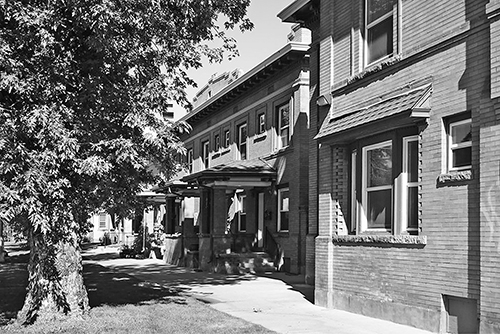
City West Apartments: A black-and-white view of the historic City Park West Apartments in Denver, a longtime neighborhood landmark that served residents for generations.
After standing for more than a century, the City Park West Apartments, first opened in 1923, are officially slated for demolition, marking the end of an era for one of Denver’s long-standing residential landmarks. The property, known for its vintage brick exterior, narrow stairwells, and generations of tenants who called it home has been cleared to make way for a new redevelopment project: the Chrysalis Apartments. The Empowerment Program, a local nonprofit, demolished the 1920s apartment building and an older duplex at 1767 and 1777 Franklin Street. In its place, the organization will construct a 7-story, 70-unit complex.
For longtime residents and nearby neighbors, the announcement has been met with a mix of nostalgia, frustration, and cautious curiosity about what comes next.
“This building has been part of the neighborhood’s heartbeat for as long as anyone can remember,” said one nearby resident who asked not to be named. “You walk past it and you feel Denver’s history. It’s sad to see it go.”
A Building That Outlasted
Decades Of Change
The City Park West Apartments were built during a period when Denver was rapidly expanding outward from downtown. Nearly all of the neighborhood’s early development followed the rise of streetcars, new civic parks, and a growing middle class seeking housing close to city amenities.
Over the decades, the apartments became home to an ever-changing mix of Denverites, young professionals, retirees, artists, service workers, and families, many drawn to the building’s affordability and proximity to City Park, Colfax Avenue, and central Denver.
While charming in reputation, the building also reflected the realities of aging infrastructure: limited modernization, outdated layouts, and increasing maintenance costs.
Why Demolition Now?
According to redevelopment representatives, the decision comes down to structural limitations and the economics of renovation versus rebuilding.
Though historic in age, the City Park West Apartments were never officially preserved under the highest levels of historical protection, leaving the property vulnerable to redevelopment pressures in one of Denver’s fastest-changing housing markets.
The upcoming Chrysalis Apartments project is expected to feature updated units, modern amenities, improved energy efficiency, and a more contemporary design intended to meet the demands of today’s residents.
“Chrysalis”
A Symbol Of Transformation

Chrysalis: A rendering of the future Chrysalis Apartments in Denver, a modern mixed-use redevelopment planned to replace the former City Park West Apartments site.
The name Chrysalis Apartments appears to be a deliberate nod to change and renewal: a chrysalis is the stage of transformation before something new emerges.
Supporters say the project represents opportunity, more housing supply, better building standards, and a chance to reimagine a property that has long needed investment.
Critics, however, warn that “transformation” can be a gentle word for displacement.
“To some people, this is progress,” said one community advocate. “But to tenants who have been here for years, it feels like they’re being pushed out of their own neighborhood.”
Concerns Over Affordability
And Displacement
As Denver rents continue to rise, residents are watching closely for details about what kinds of units the Chrysalis Apartments will include.
Community members have raised questions such as:
- Will any portion of the new apartments be affordable or income-restricted?
- Will current tenants receive relocation assistance?
- Will the redevelopment preserve any of the original character of the site?
- What impact will construction have on nearby streets and businesses?
In many Denver neighborhoods, older apartment buildings serve as naturally occurring “affordable housing” simply because they’re outdated. When they are replaced with luxury new builds, rent prices often jump dramatically, shifting who can afford to live nearby.
A Neighborhood Landmark
Fades Into Memory
Even residents who support new housing say the moment still carries weight.
There is something uniquely bittersweet about watching a nearly 102-year-old building disappear, one that stood through the Great Depression, World War II, the rise and fall of downtown development patterns, and Denver’s modern boom.
For some, the City Park West Apartments were more than just brick and rent checks. They represented first jobs, first leases, new beginnings, and the kind of imperfect but authentic city living that shaped Denver’s identity.
As demolition nears, neighbors have begun sharing photos and stories online, quietly memorializing a building that many assumed would always be there.
by Editorial Board | Dec 15, 2025 | Editorials
Editorial —

Two adjacent skyscraper office buildings in downtown Denver located at 621 and 633 17th Street recently sold for $3.2 million. The buildings have nearly a million square feet of office space combined. Six years ago, the buildings were valued at $200 million – a 98% drop in value.
The purchase indicates the buildings were essentially worthless as office space. With a cost basis of $3.2 million, the buyer, Los Angeles developer Asher Luzzatto, could rent office space at extremely low rates and seemingly make a great deal of profit. But no, apparently there is almost no major market for rental offices downtown at virtually any price. Instead, the buyer is going to spend tens of millions to turn the buildings into 700 residences.
This developer is not the first one in Denver to come up with this idea. It was announced recently that the historic Petroleum Building will be converted from office space into residential units. The building was given its name as it was housing a myriad of businesses in the oil and gas business. No need to worry about such use as Governor Polis and the legislature have killed the oil and gas industry in Colorado in the name of preventing global climate change.
The problem is that there is no data out there indicating that people are dying to move to downtown Denver for residential purposes. In fact, Channel 7 in Denver recently ran a story entitled “Data shows people are actively avoiding moving to Denver” citing data from a MoveBuddha study. Moreover, as our front-page story indicates that apartment rental rates in Denver are going down reflecting lowering of demand.
At one time Denver could count on an influx of monied people from California but no longer. Why move from misgoverned Los Angeles and California to misgoverned Denver and Colorado. They are heading to red states such as Texas and Idaho.
So what in the world is the developer Asher Luzzatto thinking? Back in the Chronicle’s May 2024 edition we prognosticated in an editorial titled “No Mr. Mayor, the Woes Of Downtown Denver Will Not Be Saved By A Half Billion Dollar Retrofit Boondoggle” that proposed new Downtown Denver BID assessments would end up in the pockets of downtown office owners to help convert their buildings into residential properties. Rest assured that some of the bond proceeds from the just passed “Vibrant Denver” bonds will end up in the same pockets.
We assume that Asher Luzzatto is nobody’s fool. Most of the money to convert the two office buildings will come from governmental entities. If the project fails, the developer will lose very little money but if it succeeds the developer will very handsomely profit.
But what does the super bargain basement sale say about Denver’s economy? At a minimum the city’s budget will soon be in major trouble. Assessments for commercial property in downtown Denver will plummet, which will lead to a commiserate drop in property tax revenues.
Similarly, revenues from the head tax that Denver imposes on people who work in Denver will similarly drop.
Perhaps the proposed Burnham Yard redevelopment that includes a new Broncos Stadium will create some economic growth along with short-term boost from the newly approved Vibrant Denver bonds.
Ultimately reading the tea leaves, Mayor Johnston’s administration is betting on the farm downtown Denver becoming a residential hub through the conversion of office building into residences paid for by the government. If that bet fails hard times will likely await the Queen City of the Plains.
— Editorial Board

by Jessica Hughes | Nov 17, 2025 | Editorials
by Jessica Hughes
Dinosaur National Monument is one of many national parks experiencing severe budget cuts and staff shortages. Photo credit: Jessica Hughes
Often referred to as “America’s best idea,” our national parks are what many consider a national treasure, not only loved for their beauty and recreational access, but for their commitment to conservation, culture, and collective heritage.
Yet, now more than ever, our national parks are in crisis. Since the beginning of this year, they have become political pawns in a larger agenda that seems intent on undermining their mission. Behind the scenes, the foundational work of protecting landscapes and preserving cultural history is under attack.
National parks have struggled under a severe staffing crisis, losing roughly one quarter of their permanent workforce. This loss has made it increasingly hard to keep gates open, deliver basic visitor services, or carry out vital maintenance. It has also caused delays in research and critical maintenance, putting the long-term protection of America’s most iconic landscapes and cultural resources in jeopardy.
But the threats extend far beyond shrinking budgets and empty positions. Park leadership has been pressured to strip climate change information from official webpages and to remove references to slavery and LGBTQ+ history. Staff were also directed to inventory interpretive signage and museum content, and flag so-called “negative information” about past or living Americans via QR-code reporting and submit content for review. These requests are not isolated efforts, rather they reflect a sweeping effort to reshape our national park system and how American history is told.
All of this comes at a time of heightened pressure. Visitation has surged since the COVID era. Climate change is accelerating. And now, with cuts and mandates, national parks are being squeezed from every angle.
In Colorado, where more than one-third of the land is federally owned, roughly 24 million acres, parks were the busiest ever this year, with record-breaking visitation, all forced to operate with minimal staff. “The Administration ordered all NPs to remain open to maintain the appearance of a park visitor experience,” notes Tracy Coppola, the Colorado Program Manager at the National Parks Conservation Association. “It’s been tough this year.”
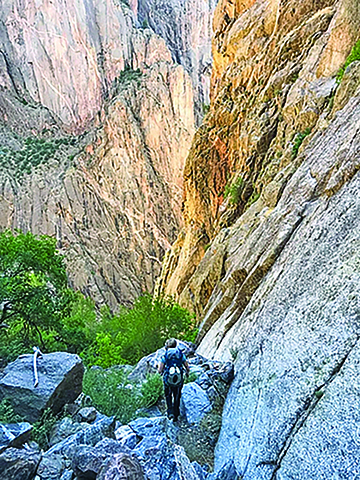
Black Canyon of the Gunnison National Park is currently operating with no maintenance crew and half its staff. Photo credit: Jessica Hughes
The Black Canyon of the Gunnison National Park was forced to operate with no maintenance crew and half of its staff. “That means Black Canyon of the Gunnison National Park is unable to fill 24 of the park’s 74 positions – a 1/3 reduction in staffing,” says Caitlyn Burford, the NPCA Senior Communications Manager. In other instances, this past summer, the park operated without rangers at the park’s North Rim, requiring signs to be posted telling visitors that search, and rescue would be slow or unavailable. And because all custodial staff had been terminated, higher-grade employees were being directed away from their regular duties to perform custodial functions.
Even amidst the government shutdown, most parks remain open with fewer amenities, and to the public, no real change is seen. But Coppola points out the front-facing staff shortages and closures aren’t the real issue.
“The challenge with the current narrative is that parks behind the scenes are scrambling. Visitors aren’t really seeing it out front; it is more behind the scenes,” explains Coppola. “It’s the scientists, conservationists, all those behind the scenes are where the parks are feeling it the most.”
Coppola refers to the staff who are hired to help protect the park’s natural and cultural resources. But with the recent cuts, places like Dinosaur National Monument, where its Cultural Resources person was fired, aren’t allowed to replace or rehire this position. And because administrative and maintenance staffing at the park is down 40%, those who remain behind the scenes, such as the park’s archeologist, are jumping in to help where they can, taking them away from what they were hired to do.
“We’re at a place where the parks are being put in an impossible situation,” says Coppola. “The future is uncertain. It is terrifying. We never thought the administration would come for the parks like they have; the parks are becoming politicized more, and we’re losing the reason why parks were created in the first place.”
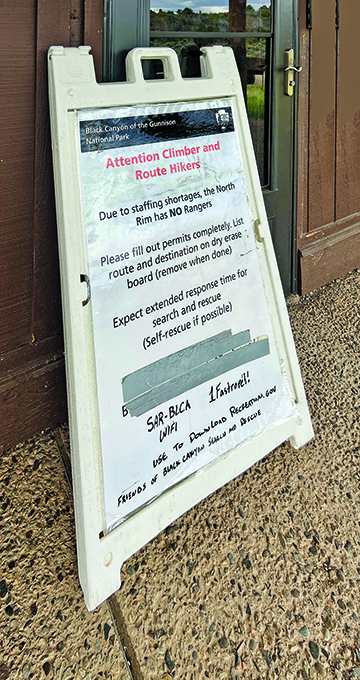
Staff shortages at national parks have led to visitors exploring at their own risk. Photo provided by National Park Conservation Association
The National Park Conservation Association is the only independent, nonpartisan organization dedicated to protecting and advocating for America’s National Park System. This year, Coppola has seen a huge pivot in the organization’s focus, most of which has been voicing how critically important park staff is, and how these cuts have put a huge strain on the park system.
“We estimate that at least 24% of park permanent staff is gone across the board,” says Coppola. “So, we’ve been using our voice to stand up for park staff.” Another big focus for the organization is the sweeping changes that could come with president’s most extreme proposed 2026 budget.
The harshest budget proposal asks Congress to cut more than $1 billion to the National Park Service, which includes a $900 million cut to the operations of our national parks. According to the NPCA’s calculations, “achieving a $900 million cut to operations would require eliminating funding and staffing for roughly 350 park sites from the smallest to some of the largest.”
The NPCA also goes on to list other Park Service-related budget cuts proposed in the President’s budget, including:
- $73 million cut to park construction funding
- $77 million cut to recreation and preservation funding
- $197 million cut to the Historic Preservation Fund
“This is the most extreme, unrealistic, and destructive National Park Service budget a president has ever proposed in the agency’s 109-year history,” according to a statement issued by National Parks Conservation Association chief executive Theresa Pierno. “It’s nothing less than an all-out assault on America’s national parks.”
It’s clear, no matter how you slice it, the future of America’s national parks is on the line.
by Editorial Board | Oct 20, 2025 | Editorials
Editorial —
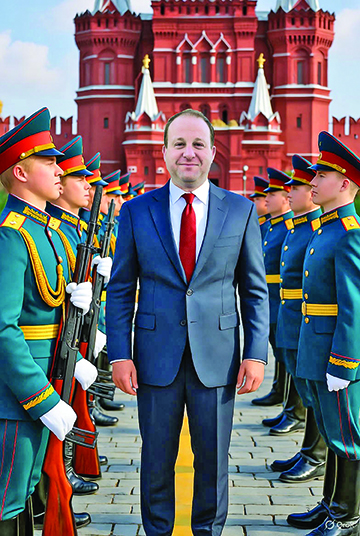
Comrade Polis
One of the keys to progressive left policies is to make sure people do not have any alternatives. When the Soviets imposed their form of communism on East Germany, it had to build the Berlin Wall to prevent the masses from escaping the workers’ paradise to West Germany. The progressives of North Korea attempted to prevent its citizens from escaping not only to South Korea but also to slightly less oppressive China.
Denver has decided it loves maximum density and a minimum number of cars. Afraid that not all Coloradans may want to live in Denver’s “affordability paradise,” the state legislature, as well as Governor Polis, have begun imposing Denver inspired restrictions and mandates on towns and counties across Colorado.
As a practical matter, progressives intensely dislike single family homes and, for that matter, nuclear families. The new law (HB 24-1152) prohibits local jurisdictions imposing mandatory owner occupancy laws and specific minimum square footage for residencies. No more single-family homes with those lots potentially becoming mini apartment buildings with streets jammed with cars. Since progressives can’t just say they hate nuclear families, they say what they are doing is make housing more “affordable” and fighting against “climate change.”
Housing will undoubtably become more affordable due to the legislature’s and the governor’s actions as fewer people will want to live in Colorado. The price of what were once called single family homes will plummet.
Next the state legislature adopted HB24-1313 which prohibits municipalities from adopting or enforcing parking requirements within a quarter mile of various transit stops. The legislature mandated that municipalities allow high density high rises near transit stops. The urbanization of Denver suburbs will, if successful, overwhelm infrastructure, strain schools, and destroy community character. In Polis’ mind what is there not to like?
Unfortunately, the proletariat outside of Denver have not been enamored by the Polis vision. Many communities refused to implement the necessary ADU regulations/ordinances. Moreover, six cities — Glendale, Greenwood Village, Arvada, Aurora, Lafayette, and Westminster — sued the state to stop the implementation of the legislation.

Polis’ vision of what suburbs in Colorado should look like.
Watching the peasant revolt, Governor Polis looked to President Trump’s authoritarian tactics for inspiration. Polis elected to issue an executive order that the rebel cities either comply or face losing out on $277 million in housing grants. Of course, there is nothing in the State Constitution or state statutes giving him the power to do so, but then again where does Trump get the authority for many of his executive orders.
The rebel cities in their lawsuit rely on the over century-old Article XX, Section 6, allowing home-ruled cities to operate free of state control on matters of local concern including zoning and land use. There are no exceptions for affordability and/or climate change. While on the surface the rebel cities appear to have a slam dunk case, Polis knows he has appointed many of the judges who will hear the case at the district court level and on appeal. Colorado courts have already largely gutted large parts of the citizen adopted constitutional amendment called the TABOR amendment. The Colorado Supreme Court was also happy to try to deny Republican voters the right to vote for Trump for President until the U.S. Supreme Court intervened. As a result, few people these days have any trust in the Colorado courts to fairly adjudicate the meaning of the state Constitution or Colorado laws.
It is well known that Polis is seriously looking at running for U.S. president in 2028. He would appear to be a worthy successor to the power-hungry Donald Trump.
— Editorial Board