
by Mark Smiley | Jun 28, 2018 | General Featured
by Glen Richardson

Visual Content: JSD’s Jennifer Jordon behind the scenes at LAX producing compelling visual content that connects with customers.
They say a picture is worth a thousand words. And in today’s online world, video can be worth thousands of views and that means more clicks to a business’s website, more likes, more shares and more positive connections with potential customers. Across the board, tech research shows that video content is crucial. Video posts are twice as likely to get views as still pictures. And one media company estimates videos are shared a thousand times more than a simple text post.
Julie Hayden, Marketing Director for the Glendale Cherry Creek Chronicle says, “Business owners know how important it is to have an Internet and social media presence. But for almost any business, providing new and compelling video content is a challenge.”
That’s why the Glendale Cherry Creek Chronicle is launching a partnership with JSD Digital, a video production and SEO (search engine optimization) company.
Jennifer Jordon oversees JSD Digital’s video production. Jordon says, “I discovered my passion for storytelling through the visual platform of cinematography in college.” She started out transcribing video tapes (back when footage was actually shot on tapes) and quickly moved up the ladder to an associate producer on an HGTV program.
She was promoted to field producer and director and has worked with networks like HGTV, Travel Channel, VH1 and many others. “I’ve braved grizzly bears while producing programs in Alaska, marveled at magnificent sunrises working on water park episodes in Costa Rica and been amazed at the engineering and zipline feats performed by the teams from DIY Network’s The Treehouse Guys.” Her many commercial business projects include a multi-year campaign on the renovations at LAX, Los Angeles World Airport. Hayden says, “Jennifer is uniquely qualified to handle whatever visual scope a business desires, from one camera shoots to multi camera produc
Expertise Gets Results: JSD’s Jennifer Jordon on location with reality TV series in Homer, Alaska.
tions including drones.”
Jordon adds, “Our productions range in scale from a “one-person band” operation where I do all of the preproduction, film all the components in the field while producing and directing and then edit everything in house. For clients looking for a higher cinematic value, I build teams of freelancers whose expertise complements each other. Both result in a dynamic and impactful finished product. We can achieve a lot with whatever budget a client has to work with.”
Because of her experience with large-scale productions, Jordon notes she’s seen big corporations out compete everyone else. “My goal is to give small businesses the marketing tools they need to compete with the bigger guys by making the right impression on their potential clients and customers.”
Jordon explains the Internet is both a blessing and a challenge for small businesses. “With the nature of social media like Facebook, YouTube, Instagram and Twitter you don’t need network television advertising to get your commercial or video posting to y

SEO Maximizes Exposure: Seth Drake with JSD Digital utilizes SEO strategies to maximize internet search results.
our demographic. But you do still need a quality visual product and many businesses don’t have the time or the expertise to use the Internet to their full advantage. Video content can help make a great, lasting impression if you make the right impact and really captivate your viewers.”
Hayden points out, “We’re not talking about traditional commercials.” Jordon adds, “At JSD Digital, we meet with the business owner, talk about their brand and what message they want to convey. Our goal is to create visually compelling video and still pictures that spark a positive emotional connection with potential customers. We provide two to three minute clips or longer for use on websites or Facebook but also shorter ‘sizzle’ pieces for social media like Twitter. Our packages focus on maximizing the results with whatever budget the business has to work with.”
Customer Satisfaction
One of JSD Digital’s video partnerships is with Delastudio.photos. Owner Ariane Delafosse Uhll offers a unique brand where she photographs people doing whatever they are passionate about. She contacted JSD Digital because she wanted videos to show customers just what they could expect in a session with her. “I wanted to convey how fun it is, how our team of hair and makeup experts will make them look their best. I wanted a video that walked them through the process.”
Delafosse Uhll says JSD Digital exceeded her expectations. “Jennifer was totally professional and also excited and interested in my business. She worked wonders within my budget and the final product was amazing. She was able to produce something beautiful in a short period of time that perfectly captured my vision and what I wanted to convey.” Delafosse Uhll adds the investment was worth it. “Having a beautiful, professional video really helps set my business apart and sends the message that I am a high quality, successful business.”
Jordon says, ‘Seeing a business owner light up when they watch the commercial video I have created is my favorite moment. Knowing they will have something that makes them proud and will truly bring in new customers and build trust when a potential client visits their website is huge.”
SEO Maximizes Exposure
Creating compelling visuals is the first step to help businesses get noticed. JSD Digital’s SEO component provides the second step to make sure they keep getting noticed. Owner Seth Drake explains JSD Digital uses industry-leading tactics to first check and amend your site to make sure the architecture and design of the pages are recognized as relevant to your industry. He says, “This helps search engines understand your business and therefore rank them accordingly.” From reputation management to the discovery process behind keyword analysis, JSD Digital harnesses all avenues within SEO.
If you have considered maximizing your business’s potential through visual content or are curious about SEO potential, JSD Digital offers free consultation and website evaluations.
For more information, contact Glendale Cherry Creek Chronicle Marketing Director Julie Hayden at julie@glendalecherrycreek .com or 303-359-8366.

by Mark Smiley | May 25, 2018 | General Featured
Glendale Barnes & Noble Hosts Signing On June 16
The stories of three Colorado authors who found love in midlife when they least expected it are included in Chicken Soup for the Soul: The Miracle of Love that will be available in bookstores and online June 5. Cindy Charlton of Lakewood, Lisa Marlin of Denver, and Susan Mathis of Colorado Springs, are among the 101 authors featured in the latest release from the popular book series.
The new book is a compilation of true stories from women and men who have written openly about their adventures in dating and romance, proposals and weddings, lasting marriages and second chances at finding love.
Charlton had resigned herself to being content without a relationship. Her story “Romance Therapy” is about reconnecting with the physical therapist she’d met 20 years ago when she was adjusting to life as a triple amputee. Their midlife lunch date evolved into a new relationship. “When it happened, I couldn’t believe that this was my life,” she said. “When I gave him the story to read, before I even submitted it, he was a bit in awe I think.”
This is Charlton’s fifth time to be published in Chicken Soup for the Soul. “I wanted to share this unbelievable lov

Susan Mathis
e story with the masses,” she said.
Marlin said she’s enjoyed Chicken Soup for the Soul books for years and decided to see what it would be like to write for them. Scanning the lists of topics on their website last year, this one caught her eye. “I’d already written a love story as an anniversary gift to my partner about how I remember us meeting as teens but not getting together until 30 years later,” she said. “So I polished it up and sent it in.”
In March, she got word that her story “Haven’t We Met Somewhere Before?” had been selected. “After I got over the shock, it occurred to me that I should ask my partner if it would be okay to share our story with the world,” Marlin said. He did not hesitate when he told her, “Of course. We’re a good story.”
Mathis said that she too has always liked reading the inspirational books and was in fact published two years ago in Chicken Soup for the Soul: Spirit of America. For this new book she said, “I wanted to share our love story since it’s a story of commitment, hope and enduring love. In a world that throws away relationships far too easily, ‘for better or worse, in sickness and health’ is a much-needed vow.”
Mathis’ story “Live Without Regret” is about how they faced her husband’s health issues before and after they married. The couple has also co-authored relationship books, including The ReMarriage Adventure. Just days before his birthday in May, she surprised her husband with an advanced copy of the new book. “He, too, is happy to be part of sharing our ‘miracle of love,’” she said.

Lisa Marlin
Before the authors knew they had been selected, Amy Newmark, publisher and editor-in-chief of the Chicken Soup for the Soul book series, knew their stories would resonate with readers. “People tell us that they want to be able to offer hope,” she said. “They want to share this book with a 25-year-old daughter to encourage her as she waits for love or to let a widow or divorcee know that second chances at love are possible.”
With more than 150 books to her credit since she and her husband Bill Rouhana acquired Chicken Soup for the Soul in 2008, Newmark has a sense for what readers want. Sometimes she discovers that by what writers are submitting. That’s how this most recent book came about when a call for submissions for the topics “Step Outside Your Comfort Zone” and “Miracles and More” garnered a lot of love stories that fit into those categories but seemed to need a place of their own.
“As I got stories for the other books, there were all these fascinating ways people wrote that they found love,” Newmark said, adding that she approached her publishing team who all agreed when she suggested they do a book about finding love.
As with all Chicken Soup for the Soul books, this one delivers a message of hope. In this book, that hope comes from real life stories that prove love is possible at any age and often in the most unexpected ways because, after all, that’s the miracle of love.
Marlin and Mathis will sign copies of the book at Barnes & Noble, 960 S. Colorado Blvd., in Glendale, on Saturday, June 16, from 1:30 to 3:30 p.m. Charlton is not available for the event.

by Mark Smiley | Apr 27, 2018 | General Featured
by Glen Richardson
Veteran Newsman: Award-winning broadcaster Steffan Tubbs joined the lineup on Newstalk 710 KNUS radio this year.
Popular radio newsman Steffan Tubbs who anchored 850 KOA’s Colorado Morning Show for over a decade has joined 710 KNUS after the most challenging period of his life. Tubbs texted a highly confrontational girlfriend while intoxicated. She had previously been arrested for harassing him. She turned over the text messages to the Denver Police and he was arrested on July 30, 2017. He was charged with “domestic violence” by telephone with the legal authorities declaring that he used “vulgar language with the intent to annoy the victim.” He spent 36 hours behind bars until finally being brought before a judge.
His arrest photo led the evening news on FOX 31 News and he watched his life fall apart. He was suspended by KOA Radio and he saw friends and business acquaintances disappear. He credited his legal counsel with standing up for him when almost nobody other than his family, particularly his children, were willing to do so. All charges were dropped by the Denver District Attorney in October 2017. Notwithstanding the dismissal, KOA refused to rehire him and he found no one willing to give him an opportunity.
That was until 710 KNUS morning host Peter Boyles had him fill in for him and went to bat for him at the station. When Dan Caplis the evening drivetime host at the station retired to spend more time with his family and his highly successful law practice, Tubbs applied for the job.
He is now: “A longtime newsman, now with an opinion….” That’s the introduction you hear on Newstalk 710 KNUS radio at 4 p.m. every Monday through Friday as the veteran broadcaster begins his program. The “Steffan Tubbs Show” is on weekdays from 4 to 7 p.m.
“I thought I’d had dream jobs before,” Tubbs says. “But I’m absolutely loving my new position at 710 KNUS. I’m truly blessed. After 30 years as a newsman, I’m in a learning phase of how to incorporate news with talk. I value the opinions of o
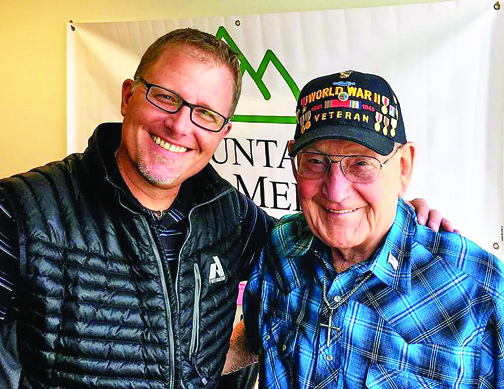
Advocate For Veterans: Steffan Tubbs is a strong advocate for veterans. He was an embedded journalist with American troops in Iraq on several occasions. Here, he is pictured with U.S. Army WWII veteran Bill Brunger.
thers and even if we disagree I think we can have productive dialogue in a civil way.”
Tubbs has 30 years of news experience. He spent more than six years as a national correspondent with ABC News based in Los Angeles, and then moved to the other coast where he worked as a reporter and anchor for FOX5-TV in New York City. Tubbs says he returned to Denver in 2005 and for the next 12 years hosted the morning drive news program on KOA NewsRadio.
Tubbs has covered some of the most important stories not just in Colorado, but also throughout the country and the world. “I reported on the Oklahoma City bombings and subsequent trials, Columbine and 9/11,” Tubbs says. “As well as every type of natural disaster including fires and hurricanes, floods and earthquakes, drought and tornadoes.”
Tubbs’ broadcasting experience expands into sports as well. He reported on multiple Super Bowls, World Series, NBA and Stanley Cup finals and even the 2002 Winter Olympics in Salt Lake City. His numerous awards are a testament to the quality of his work. Tubbs is a four-time winner of the Edward R. Murrow Award for national reporting, he’s received several Colorado Broadcasters Association awards and has twice been named best radio personality in Denver.
Tubbs also has a documentary film company where he says he funnels his passion for real, honest storytelling. His films focus on military men and women, who he proudly supports.
Tubbs says, “I end my show every day by reminding us the remember our troops.”

Drive Time: The Steffan Tubbs Show can be heard Monday through Friday from 4 p.m to 7 p.m. on Newstalk 710 KNUS radio.
The Steffan Tubbs Show launched in February of this year in the crucial afternoon drive time slot on Newstalk 710 KNUS. Tubbs says, “I am blessed and truly love what I’m doing in this new chapter of my career with 710 KNUS.”
His show rounds out the other top-rated programs including the Peter Boyles Show from 5 to 9 a.m. Monday through Friday and the Chuck Bonniwell and Julie Hayden Show weekdays from 1 to 4 p.m.
Newstalk 710KNUS has led the coverage of the Denver Mayor Michael Hancock scandal and Tubbs says, “I think the Hancock scandal is a perfect example of how real news can be combined with the comments and questions of our audience.”
Tubbs adds, “I know we’re not reinventing the wheel with yet another new talk show but that said — I really think we have a unique opportunity to do a news program that integrates callers and opinion.”
A proud dad of two teenage boys, Tubbs notes he is very engaged on social media and loves to tweet and use Facebook posts before, during and after the show. You can follow the show’s Twitter @TubbsShow or @SWTubbs as well as The Steffan Tubbs Show on Facebook.
by Mark Smiley | Mar 28, 2018 | General Featured
by Lisa Marlin
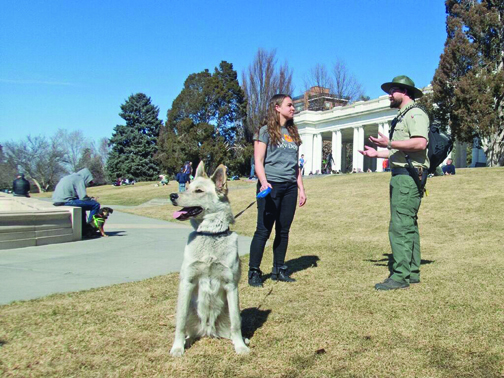
Patiently Waiting: Tugboat waits patiently on his leash while his owner Kyra Bebus visits with Sam Gannon, Denver Senior Park Ranger, at Cheesman Park. Tugboat is able to jump and play while safely on his leash, right.
“Rules are rules,” William McGihon of Denver said after he put a leash on his dog Liam when told to so by a park ranger on a warm March Sunday afternoon in Cheesman Park. “I am aware of the leash law, so I understood and was willing to cooperate obviously.”
The leash law forbids dogs to be off leash unless they are in a designated city dog park. The ordinance is posted on signs throughout the park system, but as outdoor temperatures rise, so does the number of people who ignore the ordinance, especially in Cheesman Park. In 2017, 20 percent of the 240 off-leash citations in Denver’s 228 parks were issued here.
“Cheesman Park has the highest number of off-leash dog issues, followed by Wash Park and City Park, probably because of its really big meadows and location,” said Denver Park Ranger Supervisor Jacob Wells. He also emphasized that leashes can’t be longer than six feet, so those retractable ones that allow owners to adjust the length beyond that are not okay.
It’s not just the parks that fall under the leash law. It goes for every public space throughout Denver’s jurisdiction that is not designated as a dog park. Last year, 576 off leash citations were issued outside of the park system, such as on neighborhood streets and sidewalks.
The citations carry a $100 fine for a first offense but that’s usually not the first course of action taken by animal control officers or park rangers. “We try to be more education-oriented than happy-handed,” Wells said, explaining that warnings are more frequently given and are dependent on the scenario. Someone playing frisbee with their dog when no one else is around might get a warning, but when the park is busy, the consequences are different. “A couple of years ago I came across a situation where someone was throwing a ball and their dog tripped someone else and broke their wrist,” said Wells.
Often when dog owners are confronted, they res
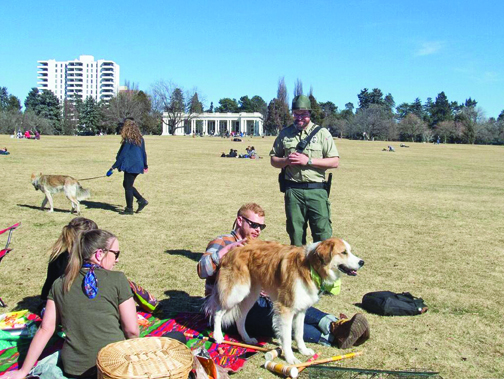
Leash Law: Denver Senior Park Ranger Sam Gannon reminds William McGihon that his dog Liam needs to be on a leash at Cheesman Park.
pond much like Liam’s owner did. “I just felt like he was under our supervision and control by voice command, so I thought that was probably an acceptable scenario,” McGihon said. Of course, he quickly learned it wasn’t when Sam Gannon, the senior park ranger patrolling Cheesman, stopped to chat with him.
“When I see violations, I tend to talk to people and remind them this is a park rule and we need you to follow it,” said Gannon. “And then we give them a reason, which is usually other people’s enjoyment of the park and safety. Once people get the reason behind the rule, we tend to get a lot more compliance.”
He explained that citations are used as a last resort to gain compliance with people who don’t heed a warning and decide they want to do it anyway, even with the $100 fine. A second offense jumps to a $250 fine and goes to $500 for a third.
With a citation avoided and Liam leashed, Gannon headed over to where  he saw a medium-sized dog running freely about 50 yards away. But since Gannon is easy to spot in his distinctive wide-brimmed hat, gray shirt and green trousers, the dog was quickly leashed by its owner before he reached them. “When people see me and they visually comply, oftentimes I will not remind them of the rule. But a lot of times if they’re visually complying they know the rule anyway,” Gannon said.
This ended up being the case with the woman who leashed her dog before Gannon got there. Later, she shared that she is from north Boulder where leash laws are different. “I don’t know Denver’s leash laws though I assume there are some,” said Lindsey Riley who was at Cheesman with her dog Clyde as he strained on his leash to play with Tugboat who was there with his owner Kyra Bebus.
As the dogs sniffed, pawed and frolicked around each other, Bebus kept a close eye and tight hold on her pet. “I know Tugboat is harmless, but he is a one-year-old puppy that weighs 80 pounds and he can get a little excited playing and that can definitely be intimidating to people who aren’t used to that,” she said. That’s why she usually heads to dog parks in the Denver-area where Tugboat can run and jump with other dogs off leash to his heart’s content. Leaving Cheesman, she took Tugboat a short distance away to the recently opened Carla Madison Dog Park off Colfax.
Wells said this newest dog park should help alleviate some of the off-leash issues. Having more rangers patrolling should also have an impact. “We bring in most of our resources when we see more people using the parks, from about April to September, he said. “Our ranger group is growing and so with more of them in the field to spot issues, the situations go down.”
They may go down, but not away. As Gannon stood just beyond where he parked his patrol unit near the Pavilion at Cheesman Park, he browsed the surrounding lawns where people and their pets were coming and going. “There will be dogs off leash here all day,” he said. Some he’ll see as he patrols and others he’ll hear about from calls made to 3-1-1, Denver’s Help Center. He’ll talk to as many dog owners as he can and hopefully see them comply, but if a citation is what it takes, he’s ready to do that too. “It is truly an issue and we do take it seriously,” he said.

by Mark Smiley | Mar 1, 2018 | General Featured
by Ed Mate, Executive Director
Colorado Golf Association
For most golf fans the return of Tiger Woods is a long overdue and welcoming sight. It is well documented that Tiger’s influence on Nielsen ratings is as direct and powerful as low interest rates on the stock market. What amazes me are those who believe that the sport either a) doesn’t really need him or even, b) is better off without him. For those it goes something like, “We have all of the young guns, like Rory, Rickie, Jordan and Dustin.” Pardon me, but that sounds more like roll call at an after school daycare than the lineup of a world class sports franchise like the PGA Tour. Let’s be honest folks, the PGA Tour needs Tiger — no, not to survive, but if the sport hopes to enjoy anything remotely close to its previous notoriety, cache and basic “cool factor” it is going to need more than Chez Reavie and Ryan “I’m no Arnold” Palmer slugging it out on the back-nine on Sunday.
Personally, the reason I am excited about Tiger’s return is only partly due to his amazing talent and golf charisma. Yes, I will enjoy watching him attempt to regain his previous form, but I am more interested in seeing how he can use his “rebirth” (if indeed that is what we are witnessing) to influence a sport that has evolved significantly since his last major championship win in 2008. Over the past 10 years the game has rolled out more innovative and forward-thinking growth of the game initiatives than it did in the previous 100 years. Drive-Chip-Putt, PGA Junior League, LPGA/ USGA Girls Golf, and Youth on Course are four of the keystone programs that have been embraced by the golf community on the local, state and national level. These programs are all designed, in different ways, to attract a wider and more diverse audience to the sport. Time will tell if they will be successful, but early evidence is extremely encouraging.
What does all this have to do with the Colorado Golf Association, or for that matter, what does it have to do with the Denver and Cherry Creek corridor who receives this publication? Quite a lot actually. The Colorado Golf Association just so happens to own and operate CommonGround Golf Course, the former Lowry Air Force Base course that went through a complete metamorphosis in 2008 — the same year Tiger took down Rocco Mediate in an 18-hole playoff to win the U.S. Open — the last of his 14 major golf championships. CommonGround, as its name suggests, was designed to be “a place for all and all the game teaches.” CommonGround is the Colorado Golf Association’s vehicle to introduce golf to those who previously had no access to the game.
The CommonGround campus includes an 18-hole championship golf course designed by world-renowned architect, Tom Doak. But it also includes a practice facility that is regarded as one of the best in the state, a nine-hole Junior Par 3 course that is absolutely free to kids under the age of 18 and an expansive community putting green that is free to everyone with a putter and some time on their hands. But more important than the campus itself, it is the programs that are hosted at CommonGround that make it such a community asset. Among these programs is the Solich Caddie & Leadership Academy that was featured in this publication last year — a program that introduces 30 to 35 young adults (mostly 8th and 9th graders) to a summer job, leadership training, and community service. The CGA uses CommonGround to create partnerships with organizations such as Big Brothers-Big Sisters, Special Olympics and a dozen neighborhood schools to bring the game to those who would never otherwise experience it. CommonGround hosts over 200 outside groups every year who make use of the facility to raise money for charity, provide after work recreation to their employees, or simply provide a gathering place for old friends.
CommonGround most certainly is living up to its name, but I can’t help but wonder how much more we could do with a champion like Tiger Woods serving an ambassadorial role. The community surrounding CommonGround is one of the most diverse of its size anywhere in the country. When you drive the Havana corridor you will see every ethnic restaurant you can imagine. Wouldn’t it be cool if Tiger used his notoriety and global brand to encourage those living in this community to identify more strongly with the sport of golf? Tiger has described himself as a “Cablinasian” speaking to his Caucasian, Black American, American Indian and Asian heritage. What could be more perfect to promote CommonGround and all it represents than Tiger Woods’ return to the world stage of golf?
With Tiger’s return it is my hope that he will do more than simply hoist trophies once again. It is my hope that instead of slamming clubs and dropping expletives, the new and improved Tiger will speak more openly about his diverse ethnic background and encourage those who look more like him to consider taking up the sport. Ultimately, Tiger Woods can do so much more than move the needle with sponsors and televisions viewers. He truly can help change the face of the game and those who play it for generations to come. In 2008 the game of golf wasn’t ready and neither was Tiger. Today the game has done its part as evidenced by what is happening right here at CommonGround.
Come on, Tiger, it’s your turn!
Tiger’s Back: Tiger Woods competed in his first back-to-back tournaments since April 2017 when he teed off at the Honda Classic on February 22, 2018, at PGA National Resort and Spa in Palm Beach Gardens, Florida.
by Mark Smiley | Jan 29, 2018 | General Featured
The CUBE Focuses On Innovative Learning And Real-World Experiences
by Ruthy Wexler
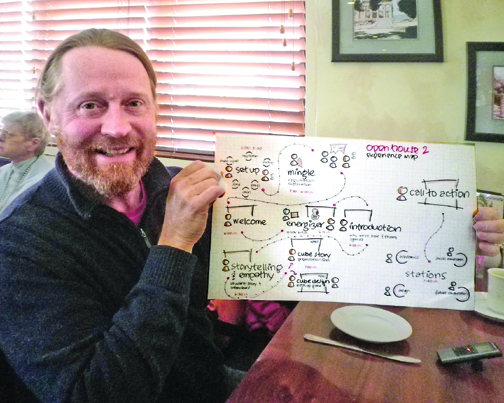
Co-Founder: Jim Stephens, co-founder of The CUBE, displays his plans for the Open House that was held on January 8, 2018. Stephens hopes to have enough students enrolled by the end of February 2018. The requirement is 93.
The CUBE, a new high school in Denver, is ready to enroll students and eager to explain how their innovative program not only boosts reading, writing, and math skills, but connects students to the real world — and their best selves.
Since Denver Public School’s school choice enrollment takes place February 1-22, The CUBE held a series of Open Houses in January, “so kids and parents could see who we are and what we do.” At the first one, held on January 8 in The CUBE’s temporary home, Vickers Boys and Girls Club, an attentive, curious group began to grasp how profoundly different this school would be.
“But don’t you have … classes?” one mother asked.
“Yes, we have classes,” smiled co-founder Bret Poppleton. “But they’re not what you’re used to. One course students can take first semester is ‘Flour, Water, Salt and Yeast.’”
“They bake bread?” said a puzzled adult.
“Yes. And that’s fun and engaging. But they also learn chemistry, math, research, writing … because all those things are involved.”
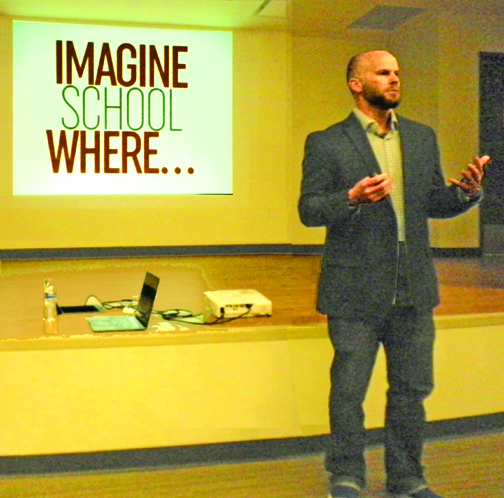
Presentation: Bret Poppleton, co-founder of The CUBE, explains CUBE concepts to parents at the Open House. School Choice for Denver Public Schools runs from February 1 to 28, 2018, and CUBE supporters hope to enroll 135 students.
Because It Was Real
“We call our courses ‘mash-ups,’” Poppleton explained. “An interdisciplinary smashing together of ideas that teaches students to think more deeply about the world. It’s actually how real learning happens. Not linear but from all directions. Starts with being engaged.”
He shared an epiphany. “In middle school, I was always complaining, ‘Why do I have to learn this?’ Then, between 10th and 11th grade, I spent a week in construction, building homes. I learned more that week, it seemed, than in a whole year of school. Because it was real.”
The CUBE’s other founder, Jim Stephens, told much the same story. “Between my sophomore and junior years of college, I went to Jamaica, a summer field school for anthropology. At first, I thought, great, a vacation. But doing excavations right there on sugar plantations with descendants of enslaved people, I understood history so deeply. I drew the artifacts, made maps. It all connected. For the first time in my life, learning came alive.”
Based On Research
What happened in Jamaica — what will occur at The CUBE — is “integrated learning,” said Stephens, who honed his educational skills for years before embarking on a “national search for the kind of place I wanted to teach” — and landed at the Denver School of Science and Technology (DSST).
“I learned so much there,” recalled Stephens, whose passionate interest in the swiftly-shifting future was shared by DSST colleague Bret Poppleton.
The more the two learned how the world was changing — how radically different the work force will soon appear — the more they wanted to equip students with the skills to “pivot”; i.e., change direction with confidence.
Soon they agreed: “Let’s open up our own school.”
“First, we needed to understand the teenage brain the same way that Montessori understands the early years,” Stephens recalled. “Studies show, for example, that the brain’s sleep pattern changes markedly during adolescence. That’s why teens fall asleep in early classes. Our classes won’t start until 9 a.m.” [Although The CUBE will stay open from 7 a.m. to 7 p.m.]
Questions
On January 8, impressed parents nonetheless had worries.
“What about standardized testing?”
“Yes, we take them. All our kids will learn to read, write, compute and think, skills absorbed so much more easily when engaged,” said Poppleton.
“Is there homework?”
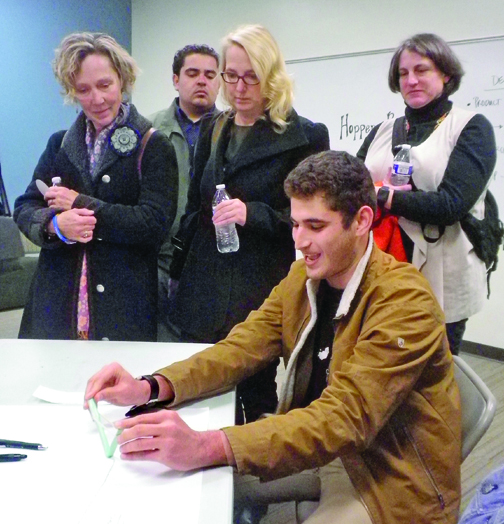
Demonstration: Abcim Molavi, former student of The CUBE’s co-founders, demonstrated his solution to the Hopper Project as parents look on at the Open House held in January. The Hopper Project is statistical machine learning for advanced search of mathematical and scientific literature.
“Working on a project, doing research, that’s homework,” Poppleton said. “But they’ll love what they’re doing and learn more.”
“What about transcripts?”
“We have a transcript format that includes the traditional information, as well as social-emotional and 21st century skills data.”
“Accountability?”
“We offer fun and engagement, so we expect more participation. But we have expectations too. When students finish one of the mash-up classes, they must do three things: write a paper, create a product, do a presentation.”
Future
Earlier, Jonathan Best, The CUBE’s “Computation Jedi,” had led students to an adjoining room. After an hour, parents joined the kids, who’d been divided into groups and instructed to build “something that moved” from a box of ordinary objects.
“We’re telling them, ‘You’re smart, you can figure out how to build something that moves from these few materials,’” explained Best. “It’s not about competing. It’s building confidence to think outside the box.”
The CUBE’s founders excitedly envision a student body “where every kid knows how to code,” week-long courses “that take place in the real world, like an ice-climb in Ouray,” unlocking “the huge potential inside each child.”
Currently, they’re addressing the challenges of any new school.
“Fundraising. Finding the facility. Getting kids,” listed Poppleton. “We’ve already raised $2.5 million.”
“We’re going to take 135 students,” said Stephens. “Or more. But by the end of February, we have to have 93.”
What if too few sign up?
He smiled gently. “Well… then people aren’t ready for our school.
“But I hope they are. We’re ready for them! We can’t wait to show how powerful storytelling and empathy and mash-up classes are.
“We don’t use the term ‘alternative’ — because we believe all schools should look like this. And will, in the future.
“It’s just that The CUBE is doing it now.”
For more information, go to www.thecubeschool.org.