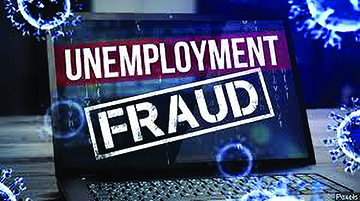
Fraud: In September, the Colorado’s Department of Labor and Employment’s estimated that three out of every four claims it received between July 18 and August 22 were fraudulent.
More Coloradans are opening their mailboxes to find US Bank ReliaCards or 1099-Gs that they don’t need, a sign that someone fraudulently used their name to file for unemployment.
In recent weeks, a freelance graphic designer and the CEO of a local aerospace company told Glendale Cherry Creek Chronicle that they were both victims of fraud. Luckily for them, the claims are amounting to an inconvenience. But, for many Coloradans waiting for or already receiving unemployment benefits, these fraudulent claims are wreaking havoc as tax season arrives.
Unemployment benefits are taxed as income, meaning taxpayers pay both state and federal taxes on the benefits. For fraud victims, this can result in paying multiple thousands of dollars in extra taxes while someone else reaps the benefits.
The freelance graphic designer described the hours of phone calls she’s made to both local and federal authorities concerning the fraud. Each time, she’s been met with the same response: “We might contact you with further questions.”
For the past month, it has been an exercise in futility to get someone to assist with the claim, or to even hear a human voice on the other end of the phone, she added.
“I truly can’t imagine what’s it would be like if I really needed these benefits,” she told the Chronicle.
What Happened?
On January 11, Colorado’s Department of Labor and Employment (CDLE) upgraded its unemployment software system to the MyUI+, whic
h combines regular state unemployment benefits with the PUA Online System used by claimants receiving federal Pandemic Unemployment Assistance (PUA).
The goal of the upgrade is to streamline responses to PUA claims, customers requesting payment via the phone line (CUBline), and providing virtual assistance, CDLE said during the launch.
Initially, when the system went online, it immediately flagged 20% of claims as fraud, prompting the state to seek guidance from the U.S. Department of Labor. In response, CDLE revised down a month of unemployment claims, revealing a batch of 31,237 fraudulent claims. CDLE said that a majority of the fraud is coming from overseas.
“When we deployed the new system Sunday morning at 6:30, we watched,” Cher Haavind, deputy director of the state Department of Labor, said in a statement. “We were all on a dashboard and we could see where people were hitting the system. They were coming from outside of the United States. They were coming from Nigeria. And they were, within five minutes of deploying the system, trying to access MyUI+.”
In December, USA Today published an exposé of a Nigerian engineer who paid $2 in Bitcoin to access a database of stolen Social Security Numbers and other personal information. In many states, that’s all the information one needs to start a claim. Websites such as FamilyTreeNow and TruthFinder offer additional information for a fee.
Others gained personal information through phishing expeditions. CDLE found a fake Twitter account under the handle @LaborColorado that was distributing an online form purporting to help Coloradans apply for unemployment. CDLE’s official Twitter handle is @ColoradoLabor.
Feeding Frenzy
CDLE said its unemployment software was due for an upgrade before the pandemic hit. Colorado’s system was running on a decades-old coding language known as COBOL. At least 12 other states run on similar aging language, including Alaska, Connecticut, California, Iowa, Kansas, and Rhode Island.
However, CDLE’s upgrade was delayed once the agency began receiving record numbers of claims during the spring. In 2019, CDLE handled nearly an average of 2,000 unemployment claims per week. Since mid-March, the agency has handled an average of 17,500 claims per week.
Meanwhile, a rapid update of the Colorado’s unemployment processes created layers of vulnerability within the system that officials are struggling to control. Governor Jared Polis added to the frenzy in March when he signed Executive Order D 2020 012, which requires the state labor office to begin paying claims within 10 days of receipt.
Once state officials began tracking fraud claims in June, they were left to navigate making timely payments, ensuring the security of their operating system, and rushing to find fluent coders to complete the upgrade.
Employers made mistakes, too. CDLE said employers are supposed to file a fraud report whenever an employee files for unemployment. But, if the employer checks “other” on the form, state labor officials assume the claim is from a job separation. In this case, the state is supposed to hold payment pending resolution. Polis’ 10-day order changed all that.
How Big Is The Impact?
State systems are not the only weak spot, CDLE contends. Another suspect is the federal PUA program, which expired at the end of December.
PUA was intended to help freelancers, gig workers, and others who lost their jobs because of the pandemic and don’t qualify for regular unemployment. The program provided $600 per week in benefits. However, the hasty rollout of the program made it a target for hackers and scammers.
Under PUA’s guidelines, state and local labor officials are responsible for administering the program. However, Colorado is currently not distributing PUA payments until it can secure its system. This means Coloradans relying on federal unemployment may go months without receiving payment.
Meanwhile, unemployment officers are still struggling to handle the increased workloads caused by the pandemic. An investigation by Colorado Public Radio found CDLE’s current wait time is over six weeks. As of mid-December, over 12,000 callback or appointment requests were in the queue. CDLE even began hiring customer service help from third-party staffing agencies in December, but the agency’s backlog seems endless.
Surprise Cards: Coloradans are opening their mailboxes to find US Bank ReliaCards or 1099-Gs that they don’t need, a sign that someone fraudulently used their name to file for unemployment.
Since mid-March, CDLE has paid out $2.5 billion in PUA claims and another $2.5 billion in regular unemployment insurance, according to CDLE data.
In September, CDLE estimated that three out of every four claims it received between July 18 and August 22 were fraudulent. Colorado officials were able to stop between $750 million and $1 billion leaving state coffers. Other states haven’t been so lucky.
In August, the U.S. Attorney’s Office for the Western District of Pennsylvania charged 33 individuals, including inmates at eight state and county jails and prisons in western Pennsylvania and their accomplices, with defrauding the PUA system of over $100 million total.
Later in December, U.S. Attorneys in California recovered another $2 million from a single actor. The scammer used the identity of a sitting U.S. Senator to file the claims.
Stopping The Gap
CDLE received updates rules from the U.S. Department of Labor concerning the administration of the PUA program on January 8. The new guidance reopened the program, reduced payments to $300 per week, and extended the eligible weeks of unemployment up to March 14, 2021.
Shortly thereafter, DOL officials released $100 million to states to shore up their unemployment systems and help them detect fraud.
Colorado spent a portion of the funds on a new partnership with ID.me, a biometrics company that will help the state verify unemployment claims so it can begin processing payments. Labor department Executive Director Joe Barela said the system will be used to verify the legitimacy of claims held up by weeks or months after being flagged as potentially fraudulent.
All new claims must perform identity verification through ID.me, with payouts released following a verification with facial recognition. The process is expected to be completed by January 27.
According to the company’s website, ID.me is currently used by over 22 million people and 350 partners, including federal and state agencies, health care organizations and financial institutions. It’s also in 14 other states, including Pennsylvania and California.
For Barela, the new funds and tools are a welcomed gift. However, they don’t mean Colorado is in the clear just yet.
“It’s important to note that we are walking a tightrope here,” Barela said in a statement. “We know that we want to get benefits out as quickly as possible to those who need unemployment insurance at this time. But we also want to put systems in place that protect our funds or benefits from going out the door to fraudulent claims.”
Denver’s Office of the Independent Monitor (OIM) released a long-awaited report on the actions of Denver police officers during the first five days of the George Floyd Protests, saying the officers’ lack of communication, excessive force, and scant documentation are “extremely troubling.”
The report specifically addresses several gaps in the Denver Police Department’s (DPD) use of force policy, crowd control measures, and less-than lethal weapons policies which “could have played a role in command review of force while events were unfolding.”
In all, OIM made 16 recommendations, including updating DPD’s crowd control policies to track which officers are assigned the duty, issuing multiple dispersal orders before using force, and disallowing the use of rubber-ball grenades.
DPD did not respond to request for comment from the Glendale Cherry Creek Chronicle.
Monitor Nick Mitchell said the recommendations are the result of a six-month investigation that considered both the unprecedented size of the crowds and the injuries suffered by both law enforcement officer and community members.
“Welcoming this level of scrutiny is not easy, and it demonstrates a strong commitment to public safety and building community trust,” he wrote in a letter presenting the report’s findings to City Council, the Mayor’s Office, the Department of Public Safety, and the Citizen Oversight Board.
“DPD officer and command staff demonstrated a similar commitment by responding thoroughly to our extensive document requests, and volunteering to participate in interviews,” Mitchell said.
Documentation And Policy Gaps
Between June and November, OIM reviewed DPD policies as well as over 200 hours of video and audio recordings and 25 hours of video recordings from DPD’s helicopter. The OIM team then compared their findings with academic literature on law enforcement best practices.
However, several encumbrances arose during OIM’s investigation, according to Mitchell. A prime example is DPD’s after-action reports — which are supposed to be filed every time an officer uses force — were often vague and documented only a fraction of the incidents.
Department policy requires police officers to file timely Use of Force Reports that include a description of the incident and a detailed recounting of the officer’s observations and actions. However, the agency’s crowd control manual is silent on these matters, which could have led to the delayed and vague incident reports OIM reviewed. Many officers did not fill out reports until 12 days after a use of force incident occurred, the investigation found.
A “footage gap” also arose during the investigation because gaps in DPD’s body-worn camera (BWC) policy resulted in several officers failing to record footage during the protest. DPD policies state BWCs must be activated by officers during “any encounter that becomes adversarial.” This practice is meant to shield officers from false accusations of excessive force.
OIM was able to identify over 150 officers who were assigned to the protests from a roster created on June 1, the only roster received from DPD. Of this total, only 38 officers produced BWC video files.
That same day, DPD officers made 124 arrests for curfew violations, carrying a concealed weapon, burglary, and felony menacing, among other charges. Department policy notes the core purpose of the BWC policy is “to capture crimes in-progress” and that “all arrests/citations” must be recorded. DPD did not provide OIM with a reason why these 124 arrests were not recorded.
Similar comparisons for the other four days the report covers were difficult because DPD did not record the number of officers assigned to the protest. DPD estimated between 150-200 officers worked the protect on May 30, but when OIM asked to see the BWC footage, it only produced videos from 75 officers.
Lawmakers addressed this issue when they passed SB217, also known as the “Law Enforcement Integrity Act” on June 10. The bill requires officers to record all interactions with the public and the footage of which may be available to the public within 21 days of the incident. Officers may also be decertified for failing to produce BWC footage in court.
Denver City Council finalized the purchase of new BWCs that automatically begin recording when an officer draws their firearm on December 7.
Use Of Force Against Protesters
OIM also said DPD inconsistently documented its crowd dispersal orders and less-than lethal munition deployments. The Department could not assess the total number of munitions deployed during the protests even though it produced a pre-protest inventory of its less-lethal munitions. Instead, OIM found that DPD asked the Aurora and Englewood police departments for supplies before spending $202,431.50 on munitions. The Colorado State Patrol even flew a plane to Wyoming to pick up the munitions.
Some officers who deployed these munitions were not certified to do so, OIM found. DPD certifies officers to use pepper ball and 40mm rubber bullet launchers through a four-hour training course. However, OIM discovered reports from officers who claimed to receive training when they arrived to work the protests given the emergency at hand.
One potential reason for the documentation gaps, according to the report, is that DPD officers reacted to the protest emotionally rather than professionally. The report cites a 2018 study published in the Journal of Social Movement Studies that concludes “police tend to respond to demonstrations about police brutality more aggressively than to protests with other messages.”
“The challenges presented by policing mass protests are magnified exponentially when the demonstrations concern police conduct itself. Police must still balance First amendment guarantees with the need to protect life and property, but they must do so under sustained criticism from protest participants,” OIM’s 94-page document reads.
The report also mentions “sustained criticism” of DPD officers may have accelerated the use of force against George Floyd protesters. Given the caustic nature of the protest, OIM said DPD should have instituted tighter internal controls over its use of force policy and added stricter reporting requirements but failed to do so.
“When a protest is about the police, officers may be insulted, threatened, or even targeted with thrown projectiles or other improvised weapons,” the report reads. “This behavior will naturally provoke a more forceful response from the police.”
Mutual Aid
While DPD was the main respondent to the protests, 18 other law enforcement agencies provided mutual aid. They include local police departments from Arvada, Thornton, and Westminster as well as the US Federal Bureau of Investigations and the Colorado Rangers.
Mutual aid is common in police work. Departments regularly sign agreements with each other outlining the scope of the aid to be provided and the resistance thresholds to abide by. However, several of the responding departments neither negotiated nor signed mutual aid agreements with DPD prior to the protests.
Without an aid agreement in place, assisting officers were required to follow their own department’s use of force policies rather than DPD’s policy. Many of the assisting agencies had less restrictive policies than DPD, which “may have impacted the kinds of force used by officers and in what amounts,” the report reads.
This created a situation where assisting departments had varying levels of involvement. Some were tasked with crowd control while others were asked to manage traffic. Meanwhile, several agencies fired less-than lethal munitions at protesters, resulting in several complaints for excessive force against DPD. Internal investigations that determined complaints to be about assisting officers were rerouted to the appropriate agency.
During interviews, DPD officers expressed concerns about requiring mutual aid officers to follow DPD’s use of force policy because other officers are trained under different policies. OIM said the concern is understandable but can be overcome through joint periodic training and proactively negotiating mutual aid agreements.
Going Forward
OIM stopped short of sweepingly rebuking the department. However, it said DPD’s actions signaled it was caught off guard by the protests. Even so, the agency commended the leadership of Police Chief Paul Pazen and Executive Director of Safety Murphy Robinson for their commitment to reform and rebuilding community trust.
“We have full confidence in their commitment to learning from these events and making the changes necessary to prevent similar outcomes in the future,” the report concludes.
However, some community members aren’t sold on the OIM’s rosy outlook. The Citizen Oversight board, which is tasked with reviewing DPD’s disciplinary and use of force policies, said “law enforcement or the preservation of order should ever come at the expense of transparency or accountability.”
“These are military grade munitions being used against citizens expressing their First Amendment rights,” Al Gardner, COB Chair, said in a statement. “The OIM’s report raises important questions about what is appropriate use of force in response to protests and demands a closer look at what institutional accountability should look like in these circumstances.”
At the onset of 2020, Samantha Donen had it made. She had recently graduated from Metro State University with a Bachelor of Science in industrial design. After completing four years of intense study, she had also won several prestigious design contest awards including first place in the Community Veggie Box Denver Botanic Gardens Contest, first place in the Clean River Design Challenge, sponsored by Greenway Foundations and the City of Denver, as well as the 2020 Impact Award from MSU Denver. She has also designed a dog harness called “Wag” and an ergonomic desk for children dubbed “Little Butts.”
As February crept into March, however, it became apparent that an industry frozen from the impending COVID-19 shutdown was putting a serious damper on her dreams. Sam was set to kick off her career as an exhibit designer, when over 650 trade shows across multiple industries were shut down by COVID-19 restrictions. By April, it was clear that pursuit of her design career would have to be put on hold, as the pandemic had other ideas for the economy and for society in general. “Pursuing my passion in a year riddled with anxiety was not an easy thing to do,” she recalls. “”I had to realize,” she continues, “that it was not personal — this was happening to everybody.”
A Hero’s Journey
Despondent but not deterred, Donen sought guidance from a local leader by the name of Rabbi Yossi — a figure known for his outreach work with the Jewish community the world over. He encouraged Sam to follow her chosen path no matter the obstacles — citing the parable of Noah’s Ark as a compelling example of design work rendered in a challenging time.
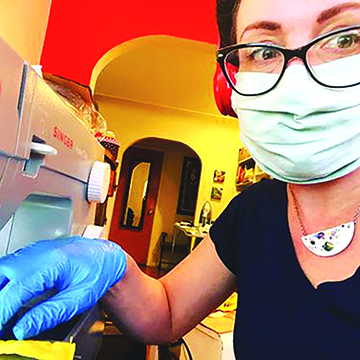
Despite the lockdown, Samantha Donen was determined to put her design skills to work.
Inspired to press on, Donen began noticing the repeating news items about the severe lack of readily available personal protective equipment (PPE) — not just for medical workers, but for the average citizen as well. She did a bit of digging and discovered Make4Covid.co — a nonprofit organization dedicated to making masks and delivering them to as many hospital workers and everyday citizens as possible.
Donen reached out to Dan Griner, the Design and Clinical Testing Lead for Make4Covid, and after a four-hour Zoom meeting she was welcomed into the fold. She then teamed up with Lance Ferguson, the Soft Goods Industrial Designer. The two were tasked with curating a database of all the mask designs floating about the internet and coming up with one universal design which was effective, comfortable, easy for beginners to sew and great for experts to mass produce.
Off To The Races, Onto The Faces
Thirty days later, after several prototypes and tests, they had created the perfect design along with a “how to” video to boot — complete with captions, examples and narrated instructions. Donen then found a way to become further involved, “Since I live in the Denver/Aurora area, I offered to be a ‘hub captain’ — so people drop off and pick up at my place every Sunday — with all COVID-19 precautions in place, of course.” A typical Sunday will have folks who are donating materials dropping off, people dropping off batches of completed masks, and organizations in need of masks picking up requested orders.
Although her professional career was still on hold, Donen quickly discovered that she was gaining valuable experience not only as a designer, but as a coordinator, an administrator and a team leader. “Where I could have become isolated (due to COVID-19 shutdown) I was actually becoming more and more connected to people in my industry.”
“This is a big organization,” Donen explains, “with a marketing team, lawyers, clinical testers, shipping departments, request receiving departments and a lot more.” Ever the driven innovator, Donen then created a child-sized version of the Make4Covid model with a “cord lock” for the ear straps and an overall smaller design.
An Inspiring Perspective
Thus far, Make4Covid has sewn and distributed over 20,000 masks for COVID-19 prevention in the Denver area and more than 50,000 overall. Donen’s design is an open source model available to anyone and everyone who wants and/or needs to make masks. Currently, there is a network of volunteers making masks for family, for professionals in their personal circle and even as a way to make a few bucks — which is perfect for those who have lost work due to the shutdown.
Donen offers some words of wisdom after her first year in the private sector: “Anyone still struggling with ‘what’s next’ or ‘what do I do’ since their careers may have been interrupted — I encourage you to reach out and see where your skills can be used. You can still have a purpose and make a difference and maybe even become part of an organization of like-minded people. Before you give up, seek guidance from someone who can offer an outside perspective.”
The Story Of A “Sewist”
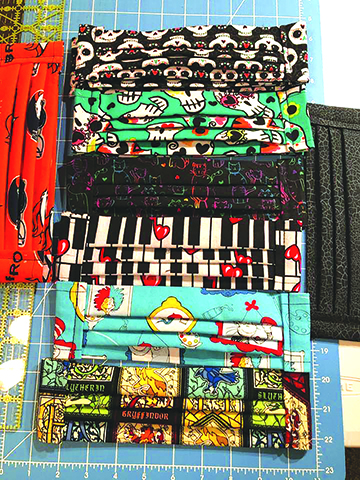
Somewhere along the way, the Make4Covid mask-sewing volunteers were given the nickname of “Sewists” — a term of endearment, no doubt, for folks donating their time and effort for the greater good. One such volunteer is Sammie Hamilton, a longtime friend of Samantha Donen who was drawn into the Make4Covid movement through Donen’s enthusiasm and gung-ho attitude. “She is this driving force — she really inspired me,” recalls Hamilton, an experienced jeweler skilled in the mediums of copper, silver and brass. “I dusted off an old sewing machine, looked at the directions and got to work — and I don’t even sew!” Sammie and husband Tate are long-standing stalwarts of the Denver arts and music scene. “One thing we have learned is adaptability. That’s a hallmark of the art world.”
A sampling of masks from Sammie Hamilton — a “Sewist” for Make4Covid.
Hamilton sews masks nearly every day, donating anywhere from 25 to 50 per week and even making a few on the side to sell where and when she can simply through word of mouth — no website, no Twitter account, no Instagram — just by reaching out to other people personally. She sees her involvement in Make4Covid as a silver lining of sorts: “She [Donen] challenged me in a very soft, very quiet way … and that’s what has kept me going from April until now.”
Enter The “Stitch Ninjas”
Meanwhile, by mid-March 2020, another Denver group had surfaced with a similar directive. The Denver Mask Task Force was started by Amanda Glen, who saw the need for PPE and drew inspiration from her mother’s quilting group on Facebook. Volunteers making masks for medical professionals were dubbed “Stitch Ninjas” and can currently order a sew kit at denvermask taskforce.com and get started asap. Currently, the group is run by Sara Spery and volunteer partner Amy Perlman. Thus far, Spery reports having donated 42,000 masks to medical providers.
The Denver Mask Task Force “Stitch Ninjas” are making a huge difference across the Mile High City.
The group launched with a small grant of 10K and a slew of donated start-up materials. A local arts and crafts supplier, Fancy Tiger Crafts, (59 Broadway, Denver, CO 80203) heard about the Denver Mask Task Force and reached out to help by sharing their network of fabric and textile manufacturers for soliciting donations. “One of the coolest things from this experience” Spery attests, “is that it has given people’s lives purpose and meaning, whether it is an elderly person who can’t leave home who is sewing masks or a person with a car who is delivering them.”
The company’s business model is a hybrid concept, with the directive of donating time, materials and finished products to the medical field while marketing high-quality, breathable, washable, reusable masks to the general public. An inspiring effort indeed, to see a new business forming rather than another one shutting down. “I was in it from the get-go,” Spery continues, “I was bored, I had nothing to do — so I had nothing to lose.”
Elite competitors will have a new avenue to showcase their athletic talent. Taking place November 17 through 21, Glendale is hosting an invitation-only crossover camp that is designed to attract top athletes from non-rugby sports and teach them how to play rugby. The brainchild of Glendale’s Director of Rugby and Manager Mark Bullock, the crossover camp will focus on recruiting American athletes who could become star rugby players.
Photo by Justin Purdy
“The majority of elite athletes in the USA were playing university sports and then would go on to the NFL, NBA, NHL, or the Olympics for track and field, wrestling etc., if good enough,” Bullock explains. “The thought was, why not recruit those elite athletes to rugby once they have completed their university eligibility and/or were cut from professional teams.”
According to Bullock, other rugby teams are at the top of the world rankings because they have elite athletes playing for them. Conversely, the USA has done poorly in the Rugby World Cup over the years because the competitors have been good rugby players but not top athletes. He adds, “We want to change the equation. In the past, our top USA Men’s National Team players have all come from other sports.” By effectively converting elite athletes (who have previously been in scholarship university sports programs) into rugby players, Bullock hopes to mold them into World Cup-worthy competitors.
New Method Of Recruitment
For those unfamiliar with the rugby world, and to use pop culture as an example, the notion of an athlete crossing over from one sport to the other has historically gone well. In The Cutting Edge, a college hockey star trains hard and becomes a gold medal-winning Olympic figure skater and, in Cool Runnings, track runners work hard and become a competitive bobsled team. But in real life, some might question whether or not a former track star, or former hockey, basketball, or baseball player can turn into a competitive rugby player. Based on the trial camp Bullock ran in 2018, he is confident it will work.
“We trained for a week and then played in the Aspen Ruggerfest where we lost our first two matches but improved each game,” he remembers. “The last two matches we won quite readily as the players got better acquainted with the game, and how it is played, demonstrating that we can make the transition. Now our goal is to transition the players into a professional team to ultimately compete in a foreign competition and develop players for the USA National Team.”
In preparation for the crossover camp, Bullock and his staff created a database comprised of approximately 3,000 athletes from collegiate football, basketball, wrestling, track and field, along with players from the NFL, XFL, CFL, and other sports. Additionally, similar to Cool Runnings, Bullock and his staff have worked with the USA bobsled program and learned about how they recruited crossover athletes for their program. By researching university athletic program websites, coach contacts, NFL websites, and team sites, they were able to accumulate a comprehensive list of athletes and then watched video, spoke to coaches, and found methods to contact the players who fit their criteria.
Photo by Seth McConnell
Intriguing Sport
When asked whether these athletes are excited about rugby or if they know anything about the sport coming into the camp, Bullock says that so far, he has seen a mix. He explains, “Some have played, some have seen the sport, and others have just heard of it. One example is a wrestler, who recently graduated from Stanford, told us he was intrigued by the sport and really liked the ‘pile of guys in the middle,’ referring to a scrum. And he wanted to be right in the middle of it.”
Another example comes straight from the Glendale coaching staff. Defense Coach and Director of Amateur Rugby Luke Gross was a Division One basketball player on scholarship at Marshall University and was randomly asked to play rugby while he was a graduate student. He accepted the offer and within a year he was on the USA National Team, earned a contract to play professionally in Europe, and ultimately played 12 years as a professional rugby player in England, Wales, and Italy.
Talent Goes A Long Way
Overall, Bullock’s goal for the crossover camp is to offer players professional contracts following the camp, and for these players to develop to the point where they are able to represent the USA and make the team a contender at the Rugby World Cup. He says he expects a minimum of 40 athletes to attend the camp and contract offers will depend on performance during the camp.
“This is an experiment and we have a hypothesis that we can convert crossover elite athletes to become a high-performing rugby team,” Bullock explains. “Not all hypotheses work out 100 percent but we will adjust and learn along the way, just as the athletes we will be introducing to the game will learn.”
Pumpkins: Pumpkins will be available for purchase from the 4MHP Pumpkin Patch.
Fall into some old-fashioned fun at Four Mile Historic Park’s annual Pumpkin Harvest Festival. The festival is set for Friday, October 2, and Saturday, October 3, from 9 a.m. to 8 p.m. and Sunday, October 4, from 9 a.m. to 6 p.m. Pumpkin Harvest will require advanced purchase, timed tickets. A ticket guarantees you a 90-minute experience in the 12 acre park.
Fun For All Ages: The annual Pumpkin Harvest Festival at Four Mile Historic Park will feature activities for all ages including craft kits, pioneer games, and pumpkin decorating. The festival is set for October 2-4 with a free preview for members on October 1, 2020.
Activities for all ages include craft kits, pioneer games, live music, photo booth, pumpkin walk, pumpkin decorating, demonstrations and more. Additional activities available for purchase include Pumpkins from the 4MHP Pumpkin Patch, Tasty Treats for Purchase from partnered Food Trucks, Fall-Inspired Beverages.
Sponsorships are still available and include a 10’x10’ tent, choice of location, access to power, listing on event collateral, and complimentary tickets to the festival. Visit FourMilePark.org for more information or to fill out a sponsorship form.
The Pumpkin Harvest Festival admission is $15 and Children 3 and under are free. Members have exclusive access to a free preview night on Thursday, October 1, 2020. There is still time to purchase a membership at www.fourmilepark.org/get-involved/membership.
“Civil service statutes establish a floor for police officer employment protections, which the unions can raise through collective bargaining.”
by Robert Davis
Imagine working in an office with 1,000 coworkers. Once every five days, you get a memo saying a coworker was accused of misconduct. One day you see a video from one incident — a coworker shooting someone in the back. You ask the coworker about it and they say the other person had a gun and they feared for their life. With those magic words, you know the shooting will be justified by the company, almost no matter what the video showed.
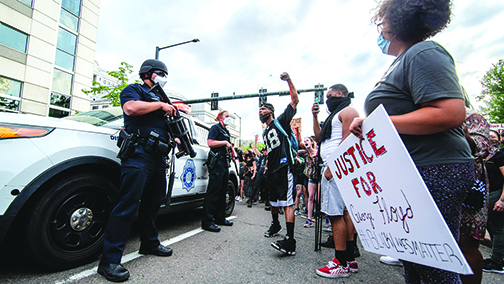
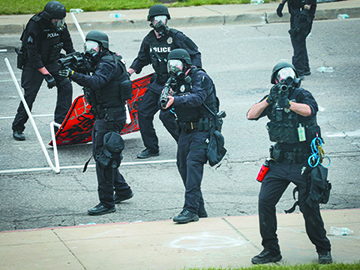
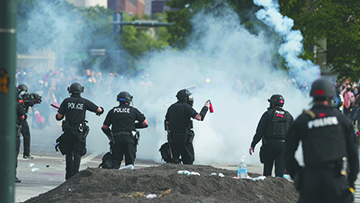
Backup: Denver Police Department called in 12 local agencies for backup amid protests.
Anywhere else and this would be unthinkable. For the Director of Denver’s public safety department Murphy Robinson and Police Chief Paul Pazen, this office is familiar. And it’s the storied history of the office that prevents police reform activists and police officers from reforming the mountain of legal protections afforded to police officers accused of misconduct.
Why? Because the city’s civil service laws were designed with a job description in mind. In turn, Denver’s police union — Denver Police Protective Association (DPPA) — learned how to coil its collective bargaining agreement around those laws to protect officer misconduct. And until this job description is reimagined, longstanding police misconduct reform seems ill-fated.
Director of Public Safety Murphy Robinson broached the topic with city council in June during a discussion on reforming DPD’s use of force policy. As a self-proclaimed student of history acknowledged that moving on from his department’s storied history is necessary to institute immediate reforms.
“We are at a place where we need to move the needle forward,” Robinson said.
His words rang hollow to protesters in attendance like Brian Hostraw, who witnessed police officers tear-gassing small children without warning, firing pepper balls and rubber bullets indiscriminately, and destroying the property of homeless individuals with impunity during the George Floyd protests.
“These are not the actions of people I trust to protect me or my family,” Hostraw said.
And there are plenty of police officers who side with Hostraw. Chief Pazen told lawmakers that a majority of his officers agree with the increased scrutiny placed on them by SB217.
But, the one reform activists are demanding most loudly in the wake of the George Floyd protests — easing the ability of police chiefs to fire officers for misconduct — is the most difficult policy to reform.
Denver began crafting legal protections for its police officers when the first settlements along Cherry Creek were staked out in 1858. Territorial governor John C. Moore organized the Rocky Mountain Rangers under a vigilante mandate to protect the miners from the prostitutes, gamblers, and thieves that followed them west. By the time the City & County was chartered in 1904, police officers were influential players in state sponsored corruption, and earned legal protections because of it.
Before being elected mayor, Robert Speer was a veteran member of the Police and Fire Board, which oversaw a diverse range of city operations from peace officer certification to public censorship. As such, he knew how to use Denver’s finest to serve his political ends and was willing to do so.
During his first two terms, Denver’s finest engaged in voter suppression, rigging elections, and shakedowns of casinos, brothels, and saloons. Speer’s motivation was obviously political — his administration of tolerated vice and honest corruption relied on an invisible hand used to ward off Speer’s competitors. Over time, Speer rewarded Denver’s finest with employment protections that unions would later use to thwart cases of police misconduct.
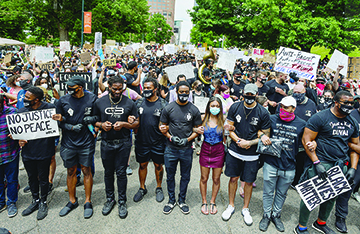
Clash With Police: Demonstrators clash with police at the Colorado Capitol on Saturday, May 30, 2020, during the third day of protests in Denver in response to George Floyd’s death at the hands of police in Minnesota. Photo Credit: (Joe Mahoney, Special to The Colorado Sun)
Realizing how important Denver’s finest were to his political success, Speer created the Civil Service Commission (CSC) during his third tour in office in 1916. The commission established a costly disciplinary and disqualification review processes that often incentivizes public officials to look the other way at police misconduct rather than pursue a moral victory of terminating a rotten officer.
Stephen Rushin, assistant law professor at Loyola University — Chicago, argued in his 2017 article in Duke Law Journal that police union contracts use civil service laws like a double-edge sword. First, they “establish a floor for police officer employment protections, which police unions can raise through collective bargaining.” Second, they tilt the political scales in favor of the unions during negotiations.
Employment protections are established through case law, which often results in costly legal bills for the city. In Denver, city representatives must present their entire case to officers accused of misconduct before the officer decides whether to fight it in arbitration. If arbitration returns an unfavorable result, the case is appealed through the courts, where it hopes to find a judge who will accept an assertion of qualified immunity.
Judge Carlton Reeves of the Southern District of Missouri described qualified immunity as “manufactured fiction” that has had a damning influence on how courts handle cases involving police officers in his decision in Jamison v. McClendon.
He cited a decision from the Fifth Circuit Court where qualified immunity was successfully asserted by corrections officers who were accused of keeping an inmate in a jail cell covered in fecal matter for a weekend before transferring the inmate to a cell in solitary confinement that didn’t have a working toilet or sink.
The Court’s reasoning? Qualified immunity can be asserted in cases where a law is not clearly established. In terms of the case from the Fifth Circuit, the court reasoned the timeframe in which the inmate was kept in unsanitary conditions was unsettled and, therefore, qualified immunity could be asserted.
Judge Reeves specifically addressed this logical quagmire in his opinion, stating “it is a fool’s errand to ask people who love debating whether something is debatable.”
University of Virginia law professor Rachel Harmon observed in her article The Problem of Policing in the Michigan Law Review that civil service laws empower frontline police officers “to challenge any internal managerial action that affects them on both substantive and procedural grounds in a formal adversarial process.”
In May, Denver paid $1 million to settle a case against two police officers who were terminated in 2013 after they lied about assaulting two club-goers in downtown four years earlier. Over the past three years, the city has coughed up over $14.5 million to settle cases involving officer misconduct, according to an investigation by The Denver Post.
Moral Hazard
Because of the cost of disciplining police officers, departments where misconduct is rampant are thus incentivized to withhold information unless an incident rises to a level warranting action. Whistleblower Brittany Iriart revealed in June that DPD, in fact, alters information on its internal misconduct reports to protect its officers before she was fired for violating the confidentiality clause of her employment contract.
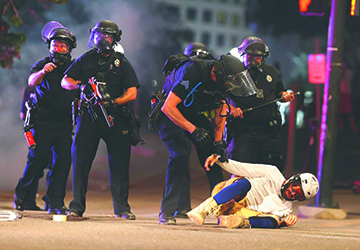
DPD: Denver Officers clear a man who fell to the street after they used tear gas and rubber bullets to disperse the crowd of protestors on May 28, 2020.
Politically, Rushin says, because municipal expenditures such as court settlements can dominate local headlines, the result for lawmakers is a moral hazard. On one hand, they are tasked to upholding the law, yet rely on a third party who is prone to turning the other cheek to prosecute miscreant police officers.
“Municipal leaders may be incentivized to offer concessions on police disciplinary procedures because they are less likely to bear the costs of those concessions in the immediate future,” he wrote.
This issue is further complicated by the political activities of DPPA and its members individually. Since 2012, DPPA has donated over $200,000 to city council candidates, according to the city’s campaign finance data. Over the same time frame, more police officers reported donating to Mayor Michael Hancock than any other candidate for office.
Likewise Denver’s statewide union, Fraternal Order of Police Lodge #27, contributes to General Assembly candidates as in local District Attorneys races.
In her Iowa Law Review article titled Who Shouldn’t Prosecute the Police, law professor Kate Levine argues that a “structural conflict of interest arises when local prosecutors are given the discretion and responsibility to investigate and lead cases against the police,” because “prosecutors rely heavily on the police for their success.”
Levine acknowledges that no criminal case would exist without first contact from a police officer and officers can create and control facts by collecting evidence from the crime scene, interviewing witnesses, or through undercover work, all of which prosecutors can admit in court.
But, the relationship between prosecutor and officer doesn’t end when a case is closed.
DA’s need campaign donations to be elected to office. Then, they rely on police officer conduct to determine negotiating leverage during grand jury cases. The Department of Justice estimates approximately 90 percent of prosecutions end with a plea bargain.
“While cases of police brutality are unlikely to go completely unnoticed, issues of “testifying” by the police, as well as evidence planting, tampering, or withholding, and illegal intimidation tactics will never emerge unless another officer or a prosecutor addresses them,” Levine wrote.
Meanwhile, even though DPPA is a public-sector union, its negotiations with city council are kept confidential. This puts councilmembers at a political disadvantage by keeping them from crowd-sourcing reform ideas from their districts.
Councilmembers also cannot negotiate with union representatives. Instead, they must negotiate through an intermediary. This year it is Legislative Services Director Linda Jamison. Denverite reported that Jamison was not invited to the meetings until three weeks after they began.
Police unions also create leverage vicariously through local news reports on crime rates. Crime statistics from DPD show that violent crime and property crime were all higher in the previous five negotiation years. Last year’s annual report by the Office of the Independent Monitor confirmed officer complaints were higher in these years as well.
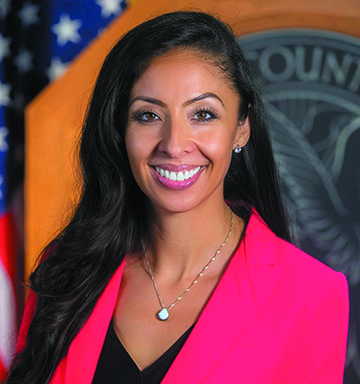
Denver City Councilmember Candi CdeBaca, District 9
According to a statement by District 9 Denver City Councilperson Candi CdeBaca, the current CBA negotiations include a measure protecting police officers from furloughs as Denver faces a budget crisis caused by the coronavirus pandemic and a two-percent salary increase.
Meanwhile, other government employees covered by career service mandates may be subject to budget-required furloughs. Currently, city projections estimate it will suffer a $226 million shortfall, of which $10 million will come out of DPD’s budget.
“This contract amounts to a uniquely beneficial agreement for DPD in the midst of hundreds of excessive use of force investigations and against a background of nationwide calls for police accountability and transparency,” CdeBaca said.
Violent crime is up 11 percent this year compared to last, according to city data.
Why Reform Hasn’t Worked (Yet)
Police reform activists currently can’t decide whether they advocate for completely tearing down the Denver Police Department or reimagining the role of police officers as a community support role, and this impasse is hindering their overall goal of easing restrictions and procedures for firing police officers for misconduct.
In August, Councilperson CdeBaca introduced legislation to abolish DPD and replace it with a peacekeeping department, a policy she claimed on social media was supported by thousands of Denverites.
Mayor Hancock called the legislation “reckless and irresponsible” in a statement shortly after it was introduced.
“The Councilwoman should exercise greater transparency and public accountability before putting something of this magnitude forward for a vote again instead of springing it on the public. I firmly stand by the men and women of our Police Department and will continue to hold accountable those who step over the line when dealing with the public,” he said.
The proposal lost at the Council level with only CdeBaca supporting it.
Others taking a community-centric approach include the newest appointee to the Citizen Oversight Board (COB), which oversees the body responsible for officer investigations, forensic psychologist Dr. Apryl Alexander.
As an academic, Alexander hopes to use her background to help forge new ways of thinking about community policing that doesn’t include excessive force, but includes accountability and restorative practices.
“People are looking for change in this moment,” she told Colorado Politics.