by Amber Wyatt | Feb 18, 2026 | Editorials
by Amber Wyatt
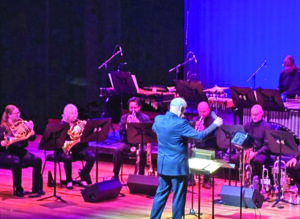
Second from left, Susan McCullough playing French Horn.
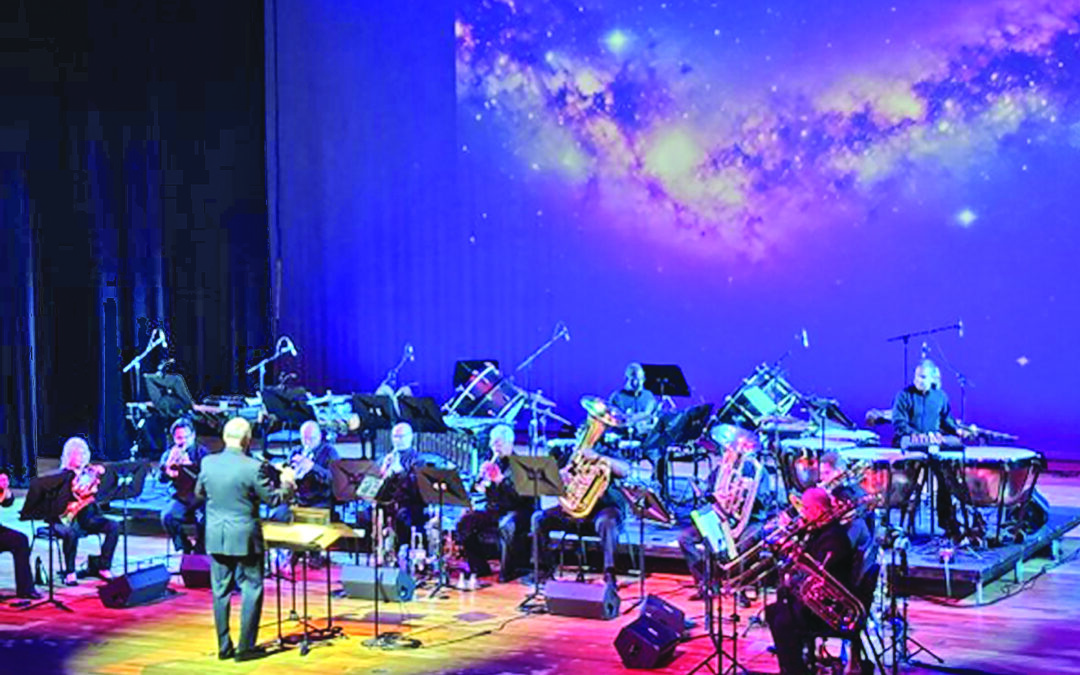
By any measure, Rhythms of the Cosmos is not your typical brass concert. Presented by the Denver Brass, the multimedia performance blends bold brass sonorities, percussion, lighting, and cosmic imagery into an immersive experience that feels as much like a journey as it does a concert. For a group celebrating more than four decades of music-making, the show is a striking reminder of why Denver Brass continues to captivate audiences across the Front Range.
Founded in 1981 by Kathy Brantigan and her husband, both tuba players, the ensemble was born from a simple desire to make music together. “We founded Denver Brass because we both played tuba,” Brantigan recalled with a laugh. “We wanted to play together. So we had to multiply out from two tubas, how many trumpets do you need to balance out? How many trombones? How many horns?” That playful curiosity ultimately grew into one of the region’s most distinctive musical organizations.
Brantigan believes the ensemble’s longevity stems from both its sound and its spirit. “Brass players have kind of a unique fraternity,” she said. “We all have similar personalities, and we love the power and the heroic sounds that brass makes. It’s really special to play with all brass, it’s a unique sound.” Far from being one-dimensional, she emphasizes that the ensemble 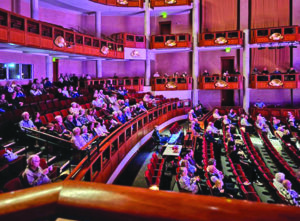 can move seamlessly from delicate and romantic to bold and triumphant. “I’ve always said goosebumps are guaranteed,” she added. “There are moments at our shows you don’t forget when you go home.”
One of the musicians who has experienced the entire arc of the ensemble’s history is French horn player Susan McCullough, the only remaining original member. “As long as we’ve been in existence, around 45 years,” she said when asked how long she’s played with the group. McCullough describes Denver Brass concerts as constantly evolving. “Everything we do is completely different from the last. One show it’s classical, the next time it’s jazz, then funk. What style is your show? Everything,” she shrugs.
That stylistic freedom is on full display in Rhythms of the Cosmos, which features music inspired by space, time, and motion. Trumpeter and composer Sean Schaffer Hennessey contributed original works to the program, including Guardians of Time. “It’s a tough show,” he admitted. “Brass players get tired, but it went really well.” For Hennessey, the appeal of Denver Brass lies in its emotional breadth. “Each show is kind of a roller coaster through emotion,” he said. “There’s a heart to this group. We take music that’s often orchestral and bring it into a whole different realm.”
The concert’s cohesion owe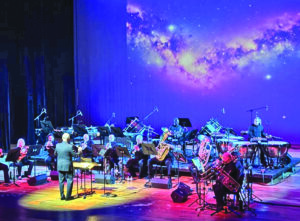 s much to conductor Warren Deck, former principal tubist of the New York Philharmonic, who joined Denver Brass after moving to Denver in 2002. Deck’s path to conducting was unconventional. “I never conducted anything,” he said. “I just sat in orchestras and watc
 hed my conductors. One day these guys said, ‘Why don’t you conduct?’ and I heard ‘yes’ come out of my mouth.” His approach reflects the ensemble’s adventurous spirit. “You never know what you’re going to get,” Deck said. “That versatility is worth checking out.”
Behind the scenes, Executive Director Becky Wilkins helps shape the show’s narrative arc with Kabin Thomas and Andy Wolfe. “It starts with the theme,” she explained. “For this one, we were talking about rhythm, and we added space.” From there, she works on sequencing the music and layering theatrical elements that curate an experience, lighting, imagery, and sound design, support the audience’s emotional journey. “It’s more than just a concert,” Wilkins said. “It’s a show. You experience all these elements and let the music really sink in, it becomes an almost spiritual event.”
One of the most striking moments features ambient sound recordings from Mars, paired with imagery that evokes isolation and discovery. “The images really took me there,” Wilkins said. “They’re the frosting on the cake, helping convey the story.” Kabin Thomas, narrator of Rhythm of the Cosmos and on-air morning show host and producer at Colorado Public Radio’s Classical station, drives each work to the next, “Space,” Thomas leads, “The final frontier.”
As Denver Brass looks ahead, that spirit of innovation continues with their fans that follow every show. One attendee I spoke with during intermission named Ginny, remarked “I can’t wait for Celtic Mania! The Cosmos is quite different for Denver Brass.” “Rhythms of the Cosmos stands as a powerful reminder of what the ensemble does best,” attendee Richard tells me, “Challenges expectation, stirs emotion, and invites audiences into unforgettable moments.”
If you missed Rhythms of the Cosmos, there’s still plenty to look forward to. Denver Brass continues its season with Celtic Mania on March 7th and 8th at 2:30 p.m. at the Newman Center, followed by Pulse of America on May 17th at 2:30 p.m. at Bethany Lutheran Church. Each performance offers a distinct musical experience, showcasing the ensemble’s precision, and unmistakable energy.
As Brantigan put it simply, “There are magical moments you remember from our shows, and they last.”
by Amber Wyatt | Feb 18, 2026 | General Featured
by Amber Wyatt
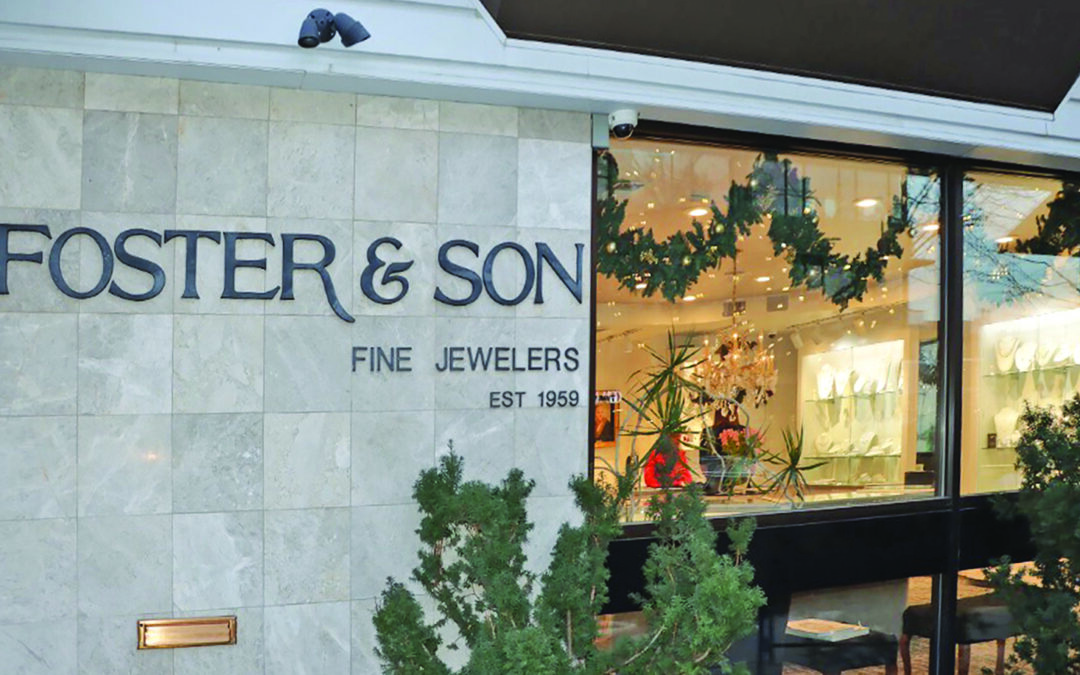
The iconic facade of Foster & Son Jewelers where craftsmanship, heritage, and brilliance meet.
By any measure, Cherry Creek North has changed dramatically over the past decade. New mixed-use developments rise where parking lots once sat, national brands rotate in and out, and office foot traffic ebbs and flows with rapidly growing technology. Yet tucked between luxury storefronts and minimalist façades are artisans who have quietly shaped the district’s character for decades. Their stories reveal not just resilience, but a deep commitment to community.
Few businesses in Cherry Creek can trace their roots as deeply as Foster & Son Jewelers, a family-owned institution that has been serving the neighborhood since 1959. Long before Cherry Creek became a nationally recognized retail destination, Patricia Foster, known to most as Patty, opened a small jewelry shop in Cherry Creek called “The 14 Karat,” an ode to the 1859 Gold Rush to the Rockies. At the time, the area was still defining its identity, and Patty’s shop quickly became a trusted fixture for craftsmanship, honesty, and glamour.
As Cherry Creek grew, so did the business. Patty’s son, Brien Foster, joined the team in 1987, bringing a new generation of expertise, with his wife Cindi. Together they worked hard to preserve the values that built the shop’s reputation like reliability, community-involvement, and elegance. With the duo’s involvement, the store evolved into Foster & Son Jewelers, a name that reflects both its family roots and its long-standing commitment to quality. Today, Brien’s son Tucker and his wife Katie Foster continue to lead the business, the third generation of the Foster family to work behind the counter.

Brien and Cindy Foster on their wedding day.
Last week, I spent about an hour catching up with Tucker Foster at Foster & Son Jewelers, along with his wife, Katie, and it was one of those conversations that reminds you how much heart and history live inside a family business. Tucker lit up talking about his specialty, Cuban link chains and studded-out grills, and even showed me a few custom pieces he’s currently crafting for a local celebrity whose name, of course, could not be disclosed. A testament to how times have changed.
We also talked about the importance of lineage and carrying the Foster legacy forward, a tradition that has shaped the brand for generations. The couples’ daughter Sadie proudly holds the title of dynasty princess for now, but Tucker assured me that role is only temporary and that an heir to the Foster throne is very much in the plans. Katie shared many of the family anecdotes with me, like the tale of Brien assembling the glistening centerpiece of the store, a chandelier Patty ordered in China which came entirely with Chinese instructions.
Tucker not only has a hand in shaping the business, because, “In many ways,” he admits, “the business shaped him.” Tucker shared stories from his childhood that felt like something out of a movie: making bows for the gift-wrapped jewelry pieces customers bought for their loved ones, then sneaking around the corner to the old Wizard’s Chest location to hunt for Pokémon cards. Today, he and Katie are building their own chapter of the Foster story keeping both the craftsmanship and the family tradition alive but adapting effortlessly to the changes 67 years in the making.

An eclectic selection of wines.
 In an era when many jewelry purchases are made online or through national chains, Foster & Son remains a traditional, full-service jeweler, offering custom design, repairs, appraisals, and fine jewelry curated with care. “While it’s awesome to go to Tiffany and Co and the blue box is absolutely stunning,” Tucker said, “you can get a better experience that’s more personalized and less expensive working with a family jeweler.” Their relevance lies not only in longevity, but in relationships. Many customers have been coming to the store for decades returning for engagement rings, anniversary gifts, family repairs, and milestones that span generations.
“In the past, value was in effort. Today, it’s in a brand name,” Tucker says. Oftentimes that brand is a symbol of something. People who shop with Foster and Sons wear the symbol of community, importance of family, and supporting a legacy. Brands like Tiffany & Co, however, charge customers substantial amounts just to wear the name.
That sense of trust has allowed Foster & Son to adapt as Cherry Creek’s retail landscape has shifted. While the neighborhood has seen luxury brands come and go, the Foster family has remained anchored by personal service and expertise that cannot be replicated online. Their in-store experience emphasizes conversation, education, and comfort, values that resonate in a district increasingly focused on experience-driven retail.
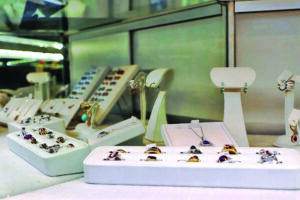
Front counter display of various jewelry types.
Foster & Son’s continued presence also reflects Cherry Creek’s evolution from a neighborhood shopping area to a dynamic cultural district. Through decades of development, economic shifts, and changing consumer habits, the store has remained a constant, quietly shaping the character of the area as much as responding to it.
The story of The Vineyard Wine Shop begins with its founder, Robbie Wilson, who established the shop in 1971 after falling in love with wine while living in California. As Clif Louis explains, “Robbie Wilson was the original owner, he got moved over to San Francisco, fell in love with wine, came back to Denver and said, ‘I want to open a wine store!’”
What began as a modest basement operation, accessible only through an alley, quickly became something special. “In 1971 to get to the front door, you’d come down the alley, go through the door, and down the stairs. It was only 500 feet of space to put wine,” Louis recalls, adding that Wilson’s wife Val handcrafted the stained glass windows and shelving that remain in the shop today. From the start, The Vineyard offered a thoughtful, intimate environment focused on discovery and quality rather than convenience.

Tucker, Katie, and Sadie Foster.
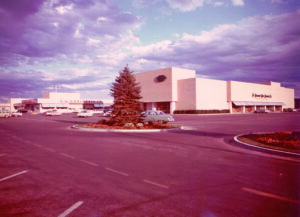
The Cherry Creek Mall photographed around 1960.
The second chapter of The Vineyard’s history began when a young Clif Louis entered the picture in the early 1980s. Driven by a lifelong appreciation for wine sparked by his father who “was stationed over in France, he fell in love with French wines, we always had wine at dinner, and dad let me pick the wine.”
Louis approached Wilson looking for work. “I said, ‘I’ll do anything. I just want to learn about wine.’ So he hired me as the stock boy for $4 an hour,” Louis says, noting how quickly he realized how much there was to learn about the industry. After just a year, Wilson offered a life-changing opportunity. “He said, ‘Clif, why don’t you buy me out?’ and I bought him out slowly over three years.” Louis explains.
From that point on, Louis carried forward the same philosophy of accessibility, warmth, and expertise that Wilson had built. “We weren’t the big box mentality. We didn’t want to force customers to buy a $100 bottle when a $20 bottle was just as good,” he says. “We weren’t snooty wine people. We like to sell wine to drink it.”
Under Wilson and Louis’ leadership, The Vineyard became deeply rooted in Cherry Creek’s retail culture as a staple of high society. Louis’ wife Rosella owned The Brass Bed for decades, and today their children continue the multi-generational tradition with White Peacock just down the street. “We both got into retail, and then my kids got into retail, so it really became a family thing here in Cherry Creek,” Louis shares.
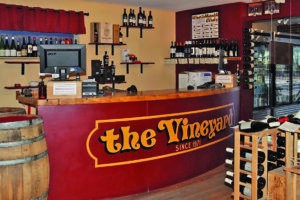
The Vineyard Wines original front counter.
Today, The Vineyard remains anchored by the kind of personal service that can’t be replicated online. “Everyone who works here is taking wine classes, they’re trying to get their degrees in wine,” Louis explains. “When a customer comes in, they talk to somebody. We help them find exactly what they like.” And despite assumptions about Cherry Creek pricing, value remains central. “People think we only sell $100 bottles of wine, and that’s not the case. Most of our wines are around $20,” he says, emphasizing the shop’s commitment to quality at every price point.
That personal connection has helped The Vineyard weather major shifts in retail, including grocery stores entering the wine market. “When they passed the law allowing wine in grocery stores, that hit our sales pretty bad, probably down 30%,” Louis admits, yet he remains confident in what sets The Vineyard apart: “In the big box stores you just pull wine off the shelf. Here, everyone’s an expert. We talk, we educate, we connect.”
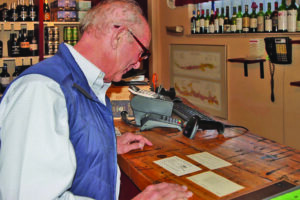
Clif Louis looks back on old mailers the company distributed.
Despite evolving development and competition, Louis has no plans to leave. After more than four decades, what keeps him rooted isn’t foot traffic or trends, it’s loyalty, history, and relationships built bottle by bottle. “We’ve had very loyal customers. A lot of them know my first name,” he says simply.
As Cherry Creek continues to modernize, The Vineyard stands as proof that progress doesn’t have to erase craftsmanship. Behind its shelves of carefully curated wine is a legacy built on curiosity, community, and conversation, one that continues to carry forward the spirit Robbie Wilson first poured into a small basement shop back in 1971.
Below: Current heiress of the Foster family business, Sadie Foster, daughter of Tucker and

by Jessica Hughes | Feb 18, 2026 | Glendale City News
Book Review —
by Jessica Hughes

Katie Vieira is an educator, wife, mother of three, and now a published author. Into the Field is Vieira’s first book.
Monitoring children’s screen time has become one of the most pressing challenges facing parents today, often compared to regulating sugar intake or substance exposure. Where the 1990s urged families to “D.A.R.E.” kids to avoid drugs, today’s battle is often centered on limiting time spent in front of screens. Which is why, Katie Vieira, an educator, wife, and mother of three wants to help children and their parents combat screen addiction by turning to the outdoors with her debut book, Into the Field.
Vieira began noticing the impact of that struggle firsthand when her two daughters showed increasing dependence on digital devices. “I started to notice my kids were constantly asking for it. That’s all they wanted to do,” says Vieira. “No matter how many times I would give the warning to turn off screens, they threw tantrums and became completely distraught.”
She recalls frequent power struggles, especially with her oldest daughter, over getting outside — an early warning sign that prompted concern. “They showed symptoms of digital addiction like difficulty disengaging from technology, mood swings, declining interest in offline activities, compulsive asking for the technology.”
Digital Addiction, as defined by the National Institutes of Health, is identified as functionally equivalent to all addictions, characterized by the compulsive, habitual, and uncontrolled use of digital devices and an excessively repeated engagement in a particular online behavior.
Wanting to help combat her kid’s digital addiction, Vieira focused on creating structures around screen time while intentionally prioritizing outdoor time. They avoid using iPads for education, treat screen time as shared family time, and use technology as a tool for connection rather than distraction. She acknowledges that balance is difficult to maintain. “It’s hard. It’s a slippery slope because it’s easy to say, ‘just put a show on’ but we can’t necessarily get away from it.”

Katie Vieira and her family.
The idea for the book emerged during one of the busiest seasons of Vieira’s life. She was pregnant with her third child while moving across the country before settling in Colorado. During that transition, as her daughters adjusted to a new home and homeschooling, Vieira noticed signs of digital addiction becoming more pronounced. Determined to help them form connections and spend more time outside, she discovered the 1,000 Hours Outside Challenge, which encourages families to match screen time with outdoor time. The challenge responds to data showing children spend roughly 1,000 hours per year on screens — about 2.5 hours per day.
Into the Field is a nature-based adventure story designed to help kids and their parents combat screen addiction through outdoor play. It follows two young sisters — modeled after Vieira’s daughters — who embark on an outdoor adventure to save a friend from screen addiction. Vieira describes the story as portraying an extreme version of the problem. “They are having to save their friend from the video game.” Colorful illustrations by Vieira’s cousin bring the adventure to life, with scenes set amid the landscapes of Tennessee.
The writing process became a family affair. “My girls not only inspired the story, but they actually played a role in writing it,” says Vieira. “I would jot down chapters based off hikes we had just done, after the kids went to bed, and the next morning I would read them the chapter I wrote. They would give some insight on what the kids should wear and sometimes say in certain situations.”

Into the Field is an adventure story designed to help kids and their parents combat screen addiction through outdoor play.
As former classroom teacher with a master’s degree in education, Vieira homeschools her children and emphasizes that technology itself is not the enemy. “I am aware that it is 2026 and still have to use the technology,” she says. “It’s about learning to keep it in their lives in a balanced way.”
She describes the book as magical, adventurous, and family-focused, with a central goal of inspiring outdoor play and creativity. “We have to allow for boredom and force them to be creative without their screens,” she says. “Going outside, allows them to tap into those creative outlets. Allowing them to be imaginative without the stimulus of screens.”
Into the Field is Vieira’s first book, and she has already begun work on the second installment — called Colorado Campground. She plans for the project to become a series, with each book set in a different state. Inspired by her educational background, Vieira also sees Into the Field as a classroom-friendly resource for teachers and parents alike. “My goal is to try and showcase the different biomes across the country, from beaches to mountains,” says Vieira. “I want to weave in social studies and science without the kids really knowing or realizing.”
Through storytelling, geography, and outdoor exploration, Vieira hopes the book series will quietly blend multiple curricula — reading comprehension, science, social studies, and social-emotional learning — while encouraging families to step away from screens and back into the natural world.
Alongside the book, she is also releasing compilation guides and accompanying activities that relate back to each chapter via her Instagram page. You can follow her at @intothefieldbook.
She will also be at the Barnes & Noble in Glendale for a book signing on March 22, from 1-3 p.m. You can also reach out to her directly at intothefield@gmail.com.
by Mark Smiley | Feb 13, 2026 | Travel
by Mark Smiley
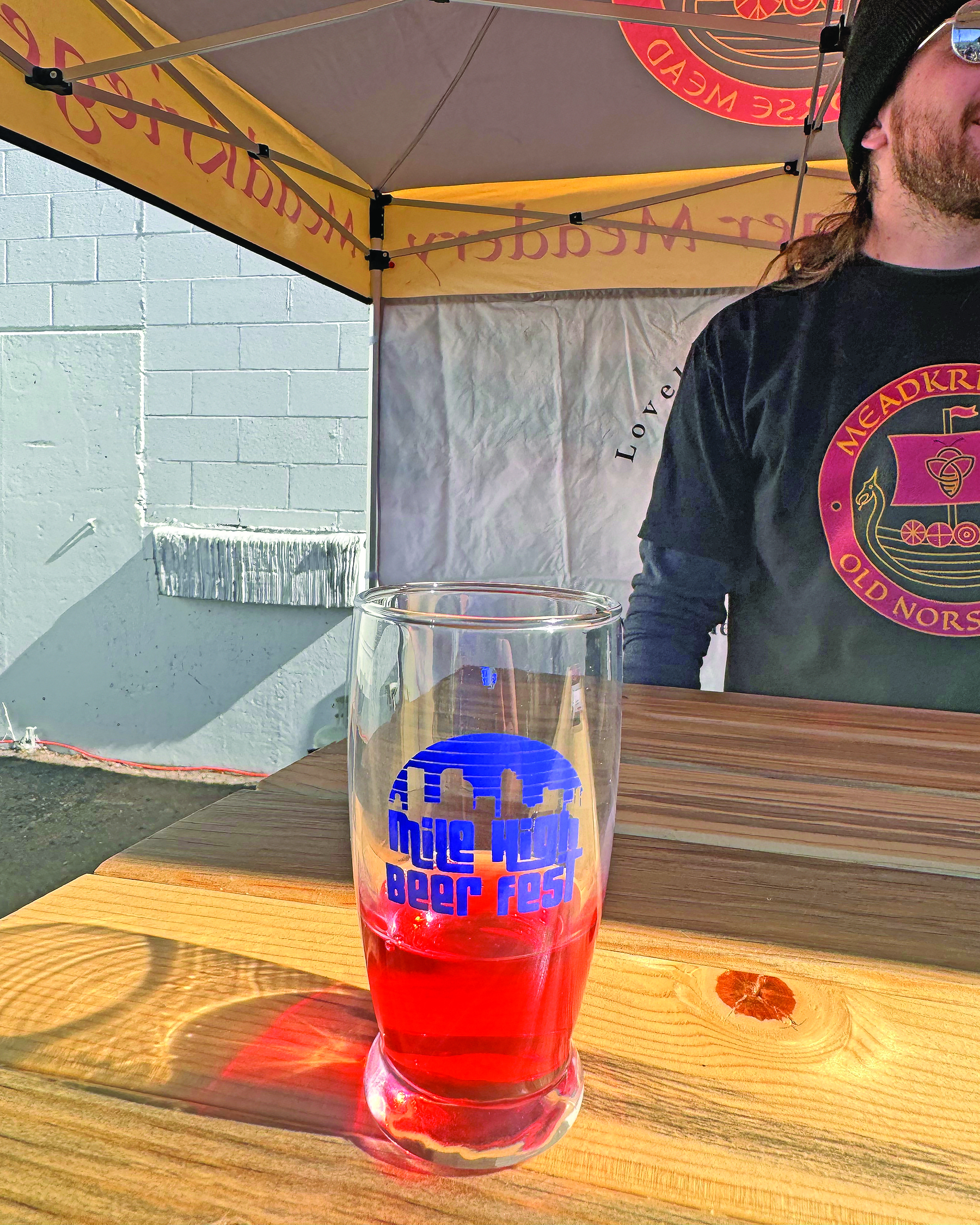
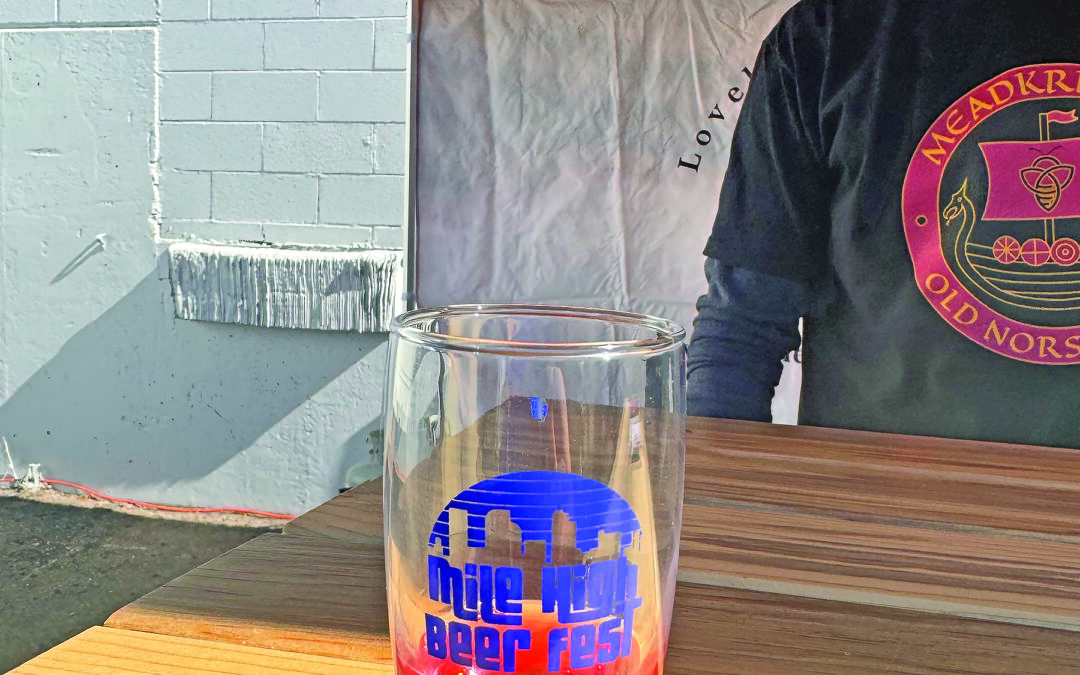
Tasting Glass: A Mile High Beer Fest tasting glass catches the light as attendees sample unique pours from local and regional breweries, highlighting the relaxed, discovery driven atmosphere of the festival.

Five Iron: Representatives from Five Iron Hard Seltzer share their offerings with festivalgoers during Mile High Beer Fest, highlighting the growing variety of craft and non-alcoholic beverage options in Colorado’s evolving beer scene.
The Mile High Beer Fest is returning to Denver on March 7, 2026, bringing nearly 50 breweries together for a celebration of Colorado craft beer, community, and creativity.
This year’s festival will take place at Denargo Market in the RiNo Arts District, a new development featuring expansive public spaces, green lawns, and one of the neighborhood’s most recognizable landmarks, the giant climbing rhino.
Festival organizer Lacey Spruce said the move to Denargo Market offers both flexibility and a fresh experience for attendees. “We’re really excited to partner with Denargo Market,” Spruce said. “The space is beautiful, and it gives us the ability to create a fun, easy to navigate festival while keeping the spirit of Mile High Beer Fest the same.”
The 2026 festival is expected to draw approximately 1,500 attendees and will feature breweries from across Colorado and beyond. Registration for breweries filled quickly, prompting organizers to cap participation at nearly 50 vendors.
Spruce credits the festival’s continued success to its strong focus on local breweries and community connection.
“This event is about celebrating local beer,” she said. “A lot of the time, the people pouring the beer are the brewers or the owners themselves. That personal connection is really special for attendees.”
While the craft beer industry has faced challenges in recent years, including brewery closures and shifting consumer habits, Spruce believes events like Mile High Beer Fest continue to resonate.
“Trends change, but there will always be people who enjoy beer,” she said. “We’re also seeing a big increase in non-alcoholic options, and we’re embracing that by offering more variety every year.”
New breweries joining the festival in 2026 include Goldspot Brewing and Fiction Beer Company, adding to a lineup that blends well known favorites with new discoveries.
In addition to beer, attendees will have the opportunity to learn about Hopscotch, a new beer garden opening this spring at Denargo Market. Operated in partnership with Drink Denver, Hopscotch will feature 16 taps, local beers, canned options, non-alcoholic drinks, wine, and cocktails.
Tickets to Mile High Beer Fest are all inclusive, with no tokens or drink tickets required. Attendees can sample freely throughout the event, a feature Spruce says helps maintain a smooth flow and relaxed atmosphere.
With fewer beer festivals taking place in Denver, Mile High Beer Fest has become a standout event for both brewers and enthusiasts.
“Our goal is to keep delivering a great experience,” Spruce said. “We want people to have fun, discover something new, and feel connected to the local beer community.”
For tickets and event details, visit milehighbeerfest.com.

by Mark Smiley | Feb 1, 2026 | General Featured

Jim Gaffigan performs at the Paramount Theatre on January 24, 2026.
By Mark Smiley
On January 24, 2026, the historic Paramount Theatre in downtown Denver was filled with laughter as one of America’s most beloved stand-up comics, Jim Gaffigan, brought his Everything Is Wonderful! tour to a sold-out audience.
Gaffigan’s appearance, part of a highly anticipated continuation of his 2026 tour, delivered the warm humor and sharp observational wit that has made him a fixture in comedy for decades. The Paramount’s ornate 1920s interior provided an ideal backdrop for an evening of accessible, family friendly entertainment that kept the crowd laughing from start to finish.
From the opening moments, Gaffigan displayed his characteristic ease onstage. His delivery was unhurried yet razor sharp, with each punchline landing precisely. True to form, he mined everyday life for laughs, touching on food obsessions, parenting mishaps, and the small absurdities of modern living. The material felt fresh for longtime fans while remaining instantly relatable for newcomers.
Highlights of the evening included Gaffigan’s playful routines about culinary indulgences and his self-deprecating takes on family life. His comic timing never faltered, and his ability to shift smoothly between quick one-liners and longer narrative bits kept the energy high throughout the set. The entire show ran about an hour and a half which included an opener, typical for a headlining performance, yet there were moments when it felt like the laughs could have continued well into the night.
The Paramount audience was fully engaged, capturing the communal joy that only live comedy can create. Even the familiar challenges of Denver traffic an d crowded parking did little to dampen spirits, as fans arrived with a shared sense of anticipation.
At a time when stand-up comedy often leans toward the abrasive or confrontational, Gaffigan’s easygoing, conversational style stands apart. His humor is clean without being timid and sharp without being cynical. For audiences seeking a night of laughter that feels both comforting and clever, Jim Gaffigan’s performance at the Paramount Theatre delivered exactly that.

by Mark Smiley | Jan 16, 2026 | Editorials
by Mark Smiley
Demolition: Demolition crews begin tearing down the historic City Park West Apartments, standing since 1923, marking the end of a century-old Denver landmark as the site prepares for the future Chrysalis Apartments redevelopment. Photo Credit: Matt Geiger/BusinessDen
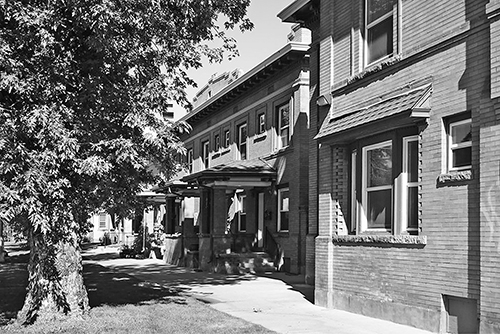
City West Apartments: A black-and-white view of the historic City Park West Apartments in Denver, a longtime neighborhood landmark that served residents for generations.
After standing for more than a century, the City Park West Apartments, first opened in 1923, are officially slated for demolition, marking the end of an era for one of Denver’s long-standing residential landmarks. The property, known for its vintage brick exterior, narrow stairwells, and generations of tenants who called it home has been cleared to make way for a new redevelopment project: the Chrysalis Apartments. The Empowerment Program, a local nonprofit, demolished the 1920s apartment building and an older duplex at 1767 and 1777 Franklin Street. In its place, the organization will construct a 7-story, 70-unit complex.
For longtime residents and nearby neighbors, the announcement has been met with a mix of nostalgia, frustration, and cautious curiosity about what comes next.
“This building has been part of the neighborhood’s heartbeat for as long as anyone can remember,” said one nearby resident who asked not to be named. “You walk past it and you feel Denver’s history. It’s sad to see it go.”
A Building That Outlasted
Decades Of Change
The City Park West Apartments were built during a period when Denver was rapidly expanding outward from downtown. Nearly all of the neighborhood’s early development followed the rise of streetcars, new civic parks, and a growing middle class seeking housing close to city amenities.
Over the decades, the apartments became home to an ever-changing mix of Denverites, young professionals, retirees, artists, service workers, and families, many drawn to the building’s affordability and proximity to City Park, Colfax Avenue, and central Denver.
While charming in reputation, the building also reflected the realities of aging infrastructure: limited modernization, outdated layouts, and increasing maintenance costs.
Why Demolition Now?
According to redevelopment representatives, the decision comes down to structural limitations and the economics of renovation versus rebuilding.
Though historic in age, the City Park West Apartments were never officially preserved under the highest levels of historical protection, leaving the property vulnerable to redevelopment pressures in one of Denver’s fastest-changing housing markets.
The upcoming Chrysalis Apartments project is expected to feature updated units, modern amenities, improved energy efficiency, and a more contemporary design intended to meet the demands of today’s residents.
“Chrysalis”
A Symbol Of Transformation

Chrysalis: A rendering of the future Chrysalis Apartments in Denver, a modern mixed-use redevelopment planned to replace the former City Park West Apartments site.
The name Chrysalis Apartments appears to be a deliberate nod to change and renewal: a chrysalis is the stage of transformation before something new emerges.
Supporters say the project represents opportunity, more housing supply, better building standards, and a chance to reimagine a property that has long needed investment.
Critics, however, warn that “transformation” can be a gentle word for displacement.
“To some people, this is progress,” said one community advocate. “But to tenants who have been here for years, it feels like they’re being pushed out of their own neighborhood.”
Concerns Over Affordability
And Displacement
As Denver rents continue to rise, residents are watching closely for details about what kinds of units the Chrysalis Apartments will include.
Community members have raised questions such as:
- Will any portion of the new apartments be affordable or income-restricted?
- Will current tenants receive relocation assistance?
- Will the redevelopment preserve any of the original character of the site?
- What impact will construction have on nearby streets and businesses?
In many Denver neighborhoods, older apartment buildings serve as naturally occurring “affordable housing” simply because they’re outdated. When they are replaced with luxury new builds, rent prices often jump dramatically, shifting who can afford to live nearby.
A Neighborhood Landmark
Fades Into Memory
Even residents who support new housing say the moment still carries weight.
There is something uniquely bittersweet about watching a nearly 102-year-old building disappear, one that stood through the Great Depression, World War II, the rise and fall of downtown development patterns, and Denver’s modern boom.
For some, the City Park West Apartments were more than just brick and rent checks. They represented first jobs, first leases, new beginnings, and the kind of imperfect but authentic city living that shaped Denver’s identity.
As demolition nears, neighbors have begun sharing photos and stories online, quietly memorializing a building that many assumed would always be there.