
by Valley Gadfly | Nov 17, 2022 | Main Articles
Lit Up And Dressed Up, Valley Buzzing With The Sights, Sounds Of The Holiday Season
There’s an air of excitement and celebration in Glendale-Cherry Creek, downtown, and throughout the Valley this December. Neighborhoods are aglow with decorations and abuzz with activities and events. As the song goes, “this is the most wonderful time of the year.”
Get the family into the holiday spirit with these fun activities, celebrations, events, and dining options:
Cherry Creek North
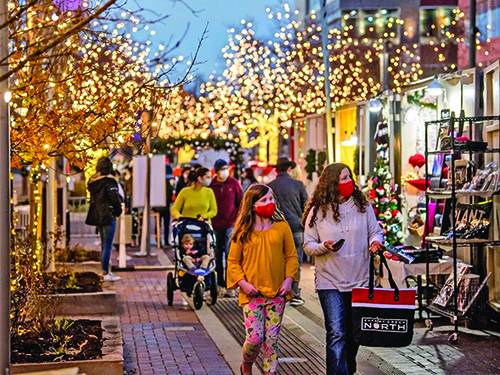 Cherry Creek Holiday Market: Shop for gifts at more than 50 spaces daily Nov. 17-Dec. 24. Event features live music Thursday-Sunday, plus a full bar. Deals, programming, and pop-ups make visits unique.
Cherry Creek Carriage Rides: Free horse-drawn carriage ride through Winter Wanderland every Wednesday, Nov. 23-Dec. 21, 5-8 p.m. Rides are first come, first served at 2nd Ave. and Fillmore St.
Winter Wanderland Light Walk: Neighborhood’s over 600 trees adorned with a million lights. Eight displays in the 16 blocks choreographed to holiday music. Visitors can register to win a $1,000 gift card.
Chanukah Celebration: Chabad of Cherry Creek hosts a menorah lighting on the first night of Chanukah, Dec. 18, 8 p.m. Face painting, fire juggling, and treats at Gart Plaza on 3rd Ave. and Milwaukee St.
A Journey Through Time: Interactive art installation features six giant musical hourglasses on display daily, Nov. 17-Dec. 24. You’ll enjoy spending time watching bursting lights fill the air with dancing colors.
Saturday Night Lights: Festive entertainment will line the streets on Saturday nights, 5-7 p.m. The family-friendly celebration features stilt walkers, acrobats, jugglers, and other performers.
Small Business Weekend: Shop Cherry Creek North’s more than 125 locally-owned shops and 30+ locally owned restaurants, Nov. 25-27. Deals, gifts plus a chance to win a $500 gift card.
Blossoms of Light: Don’t miss the holiday light extravaganza on display at Denver Botanic Gardens through Jan. 7, 4:30-9 p.m. Information: 720-865-3500.
Downtown Denver
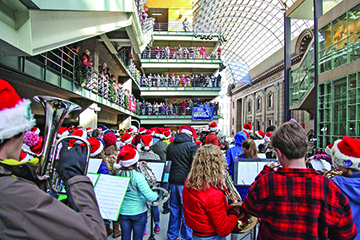
Sounds Of The Season: Don’t miss the free Holiday BrassFest concert Dec. 2 in the Denver Center For Performing Arts complex starting at noon, Dec. 1.
Art On Santa Fe: View paintings, ceramics, jewelry, and sculpture in galleries during 35th Holiday Show this month. Open weekdays and on 1st and 3rd Friday evenings. Information: 303-573-5903.
Light The Lights: Catch the eight-minute choreographed light-music show in Civic Center Park, Nov. 23-Jan. 22, 5:45 and 6:45 p.m. Lights on City-County Bldg. before, between, and after nightly shows.
Lights & Sights Tour: Visit the D&F Clock Tower, Larimer Square, The Mile High Tree, and Christkindlmarket, ending at Union Station Nov. 26-Jan. 1, 5:40-7:40 p.m. Information: 720-372-3849.
Holiday BrassFest: Plan to be downtown at the DCPA Complex for free Denver Brass concert Dec. 2, starting at noon. Information: 303-893-4100.
 Zoo Lights: Enjoy animated animal sculptures, entertainment, and live animal encounters with the kids at the Denver Zoo through Jan. 16, 5:30-8:30 p.m. Information: 720-337-1400.
Rudolph Ramble 5K: Take the kids to City Park for free Kids Fun Run Dec. 4, 9 to 10:30 a.m. Youngsters will be helping Santa find Rudolph. Information: halsports.net.
Cristkindlmarket: Shop authentic German Holiday Market in Civic Center Park, Nov. 18-Dec. 24. Cozy huts sell artisan gifts and tasty treats. Information: gacc-co.org.
Santa’s Flight Academy: Take the kids to see the 22-ft.-tall sleigh and experience the magical snowfall in the Grand Court at Cherry Creek Shopping Center Nov. 11-24. Information: 303-388-3800.
Happiness Is Helping
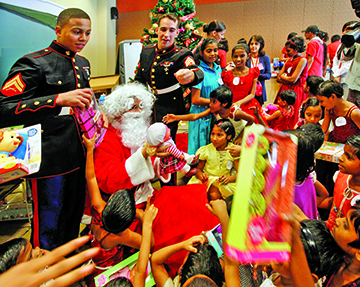
Holiday Is For Kids: Among ways to help struggling families this month is by supporting the Toys for Tots program run in partnership with the Marine Corps.
Help struggling families this month by providing free toys, food boxes, meals, and gift cards. More: Volunteer to prepare meals so children and elderly adults experience holiday joy.
Toys For Tots: Program is run in partnership with the Marine Corps. New and gently used toys are given to needy children. Information: 720-346-3234.
Senior Services: Gerontological Society provides low-income seniors with free boxes of food for the holidays. Information: 303-333-3482.
Inner City Parish: Parish collects toys and food to assist children. Families are given food baskets, Christmas meals, small toys, and more. Information: 303-629-0636.
Denver Rescue Mission: Based on donations, free toys, gifts, and food are passed out by the charity to the homeless and vulnerable. Information: 303-297-1815.
Garden Of Color: The annual Blossoms of Light has returned to the Denver Botanic Gardens on York St. now through Jan. 7.
Community Ministry: Christmas food boxes provide complete holiday dinners. The Sharing Tree program offers a designated dollar amount to buy presents for children-teenagers. Information: 303-935-3428.
Denver Santa Claus Shop: Helps children, single moms, immigrants, and low-income families. Free toys, gifts, jackets, gift cards, and more. Information: 720-944-3666.
Operation Santa Claus: Provides adopt a family program during the holidays. Free gifts, tree decorations, toys, and holiday food boxes are provided. Information: 720-308-1828.
Volunteers Of America: VOA has a Santa Shop for kids age 0 to 18. Games, books, winter clothes, bicycles, and other toys offered. Information: 303-297-0408.
Holiday Eats
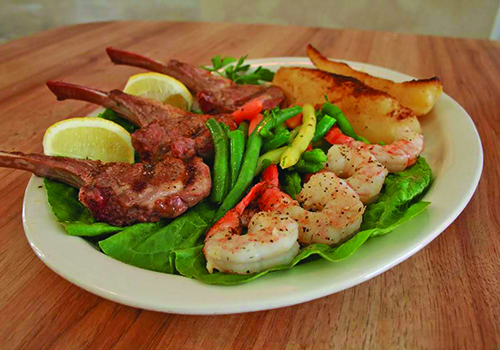
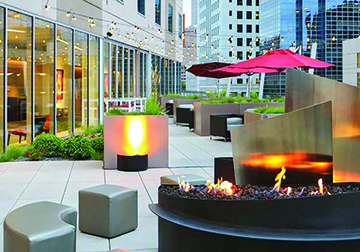
Fire & Food: Dining out makes the holiday season doubly special. You can find nourishment from Noel to New Year’s at the Fire in the ART Hotel and at the Monaco Inn Restaurant serving four specials, including Lamb Chops & Grilled Shrimp on Christmas, New Year’s Eve.
Not everyone wants or chooses to cook for the holidays. Fortunately, there are ample restaurants offering hours on Christmas Eve, Day, plus New Year’s Eve. Here’s a quick year-end guide to where to find nourishment from Noël to New Year’s:
Blackbird Public House: If turkey or ham dinners with all the trimmings are what you crave, consider this eatery on S. Downing St. in Wash Park. Open Christmas Eve. 7 p.m. to 1 a.m., closed Christmas Day, and open shorter hours on New Year’s Day. Information: 303-733-3923.
Blue Island Oyster Bar & Seafood: For a comfortable, casual holiday spend time at this E. 2nd Ave. eatery in Cherry Creek North, a top sea food restaurant. Celebrate the season with steamed mussels, lobster rolls, and fresh fish, plus craft cocktails and wine. Information: 303-333-2462.
Fire: Warm up with the Christmas Eve and Christmas day brunch or dinner at this restaurant in the ART Hotel near the Denver Art Museum. Cuisine choices include Sea Bass, Filet Mignon, and Colorado Lamb. Information: 303-572-8000.
Monaco Inn Restaurant: Give yourself the gift of good food, good prices, and good times at this long-time holiday hot spot serving Christmas Eve and New Year’s Eve from 5 to 9 p.m. Specials include a choice of Lamb Shank, Lamb Chops & Grilled Shrimp, New York Steak & Fried Shrimp, or Grilled Salmon served with choice of Avgolemono Soup or Greek Salad. Regular menu also available. Information: 303-320-1104.
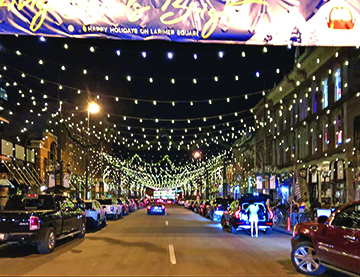
Russell’s Smokehouse: Make it a slow and smokey holiday at this Smokehouse on Larimer St. Christmas or New Year’s Eve. Enjoy Prime Rib Roast, Beef Au Jus, and Whipped Potatoes as you bid adieu to the Larimer Square long-time eatery.
’Tis The Season: Shop for gifts at the Cherry Creek Holiday Market, Nov. 17-24. Market has live music Thursday-Sunday, plus a full bar.
by Valley Gadfly | Nov 17, 2022 | Main Articles
Loss Of Larimer Looms As New Owner Runs Restaurants, Retailers Out Of The Historic Heart, Soul Of Downtown Denver
by Glen Richardson
Bitter End: Exit of a steady stream of restaurants-retailers spells end of Larimer Square, City’s oldest commercial block. Charlotte, NC firm, Asana Partners, paid $91.49 million for the district at end of 2021.
Larimer Square — the Mile High City’s first historic district — first landed on the National Trust for Historic Place’s list of “most endangered historic places” in 2018. As 2022 draws to an end, a steady stream of restaurants and retailers on the city’s oldest commercial block have disclosed they are closing their doors.
Among the restaurants and retailers announcing their departure or closure since the purchase by Asana Partners are award-winning French restaurant Bistro Vendome and renowned local jeweler Gusterman Silversmiths. More: Chef driven restaurant group Bonanno Concepts is closing both Russell’s Smokehouse and Green Russell. Other retailers shuttering Larimer spaces thus far are Victoriana Antique & Fine Jewelry and Pendleton Wool Shop. The overhaul of buildings along the Square by Asana — including the 1880 Sussex Bldg. where Bistro Vendome is located — foretells the impending, untimely closure of additional businesses.
The empty storefronts will be more than just depressing eyesores; they also threaten the economic viability of the remaining businesses. The 2023 flight of companies from Larimer Square not only threatens the beating heart of Denver, it also likely spells serious consequences for downtown’s struggling comeback.
Loss Of Larimer
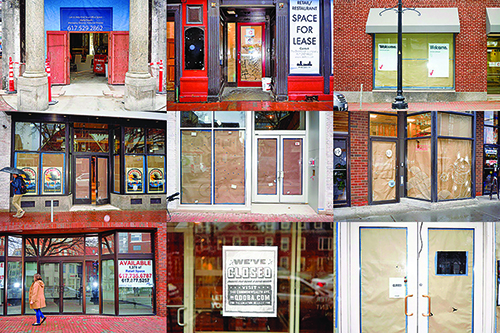
Historic New Look: Like new owner Asana Partners’ Harvard Square, Larimer Square is expected to be boarded up as firm awaits juicy leases from lucrative national chains.
Charlotte, N.C.-based Asana Partners paid $91.49 million for the district located on Larimer and Market streets between 14th and 15th streets, plus an adjacent parking garage at the end of 2021. The purchase is comprised of 25 properties including 22 historic buildings, some dating back to the 1880s.
Previous owner Jeff Hermanson — who controlled the city’s most recognizable and popular commercial district for 27 years — brought celebrated restaurants and renowned retailers to the district. Developer Dana Crawford originally owned many of Larimer’s buildings and was the driving force behind its historic designation. She sold the Square to San Diego-based Hahn Co. in 1986. Hermanson bought it from Hahn in 1993. After almost two decades as a Larimer Square staple, award-winning restaurant Bistro Vendome was the first to announce its departure. That was followed by Bonanno Concepts’ announcement that it would be closing both its high-end barbecue space Russell’s Smokehouse and underground speakeasy Green Russell for the same reason, Asana’s up to three-year renovation of the Sussex building that houses the trio.
Forcing Businesses Out
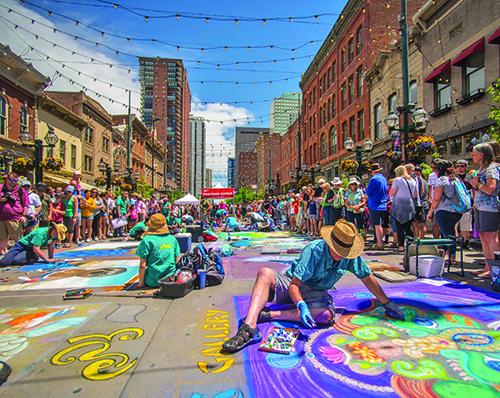
Larimer’s Last Draw: Chalk it up to communal gluttony, community events such as the Chalk Art Festival are being wiped out just like the businesses along Larimer St.
Valley residents had high hopes that the sale of the commercial blocks to Asana wouldn’t cause much of a change. Indeed, that seemed to be the message of newspaper and TV reports when the sale was first announced. However, a check by the Chronicle of historic mixed-use sites the firm owns and operates in the U.S. is troubling: Following purchase, tenants at Asana-owned properties grapple with high rents, resulting in huge turnovers.
Historic Harvard Square in Cambridge, Mass., is quite comparable to Larimer. The real estate firm arrived at the plaza in 2017, paying $108 million. Retailers-restaurants at the site were still intact and business was booming at the time of purchase. Less than three years later, numerous local businesses had either moved or were shuttered — and all but one of them replaced by national chains. Papered-over storefronts and “for rent” signs have marred the appearance of Harvard Square and are threatening the heart of Cambridge.
After Asana took over, local businesses relocated or closed as their leases ran out, citing a breakdown in negotiations or unsustainable rent hikes. Bottom Line: The sky-high rents at the square have forced out small businesses, sparking concerns among community leaders and earning Asana mixed reviews from proprietors and patrons alike.
Restaurants Rattled
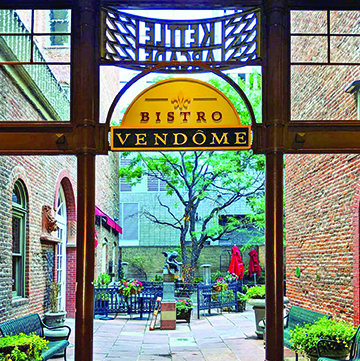
French Kiss Goodbye: After almost two decades on Larimer Square, Best French Restaurant Bistro Vendôme is relocating to Park Hill.
After almost two decades at Larimer Square, Bistro Vendôme — named Best French Restaurant, Top Brunch, and Best French Fries — is moving to 2267 Kearney St. in Park Hill. Owners have negotiated a lease for the new site — where closed eatery Tables was located — that could last though 2039.
Restaurateurs Jacqueline and Frank Bonanno are closing both Russell’s Smokehouse and their speakeasy-like bar Green Russell beneath Larimer Square after 12 years. New Year’s Eve will be the last day for both.
Jacqueline says they were originally told “it was a permanent infrastructure.” Later Asana said it was temporary, “invited us back in two years when the work is done and we could renegotiate the lease, which we’re not going to do.” She describes their relationship with Asana as distant at best.
The Bonannos are eager to find a new spot and reopen the barbecue eatery. Should they locate a space, it would again be headed by Chef Bryan Rosen, albeit the name could change. The speakeasy, however, won’t be resurrected. Asana indicates it plans to turn the Green Russell space into a boiler-maintenance room.
Retail Roulette
The beloved Gusterman Silversmiths — a nearly six-decade fixture on Larimer —under the ownership of Mary Eckels since 1978, closes. The shop’s patrons included actress Debbie Reynolds, author Clive Cussler, and Senator Gary Hart. She had completed a dozen four- and five-year leases, but the next renewal would have been under Asana. “The proposal they gave me to stay was not something I could commit to,” Eckels declares.
Dana Crawford helped start Victoriana Antique & Fine Jewelry in 1984. She later sold it to David & Veronica Prebble. The couple had planned to sell Victoriana to its current manager, Zach Burk. But Asana told them the store would have to move to a location off Larimer with half of its current 832-sq.-ft. space. “It was a totally unworkable situation,” David Prebble says. “They have the right to make me move, but they’re supposed to provide me with a comparable space. But they said there was no comparable space available.”
When Portland, Ore., based retailer Pendleton Wool Shop’s Larimer Square lease expired, the shop was relocated to the River North Art District. New address for the wool company is 2650 Walnut St.
by Mark Smiley | Nov 17, 2022 | Main Articles
by Mark Smiley
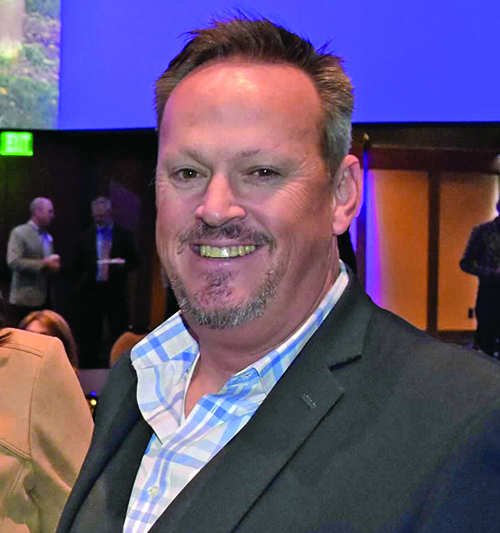
Long Career: Captain Mike Gross served under six Glendale city managers during his 28 years at the Glendale Police Department. He is pictured here in 2019 at the retirement party for then-City Manager Jerry Peters.
Captain Mike Gross of the Glendale Police Department has retired from the force he called home for 28 years and has started a new career. Gross, who began his law enforcement career as a reserve officer in Glendale, was part of the first class to come out of that program in 1994. And on January 12, 1995, he was hired on full time.
Since he was a teenager, Gross wanted to be a police officer. “When I graduated from high school, I wasn’t old enough to be a police officer,” said Mike Gross. “I asked the people at the Sheriff’s office what I should do. They said to go into the military. I asked them which one was the hardest. They said the Marine Corps, and so I went to the Marine Corps office and signed up. I was injured in the Marine Corps and received an honorable medical discharge and went into the academy and the rest is history.”
After eight years on the force, Gross was promoted to lieutenant in 2003 and he was a key part of the Glendale Police Department changing its culture after some incidents of excessive force in the 1990s. Under then Police Chief Victor Ross, Gross started to introduce new concepts that were cutting edge at the time. “We started to change the culture of the police department,” said Gross. “Specifically, with how we use force. We completely overhauled our training program and we changed our policy. This is something I am especially proud of, the changing of the culture, ushering in scenario-based training that was ahead of its time. It’s common now, but in 2003 we were cutting edge.”
Also under his watch, the Glendale Police created a Workplace Violence training course for the businesses. “With so few single family homes [in Glendale], it makes sense for us to focus on workplace violence,” said Gross. “Workplace violence is one of the greatest threats to our personal safety in our society.”
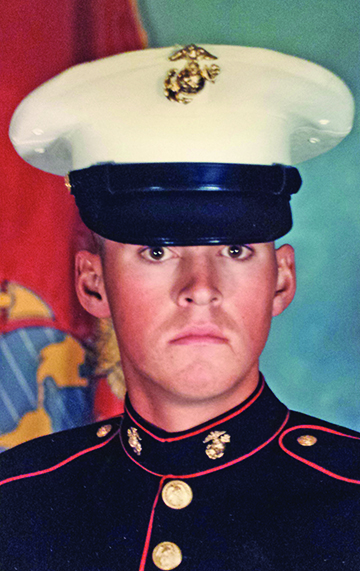
Marine: Mike Gross entered the Marine Corps out of high school because he was too young to join a police department.
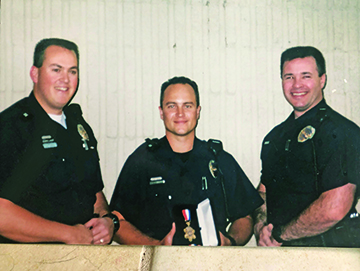
Rookie Cops: Mike Gross, left, Joe Silla, and Joe Haskins were young police officers coming up through the ranks in the mid-1990s.
Another notch in his long list of accomplishments was being an important voice on the development of Infinity Park, a multi-use complex built in 2007. “One of the things I love most about Glendale is that it is a small city and you have to wear a lot of hats,” said Gross. When the city started to build Infinity Park, it had a decision maker from each department meet every Wednesday, which Gross was a part of. “It was really neat to be part of that project and be able to have an opinion on things,” said Gross. “That was a unique experience to be part of and it was great to get to do that.”
In an interview with Glendale Mayor Mike Dunafon, the Mayor had many kind words to say about Gross, including calling him a “class act.” “We were fortunate to have Captain Gross as an integral part of our police force for 28 years,” said Mayor Dunafon. “He had an incredible ability to think through problems and juggle multiple projects that required a vast array of skill sets. His organizational skills were tremendous and I am confident he will utilize his many talents in his future endeavors.”
That future endeavor is already locked in, as Gross has accepted a position as Vice President of State, Local, and Education at NowVertical Group, a global technology firm. “We congratulate Mike for his well-deserved retirement from law enforcement,” said Dave Whitmire, President of NOW Solutions. “We are incredibly blessed to have Mike as an executive on our team. Mike brings decades of experience in law enforcement and smart policing to our team and will lead our technology-enabled services group to create critical tools for our first responders.”
Whitmire went on to address Gross’s leadership abilities. “Mike’s leadership has been, and will continue to be, instrumental in providing us valuable insights in protecting our nation’s critical infrastructure,” said Whitmire. “We are honored to have Mike and are humbled by his many years of service to his community. We look forward to his continued service to it in the commercial sector.”
Gross is one of the most highly decorated members of the Glendale Police Department. He was awarded the Medal of Valor and the Distinguished Service Medal. Gross speaks fondly of his nearly three decades of service in Glendale. “I am so thankful for the opportunities I was given in Glendale,” said Gross. “I was able to be a part of a bi
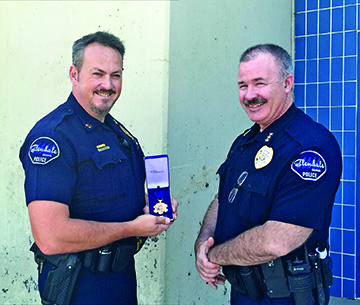
Highly Decorated: Mike Gross was one of the most decorated police officers in the history of the department. He is shown here receiving the Distinguished Service Medal from Glendale Police Chief Joe Haskins.
g project [Infinity Park] and see it be designed, built, and operated as a member of the police department.”
Although this highly decorated Police Captain was able to accomplish a lot in the Village of Glendale, he acknowledges that it is the support of his family that allowed him to be such an impactful contributor. “I would like to thank my wife Leslie and my daughters Maddie and Megan for always supporting me through all the holidays, birthdays, and special occasions that I missed,” said Gross. “All of the times that plans changed or were cancelled because I was called in to work.”
And it is this dedication to the Glendale Police Department and the citizens and businesses of Glendale that made Captain Mike Gross respected, honored, and valued. Gross can still be found at Infinity Park catching a rugby game from time to time. After all, it is a stadium he was a key member of creating 15 years ago. He enjoys coming back to enjoy the fruits of his labor.
by Valley Gadfly | Oct 21, 2022 | Main Articles
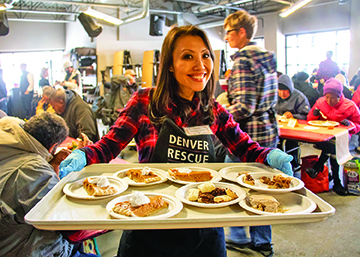
Food For Thought: Consider donating time, food, and funds to help others this Thanksgiving. Denver Rescue Mission is among groups feeding the hungry this year. (Kevin J. Beaty/Denverite)
A Leg Up On Restaurants Open For Holiday Dining Nov. 24th; This Year’s United Way Turkey Trot Has Been A Tradition Since 1973
Celebrated on the fourth Thursday in November, Thanksgiving is Nov. 24 this year. Shifting each year, dates for the federal holiday can occur from Nov. 22 to Nov. 28.
For many it is a way to express gratitude for family, or to a higher power; for others, it’s simply a holiday to be with family and enjoy delicious food. Despite inflation and a bird flu outbreak, nearly 90% of people plan to celebrate this year, an increase from 2021.
Thanksgiving is synonymous with family and lots of good food, but that doesn’t mean the food has to be made at home. Why cook when you can eat-in or take out at area restaurants?
Where To Dine Out
Citizen Rail: A holiday veteran, restaurant in LoDo’s Kimpton Hotel Born is featuring a three-course Thanksgiving meal — dine-in or take out — with 10% of proceeds made to No Kid Hungry, 1 to 8 p.m. Information: 303-323-0017.
The Corner Office: Downtown Curtis Hotel eatery is serving a Thanksgiving spread starting with butternut squash & cider soup. Feast features achiote-marinated turkey breast, mashed potatoes, trimmings, 11 a.m. to 9 p.m. Information: 303-825-6500.
Del Frisco’s Grill: Cherry Creek bar-grill on St. Paul St. is offering a three-course turkey dinner with herb-butter roasted turkey breast, 11 a.m. to 9 p.m. Some menu items offered. Information: 303-320-8529.
Edge Restaurant: Steakhouse in the Four Seasons on 14th St. is serving an adult & kids buffet, 11 a.m. to 5 p.m. Traditional entrees, carving station, raw bar & dessert bar. Pre-fixe dinner menu, 6 to 9 p.m. Information: 303-389-3050.
Humboldt Kitchen: Eatery offers brunch from 10 a.m. to 1 p.m. That’s followed by Thanksgiving dinner served at 2 p.m., 4 p.m. or 6 p.m. Choose from turkey breast, prime rib, grilled salmon, or butternut squash risotto. Information: 303-813-1700.
The Kitchen: Restaurant in the Sugar Building on Wazee St. is featuring turkey with leek & mushroom dressing, plus starters-desserts. Dine-in or take out. Information: 303-623-3127.
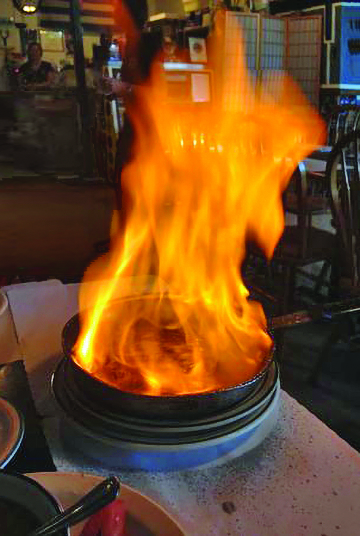
Feast Returns: Holiday hot spot, the Monaco Inn Restaurant is bringing its Thanksgiving Feast back, noon to 6 p.m. Patrons can ignite the holiday with a flaming Saganaki appetizer.
Monaco Inn Restaurant: Opa! This holiday dining institution is bringing its Thanksgiving Feast back, noon to 6 p.m. Tucked in corner of Monaco Square, cozy eatery is serving classic roast turkey with stuffing and all the trimmings. Other choices include Leg of Lamb, Lamb Chops, a Greek Combo, New York Steak, Salmon, or Trout. Ignite the holiday with a flaming Saganaki appetizer. Information: 303-320-1104.
Quality Italian: Cherry Creek’s Halcyon Hotel eatery on Columbine St. is serving roasted bird with rosemary gravy, mushroom stuffing, and kabocha squash. Information: 303-532-8888.
Urban Farmer: LoDo’s Oxford Hotel eatery offers a choice of honey roasted turkey breast, prime rib, a 6 oz. filet, salmon, or cauliflower steak, 11 a.m. to 8 p.m. Information: 303-262-6070.
Ditch The Turkey?
Ace Eat Serve: Want a change from turkey? Try Peking duck at this uptown eatery that’s carved tableside and served with mu shu crepes, 4 to 10 p.m. Information: 303-800-7705.
Gyu-Kaku Japanese BBQ: Cook but kick the turkey at Cherry Creek’s Japanese eatery on 1st & Steele St., noon to 9 p.m. Grill beef, chicken, pork, seafood, and vegetables tableside. Information: 720-826-3214.
Thanksgiving Take Out
Edible Beats: Three of group’s restaurants — Root Down, Linger, and El Five — are featuring turkey done two ways, plus sides. Order by Nov. 22, pickup on Nov. 24-25 at Linger, located at 2030 W. 30th Ave. Information: 720-282-3593.
Turkey Day Doings
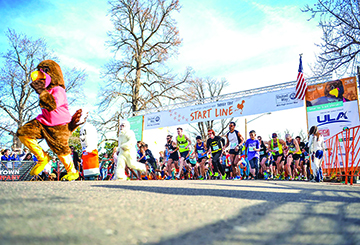
Hot Turkey Trot: Join Mile High United Way’s Turkey Trot in Wash Park this holiday. Four-mile run-walk has a four-wave start every 30 minutes beginning at 9 a.m.
Beyond getting stuffed and doing annual turkey trots, you can donate time, food, and funds to stay busy this holiday weekend.
This year’s Turkey Trot marks Mile High United Way’s 135th anniversary as the first United Way in the world. It’s also the 49th anniversary of United Way’s local Turkey Trot.
By participating, you are joining in Denver’s top Thanksgiving tradition while also giving back to the community. Registration for the four-mile run-walk at Wash Park opens at 8:15 a.m. The event has a four-wave start every 30 minutes, beginning at 9 a.m. At just under a mile, the 10:40 a.m. Little Gobbler Family Fun-Run is flawless family fun. More than 9,000 are expected. Information: 303-433-8383.
Other Thanksgiving races include the Gobble Wobble Run in Littleton, the Huffin’ for Stuffin’ two-mile fun run in Loveland, plus a Turkey ROCK Trot in Castle Rock. There’s also a Pumpkin Pie 5K-10K at City Park on Nov. 19, 9 a.m.
Gobblin’ For Gifts
Denver Rescue Mission: Non-profit needs 15,000 frozen turkeys. Mission also gives 3,000 Banquet-in-a-Box turkey dinners. Donations of canned pumpkin, cranberry sauce, yams, boxed stuffing, and mashed potatoes also needed. Information: 303-297-1815.
Epworth Foundation: Support Foundation and Neighborhood Forward Denver by providing funds for 10,000 Thanksgiving baskets. Tradition is in honor of former Five Points restaurant owner Daddy Bruce Randolph. Information: 303-296-6287.
Food Bank Of The Rockies: Volunteer or give funds to help provide food-necessities for food bank that serves largest coverage area in U.S. Donate, volunteer at Bank’s 10700 E. 45th Ave. distribution center. Information: 303-371-9250.
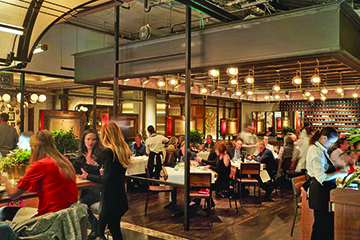
Creek Celebration: For fine dining in Cherry Creek North this Thanksgiving, Quality Italian in the district’s Halcyon Hotel is serving roasted bird with rosemary gravy.
Jewish Family Service: Donate funds to fill Thanksgiving boxes for Nov. 23 distribution. Give frozen turkeys, canned, cut yams-sweet potatoes, plus instant mashed potatoes and stuffing at 3201 S. Tamarac Dr. Information: 303-597-5000.
Project Angel Heart: Make a donation or order a pie to help provide meals for those with health conditions on Thanksgiving or anytime. More: join a pie fundraiser or order a pie from PieInTheSkyColorado.org. Information: 303-407-9418.
Samaritan House: Donate frozen turkeys at metro area Catholic Charity shelters. Donating funds support the Samaritan House and their women-only shelter, the largest in Denver. Information: 720-799-9297.
The Table: Visit, encourage family and friends to patronize café-taproom owned by non-profit Table Urban Farm. The 2109 S. Platte River Dr. eatery and its farm provide free food on Thanksgiving and throughout year. Information: 303-744-1113.
by Mark Smiley | Oct 21, 2022 | Main Articles
Comrade Brewing Company Wins Gold Medal
by Mark Smiley
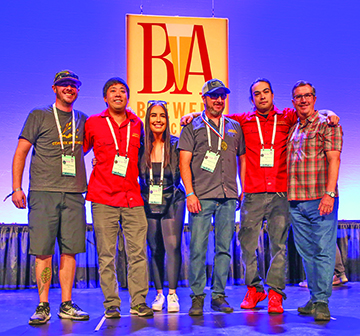
Gold Medal Winner: Comrade Brewing Company won a Gold medal at the 2022 GABF for More Dodge Less Ram in the American-Style India Pale Ale category.
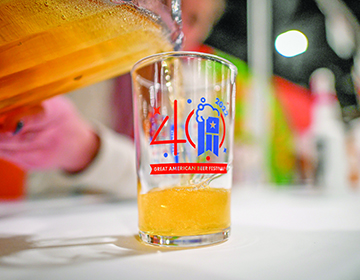
The 40th anniversary of the Great American Beer Festival (GABF) returned to the Colorado Convention Center October 6-8, 2022. GABF has grown exponentially since 1982, where just 24 breweries and 47 beers were present; 40 years later, GABF featured more than 2,000 different beers from nearly 500 of the nation’s finest breweries.
The 2022 GABF competition awarded 300 medals to the best commercial breweries in the United States. Presented by the Brewers Association (BA), GABF is the nation’s largest professional beer competition.
Award-winning breweries received prestigious gold, silver, and bronze medals in 98 beer categories covering 177 different beer styles (including all subcategories), establishing the best examples of each style in the country. In addition, three GABF Collaboration medals pairing two professional breweries, and three GABF Pro-Am medals pairing homebrewers with professional brewers, were announced.
The competition took place in three phases over a period of nine days and was judged by 235 beer experts from seven countries, including the U.S. In addition to 9,904 commercial brewery entries, the judging panel also evaluated 35 Pro-Am entries and 94 Collaboration entries. The competition was made possible with the help of 310 volunteers.
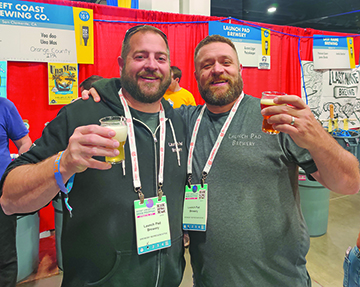
Hometown Favorite: David Levesque, Owner / Founder / Brew Master of Launch Pad Brewery, left, and Casey Bloyer, Distribution manager of Launch Pad Brewery, celebrate winning a Silver medal for their Citronaut in the English Ale category.
Many of those winning breweries were from the state of Colorado. There were 23 independent Colorado breweries that were awarded 26 medals at the GABF competition on October 8, 2022, held in the Bellco Theater.
Denver favorite, Comrade Brewing Company, earned its second gold medal for More Dodge and Less Ram, taking home top honors in the most competitive category this year, American-Style India Pale Ale. “It was a huge surprise for us, since it was the last category announced, said David Lin, Owner of Comrade Brewing Company. “After we saw there were 423 entries, our hopes were dashed. We’ve been doing our own thing here at the brewery and we’re honored to see the judges think so as well.”
Left Hand Brewing Company continued as the most awarded craft brewery in Colorado, collecting two medals in 2022 and their 29th medal at GABF overall. Bristol Brewing collected the brewery’s 10th GABF medal for Laughing Lab Scottish Ale (the last time the brewery earned a GABF medal for this beer was in 2010), and this is the 14th medal for the Colorado-Springs based brewery.
Cannonball Creek pushed its winning streak to 10 years earning a bronze medal in the specialty saison category, a first for the brewery in this style; the Golden-based brewery has won 15 GABF medals in total across 10 different categories in the past 10 years.
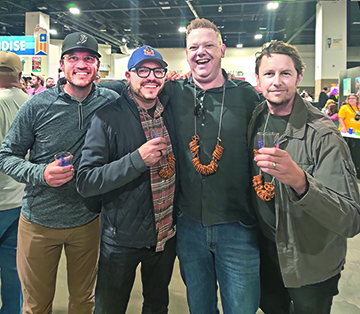
Beer Enthusiasts: These valley residents were excited to be back in person to try some of the best beers from around the country.
“Colorado proves that we are a leader in the craft beer industry and shows that our brewers continue to brew consistently excellent beers in all types of styles,” said Colorado Brewers Guild Executive Director Shawnee Adelson.
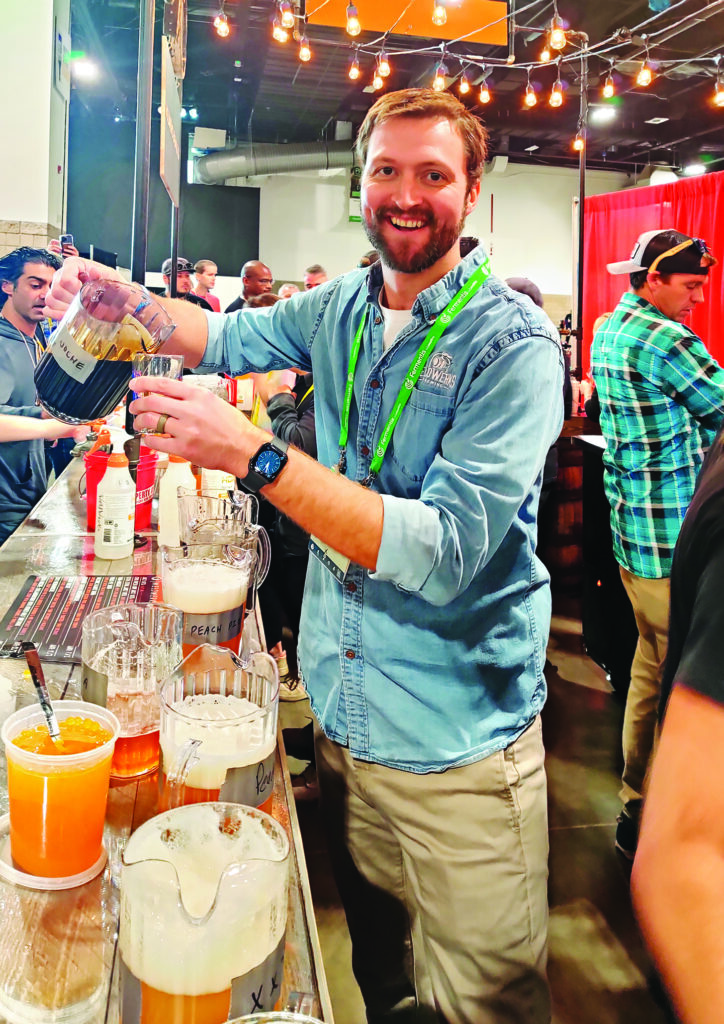
Starry Noche: Neil Fisher, Co-Founder, Head Brewer of WeldWerks Brewery, pours Starry Noche at their booth at the 2022 GABF on Saturday, October 8, 2022.
Although it did not win a medal, WeldWerks Brewery from Greeley poured its 2022 vintage of Starry Noche, started as a carefully selected blend of Medianoche batches aged for 20-29 months in a variety of freshly emptied Old Fitzgerald 14-year bourbon, Elijah Craig 19-year bourbon, Sazerac 14-year rye, Blanton’s 8-year bourbon, Eagle Rare 10-year bourbon, and Henry McKenna 11-year bourbon barrels. After resting in these casks for over two years, the blend was conditioned on more than three pounds per gallon of toasted coconut flakes and raw coconut chips and finished with toasted hazelnut.
Overall, there was a buzz inside the Colorado Convention Center. Attendees were excited to be back in person to try some of the best beers from around the country.
“Each year the Great American Beer Festival showcases the best that American brewers have to offer,” said Chris Williams, competition director, Great American Beer Festival. “With 9,904 entries, this year’s competition was the most competitive to date. Congratulations to all the winners who truly demonstrated why the U.S. is the best brewing nation in the world.”
For more information on GABF and to see the list of all the winners, visit www. greatamericanbeerfestival.com. For more information on the Colorado Brewers Guild, visit www.coloradobeer.org. The 41st Great American Beer Festival is set for September 21-23, 2023.
by Valley Gadfly | Oct 21, 2022 | Main Articles
A Flood Of New Construction Is Underway In The District Amid A Flock Of New, Renewed Projects Paused In The Pipeline
by Glen Richardson
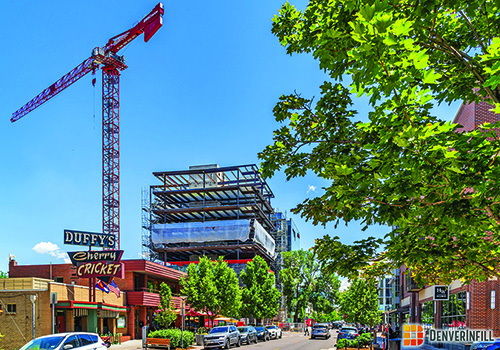
Cranes O’er Cherry Creek: Cranes are again in the air over Cherry Creek as district building is booming again. This eight-story project is on the southeast corner of 2nd Ave. as Broe Real Estate Group restarts the makeover of the east side of Clayton St.
Onset of the pandemic gave rise to a welcome respite from non-stop redevelopment of Cherry Creek North that began in 2013. Countless major projects were stuck in the pipeline during the long shutdown. As reopenings picked up the pace in 2022, the neighborhood is again undergoing a construction boom with hordes of new and renewed projects started or proceeding at an unprecedented pace.
As construction cranes again fill the neighborhood, citizens express concern that the once serene shopping district of boutiques and eclectic eateries will become a landscape of glass, brick, and steel. Others fear rapid growth will escalate the districts’ surging crime rate. A check by the Chronicle showed — 2022 vs. 2021 —violent crime in Cherry Creek is up 12.5%; property crime is up 23.2%; car thefts are up 51.1%, and robberies are up 200.0%.
Here’s a look at the flood of new construction, big and small, good and not-so-good, currently underway in the district:
200 Clayton
Substantial headway has been made on the corner office building at 2nd Ave. and Clayton St. Both the cores and steel structure have topped out with fireproofing and facade work underway. It will be an eight-story, 76,000-sq.-ft. high-rise on the southeast corner of 2nd Ave. Built by Broe Real Estate Group, it will feature both retail and commercial space.
The firm owns the bulk of the east side of Clayton St. and the corner site is restarting the transformation of this north-south street.
When 200 Clayton is completed, Broe will demolish the two-story parking garage it owns to the north and build yet another seven-story structure. It is projected to have 3,000-sq.-ft. of ground-floor retail space and 31,890-sq.ft. of office space.
255 Fillmore
In 2016 the Cherry Creek Plaza building was demolished to make way for a seven-story office building. However, the project never broke ground and the site stood as a surface parking lot. Now a new rendition of the project has broken ground with excavation underway. Yet another Matt Joblon project, it is a 100,000-sq.-ft. seven-story building that is 95% leased, with Vietnamese-French eatery Le Colonial taking one of the street-level spots.
300 Fillmore
Just a half-block from 255 Fillmore, another new office project has broken ground. Throughout the boom, Cherry Creek North has seen little development on the north side of East 3rd Ave. due to it being zoned for buildings no higher than four stories. Nonetheless, demolition of a two-story structure is underway, with a four-story, 70,814-sq.-ft. building planned that will include 117 surface parking spaces. The 0.43-acre parcel is where Grind Kitchen, Tazu Sushi, women’s boutique Harriet’s, and jewelry store Element79 were located.
300 University
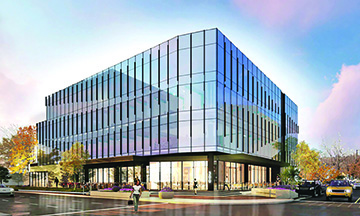 Along Cherry Creek’s western edge, on the north side of East 3rd Ave., a four-story building with 50,000-sq.-ft. of office space and 10,000-sq.-ft of ground floor retail will be built. The project is on a half-acre site where floral-home furnishing store Bloom by Anuschka was located, and includes a parking lot leased to Hillstone Restaurant. The project is a family business of Brent Farber of Elevation Development and his uncle, Rick Sapkin, of Edgemark Development. Sapkin has owned the property for more than 30 years.
180 Madison St.
Modera Cherry Creek is making great progress on an apartment project in Cherry Creek East. The five-story structure is on the southeast corner of 2nd Ave. & Madison St. It has topped out, a brick-focused facade making its way up the building. First move-ins are expected this fall in the complex, which will feature a mix of studio, one-, two-, and three-bedroom units as large as 2,044-sq.-ft.
Slew Set To Be Built 155 & 165 N. Cook
Mill Creek is planning a second project similar to their Modera Cherry Creek a block away. Plans as recent as May have been filed with the city. However, some individual plans require resubmittal. The site is on the southwest corner of 2nd Ave. and Cook St. The project is replacing a pair of three- and four-story office buildings.
299 Milwaukee
The southwest corner of 3rd Ave. and Milwaukee St. may see a new eight-story residential building. Currently, the parcel is occupied by a plaza and two-story parking structure.
242 Milwaukee
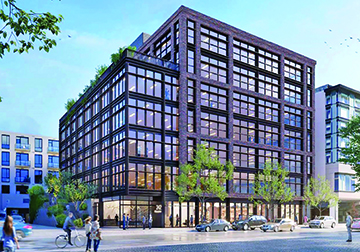
Hip High End Offices: With low inventory and high demand, new office buildings are adding to the district’s building boom. This proposed seven-story project is mid-block on Milwaukee St.
There is a lot of interest in office development in Cherry Creek North. This proposed project is between East 2nd and 3rd Ave., mid-block along Milwaukee St. Plans call for a seven-story office building that would replace a two-story retail structure.
201 Fillmore
An eight-story office building is being planned at the northwest corner of East 2nd Ave. and Fillmore St. The building would replace the single-story retail space that currently houses a Men’s Warehouse plus an adjacent parking lot.
329 Detroit
A small condo project has been proposed for a parcel mid-block on Detroit St. between East 3rd and 4th Ave. The five-story project would replace a single-story building that was the Witold-K Art Studio & Gallery for 40 years. The Denver artist’s work is in museums and galleries worldwide. He participated in the New York Graphic Masters exhibition with Picasso, Chagall, and Miro, and was the first American to have works displayed at Sotheby’s in Amsterdam.
Mall’s West End
As the Chronicle reported in March, East West Partners is planning to build seven structures up to 12 stories tall at the west end of the Cherry Creek Shopping Center. Plans call for the first four buildings to have 780,000-sq.-ft. of office-retail space, plus three condo-apartment homes with 600 units.