by Mark Smiley | Jul 22, 2022 | Main Articles
Auditor O’Brien Warns There’s A High Risk Of Errors, Misuse, Potential Fraud Of The City’s $126.9 Million In Federal Relief Funds
by Glen Richardson

Homeless Help: City & County of Denver is using the largest amount of Coronavirus Relief Funds to pay for shelter and housing for the homeless.
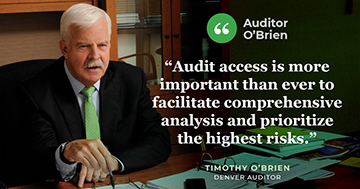
Denver Auditor Timothy M. O’Brien’s follow-up to his 2021 audit, flagged several gaps in the Denver Department of Finance that need to be fixed, especially as the City prepares to take in hundreds of millions of dollars more in federal funds from the ongoing pandemic response. “We saw huge amounts of money coming into the city from the federal government and going out the door just as quickly,” he says.
Recently awarded the National Excellence in Government Accountability Award for local auditors, his follow-up discovered the Finance Department had failed to reconcile some bank accounts related to pandemic relief funding for at least two months and supervisors had not reviewed some reconciliations for at least four months.
The Department of Finance had committed to implementing all five recommendations from the original audit, but more than six months later, four of those recommendations were not implemented, he reveals. The department did successfully implement O’Brien’s recommendation that it provide more detailed guidance to city staff on what kinds of documentation they need to keep so they can prove that an expense was related to the pandemic.
Reconciling Bank Account

Funding Failure: Department of Finance committed to implementing five recommendations after 2021 audit, but more than four months later four of the five were still not executed.
Discovery that the Finance Department had failed to reconcile pandemic relief funding bank accounts is particularly worrisome, he enlightens. “Bank reconciliations are an important procedure in any accounting system, because they help ensure accurate records and reduce the risk of errors and fraud.”
The Department of Finance promised to implement O’Brien’s recommendations following his original audit by September 2021, but they hadn’t been done six months later. Moreover, the department still has not sufficiently cross-trained its staff, and it does not yet have sufficient policies to ensure staff reconcile bank accounts each month — and that supervisors then verify that those bank reconciliations actually happen.
“While I’m pleased the city is offering better guidance on documentation, implementing only one recommendation is not good enough considering the high risks and high-dollar amounts involved with pandemic relief funding,” O’Brien warns.
Tracking Interest
The follow-up works also found the department’s procedures for tracking interest overlook critical steps, which render them ineffective. They do not ensure city staff post interest earnings in a timely and accurate manner each month and that grant managers then monitor their grants to account for the interest earned.

Pandemic Funding Risks: Auditor’s follow-up to 2021 audit finds gaps in the Department of Finance as city prepares to take in hundreds of millions of dollars more in federal funds.
Because of this, the city risks not using all available dollars when the money must be used by a certain date. “Our original audit found this happened with about $1.8 million in interest earnings the city was unaware it had in 2020 as it was planning pandemic-related projects,” he reveals. While that error was eventually corrected, it could have kept additional relief dollars out of city services and programs through 2020.
“By still not adequately accounting for interest, the city risks forfeiting additional valuable aid it could otherwise use to help the Denver community as our residents continue recovering from the pandemic,” Auditor O’Brien declares. “I hope the Department of Finance will continue working to fill in these crucial gaps in its process.”
Pandemic Funding
Federal aid in 2020 helped Denver pay for a wide array of unexpected costs related to its pandemic response. The money from the Coronavirus Relief Fund was used to support food assistance, public health efforts, economic support, and individual support. The largest amount was planned to pay for shelter and housing.
Other sources of pandemic relief aid were not part of our 2021 audit. In total, the City and County of Denver was awarded more than $604 million in pandemic-related funding from various sources, as of April 2021.
Furthermore, as of last summer, Denver was to receive another $308 million from the American Rescue Plan, which it will need to spend by Dec. 31, 2024.
Months ahead of the first payouts from Denver’s new Fair Elections Fund, the Clerk & Recorder’s Office was still working to ensure accuracy in how it will manage the program, according to a new audit from Auditor Timothy M. O’Brien, CPA. The first payments from the Fair Elections Fund will go out this month (August 2022), ahead of the next municipal election in April 2023.
The Clerk & Recorder’s Office needs a policy to verify campaign contributions made to participating candidates come from valid sources. And the office needs a way to confirm candidates are accepting only small-dollar contributions, Also the office needs to create a policy to ensure it accurately pays out any matching funds. Plus, it needs to make sure candidates are trained consistently and within the required time frame. The office needs a plan for how it will notify candidates that they have been approved to participate in the Fair Elections Fund, and it needs a way to enforce the public debate requirement for participating candidates.
“The next municipal election is coming up in less than a year, and candidates are already declaring their intent to participate in the new Fair Elections Fund,” Auditor O’Brien notes. “I felt it was important to audit this program now, so the Clerk and Recorder’s Office has a chance to get ahead of any outstanding operational needs.” Our team completed a readiness audit of the Fair Elections Fund and looked at gaps in policies and procedures, as well as how the office is planning for accountability after the 2023 Denver municipal election.

by Jessica Hughes | Jul 22, 2022 | Main Articles
by Jessica Hughes
With its distinct design, the Populus hotel will be the first carbon-positive hotel in the country. Rendering provided by Studio Gang
On April 22, 2022, a groundbreaking ceremony was held in Denver for the first ever carbon-positive hotel in the country. With plans to open in late 2023, Populus will be a 13-story hotel comprised of 265 rooms, with a rooftop restaurant and bar, all designed to serve as an architectural landmark while making strides toward a future of sustainable travel and a sustainable planet.
Developed by Urban Villages, a leading real estate developer and environmental steward based here in Denver, Populus will be the first of its kind to be entirely carbon positive beginning with its construction by calculating the carbon footprint of the entire project, including the extraction, production, transportation, and construction of every element of the building.
“We are relentless in our research in selecting materials that minimize waste, by opting for low-carbon concrete mixes and high-recycled content materials, while also taking steps to minimize the carbon footprint in the transportation of materials,” said Grant McCargo, Co-Founder, Chief Executive Officer, Chief Environmental Officer, and Partner of Urban Villages.
In addition to their on-site sustainable building efforts, Urban Villages also puts into place significant ecological initiatives offsite, including an initial commitment to planting trees that represent over 5,000 acres of forest — offsetting an embodied carbon footprint equivalent to nearly 500,000 gallons of gas and removing additional carbon dioxide from the atmosphere.
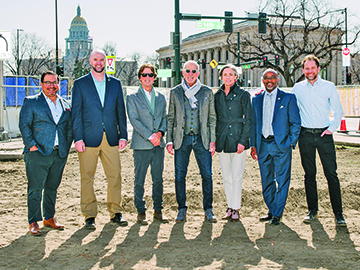
In April, a ground breaking ceremony was held in Denver for the first-ever carbon-positive hotel. Photo credit: Ryan Dearth
“We determined that planting 5,000 acres of trees would sequester that same amount of carbon out of the atmosphere, storing it in our soils,” said McCargo. “We are also committed to continually planting more trees to offset the energy we consume every day after the hotel opens. In that capacity, we are leaving the planet in a better place than we found it.”
Urban Villages is partnering with the architecture firm, Studio Gang, to help create a space that is not only carbon positive but also architecturally attractive. Populus will be Studio Gang’s first building in Colorado, designed with distinctive features that could alter the Denver skyline and the way we approach new builds in the future.
“Populus was designed with specific elements that allow it to perform efficiently in Denver’s wide-ranging climate,” states McCargo. “The building’s distinctive windows, which echo the “Aspen eyes” and façade are designed for high environmental performance — self-shading, insulating, and channeling rainwater — as part of the architecture’s larger green vision.”
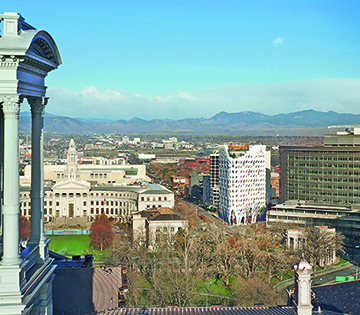
A rendering of hotel Populus nestled amongst Denver’s Civic Center neighborhood. Rendering provided by Studio Gang
The first floor will hold a mix of restaurants and shops; the second floor will house meeting spaces; and the top floor will feature a series of hospitality-style suites. But the most coveted area of the hotel will be the rooftop bar and restaurant. “The public rooftop will feature an expansive garden terrace planted with regional vegetation, which serves as a lush place to socialize and a visual representation of Populus’ green ethos while naturally and efficiently cooling the building,” said McCargo.
Populus continues with its unique design by becoming the first new-build hotel in Denver without any onsite parking. “By removing parking entirely, we encourage residents and travelers to use public transportation,” said Jeff Hermanson, Urban Villages partner and longtime owner and steward of Denver’s Larimer Square. “Parking garages are built of steel and reinforced concrete, which heavily increase carbon profiles, so by eliminating onsite parking, Populus is both significantly reducing its carbon profile.” Of course it might, in effect, just steal parking from existing parking to the deterrent of the whole neighborhood, critics argue.
The hotel will join Denver building icons, such as the Denver Art Museum and the Denver Public Library, in the Civic Center Park neighborhood. Occupying the corner section at 14th Street and Colfax Avenue, Populus might serve as the catalyst for the revitalization of this historic Denver neighborhood.
“We chose Civic Center Park as it is a prominent and central location in downtown Denver and has great potential to become an energizing connector for the neighborhood. Civic Center Park exists at the nexus of history, culture, government, and business enterprise, and this will be the area’s first true leisure hotel, breathing fresh life into its social scene,” said Hermanson.
Additional information about this project can be found at urban-villages.com/ portfolio/populus.

by Regan Bervar | Jun 26, 2022 | Main Articles
“Justice is indispensably and universally necessary, and what is necessary must always be limited, uniform, and distinct.”
— Samuel Johnson
 by Luke Schmaltz
Immigration policy and enforcement in the United States is ensnared in a three-way collision between the inertia of the Legislative branch, the duty of the Judicial branch, and the will of the Executive branch. Plainly put, Congress writes the laws on immigration, the Department of Justice enforces those laws, and the President tells them how to do it.
This entanglement of the three branches of government — which were originally designed to be “separate and independent” — sits at the heart of the Immigration Courts’ struggle to efficiently apply due process and to fairly administer justice.
The Long Arm Of The Law
Many people attempting to immigrate to the United States do not have a concrete plan of how to proceed.
Meanwhile, a large contingency of professionals across the vocational spectrum are immersed in this deluge, attempting to navigate the confusion and find some currency of reason. These individuals include judges, lawyers, clerks, administrators, detention facility staff, Federal agents, law enforcement staff and many others.
Additionally, the people embroiled in the system who are experiencing the most uncertainty are immigrants (lawfully admitted foreign nationals), non-immigrants (lawfully but temporarily admitted foreign nationals), refugees, and asylum seekers. The latter two distinctions are people who are outside their home countries and unwilling to return due to persecution or a well-founded fear thereof. The common thread between all of these folks is they are trying to find a way to remain in the United States.
Whether the wishes of noncitizens are granted is determined by immigration policy, which is governed by the Immigration and Nationality Act (INA). While this piece of legislation has been amended numerous times since its inception in 1952, Congress has demonstrated a profound inability to engineer the bipartisan cooperation necessary to make improvements which match the current demand.
Staggering Numbers
According to a June 12 article by Claire Moses of The New York Times, “The number of people crossing at the [southern] border is at the highest it’s been in at least two decades.” These individuals are arriving from places such as Mexico, Guatemala, Honduras, Cuba, Venezuela, Nicaragua, El Salvador, Peru, Haiti, and most recently, Ukraine. The vast majority are attempting to escape from poverty, authoritarian governments, natural disasters, gang violence, and war, while seeking economic opportunities.
A May 17, 2022, report issued by U.S. Customs and Border Protection (CBP) states that, during the previous month, U.S. Border Patrol agents recorded over 201,800 unique encounters at the southern border alone, along with 157,555 encounters nationwide in addition to 32,288 encounters by Office of Field Operations officers at various ports of entry. While some will be granted asylum, most will be detained and eventually removed (sent back to their home countries).
Unchecked and unbalanced, today’s Immigration policy hinders the courts therein from effectively handling the above numbers in anything resembling an efficient manner. The current system is fraught with hindrances of every sort, including a massive backlog of cases due to Covid-19 restrictions, staffing shortages, disruptive Executive branch policies, Congressional inaction, and political interference — to name a few.
An Immersed Perspective

The American Bar Association is proposing a set of solutions for streamlining the Immigration Court system.
While the immigration issue is a nationwide concern, a large number of cases are heard in Colorado in the Denver and Aurora Immigration Courts. Brian Clark is a Colorado attorney based in Alamo Placita, whose legal practice is focused on removal defense of noncitizens. Clark offers the unique perspective of a working professional who, on a daily basis, navigates and interprets the current set of policies for the intended benefit of his clients.
Clark offers detailed discourse on the obstacles faced by foreign nationals who are currently attempting to emigrate to the U.S. “ Under the current system there are short-term means that allow foreigners to come to the United States, such as tourist visas and student visas, but they’re intended to be temporary (although many people do overstay them),” he says. “Most foreigners attempting to emigrate to the U.S. in any long-term sense don’t really have a straightforward avenue for doing so unless they marry a U.S. citizen or can find a U.S. company to sponsor them as a skilled foreign worker.
“This, then, leaves the asylum process as a kind of default for many noncitizens who have left their countries of origin and have come to the United States, particularly for those from less developed countries. However, U.S. asylum law is very particular and tricky, with specific requirements that the person was persecuted in their country of origin based on certain immutable qualities about them (among other factors) — so a lot of noncitizens who come here for perfectly understandable reasons end up having a hard time showing that they qualify for asylum under the law. So, the primary obstacles faced by foreigners looking to immigrate to the United States are the lack of viable legal options available to them under current U.S. immigration law,” he explains.
Thank You, Mr. President
Clark faces myriad challenges as an Immigration Attorney, many of which stem from the tumult which arises every time a new President moves into the White House. “As a lawyer, when a prospective client comes to you seeking legal representation or counsel you have to assess the facts of their situation and candidly advise them of the viability of their case in light of the law,” he says. “That’s really tough to do when the interpretation, application, and enforcement of the law changes every time a new U.S. President is sworn into office, which is what has happened in recent years.
“A noncitizen who applied for asylum during the Obama administration may have had a strong case at the time the application was filed; and then after the interpretation of the law shifted during the Trump administration their case may have become markedly weaker as it moved through the Immigration Court process; but then during the Biden administration their asylum case may suddenly be revived and viable again. So, how strong a given case may be can depend on who the U.S. President happens to be when the case is presented in front of an Immigration Judge. That’s been one of the bigger challenges to practicing U.S. immigration law in the last few years — the unpredictability of the state of the actual law itself.”
Tumultuous Tides
Clark offers a front-row account of how the shifting balance of Executive power creates the see-saw effect which is so pervasive in today’s Immigration Courts. “In the last few years,” he begins, “The Department of Homeland Security has vigorously enforced certain aspects of immigration law under one administration, and then when the Presidency went to the other major party, they’ve been directed by the new administration to backtrack and dismiss the very same cases they were under orders to prosecute a couple of years ago. It’s anything but optimal, but immigration policy and enforcement have ping-ponged back and forth during the last three presidential administrations. And if the party in control of the White House changes again in the next election, then enforcement and application of the laws may well revert 180-degrees b

The U.S. Department of Homeland Security is run by the Department of Justice.
ack to what it was under the last administration, and all the cases that are being administratively closed and dismissed right now could be reopened again by the next administration.”
Not What It Seems
Among the frustrations of Attorney Clark, are the inaccurate generalizations by which the immigration issue is portrayed in mainstream culture. “I’m not a partisan idealogue,” he begins, “I got into immigration law in part because as a young person I lived abroad, and I fruitlessly tried to navigate another country’s immigration system without an attorney. In the current polarized American cultural climate, I find it tedious that immigration is such a hot-button issue that both major political parties tend to cast in sweeping hyperbolic binary terms. In reality, actually practicing immigration law is not about broad categories of ‘good guys’ versus ‘bad guys’ any more than any other part of the legal system is. It’s complicated and nuanced.
“Some noncitizens in the U.S. really, really get screwed over by the system and it’s deeply unfair and unjust how much the current structure of the law is stacked against them — but then there are other noncitizens who are appropriately removed from the country after they have had their day in court. That’s kind of how all aspects of the law are, in reality; individualized and particular to the people involved. Immigrants, as a group, are not a uniform cohort in almost any sense, so I find it irritating when moral grandstanding and fearmongering are done on behalf of, or against, ‘immigrants’ as though that term applies to a homogenous group of people. It does not,” he explains.
Hope On The Horizon?
Rather than concede to the idea that Immigration policy is destined to stay where it is, Clark offers poignant observations along with constructive ideas on how the ship could be righted. “The Immigration Court system is housed within the Justice Department,” he begins. “So, it is not really an independent court system like civil and criminal courts. That means that Immigration Judges are unfortunately deprived of full independence and autonomy, which can create problems when the Attorney General decides that an across-the-board change in the interpretation or application of the law is to be made. The current Immigration Court system is overwhelmed by a massive backlog of cases, which frustrates and exhausts everyone involved with it; the lawyers, the judges, the clerks and administrat
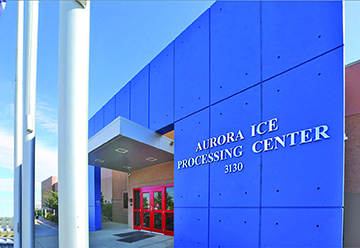
The ICE Detention Center in Aurora has a massive backlog of cases waiting to be heard due to Covid-19 setbacks.
ors, and the noncitizens whose cases it is supposed to adjudicate. The administrators of the Immigration Courts appear to be focused as of late on tackling the case backlog, which is certainly necessary in the short-term, but it’s not a permanent solution to the problems with the Immigration Courts.
“The most reasonable thing to do to fix the Immigration Courts at this point would be for Congress to pass reform legislation, and in so doing to follow the recommendations made repeatedly by the American Bar Association in the last few years — by making the Immigration Courts into proper independent Article III Courts rather than a part of the Department of Justice. Doing so would, at a minimum, help create more stability and consistency between different presidential administrations. Congress could also reform U.S. immigration law to allow for more temporary work options and other non-permanent avenues for otherwise law-abiding non-citizens to live and work in the United States lawfully. I won’t hold my breath though.”
by Jessica Hughes | Jun 26, 2022 | Main Articles
by Jessica Hughes

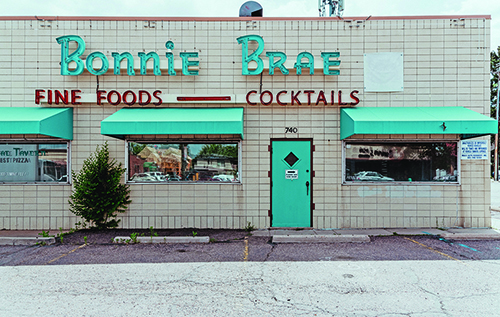
Inside: Bonnie Brae Tavern where things hadn’t changed much over 88 years. Image by JLH in Design

Driving Power: On the northeast corner of S. University Blvd. at Exposition Ave., the Conoco Gas Station has been in the Wilson family since 1942.
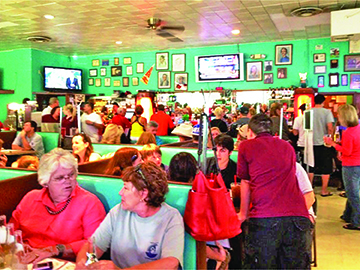
Days Long Gone: In the late ’70s and ’80s people waited an hour for dinner at the restaurant-tavern.
The 88-year-old building will be demolished to make way for apartments but with attempts to keep the original neon sign. Main image by JLH in Design
 In the wake of the pandemic, current inflation, the Great Resignation, and Denver’s expensive costs, it’s no wonder local restaurants are finding it hard to hang on. While the average life of a restaurant is only five years, two Denver restaurants weathered the storm for years but have made the decision to close in light of these tough times.
Bonnie Brae Tavern, the one-time dining nexus of Cherry Creek, and one of Denver’s oldest restaurants, closed its doors at the end of June after operating for 88 years as one of the city’s top places to grab a pizza and a beer. For nearly a half-dozen years in the late ’70s and ’80s people waited an hour for dinner at the restaurant-tavern. Built in 1934, the 88-year-old structure at 740 S. University Blvd. closed permanently at the end of June.
The Tavern ran as a family-owned and operated business for nearly nine decades but after a decline in business, a spike in property taxes, the pandemic, and their most recent roadblock of staffing issues, the tavern made the hard choice to sell. The property sold for $4.5 Million and the building will be demolished to make way for construction of a three-story, practically half-block long apartment complex.
Purchase of the Bonnie Brae Tavern’s 0.72-acre property is being led by two Denver investment pros. They are Churchill Bunn of Alpine Investments and Rhys Duggan of Revesco Properties. The pair often collaborate on local projects. Among jobs they have recently worked together on include a Golden Triangle project on Bannock St., and Chestnut Place in Union Station North. The only thing the twosome have said so far is that, “We are in the initial stages of concept planning for a three-story apartment project.” The project’s demolition order remains valid through May 2024.
The sale of the property and eventual demolition w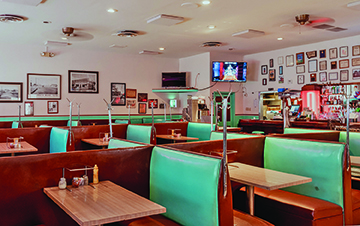 as inevitable after staffing, plumbing, electrical, and keeping up with the trends issues. “Our staff went from 32 employees to 14 and wee couldn’t find any help; staffing has been a real issue,” explains Michael Dire, one of the owners and grandson of the original owners of Bonnie Brae Tavern. “We’re an old-style restaurant and our menu hasn’t changed much over the years, but people’s tastes have changed. I guess we just didn’t stay up with the food trends.”
Michael and the tavern’s other ow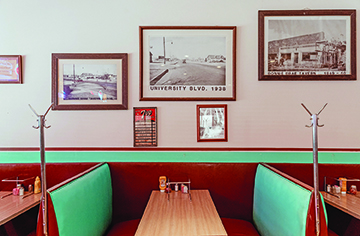 ners received multiple inquiries over the years and had thought about redeveloping the restaurant itself, but not everyone was on board. The Dire family sold the restaurant and adjoining building to developers for $4.5 million at the end of May. While the new neighbors will plan to build apartments, they intend to keep the neon sign along with some of the pictures from the restaurant as a tribute to the restaurant.
It’s a family affair at the Tavern. Since Sue and Carl Dire, Michael’s grandparents, opened Bonnie Brae Tavern in 1934, Michael’s dad and uncle started working at the restaurant, and soon following in his father’s footsteps, Michael began working there 40 years ago, along with his cousin Ricky Dire who has been there since he was 15 years old. Even Michael’s children work at the family’s business, managing, and waiting tables.
“I think they would be very proud about the business being around for 88 years, but they would be sad that the legacy is ending though,” expresses Michael.
The Tavern has received mixed reactions from the public, some that understand the transition, and others who think they sold out. Shopping district restaurants and retailers along S. University Blvd. plus homeowners in the surrounding neighborhoods are concerned and anxious about community consequences. Questions abound about how the development will change the neighborhood and their lives:
Will the sale attract chain retails and the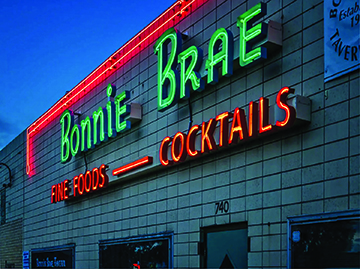 influx of commercial buildings that will erase the area’s character? Is it likely the apartments will alter who lives on the nearby streets and in neighborhoods? Are longtime business owners more likely to put their stores on the chopping block?
This much is certain: Traffic delays will develop along the S. University Blvd. strip as shadows from construction cranes become visible. Furthermore, the sale includes the space leased by In & Out Cleaners on the north end of the Tavern building adjacent to longtime eatery 730 South. Most recently home to Brightmarten, the eatery space is expected to open as taco destination Ni Tuyo this month.
At the Tavern’s south end, the Wish Gifts shop located on the southeast corner of Ohio and S. University Ave. will also be bulldozed. Originally opened as a branch to Bank of the West in Cherry Creek, the space has been a Wish Gifts since 2012. A second Wish Gifts recently opened on E. Hampden Ave. The original Wish Boutique is on nearby S. Gaylord St.
“Denver is transitioning,” says Michael. “I think there is a significant change happening. I think the restaurant industry is shifting with mom-and-pop places struggling with food costs, high rent, and employment issues. It’s too hard right now. Staffing has been the wors
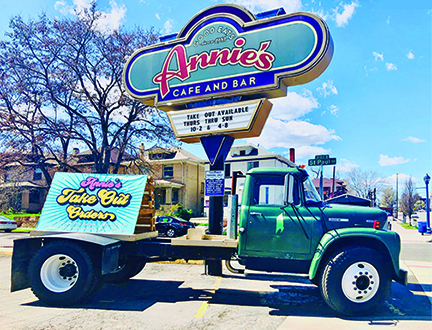
Annie’s Cafe and Bar made it through the pandemic with their take-out menu but closed last month due to expensive costs in Denver. Photo provided by Mary Meggitt
t.”
For the owners of Annie’s Cafe and Bar on East Colfax, closing was for slightly different reasons. “We did not own the building. It was purchased and we had to close,” says Mary Meggitt who helps run the cafe and is the sister of the owner Peggy Meggitt. “We had one of two options, to buy it ourselves or move again.”
Moving locations was certainly something they had done before when they had moved from their original location on Colorado Boulevard to the current one on Colfax in 2008. But with expensive costs, moving wasn’t an option.
“It is so expensive out there. The cost of doing business is so high right now. It’s just crazy,” says Mary. “We looked at all the numbers. It would cost so much money to move locations. So, we had to make the decision to close.”
Mary says staffing issues were never the problem. “We have the best staff and best employees here. Our main cook has been with us for 41 years, and some of our waitresses have been with us for 20+ years,” says Mary.
For both Michael and Mary, it is a mourning period for their families and loyal patrons. “We have worked so hard the past few years to keep it going, so it’s sad to say goodbye,” says Mary as she holds back her tears. “I’m grieving. It’s hard. My three kids were planning to take it over, so I worry about them now that we’ve sold,” says Dire.
For Mary, she will miss her customers the most. “Our customers are the best.” Speechless with the stories her customers shared about what the restaurant has meant to them over the years, Mary says “it has been so moving.”
While Michael currently doesn’t have any future plans, other than taking a breather as he sifts through the loss of his wife this past October and the loss of the family business, he hopes the neighborhood still thrives and hopes that they miss us very much.
Legacy Remains
Despite closure of the Tavern, the Bonnie Brae restaurant-retail district continues to retain much of its 1920s heritage. Most businesses are still locally owned and managed. Moreover, many have remained in the same family for generations.
Consider these local ownership facts: North of the tavern on the same side of the street, the Conoco Gas Station on the corner of South University Blvd. and East Exposition Ave. has been in the Wilson family since 1942. Even the adjacent Katherine’s French Bakery & Café — a relative newcomer — has been in business more than 10 years.
On the opposite side of University at East Exposition Ave., the Campus Lounge was owned for nearly 40 years by University of Denver alumni Jim Wiste. In 2016 he sold it and retired. The space re-opened with different owners three times in as many years. Now owned by the Recess Beer Garden, the third time was the charm. The building’s owner Charlie Woodley of the St. Charles Town Co. grew up a few blocks away.
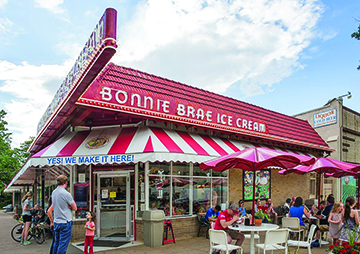
Popular Place: Owned by the same two couples since 1986, Bonnie Brae Ice Cream remains one of the street’s most popular destinations.
Ice Cream Hot Spot
Across the street from the doomed Wish Gifts, Bonnie Brae Ice Cream continues to scoop people’s favorite flavors. Owned by Cindy & Bob Pailet and Ken & Judy Simon since 1986, it remains as much of a destination as any fine restaurant.
With a line out the door at the corner of East Ohio Ave. and South University Blvd. almost anytime of year, it is one of the neighborhood’s most popular year-around businesses.
The ice cream salon, like Bonnie Brae Tavern, is zoned by the city for a three-story building. Pailet admits “change is inevitable.” and insists potential development doesn’t upset him. He, nonetheless, hopes the developers will keep the neighborhood’s feel in mind as construction begins.

by Charles Bonniwell | Jun 26, 2022 | Main Articles
by Charles Bonniwell
Rich History: The Denver Country Club possesses one of the oldest golf courses in Colorado and the club itself is the oldest country club west of the Mississippi, founded in 1887. It opened in 1905 and was designed by James Foulis, although a number of different golf designers have done renovations to the course over the years. The 18-hole, private course is 7,039 yards at its longest tees with a par of 71.
One of the oldest and most prestigious amateur golf tournaments in the world returns to the Denver Country Club (DCC) for the sixth time on July 6-9, 2022. The Trans-Mississippi Amateur was first played in 1901 and came to the Denver Country Club in 1910. Prior winners of the tournament include Jack Nicklaus, Ben Crenshaw, Johnny Goodman, Bryson DeChambeau, and in recent years, Colin Morikawa and Will Zalatoris. This year’s field is to include 102 of the world’s top 200 amateur golfers, according to Gary Potter,

DU Star: Coloradan Cal McCoy tied for seventh place in the prestigious Trans-Miss Amateur Championship in 2021. He will compete in this year’s tournament as well.
local tournament chair and DCC member.
The Denver Country Club was formed in 1887 and is the oldest country club west of the Mississippi River. Originally located at Overland Park as a club focusing on horse racing, it was one of the original 15 clubs that formed the Trans-Mississippi Golf Association. In 1901 the club changed its name from the Overland Park Association to the Denver Country Club and in 1905 moved its location to its present Cherry Creek location.
The Trans-Mississippi is part of the recently formed Elite Summer Amateur Series composed of seven of the oldest and well-known amateur tournaments in the nation representing 680 years of championship golf. The other tournaments include the North South Amateur, the Pacific Coast Amateur, and the Northeast Amateur.

Local Favorite: Jackson Klutznick was the Junior Golf Alliance of Colorado Tour Championship winner in 2018. He was also the 2019 Denver Country Club Men’s Champion. He is the son of John and Heather Klutznick, Denver Country Club members.
When the DCC hosted its first Trans-Mississippi championship in 1910 amateurs generally reigned over the world of golf. The DCC also hosted at the same time a tournament for professionals, but it was subsidiary to the amateur championship. Club President Frank Woodward was de-
termined to rule American golf. He felt he had to host the major championships at the DCC’s new course which was touted as one of the best and toughest in the country with The Golfer’s Magazine calling it “one of the best tests of skill and accuracy in the United States.”
Back in 1910, such tournaments were major social occasions with lavish balls held at the club and spectacular parties at private residences. The course proved every bit as difficult as advertised. The Denver Post noted that “players who should have done the course in less than 80 were running up scores of 100 to 120.” Only three holes of that original course remain with parts washed out in a flood in 1912 at the start of the Western Amateur held that year, and partially ruining Woodward’s plans.
The DCC has had a veritable who’s who of golf architects revise the course over the last 100 plus years, the most recent being Gil Hanse, who has also revised various US Open venues such as The Country Club outside of Boston and the Los Angeles Country Club.
One of the highlights of the 1910 Trans-Mississi

Elite Amateur Series: The 118th Trans-Mississippi Amateur Championship will be played July 5-9, 2022 at the Denver Country Club.
ppi was the rise of 19-year-old DCC youth Larry Broomfield who made it to the semi-finals against some of the best players in the country. He would dominate golf at the DCC and in Colorado for decades thereafter.
For the 2022 Trans-Mississippi, perhaps the greatest male DCC golfer since Larry Broomfield will be playing, 20-year-old Jackson Klutznick, the son of DCC members John and Heather Klutznick. A sophomore at Emory University in Atlanta, Georgia, he is the leading player on the university golf team and a finalist for the Jack Nicklaus Award for top collegiate player in NCAA Division III schools. He is a two-time DCC club champion and Kent Denver graduate. Klutznick has won various golf tournaments across Colorado and the United States. He first made the local papers news when at age 13 he drove a golf ball 357 yards at the DCC.
He will be facing such top players as Travis Vick who won the low amateur medal at the recent US Open at The Country Club outside of Boston, and Texas A&M star Sam Bennett. Locally another strong competitor will be Cal McCoy from Highlands Ranch who played for Denver University for three years before transferring to the University of Arizona. He finished tied 7th at last year’s Trans-Mississippi at the Windsong Farm Golf Club in Minnesota.
The tournament will be a 72-hole stroke play with the final two days cut to the top 54 players. The winner will earn points that will be applied to the PGA tournament in the fall in Bermuda.

by Regan Bervar | May 20, 2022 | Main Articles
“Fraud is the daughter of greed.”
by Luke Schmaltz
The continuous exchange of money for goods and services is a 24-hour, seven-day-a-week fact of life. The neurology of commerce pulses onward like the relentless heartbeat of the human race. But, like seagulls swooping down on a fishing boat, like termites eating at the frame of a house, like flies laying eggs in an open wound — the fraudsters and scammers are at work ’round the clock, attempting to gain access to what is yours in order to make it theirs.
As technology becomes more and more sophisticated, so too does the savvy of hackers and scammers. Here are a few of the top signs of trouble which are afoot today.
Job Robbers
Savvy Scammers: Be alert for warning signs of a scam. Rip-off artists are working to access what is yours and make it theirs.
The cruelty of a rip-off artist knows no bounds, and if you think no one would try to scam a person who is simply trying to better their position in life by looking for a job — think again.
This scheme starts with a text message offering the recipient a job with a reputable company. This is typically described as a nonspecific position such as “customer service representative.” The person on the other end will say they saw your profile on a job board such as Indeed or ZipRecruiter.
Once you express interest, they will say the hiring manager will need to interview you via Google Hangouts. During the “hangout” they will inform you that you have been hired and proceed to request personal information for your background check, paycheck direct deposit, etc.
Takeaway: Any job offer which comes to you via text from an unknown person should be considered a scam.
Amazombies

Urgent Amazon Bluff: Be wary of urgent emails, text messages, and phone calla about your Amazon account.
One of the top drivers of perpetual, sleepless commerce is Amazon. The online behemoth of retail owns a massive market share so naturally; Amazon scams are proportionately prevalent. In fact, the top news item in this arena is that Amazon scams are up 500% from last year.
Urgent communications about your Amazon account may arrive via email, text message, or phone call. The text or script will say there is a “problem” and that your account must be verified and the matter is “urgent.”
Clickable links will lead you further into the phishing web, as will calling a phone number provided by the message.
Takeaway: Always access your Amazon account via your device and initiate communication from the website chat or messaging portals. Amazon does not send emails or text message with “click here” prompts.
I’ll Be You
People who post notices online for missing pets, items for sale, or requesting specific makes and models of cars or musical instruments can be targeted by scammers pretending to be on the lookout for fraud.
The person will contact you and express concern that they want to “make sure you’re not a scammer.” In order to proceed, they will then send you a verification code from Google Voice and ask you to read it back to them.
In doing so, they are capturing your unique voice imprint and setting up a Google Voice account in your name so that they can continue to perpetuate what they claimed to be wary of.
Takeaway: Never read back verification codes to anyone over the phone.
The Sky is Falling

Phony Phone Calls: Charlatans ask you to read back verification codes to capture your voice imprint and make it their own.
The rise in extreme weather events and the vigor with which the news reports them has viewers highly attuned to the suffering of others.
Scammers see sympathy as weakness and as soon as a hurricane gets named by the World Meteorological Association, a “relief fund” in its name is poised to be launched the moment the storm makes landfall. The same is true with wildfires, tornadoes, and the typhoons.
Charity organizations and relief efforts are monitored by watchdog groups such as the Better Business Bureau, CharityWatch, and CharityNavigator. If you are contacted and asked to donate, you should first verify the legitimacy of the charity through at least one of these organizations. Also, you can Google the charity’s name followed by the word “scam” and any reports of fraudulent activity will come up.
Takeaway: A legitimate charity will never apply a high-pressure hard sell when asking for a donation.
The Metacurse
The latest trend in digital lifestyles, while buzzing with fascination and excitement, is rampant with new opportunities for scammers looking to swindle distracted, googly-eyed gawkers.
This relatively new construct using headsets, virtual reality, and avatars in place of analog interaction has an “emperor’s new clothes” appeal for fraudsters. The avatars of coworkers, customers, customer service reps, and sales agents can all be easily impersonated by hackers.
Interaction based solely on digital identities places all participants in jeopardy of being easily played.
Takeaway: If it seems too unreal to be true, it probably is.