by Mark Smiley | Jul 24, 2017 | Travel
by Mark Smiley
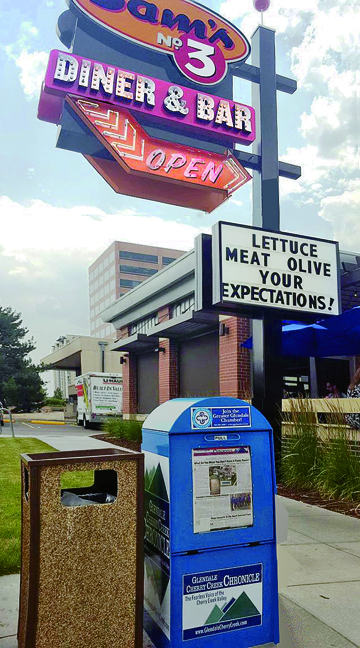
You may have noticed some shiny new blue boxes in popular spots around town. The Glendale Cherry Creek Chronicle has invested in 10 outdoor newsstands that have been placed in high traffic areas around Glendale and Denver.
The newsstands can be found in front of such businesses as Sam’s No. 3, Bonnie Brae Ice Cream, Brown Palace, Snooze, Oblio’s Pizzeria, and Washington Park Grille. Two stands are situated in Cherry Creek North and for the first time, the Chronicle can be picked up in Stapleton as one of the new stands is located in front of Starbucks in 29th Avenue Town Center. As always, copies in these stands and elsewhere are free of charge.
The Greater Glendale Chamber of Commerce helped support the project to boost their membership and the increased distribution of the paper. The Chamber has increased their membership in 2017 and at the time of press, they have climbed to 280 members. On June 23, 2017, the Chamber was ranked number 23 among all chambers in the metro area based on membership.
The Chronicle now has a distribution of 86,200 with over 83,000 of those being mailed directly to homes and businesses from Lodo to the Dam. The remaining copies are distributed to 50 locations including the 10 new outdoor stands. For a complete list, click here.
by Mark Smiley | Jul 24, 2017 | General Featured
by Julie Hayden

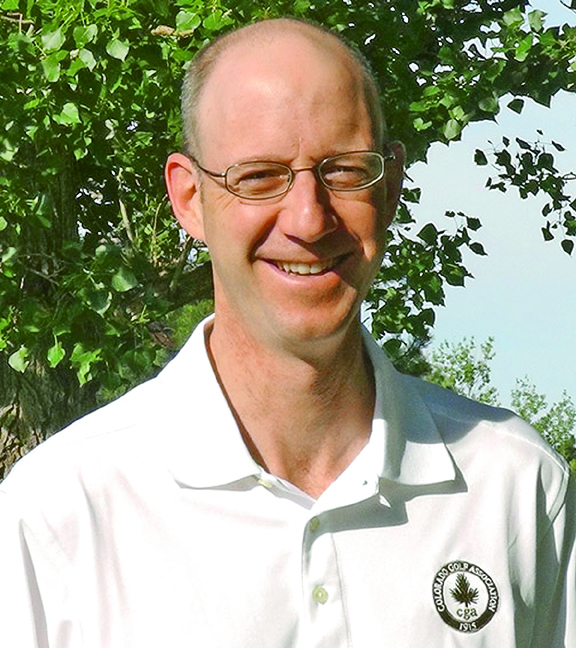
George H. Solich, President and CEO

 Merriam-Webster Dictionary has myriad definitions for the word “common” including that the word means “falling below ordinary standards,” “lacking refinement,” and “characterized by lack of privilege or special status.” Undoubtedly, the Colorado Golf Association intended, when it named the golf course it owns and operates, that the complex met the main definition of the word that it “relates to the community at large.”
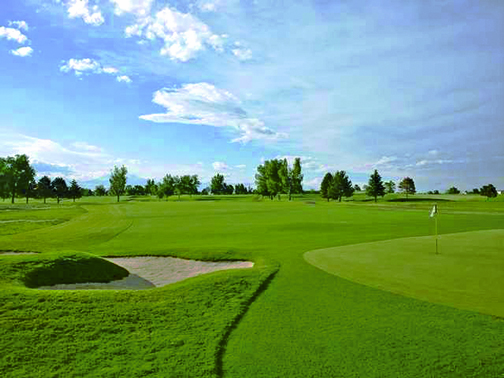
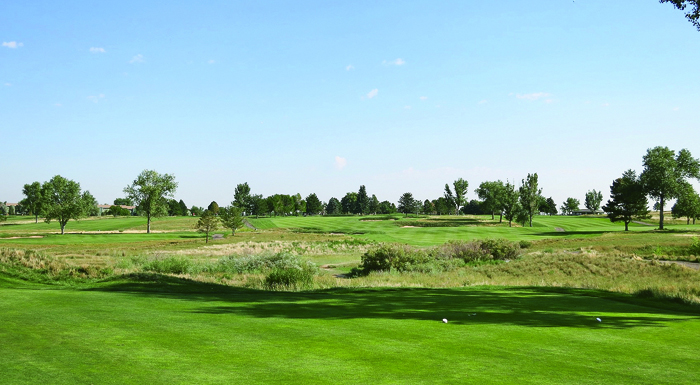
But what is happening at CommonGround Golf Course is in fact “extraordinary” and “phenomenal.” For $45 you can play one of the great golf courses in the Denver area designed by world class golf architect Tom Doak. The course is located off Havana Street between Alameda Avenue and East First Avenue. But that is not all. The CGA will give you your own free personal caddie for 18 holes.
You, of course, would want to tip your caddie as you would a waiter at a restaurant, but that is up to you. You already belong to the CGA if you have a Colorado golf handicap. Joining the CGA only costs $35 and it will allow you to obtain a handicap along with other privileges of membership. For non-CGA members the round costs $54.
How can such an incredible bargain possibly exist?
The Colorado Golf Association was founded in 1915 and had always wanted to have its own golf course. In 2005, in partnership with the Colorado Women’s Golf Association, it was able to acquire the old Mira Vista Golf Course from the Lowry Redevelopment Authority. The course was part of the former Lowry Air Force Base. Tom Doak agreed to design a new course for a nominal fee. Doak is one of the most admired golf architects in the world having designed such top ranked courses as Cape Kidnappers in New Zealand, Barnhougle Dunes in Australia, and Pacific Dunes in Bandon, Oregon. He also designed at CommonGround a separate nine-hole short course for junior golf and player development.
Since the CGA is a non-profit it is not trying to make money off the golf course but rather further the development of golf in Colorado. In fact kids play for free on the nine-hole golf course.
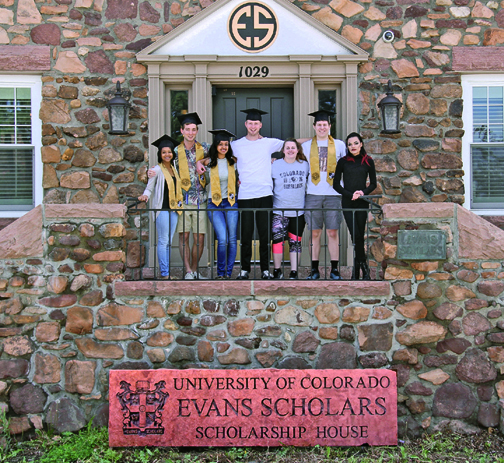
In 2012 oil and gas magnate George Solich and his wife Carol seeded the Colorado Golf Foundation with a donation of $ 2 million. In the early ’70s, George’s brother Geoff got him a job as a caddie at Cherry Hills Country Club. The brothers’ family had modest means and the caddie job resulted in George receiving an Evans Scholarship at the University of Colorado. Evans Scholarships are limited to kids who caddie for a minimum of two years, plus other requirements. Tuition-free housing at the Evans Scholars Scholarship House, which recently went through a $5 million renovation, is part of the scholarship.
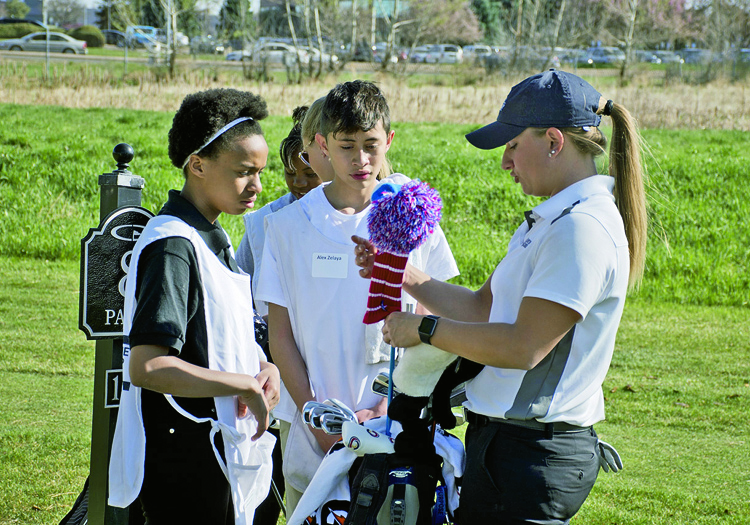
The Solich Caddie & Leadership Academy provides a two-year caddie training program in which 14 and 15-year-olds develop leadership skills and enhance character through a foundation built around caddieing.
The executive director of the CGA Ed Mate was as a teenager a caddie at the Denver Country Club and an Evans Scholar at CU. “Caddieing taught me work skills, how to be responsible and how to deal with adults,” states Mate.
Chuck Bonniwell, Publisher of the Glendale Cherry Creek Chronicle, was also a caddie in his teenage years and he declared, “Caddieing was the first job I ever had and I probably learned more from it about people and human nature than virtually any other job I have ever had.”
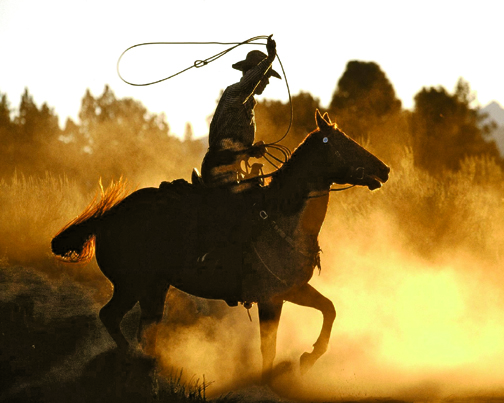
The caddies are given a $1,200 scholarship by the Academy to be used for college provided they caddie 36 rounds, attend a leadership conference once a week, volunteer for six hours of work (which can be at a kids’ development program at CommonGround) and keep a monthly work log. The leadership sessions are based around the “Cowboy Code of Ethics.” See below.
In order to be accepted into the Solich Academy you must have completed 8th grade, show academic excellence, demonstrate financial need (family income should be around $80,000 or less) and show a positive attitude and work ethic.
After completion of the two-year program the graduates are recommended to top clubs in the Denver area including Cherry Hills Golf Club and the Denver Country Club, which are thrilled to have already trained caddies ready to go. All such caddies become eligible to be Evans Scholars at the University of Colorado.
Surprisingly there are far more teenagers who want to go to the Solich Academy and are fully qualified than there are spots available at CommonGround. Mate indicates “A lot of golfers think a caddie is only for the rich or low handicap players. Caddies make the golfing experience incredibly more enjoyable and having a caddie usually results in you having a lower score. Once a person takes out a caddie at CommonGround they seldom want to go back to a cart especially since a cart costs a significant amount of money and the caddies are free.”
“The CommonGround caddies do not care that you are not Tiger Woods,” added Mate. “They are working on a college scholarship. They want you to have an enjoyable experience and thereby earn a good tip. They are there to help you in any manner they can.”
In order to reserve a tee time at CommonGround and sign up for a free caddie, call 303-340-1520. Caddies are available from Memorial Day through Labor Day. For information about the course, visit www.commongroundgc.com and Facebook @CommonGroundGC. Follow them on Twitter @CommonGroundGC.
by Mark Smiley | Jul 24, 2017 | Glendale City News
by Andrew McKenna
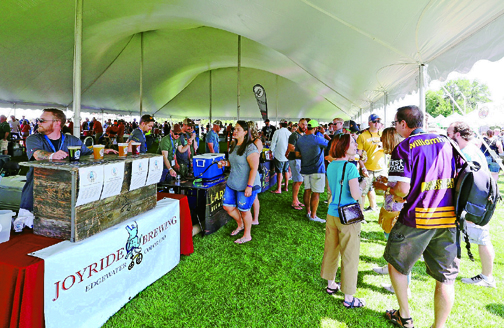 Saturday, August 26, Glendale’s Infinity Park will once again host the popular Bruises +Brews Beerfest. Coinciding with the always exciting RugbyTown 7s rugby tournament, the festival is in its fourth year of providing fans and spectators with enticing local suds and a few spirits. The Saturday event will feature more than 20 local breweries, as well as cider brewers and distilleries.
The United States has a long history with beer. Due in large part to English and Dutch colonists, beer, rather than wine, established itself as a national beverage in the colonial period. Following the repeal of the 18th Amendment (Prohibition) in 1933, brewing, sale, and distribution of beer made a strong return to the American way of life. Today, beer makes up more than 85 percent of alcoholic beverages consumed in the country annually.
In recent decades, craft brewing has seen a meteoric rise in the country, becoming a $22 billion industry as of 2016, with continued growth projected. Colorado has been and remains at the foreground of that growth — the state has one of the highest numbers of breweries per million inhabitants in the country and is among the top five states in craft beer output. New Belgium Brewing in Ft. Collins is among the top five largest craft brewers in the country. The Mountain West is considered a hot spot for beer making because the region supports the growth of many of the hop varietals used in brewing. Local beer makers will display the fruits of their labors with those hops at Infinity Park’s August festival.
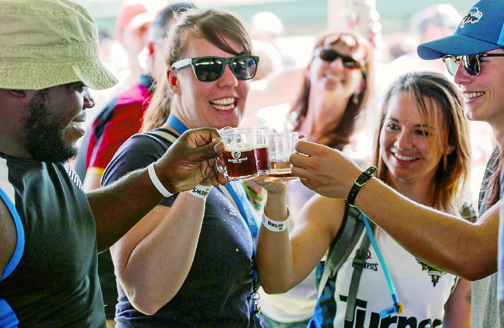 Craft beer making in Colorado and elsewhere is about more than fruitful agriculture, however. Employee and/or family ownership, local ingredients, and themed beers indicate the strong sense of community within the realm of craft brewing. That sort of local, community-based ethos makes craft brewing and Glendale rugby especially well-suited bedfellows.
Annette Gilman is the owner of Scrum Enterprises, the concessionaire that holds Infinity Park’s liquor license. Gilman, who manages the annual beer festival, is in command of securing all of the participating breweries and distilleries. Beginning in August 2014, she has worked tirelessly to combine beer and spirits with the RugbyTown 7s tournament. According to G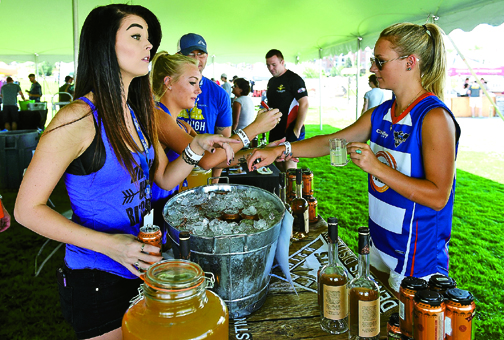 ilman, the festival has grown in size and popularity every year, successfully introducing thousands of beer lovers to the game of rugby. A joint effort between Infinity Park and Scrum Enterprises, Bruises+Brews also utilizes local rugby players as barbacks for the festival. In return, the non-profit, Glendale Youth Rugby Foundation, which supports rugby development for young players, receives a portion of the festival proceeds as a donation.
Barret O’Brien, merchandiser for Infinity Park and Executive Director for Glendale’s Youth Rugby Foundation, says the exponential growth the festival has experienced over the years has been thrilling. “Anybody who’s a beer lover knows that beer festivals are a dime a dozen in Denver. This brings to the table an entirely new experience for most beer enthusiasts — rugby and beer just go together naturally.”
It is noteworthy that the one-day beer festival happens amidst the now internationally renowned, weekend-long RugbyTown 7s tournament. Attracting teams from across the globe, including teams from all five branches of the U.S. military and players from the gold medal winning Fijian team, the tournament promises an action-packed background against which to enjoy Colorado craft brews. Sevens rugby, which debuted in Olympic competition at the Rio games in 2016, is a fast-paced, hard-hitting variation on traditional 15-a-side rugby play. Matches consist of two seven-minute halves — the short duration ensures there will be no dull moments for spectators, and allows an entire tournament to happen over the course of the weekend. Twenty teams from six nations will compete in over 60 matches for the winner-take-all $10,000 purse.
As rugby and craft beer continue to surge in national popularity, so too will Glendale’s annual Bruises+Brews Beerfest — rugby and beer: better together.