
by Mark Smiley | Jun 18, 2015 | Travel

by Mark Smiley
Cirque du Soleil’s newest touring show, Kurios — Cabinet of Curiosities, has rolled into town with 65 trucks and 2,000 tons of equipment as the 35th installment of the franchise since 1984. The show is set up under the 62 foot high big top in the west lot of the Pepsi Center and performances run until July 26, 2015.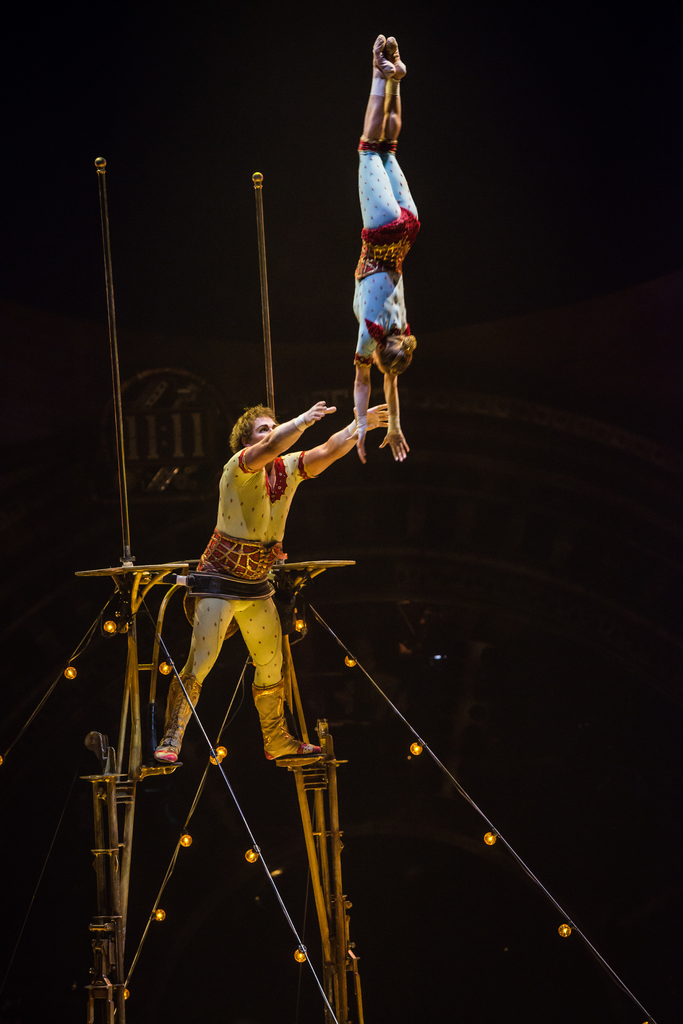
The show, which features 46 artists ages 21 to 37 and over 100 costumes, is the newest installment in the lineup of shows. It is the chance to see astonishing feats of agility, flexibility, strength, balance, coordination and inventiveness. Kurios evokes the eerie world of a 19th-century carnival. It’s a shadowy universe inhabited by strange, and vaguely ominous creatures, such as an accordion man, a serious chap with a cosmic pod for a stomach and a little woman who resembles Angela Lansbury. The production’s settings and costumes suggest a mad scientist’s laboratory and fantasies in the late 19th century.
The stage is one of the lowest of all Cirque du Soleil big top shows. It is only 24 inches high. This decision was made by director Michel Laprise so that the artists are closer to the public. The props on stage include coppered Victrola record players, a clanging vintage clock, anti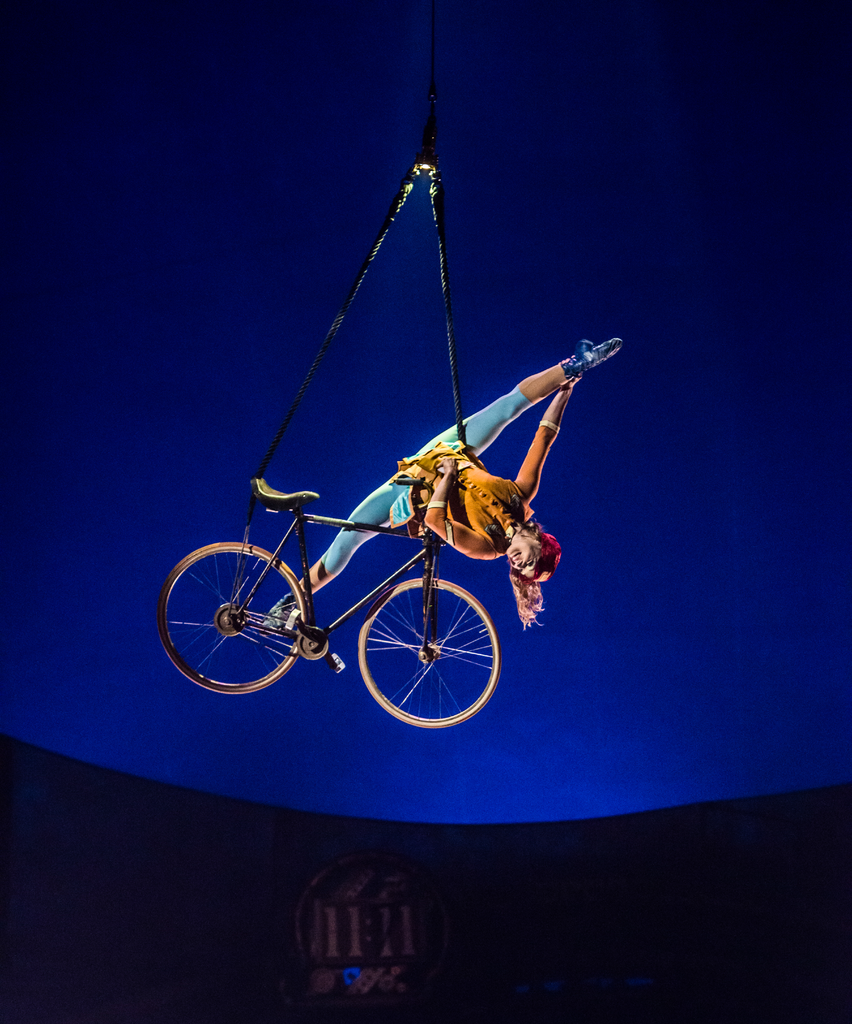 que electric lights, odd robot-like characters with pod faces and bulbous metal midsections. This is a museum-worthy assemblage, created from recycled bits and pieces of leather, metal, old gramophones and typewriters, turbine engines, piping and tubing.
Of course a Cirque du Soleil show would not be complete without acrobats, contortionists, jugglers, and death defying acts, one of which is a dashing chair balancer at a levitating dinner party, and a goggle-wearing aviator who uses his biplane as a platform for a balancing act that has him perching on a gyrating tower of cylinders and planks. James Eulises Gonzalez who performs on the Rola Bola is the only artist who cannot be replaced if stricken ill or injured. He is the only person in the world who can perform this feat.
Kurios also features comedy from the cheeky verve of the ensemble. However, David-Alexandre Després wins laughs as both the overeager suitor of a lovely young woman plucked from the audience, and as an uncannily realistic and raunchy pussycat who won’t leave the poor girl alone. Cirque du Soleil has not deployed clowns often but this show adds one.
“Let’s not forget we are still a circus …,” said Bruno Darmagnac, artistic director of Kurios, “…and since the beginnin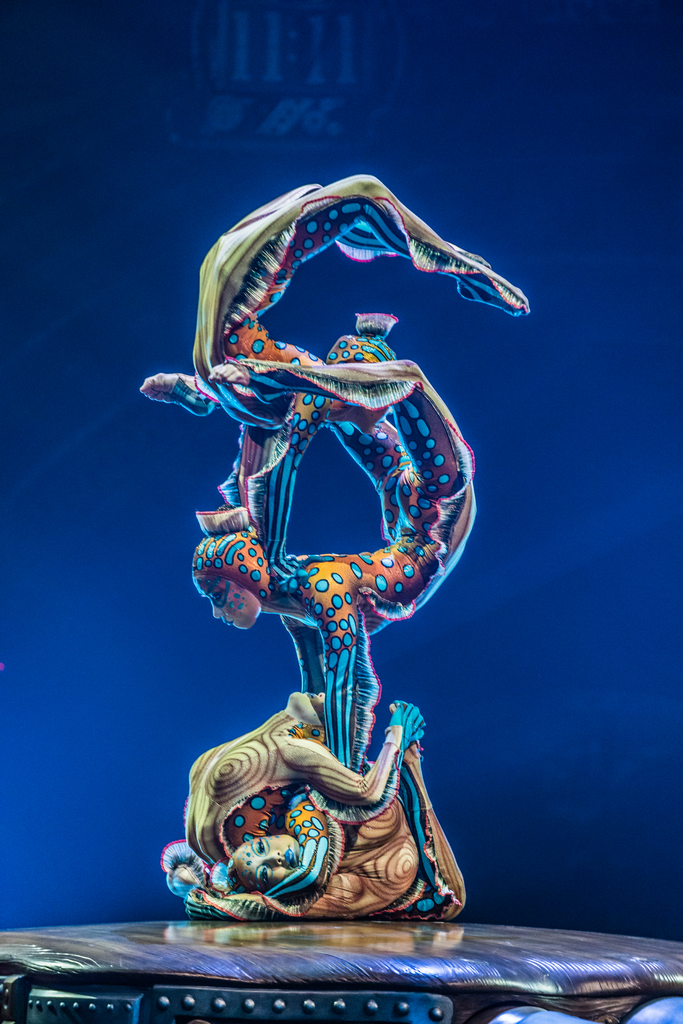 g the company made a statement to never ever use any animals in our productions, which is something often expected from a circus. In that sense we went, ‘NO, we will never do that, but clowns..YES.’ And this one is a very special clown. And different. We don’t even call him clown, we call him the comic.”
Cirque du Soleil was cofounded by Guy Laliberte and it is now one of the biggest live entertainment groups in the world having performed 35 shows in front of nearly 150 million spectators in more than 300 cities on six continents. He has been aiming to revitalize his company, known for its intricate circus shows as its creative guide.
Laliberte started out as a street performer in Quebec, walkin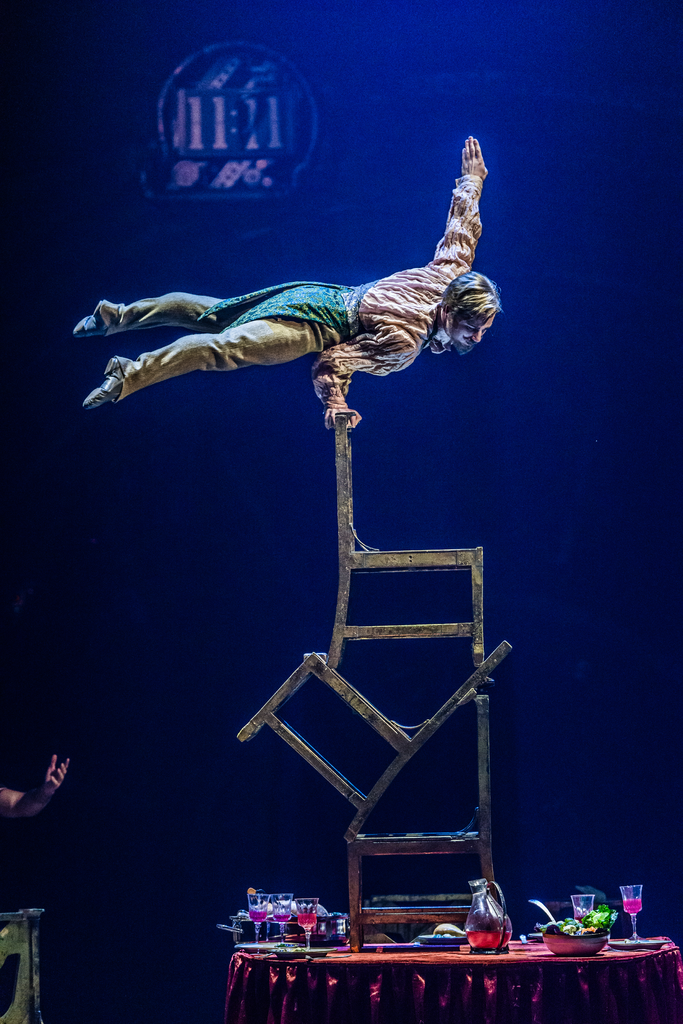 g on stilts and breathing fire. He founded Cirque du Soleil in 1984 when the Canadian government awarded him a $1 million contract to develop a celebration for the 450th anniversary of the discovery of Canada. Now, Cirque du Soleil has close to 4,000 employees, including 1,300 performing artists from close to 50 different countries.
Darmagnac indicated that Laliberte is involved with every show before it premieres. Shows are put together and then performed in front of Laliberte for final approval. Darmagnac describes this process as “entering the lion’s den.” Each act is meticulously choreographed and Laliberte will either approve each act, make changes, or eliminate it altogether. It makes for a tedious process but each employee of Cirque knows what to expect and knows the final product will be something audiences will enjoy.
Darmagnac has been with Cirque du Soleil since 2011 and before joining Cirque, was the co-creator of FLIC FLAC, a modern traveling circus in Germany. He is excited about the new show. “Allegria [the traveling tour prior to Kurios] was 20 years old. This one is new and the energy is completely  different,” said Darmagnac. “This one [show] really wanted to put humans on stage, with a face and with this steampunk look. Lots of people can relate to it and it will not go out of fashion for a long, long time.”
Kurios was written and dir ected by Michel Laprise, and features bright and breezy songs by composer-music directors Raphaël Beau and the duo Bob & Bill. The songs are upbeat, unpretentious numbers reminiscent of 1930s French jazz, buoyantly performed by a small, eclectic ensemble. The music kept the audience engaged and complemented the acts.
They’re a few of more than a dozen acts in a show that runs close to 2-1/2 hours, including one intermission. The audience at the Denver premiere gave the artists a standing ovation. Kurios — Cabinet of Curiosities tickets can be purchased at www.cirquedusoleil.com/kurios.
All photos: © Martin Girard shootstudio.ca

by Mark Smiley | May 26, 2015 | General Featured
Architect And Friends Of Crestmoor Present
Citizen-Initiated Plans, Design For 2.3 Acre Site
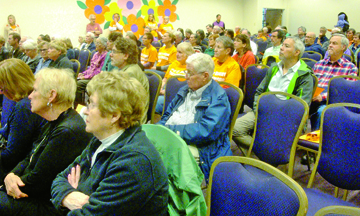 In politics or business, as in sports, a critical strategy for success is the concept of “protecting your home turf.” No one likes being manipulated into making choices that are bad for them or their neighbors. Friends of Crestmoor Park — fighting a developer seeking to build apartments on a 2.3 acre site at Cedar and Monaco — went on the offensive May 6 unveiling their own site plans for the property.
Architect Niccolo Casewit of Environment Productions, LLC, presented four alternate designs for the Crestmoor church site at 195 S. Monaco Parkway before a packed community meeting in Fisher Hall at the BMH-BJ Synagogue. Using designs made from Lego pieces flown in from the Billund, Denmark-based construction toy manufacturer’s headquarters, attendees were asked to pick their preference from the different site designs.
Metropolitan Homes, the developer who purchased the site zoned for single-family homes, originally planned to build at least 120 units on the site. Founder Peter Kudla’s latest proposal is for a three-story, 50-unit apartment complex on the northeast part of the church site plus 25 three-story townhomes facing South Locust St. and East Cedar Ave. The zoning he seeks, however, would not limit the number of units. Architect Casewit told the assembled residents that, “the zoning (S-MU3) must be stopped. We think 50 units is maximum for the site.”
Winning Site Design
The winning design chosen by attendees was a single-family model with backyard flats or carriage houses. That site design includes 13 single-family homes, five of which would have carriage houses or backyard flats for a home office or living space for an adult child or parent. The single-family homes with carriage houses would require a zoning change.
The second most popular choice was a site designed with five single-family homes plus a community garden and/or pocket park. A site design with all townhomes that would also require a zoning change was the third most popular. The clear loser was the architect’s large hybrid design that did not win a single first-place vote. It is somewhat similar to what Metropolitan Homes is proposing, showing an apartment complex plus townhomes on the site.
Each of the four models attendees voted on provided a diverse number of units that could fit on the site. The architect actually plotted all the units along with required fire lanes, open space, etc.
Showdown June 8
Friends of Crestmoor Park have shown a willingness to work with Metropolitan Homes and invited them to see the citizen-initiated designs on May 6. However on the same day — possibly under political pressure — the City scheduled a Planning Board hearing for Lowry’s Boulevard One development directly across the street and opposed by Crestmoor. As expected, the Planning Board voted 6 to 0 to approve the project’s proposed zoning changes. Friends of Crestmoor say the project is “inappropriate immediately adjacent to Crestmoor Park.”
Kudla, his lawyers and lobbyists were notably absent at the May 6 Crestmoor meeting. “We wonder why they chose not to come?” asked Friends of Crestmoor volunteer Katie McCrimmon. “Nonetheless, we are still planning to reach out to them to see if they’d like a briefing on the potential designs for the site,” she added. John Fischer of Crestmoor Filing 1, however, has since reported that he was told by a spokesperson for the developer that it doesn’t plan to meet with Crestmoor, “because they don’t plan to make any changes to their proposal.” To that Katie McCrimmon responded, “They keep telling people that they are compromising with the neighbors, but how can you compromise with the community if you refuse to meet with them or even attend a public meeting to which they’ve been invited?”
The final City Council Public Hearing and vote on the Crestmoor project is scheduled for June 8, 5:30 p.m. in Room 451 of the City & County Building, 1437 Bannock St. The last time a vote was scheduled (March) Metropolitan Homes went back to the City and engineered a last-minute delay of that hearing. The City Planning staff, however, did not accept the developer’s proposed waivers and conditions.
by Mark Smiley | May 26, 2015 | Travel
by Councilman Charlie Brown
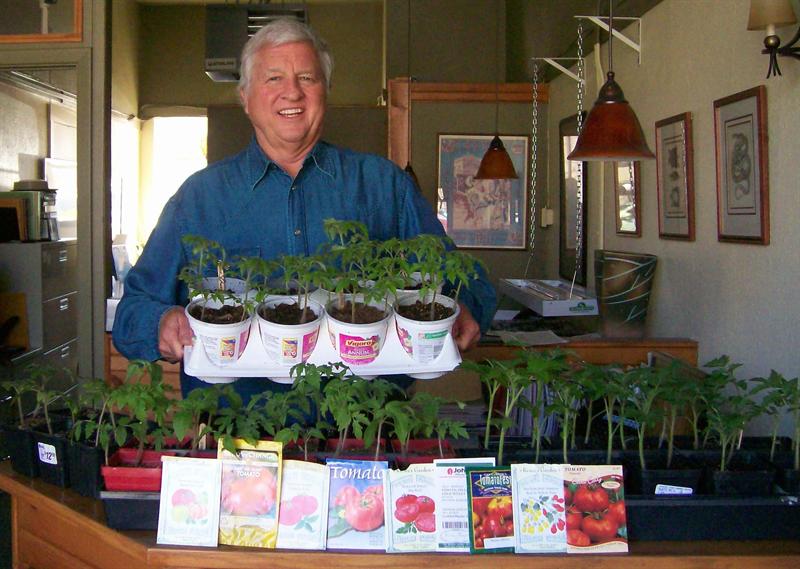
For the last eight seasons, Denver City Councilman Charlie Brown has planted thousands of tomato seeds in March and nurtured the plants to distribute free to residents and city officials in early May. He grows them in his basement and office, where they eventually end up in his office windows on Exposition Avenue and are often confused with a newly legalized plant.
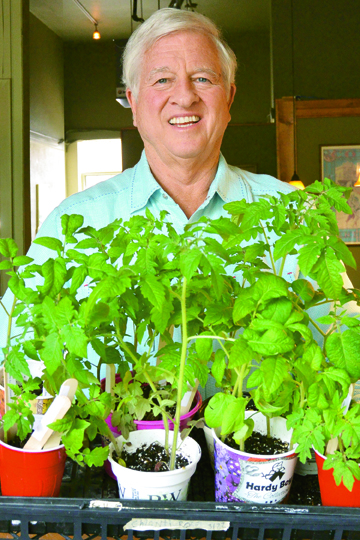 “When that happens,” Brown said, “I always remind folks that tomato plants are not a cash crop.”
The second year his efforts proved so popular that constituents started calling in April wanting to know when they could pick up “their” tomato plants. The “The Tomato Plant Entitlement Program” was hatched.
This year was his biggest yet, with more than 800 plants and 15 varieties handed out. And it will be the last year to do so, since along with five other Denver council members, he is term-limited in July. He has represented 52,000 residents in south Denver for more than 14 years.
Brown calculates he has distributed some 6,000 tomato plants during the last eight years which, if urban gardeners followed his tip sheet for growing in Denver’s fickle climate, produced 20,000 pounds of America’s favorite gardening crop. And with this era ending, he wanted to share how he got started — not with politics, but with gardening.
The love affair began decades ago.
My first gardening memories can be traced back to my grandparents’ small farm five miles east of Durham, N.C. When we were about 10-years-old, my Mom would take my twin brother and me there to spend the weekend helping them with farm chores.
Saturday mornings started early. A rooster’s cock-a-doodle-doo would send us dashing off to the hen house to gather fresh brown eggs for breakfast. That was the easy start of a long day working in the heat and humidity and the sandy clay soils of North Carolina’s Piedmont region. We milked cows, fed the pigs and chickens, and tackled the dreaded hoeing and weeding.
I would do things that city folks have trouble understanding, including wringing a chicken’s neck for Sunday supper and watching it run around the barnyard with no head; and plowing long rows of crops with a large, tail-swishing beast six feet in front of me who, surprisingly, respected my commands of “whoa mule!” I loved every minute of it, especially the gardening.
The southern climate allowed for early planting and harvesting. It’s hard for Denver gardeners to fathom that by late June we were already “bringing in” potatoes, broccoli, spinach, beets, onions, field peas, squash, butter beans, string beans, green peppers and, my favorite, tomatoes. Okra, turnip greens, cantaloupe, watermelon and corn would soon follow. Most crops would be “put up” in canning jars or, later, a small Sears & Roebuck freezer.
As I look back on those days I realize just how much my grandparents taught me. My grandmother was an early naturalist, who loved birds, wildlife and gardening. “Gardening teaches you patience,” she said. She reminded us not to keep all the fish we caught from the scummy farm pond but return some for ‘another day’ long before the concept of “catch and release.” My grandfather was a hard task master. If he would catch us leaning on our hoe to catch a quick break he would yell out: “You have to hoe to the end of the row,” a work ethic that’s sometimes hard for youngsters to comprehend.
Thanks to the influence of my grandparents, I’ve planted a garden each spring for more than 40 years. It gets in your blood. When it hails in Denver everyone is concerned about their cars and roofs. But like all farmers, ranchers and urban gardeners, our concern is about, in the words of Kenny Rogers, “our crops in the field.”

by Mark Smiley | May 26, 2015 | Featured Stories & Advertisers

by Mark Smiley | May 26, 2015 | Featured Stories & Advertisers