by Mark Smiley | Jun 29, 2026 | Main Articles
by Mark Smiley
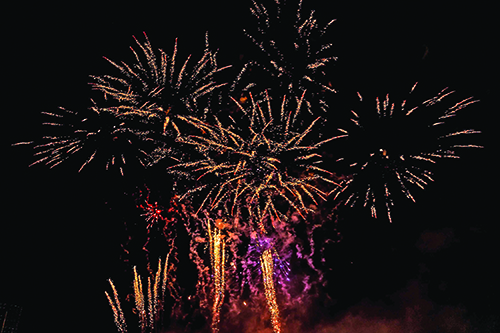
Fireworks Finale: Brilliant bursts of color illuminate the sky above Infinity Park during Glendale’s annual July 2 fireworks celebration. Known for its close-up viewing experience, the event gives spectators a rare opportunity to feel immersed in the display as shells explode overhead. Photo by McBoat Photography
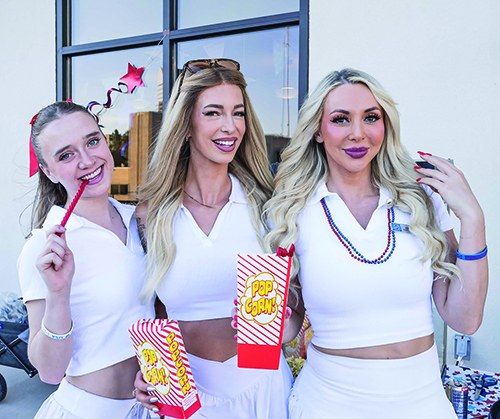
VIP Celebration: Greater Glendale Chamber of Commerce Brand Ambassadors welcome guests during the Chamber’s exclusive VIP celebration in the Try Club at Infinity Park. The members-only event offers premium views of Glendale’s spectacular July 2 fireworks show, along with networking opportunities and festive holiday fun. Photo by McBoat Photography
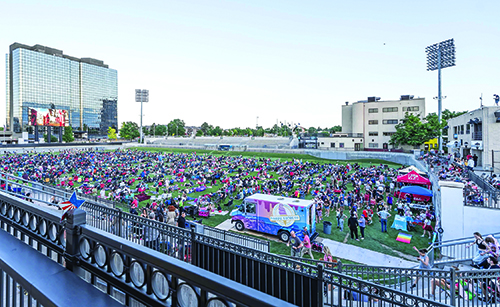
Community Celebration: Families and friends fill the field at Infinity Park during Glendale’s annual July 2 celebration, arriving early to enjoy food trucks, refreshments, and a special outdoor screening of F1 before the fireworks begin. The free event transforms the stadium into a giant community gathering space where residents, businesses, and visitors come together to relax, socialize, and celebrate the holiday. Photo by McBoat Photography
Glendale’s glittering July 2 fireworks spectacular is set to launch a lengthy Fourth of July celebration as Colorado marks its 150th year of statehood and the United States commemorates its 250th birthday.
The nation’s 250th anniversary, known as America’s Semiquincentennial, commemorates the adoption of the Declaration of Independence in 1776. Throughout Colorado, communities are planning special events to honor both historic milestones.
Among the largest celebrations in the metro area is Glendale’s annual fireworks show, widely regarded as one of the region’s premier Independence Day displays. Families and friends gather at restaurants, bars, patios, parks and porches from downtown Denver to Cherry Creek Reservoir to watch the dazzling aerial display sponsored by the City of Glendale.

Season Celebration: Glendale’s annual July 2 community celebration at Infinity Park kicks off the Independence Day weekend with a screening of F1, family-friendly activities, food trucks, and one of Colorado’s most anticipated fireworks displays. Gates open at 6 p.m., the movie begins at 7 p.m., and fireworks light up the sky at 9:30 p.m.
The community celebration at Infinity Park will begin when gates open at 6 p.m. Attendees are encouraged to arrive early, bring blankets or lawn chairs, and enjoy food from a variety of local food trucks before settling in for a screening of F1, which begins at 7 p.m. The fireworks show is scheduled to begin at approximately 9:30 p.m.
Starring Brad Pitt, F1 follows a former Formula One driver who returns to racing decades after leaving the sport to help rescue a struggling team. The film will serve as the evening’s family-friendly entertainment before the fireworks finale lights up the sky.
The Greater Glendale Chamber of Commerce will also host a private VIP party in the Try Club for Chamber members only. Those interested in attending are encouraged to join the Chamber today to secure an invitation to the exclusive celebration.
This year, residents can expect an even more dramatic show in the night sky. City officials have increased funding for the annual display, allowing organizers to pack more fireworks and special effects into the same amount of show time.
Rather than extending the length of the program, the enhanced investment will create a faster-paced and more visually intense experience featuring more shells, more bursts of color, and a significantly expanded grand finale.
“We wanted to create an even more memorable experience for residents and visitors,” said Glendale City Manager Chuck Line. “The density within the same showtime will be significantly more spectacular. There will be more fireworks and an even more impressive finale than ever before.” The result will be a show with fewer pauses between effects and a constant stream of color and excitement across the night sky. Organizers say spectators can expect one of the most action-packed fireworks displays in the event’s history.
Many residents who attended last year’s show said they felt as though they were part of the fireworks display itself. Unlike many large fireworks events where spectators watch from miles away, Glendale’s Infinity Park setting places viewers remarkably close to the action, creating an immersive experience that few other shows can match.
The event has earned a reputation as one of the most intimate fireworks celebrations in Colorado, with spectators enjoying some of the closest viewing opportunities anywhere in the state. As shells burst overhead, attendees experience the full impact of the colors, sounds, and effects in a way that makes them feel connected to the show rather than simply observing it from a distance.
That unique combination of proximity, community atmosphere, and spectacular pyrotechnics has helped make Glendale’s annual July 2 celebration a favorite tradition for families throughout the Denver metro area. Many attendees return year after year, describing the experience as unlike any other fireworks display in Colorado.
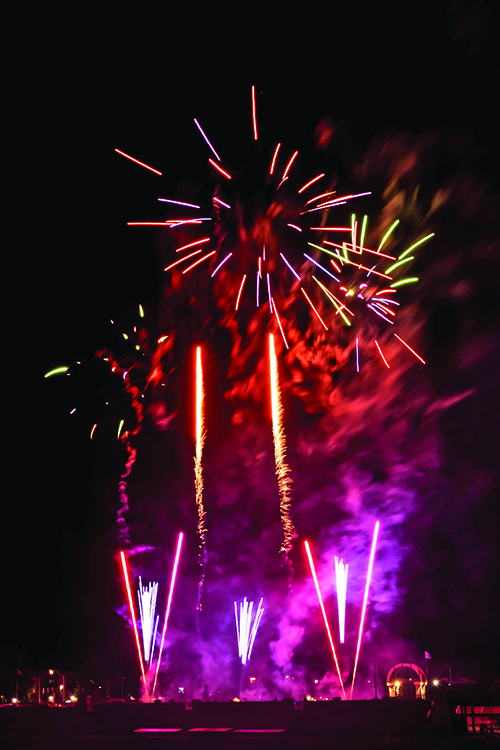
More Excitement: This year’s fireworks show in Glendale promises even more excitement, with additional fireworks packed into the same action-filled program and a larger grand finale. The free community celebration brings together residents, businesses, and visitors for an evening of food, entertainment, fellowship, and one of Colorado’s most memorable Independence Day traditions. Photo by McBoat Photography
The July 2 celebration has become a signature event for Glendale, attracting families from across the Denver metropolitan area. More than a fireworks show, it is a community gathering that brings residents, businesses, and guests together for a wonderful evening of food, entertainment, fellowship, and celebration.
Local businesses are also expected to benefit from increased attendance as visitors arrive early to secure viewing spots and patronize nearby restaurants, shops, and attractions.
Residents who have attended the event in past years say the fireworks show ranks among the best in Colorado. City leaders hope this year’s enhanced investment will further strengthen Glendale’s reputation as a premier destination for Independence Day festivities.
Weather permitting, organizers expect one of the most visually impressive fireworks displays in the event’s history when the celebration lights up the sky over Infinity Park on July 2.
by Peter Boyles | Jun 29, 2026 | Blasting with Boyles
Blasting with Boyles
OPINION
What does the media have in common with the first three? Not much.
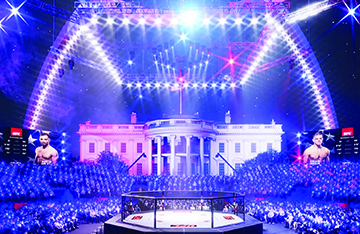
I am a UFC MMA fan. I tried to fight as a young man and wasn’t very successful, but I think I understand the mind of a fighter. So, I bought the Paramount Plus Sunday Night Fights on the White House lawn. And frankly, the last fight of the night may have been the greatest I’ve ever seen. It was incredible.
Next comes patriotism. It’s how I feel, my love, devotion, or attachment to this country. Or maybe a combination of my childhood, my young adulthood, and now as an old man. Folks, this is one hell of a country. And it did come in loud and proud and standing tall Sunday night.
I watched the fighters come out of the Oval Office and the media being so upset that “the Oval Office was being used as a locker room.”
I don’t recall that same media being so upset when Bill Clinton was using the Map Room, where FDR planned the defeat of the Axis, for his personal bordello.
Did you see CNN having a cow over that? But by God, a UFC fighter has more guts and more heart than all those media idiots combined to walk into a ring to do something none of the doofuses ever did in their lives.
Or the Congressional Medal of Honor awardee in a wheelchair being pushed to the ring by a young GI on one side and a 9/11 hero on the other side.
The Marines were lined up on both sides of the ring and, as the group went by, snapped off a sharp salute.
These media clowns actually thought that Donald Trump told the Marines to salute. If they knew anything about what it took to get awarded the Congressional Medal of Honor, they would know four-star generals salute them. But, of course, you would have to know something beyond the capabilities of those newsrooms.
The next big thing of the night was a UFC fighter calling Michelle Obama a man after he won his fight and then shaking Trump’s hand. Once again, I harken them back to Muhammad Ali, then known as Cassius Clay. In June of 1961, he met professional wrestler Gorgeous George in Las Vegas. Young Cassius was in town to fight Duke Sabedong.
George was in town to wrestle Freddie Blassie, the King of Men. Both made the media rounds to hype their shows, and they crossed paths. A young Muhammad looked at how many people came to see him fight and how many came to watch George. George sold 13,000 seats that night for five minutes with Freddie.
But he started being a big mouth and a braggart on Las Vegas radio. Ali later said that people came to see him get beat; others came to see him win. Either way, he kept them coming. He taught Ali, who loved pro wrestling as a kid, that was the night he became the Louisville Lip, shooting his mouth off about who he was going to beat. He went from a quiet young man to becoming the greatest of all time.
Sunday night, Josh Hokit simply performed what professional wrestlers have known for decades. People now will come and buy tickets to watch him get beat. He knew it. I know it.
I was trying to keep a record of how many headlines I could find tying Hokit to Donald Trump. I ran out after counting 50.
Trump, like him or not, had nothing to do with that. Hokit knew that if he did that, he would be the center of attention, just like the young Ali understood it. But morning television reports didn’t have a clue.
I had tears in my eyes watching what Jerry Jeff Walker said in one of my favorite songs, “Desperados Waiting for a Train,” where Jerry Jeff sings, “These are heroes of our country,” and asks why they are dressed up like these old men. Screw a bunch of CNN, MSNOW, NBC, CBS, ABC, and morning newspapers and talking heads.
Insiders look at you and say, “Happy birthday, 250 years, United States of America.”
And you’re right. We did come in loud as compared to Jane Fonda and the drag show hosting an alternative event. That shows you exactly where this country is headed.
More next month when we take a look at public schools and what they are teaching Muffy and Buffy.
Happy Birthday, America.
— Peter Boyles
by Ashe in America | Jun 29, 2026 | Feature Story Bottom Left
ASHE IN AMERICA
— OPINION
Most Coloradans – and Americans – are familiar with Mesa County and the tale of Tina Peters.
Lesser known is the story of Elbert County and former Clerk and Recorder Dallas Schroeder. Schroeder is currently an Elbert County Commissioner and is running for reelection. Clerk Schroeder also took forensic images of Dominion machines prior to Griswold’s 2021 “trusted build,” though he successfully avoided the political persecution of Tina Peters.
Why? Because taking images of voting machines was lawful in 2021. It didn’t become unlawful until 2022 and the Colorado Election Security Act (SB22-153).
The difference between Tina Peters and Dallas Schroeder is that Dallas took the images himself, while Tina Peters hired an outside expert to do the job — and she made some missteps in the execution for which she has expressed contrition.
Clerk Schroeder imaged the Elbert machines in 2021. Secretary of State Jena Griswold didn’t find out about it until Schroeder disclosed the existence of the images in a lawsuit against her later that year.
In court in November 2022, former Deputy Secretary of State Chris Beall got quite heated about Clerk Schroeder’s beliefs, concluding that his speech made him a security risk. “…those statements caused us to understand him. Clerk Schroeder is a security risk,” Beall said.
He also lost his temper, stating, “…this fight to um, PROVE that uh the 2020 election was, was tampered with. uh, It’s a fantasy!”
He then apologized for his outburst.
Upon learning about the existence of these images, Secretary Griswold repeated the playbook she used with Peters, sending a flurry of press releases slandering the Elbert Officials and telling the public there was a “breach.”
A legal battle ensued and, following a court order, Schroeder delivered all copies of the images to Secretary Griswold.
Griswold and CDOS also appointed a babysitter to oversee future Elbert elections. Note that was the year that Tina Peters was on the ballot, running for Secretary of State.
Elbert county is small with around 25,000 active voters currently (it was ~22,000 in 2022). The CDOS consultant/babysitter was present from the beginning to the end of the primary election in Elbert County. She produced a report that suggested the county buy bigger monitors.
Note that pretty much every recommendation in the report is preceded with some variation of, “While the county operated in accordance with applicable law…” In other words, “I got nothing, but I have to come up with some sort of recommendations or Jena won’t pay me.”
Think I am exaggerating? From the report summary:
“Elbert County conducted the day-to-day operations of administering the 2022 Primary Election through Election Day in substantial compliance with applicable laws and rules… The County appears well-equipped to conduct future elections with current staff, facilities, and resources. Therefore, it is my recommendation that the Secretary terminate her Election Order 2022-09, dated June 9, 2022, at this time.” Read the full report on my substack.
Note that Secretary Griswold ignored the finding from her appointed babysitter to terminate supervision — the babysitter was also present for the general election in November 2022. Elbert County continued to have CDOS elections babysitters through 2024.
“If there is nothing to hide, and Colorado is the ‘Gold Standard,’ then I challenge Ms. Griswold to use our images and prove it,” Dallas Schroeder said in 2022. He was ignored.
CDOS made a huge media splash with at least four press releases attacking Elbert County elected and elections officials. Those press releases are also archived and linked on my substack.
The department would likely say they issued all those slanderous releases to keep the public informed. But then they ignored the report’s recommendations and went silent in the press when the Elbert officials were vindicated. CDOS literally never told the citizens of Colorado the end of the story.
And it gets worse.
CDOS never sent the report — the report with the findings and recommendations — to Clerk Schroeder. That’s strange, because the clerk is the official who would be required to implement the findings and recommendations, and they never sent it to him.
The conduct of CDOS towards Elbert County, alone, implies that this whole saga wasn’t about election administration or security at all. It was about political narratives and ostensible cover ups.
Abuse of power.
Weaponization of government.
While CDOS didn’t send the report to the county, they did send an invoice — for $30,000.
Why is this important now? The key question is: What is going on with these images?
Has CDOS analyzed the drives? What did they find? Have they been compared to the Mesa images? Do they still have them? Are they going to publicly apologize for their treatment of Elbert County, Schroeder, and his team?
Clerk Schroeder asked for the images back a couple of times according to sources close to the matter. First he was told that the matter was still under investigation then, later, he was told that the images were on a litigation hold for the case against Tina Peters. Schroeder was prevented from testifying at Peters’ August 2024 trial, after being sworn in.
For my part, I’ve always believed those images were destroyed. I made a bet to that effect.
I’d be extremely happy to lose that bet.
As Schroeder said: If they have nothing to hide, they should prove it.
Ashe Epp is a local writer, host, and activist. Find all her work at linktree.com/asheinamerica.
by Editorial Board | Jun 29, 2026 | Editorials
Editorial —
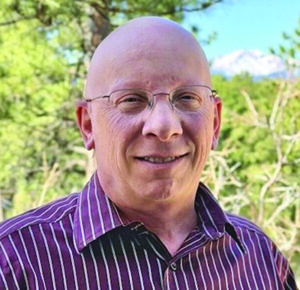
New Colorado Republican Party Chairman Craig Steiner
As everyone is aware, Colorado is a one-party state (i.e., the Democratic Party), much like California and New York, but even more so. There are no Republicans holding any statewide office and there haven’t been since ballot harvesting was legalized in 2016. Democrats have overwhelming majorities in the State House and Senate. There is not a single judge at any level in the state who is not a Democrat.
But the state’s top Democrats recognize that for Colorado to be literally a single-party state like the Stalinist U.S.S.R. is not really a good look. Better for the Democrats to be like the old Harlem Globetrotters and the Republican Party to be like the plucky Washington Generals. The Generals almost never won a game, but it was, in theory, possible.
The Republican Party at the end of May elected a new chair, Craig Steiner of Douglas County. The position had become available due to the resignation of Brita Horn, the former Routt County Treasurer. She is almost universally recognized as the worst party chair in the 150 years since Colorado became a state in 1876.
The present Colorado Republican Party is split into two factions, and the essential battle is over how the party should pick its candidates for the general election. In 2016, the Democrats, with money from so-called independent Kent Thiry, put Proposition 108 on the ballot. It overturned past precedent and forced both parties to have semi-open primaries.
Under this scheme, unaffiliated voters were mailed primary ballots from both parties, and they could choose which party’s primary they wanted to vote in. It greatly weakened the rationale for a person to be affiliated with a party.
Today, approximately 54% of all registered voters are unaffiliated, swamping the Democrats at 24% and Republicans at 22%. Because Democrats, far more than Republicans, generally do not have contested primaries (with this year being an exception), many Democratic-leaning unaffiliated voters cast ballots in Republican primaries, choosing the more moderate or liberal candidate. As a result, many Republicans in the State House and Senate are little more than Democrat-lite politically.
For example, Cleave Simpson, the Republican leader in the Senate, has an “F” rating from the Liberty Scorecard, a leading conservative rating organization. His colleague in the State Senate and leading candidate for the Republican gubernatorial nomination, Barb Kirkmeyer, has a similarly dismal (from a conservative perspective) “F” rating. If you are a conservative Republican, there is often little reason to vote in a general election in Colorado.
Proposition 108 barely passed in Colorado, with a majority of Republicans believed to have voted against it. To pass constitutional muster, Proposition 108 provided that a party could opt out of the semi-open primary system only if an impossibly high percentage of its governing committee (75% of all members) approved. A federal district court judge recently ruled that the threshold was unconstitutionally high.
While the moderate/liberal wing of the party is in the minority, it does constitute more than 25% of the membership and has therefore been successful in keeping the Republican Party in the highly disadvantageous semi-open primary system that greatly favors moderate/liberal Republicans.
They have been able to do so by playing a deception game in which they pretend to support opting out while doing everything they can to prevent it. Every Republican chair since 2018 has played that game except one, Dave Williams (chair from 2023 to 2025), who is now in Washington, D.C.
The newest chair got elected by pretending he was for the opt-out, but since being elected has shown himself to be what they call a “DeceptiCon.”
The previous chair, Brita Horn, had to resign when it was discovered that she had allowed her attorney to loot the party of all its funds. Craig Steiner, since becoming chair, has done nothing to prevent all cash funds from being scooped up by the attorney, making it impossible to raise new funds.
Why in the world would Republican chairs like Horn and Steiner want to destroy the organization they head? It’s simple. The big donors to the Republican Party, who long propped up the moderate/liberal wing, no longer want a Republican Party to choose candidates at all. They and Kent Thiry want Colorado to move to jungle primaries, where candidates petition and/or pay to get on the ballot and the top two vote-getters, regardless of party affiliation or lack thereof, advance to the general election, just like California.
It is a system dominated by multi-millionaires and billionaires, and no one else need apply.
Perhaps it is all for the best. Instead of the present one-party state, we will become a no-party state where the very wealthy control all.
— Editorial Board