In a year when tensions between police departments and the general public are at an all-time high, the notion of appointing individuals to act as liaisons between cops and civilians sounds like a smart, albeit complicated idea. Community Resource Officers (CROs) are assigned to do exactly that and are commissioned to address the non-emergency concerns of citizens ranging from issues such as neighborhood awareness, personal safety and reporting crimes after the fact.
Work Together: To affect positive change, citizens and cops may have to learn to work together.
This year has no doubt been especially challenging for CROs, as law enforcement at large is being subjected to hyper-focused scrutiny from mainstream news sources, alternative media outlets and many sectors of the general public. While it is true that the terrible actions of the few have sullied the perception of the character of the many, effective law enforcement holds an ever-crucial role in American society.
Apply A Bit Of Objective Reason
The cry to “defund the police” some citizens argue is an ill-conceived notion that, if legislated upon, would lead to extreme danger. They see a society without law enforcement, especially one as armed, addicted, and mentally afflicted as America, would quickly deteriorate into a dystopian dust bowl of lawlessness. Yet, the current climate is placing unprecedented pressure on police departments nationwide to acknowledge, address, and correct the long-standing stigmas of racism, murder, corruption and inadequate responses to common situations.
Oftentimes, the above stereotypes are perpetuated because police officers are dispatched to circumstances which they are not trained to handle such as ongoing domestic disputes, disagreements between neighbors and mentally challenged individuals who are under extreme duress. Such instances highlight the importance of CROs, and how engaging with them can help residents understand when making a 9-1-1 call is the right move and when a non-emergency situation can be handled through more effective means. Perhaps most importantly, the Denver Police Department (denvergov.org) offers a comprehensive neighborhood watch program,
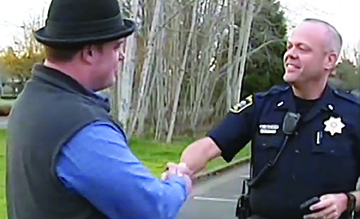
Officers: Denver Community Resource Officers.
Find Out What’s Going On
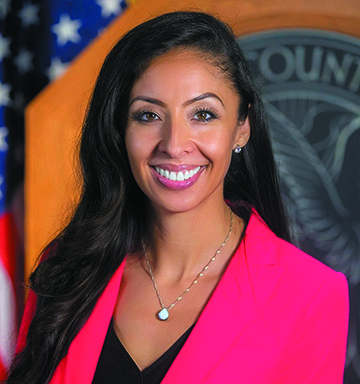
Believe it or not, some citizens may not realize that some “call 9-1-1” situations can be avoided through crime prevention. Denver Community Resource Officers hold regular meetings via their respective district headquarters which are open to the public. Due to Covid-19 precautions, these meetings have been temporarily switched to online Zoom format — hosted by specific neighborhood organizations. Regardless, these meetings are designed to equip residents with ample “Neighborhood Watch” signage for deterring residential crime and to provide crucial information on crime rates and the most recent trends in theft. Further, the DPD website offers comprehensive information on pinpointing and reporting gang activity, graffiti removal, crime statistics and maps, anonymous reporting, volunteer-operated neighborhood “Cop Shops,” victim services and more. Recently, Community Resource Officer for District 3, Kate Young, met with Baker residents in a socially distanced outdoor setting to listen to concerns and offer advice on the best ways to deal with homeless camps, midnight backyard prowlers, and license plate theft.
Get Involved
While it is by no means any citizen’s responsibility to do the job of the police, a little concern and outgoing action can go a long way — and maybe even save a life. A person can report the descriptions of people you see committing crimes such as theft, vandalism and assault. You can also write down the license plate numbers of hit-and-run drivers or burglary getaway cars. Such instances of involvement not only establish communication between your community and local law enforcement, they can also create trust between these two divided sectors of society while enhancing the overall safety of the neighborhood. Meanwhile, it is important to understand that CROs stress that taking care of your own safety first in a crisis — NOT putting yourself in greater danger — is job number one.
9-1-1: Some circumstances requiring civil servant involvement are not always 9-1-1 emergencies.
Connect On Social Media
DPD is also trying to connect with residents via Nextdoor — a social media platform dedicated to connecting residents of specific neighborhoods within a specific sector of a city. Their page on this platform, however, is more of an informal message board that is not monitored 24/7 and is not a replacement for dialing 911. Citizens with video footage from their doorbell cameras or their smartphones can upload footage of burglars, prowlers and crimes along with incident reports directly onto the DPD Nextdoor page. This is, of course, in addition to making a formal report via the DPD non-emergency number; 720-913-STOP (7867). Posting on this platform and on the DPD thread is particularly useful because other residents can have access to the video feeds, images and descriptions that help them identify danger before the fact or, at the very least, add to the reports of specific incidents and individuals who are out committing crimes. The page also provides tips on preventing theft of motorcycles, scooters, cars, trucks and license plates as well as the protocols for reporting street racing.
Boots On The Ground?
At this point in 2020, Denver Police Department CROs may either be performing a high-wire act or simply tip-toeing on eggshells. This may explain why attempts to contact six different CROs and one volunteer were met with neutral responses. Former CRO Bob Anderson replied to email interview questions by explaining: “I am no longer assigned as a CRO, as I have moved on to a different assignment within the police department. These are all good questions and I have copied the District 1 CRO team on this response so they can respond to your request. Thank you.”
Defund The Police: Some folks who subscribe to logic and reason agree that this is a terrible idea.
Meanwhile, CRO Kate Young answered a phone call, yet declined an interview or the opportunity to respond to questions about CRO protocol stating: “We have to run our answers by our supervisors before we can say anything to the press. I will try and get back to you before your deadline.”
Lastly, DPD volunteer Christie Mochoruk offered: “Through my personal experiences volunteering with DPD, I’ve witnessed many partnerships formed between our Officers and residents, once those in our community understood how and who to communicate with and the best way to utilize the many resources available to them. I would love to answer some of your questions, but I will need to reach out to the Officers first for permission, as I’m only a volunteer and want to ensure the integrity of the information being shared comes across in the most effective way.”
There was no further reply in the 55+ hours left on this journalist’s assignment hourglass between Monday, October 12 at 7 a.m. and Wednesday, October 14 at 1 p.m.
Perhaps they were all too busy making the rounds in their respective jurisdictions, or maybe the role of CROs is primarily one of forward-facing PR significance and not much else. One thing is for sure; currently there is not enough continual engagement between the public and the CROs to make a noticeable dent in crime and to assuage the general public disdain towards the police. This makes one thing clear — if you’re a citizen who wants things to improve — you’re going to have to meet your CRO halfway.
“When I was a kid, I used to pray every night for a new bicycle. Then I realized that the Lord doesn’t work that way, so I stole one and asked him to forgive me.” — Emo Phillips
by Luke Schmaltz
Irony rolls up and down the streets of the Mile High City, as many unhoused inhabitants — unable or unwilling to pay the skyrocketing rent rates — somehow cruise about upon top-of-the-line, state-of-the-art, high-end triumphs of transportation.
Bicycles as well as their various parts and components are legal tender among some folks, and are traded, bartered, bought and sold with fervor — as each new morning presents a fresh batch of bikes to the curbside marketplace that were acquired the night before.
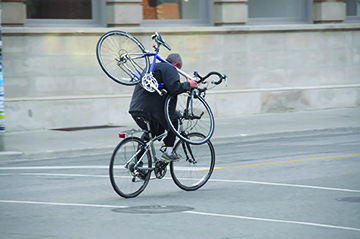
Theft: Someone riding one bike while carrying another may not have paid for either.
As Denver transplants from Silicon Valley and the Big Apple snuggle up and snooze in their posh Baker bungalows and overpriced Five Points rentals, enterprising prowlers from adjacent areas creep about and help themselves to the easy pickings of low-hanging, two-wheeled fruit.
Scenes Of The Crime
Backyards, side yards, garages, porches, storage rooms, carports and yes — the insides of residences — are not the only settings for theft. Bike racks on cars and in front of businesses as well as railings, parking meters, and street sign poles — any convenient construct upon which a bike can be locked — are pawed at daily as thieves apply various tactics for obtaining tires, chains, pedals, handlebars, seats and — many times — the whole dang thing.
An Accelerating Trend
Bicycle theft in Denver is on a record-setting pace in 2020. According to an article published by 5280.com, by October 5th there were over 3,200 reported thefts which almost eclipses the total amount of 3,283 reported in all of 2019. In late May of this year, Cycling Weekly reported their findings that insurers were seeing a near 50 percent rise in theft claims thus far, while industry professionals in the retail sector are scrambling to keep up with the buying demand. Many attribute the spike in bike sales to the pandemic lockdown, as boredom and the desire to get (or stay) fit drove people to cycling since gyms were closed down. This, in turn, feeds the theft rate as there are more bikes available, more homeless people needing transportation and most importantly — less consequence for petty crimes as law enforcement is being pressured to take a passive, inconsequential approach to low-level nonviolent crime.
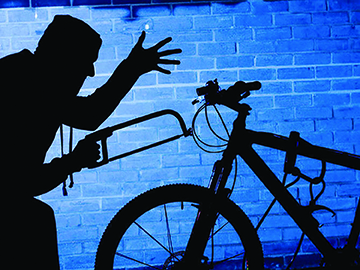
Thieves: The day of discovering your bike was stolen will come like a thief in the night.
The Lowest Of The Low
Not all people see bike theft as a “no big deal” situation, as many urban professionals ride to and from work every day — using their bike as either primary or sole means of transportation. For instance, Denver cyclist Jef Kopp rides from the Highlands district to his job at Little Black Church in Larimer Square every day. Having suffered several thefts across his decades as a cyclist, he attests: “Bicycle theft is not only a serious problem for those who depend on their bikes for transportation, it’s an act of violence. Stealing a bike might mean the bike’s owner misses a shift at work and subsequently loses a job. Or it might mean the loss of something sacred to a person like me, who not only rides bikes in a utilitarian way, but also finds a deeper connection to nature and spirituality.”
Who Is Responsible?
Meanwhile, the bike frames, handlebars, chains, pedals and tires are stacking up by the dozens — concentrated in chop shop-like setups along Logan St., in Capitol Hill, Santa Fe Ave. and various other ad-hoc dwellings that bear the unmistakable characteristics of homeless encampments. Some Denver residents have resorted to visiting these places to find their stolen property, such as downtown Denver newcomer Carter Haun, who — as reported by thedenver channel.com — who recently used a Facebook group called “Denver Stolen Bikes” to locate his prized, customized bike. He found it at the campsite on Logan and 13th streets and paid the person in possession of it $160 to get it back. Meanwhile, the blame game is swirling about — as homeless and their advocates are blaming bike owners for not sufficiently locking up their property, bike owners are blaming the police for not enforcing the law against theft, and cops are blaming the media for making them all look like murderers and neutralizing their ability to do their jobs.
Bicycle Insurance: Theft prevention and insurance can make the risk of having your bike stolen worth the trouble.
Take Action
For now, it is up to bike owners to adopt a hypervigilant approach to protecting their property. In doing so, it is important to begin by understanding the various ways in which bike parts and entire bikes are stolen.
• Hands — flimsy locks and chains can simply be yanked apart by someone who is properly motivated.
• Hand tools — parts that are held onto the frame by hexagonal bolts can be quickly loosened with a pair of channel locks, pliers or a crescent wrench.
• Hacksaws — cheap and easy to use, these can cut through most cables and chains in a matter of minutes.
• Bolt cutters — not as cheap as a saw but many times faster to use, one snip and a padlock, chain or steel cable can be rendered useless.
• Pry bars — crude but effective, a few good yanks and your lock can be broken or the metal your bike is locked onto can be bent apart.
• Bottle jacks — requiring a bit more planning and finesse, this mechanism used to lift a car can be properly placed and extended to pry apart loosely arranged U-locks and chains.
• Portable grinders — a battery operated grinder, while noisy, can cut through steel in a matter of a couple of minutes.
Practice Prevention
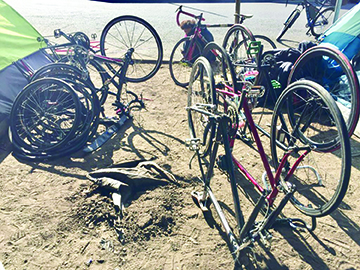
Inventory: Bikes tend to pile up between tents in inner city encampments.
Meanwhile, as a bicycle owner who cherishes and values your property, there are a few steps you can take to decrease the chances of a thief making off with your bike and increase your chances of recovery if it is stolen.
• Avoid flimsy locks altogether including thin chains and cables. Instead, invest in a super sturdy brand of U-lock and use two at a time to secure the front tire and frame as well as the back tire and frame to a bike rack, railing or otherwise permanent installment.
• Get the right brand — the best U-locks and other non-chain, non-cable applications with stellar reputations for being unbreakable are made by Kryptonite, Abus and Foldylock — among others.
Tools: Various tools and methods are used to quickly liberate bikes from their locks.
• Buy insurance — depending on how much you paid for your bike, how much you use it and how much you love it — the premiums may be worth the peace of mind.
• Document — taking photos of yourself holding or sitting on your bike can help verify that you are the owner.
• Register — filing your bike’s serial number and other ownership-specific information with your local police precinct can also help recover the bike in the event it is stolen.
Ultimately, the only way to guarantee that your bike remains in your possession is to never let it out of your sight. As that is impossible for most — you can instead choose to go back to driving everywhere, lock the thing up like it’s made of pure gold, or simply go buy one for far below market price. All you have to do is pay a visit to one of Denver’s bustling “chop shops,” and you’ll be pedaling away on the cheap in no time.
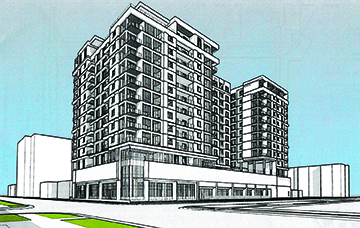
Artist’s Rendition: The engineering firm of Harris Kocher Smith prepared this drawing of AvalonBay’s Governor’s Park at the old Racines restaurant site. Neighborhood activists note that even this glamorized version not a single tree or blade of grass is provided for the entire block.
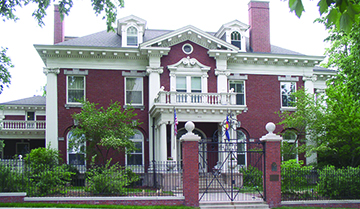
The next apparent target for high density developers in Denver is Governor’s Park at 7th and Logan. The small park is overlooked by Colorado’s residence for its governor which was contributed for that purpose by the Boettcher Foundation in 1959. The mansion was built in 1908 and had been the residence of Gladys Cheesman and her family, and then financial titan Claude Boettcher. The park was once part of the mansion’s grounds.
The park has a small children’s’ playground although, at times, Mayor Hancock has let the park be overrun by homeless campers. The present threat to the park is not to build directly on the park, but to eliminate sunlight to the area and block views of the Rockies with a massive apartment complex west of the park on the old Racines restaurant land that was recently sold to the high-density developer AvalonBay, a massive publicly traded real estate trust founded in Alexandria, Egypt, in 1978. It owns 79,636 apartment units and had $2.3 billion in revenues last year. The complex will have 305 units as presently configured and have up to 13 stories.
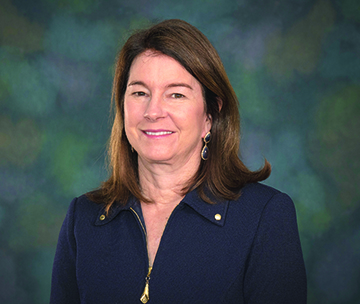
Birds Of A Feather: Shannon Gifford, above, the mayor’s Deputy Projects Officer, has been nicknamed the “Queen of Projects” for, inter alia, not recognizing being a CDOT commissioner for District 1 while being under the control of Mayor Hancock as an employee of the Mayor’s office. Lawyer Tom Ragonetti, right, of the firm Otten and Johnson is known as one of the most effective lawyer lobbyists in Denver and is seen by some as an arch-enemy of Denver’s neighborhoods on behalf of high-density developers. The two appear to be in cahoots to squash any bureaucratic opposition to AvalonBay’s massive apartment complex which would seriously damage Governor’s Park and the surrounding neighborhood.
In response the residents of the area formed Citizens to Save Governor’s Park with representatives from the boards of the four largest condominium complexes in the area on the steering committee. The organization is headed up by longtime resident of the area Ryan Ross. Squaring off against a billionaire corporation and what is widely viewed as a corrupt Denver Community Planning and Development Department, the residents face another David versus Goliath struggle.
Neighborhood Advocate: Ryan Ross is heading opposition to AvalonBay’s massive apartment complex through the new neighborhood organization Citizens to Save Governor’s Park.
Ross stated to the Chronicle: “All we want is to have a project in scale and height that is in line with all the other projects in the area. If this is approved as proposed, it will be the beginning of the end of Governor’s Park as an area you would want to live in. Governor’s Park is worth fighting for.”
The massive project’s principal impediment has been attempting to obtain a variance for a curb cut for access for cars off Sherman Street from its parking area. An email obtained by the Chronicle shows how corrupt the process has become for Denver’s high-density apartment projects.
There are almost no massive apartment complexes without some direct street access to parking for the residents and guests. The developer wanted a variance for a curb cut to Sherman Street but the city’s Community Planning and Development Department was balking. Mayor Hancock has repeatedly assured citizens that his office does not interfere with development decisions, but it is, of course, a blatant lie as shown by this email chain.
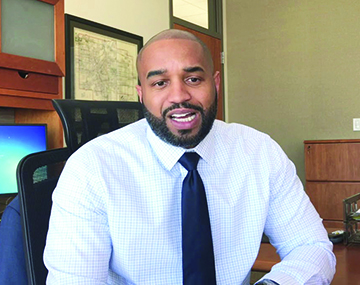
Man Under The Gun: Eulois Clerkley, the Executive Director of Denver’s Department of Transportation and Infrastructure is being bullied and squeezed by Gifford and Ragonetti to find a way to get AvalonBay’s Racine project approved notwithstanding serious traffic and other assorted problems.
AvalonBay had their variance for a curb cut on Sherman Street denied by Denver’s Department of Transportation and Infrastructure (DOTI), and the appeal was denied in mid-August 2020. It was time for AvalonBay to make a call for “lawyers, guns and money.” The lawyers were the law firm of Otten and Johnson and, in particular, their infamous “fix it” man on Denver real estate projects Tom Ragonetti. He, his firm’s partners and clients have provided significant “money” for the mayor’s various election campaigns. For political “guns” they went directly to the mayor who put his “fix it” woman to solve any such problems, Shannon Gifford on it. Her title is Deputy Chief Projects Officer Mayor’s Office for the Greater Area. But don’t let the unassuming title fool you. In emails she calls herself simply “Deputy Manager,” apparently for the whole city.
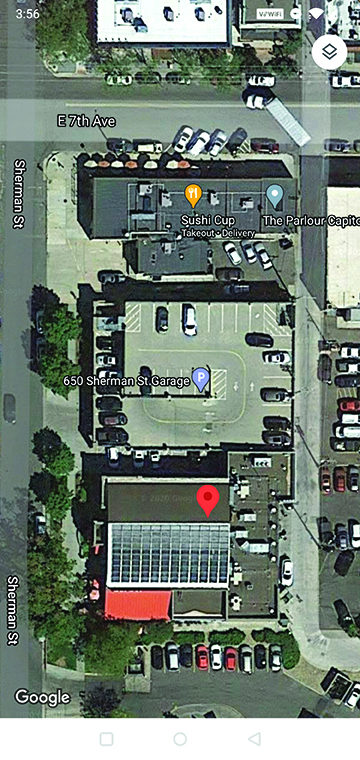
Bird’s Eye View: The overview of the Racines block that AvalonBay wants to turn into a massive apartment complex.
The 62-year-old Gifford was brought in last November to take on the mayor’s sleaziest projects. She had a great background in the same as the Commissioner for District 1 (Denver) to the Colorado Department of Transportation (CDOT), which she was appointed to in 2013. Not apparently aware of the clear conflicts of interest in being both the state commissioner of CDOT and city employee representing the Mayor’s Office, she has not resigned her CDOT post according the CDOT website.
Regarding the Racines project, the hammer came down on August 5 in an email to DOTI’s Executive Director Eulois Cleckley. Yes, the same Mr. Cleckley that got into a highly public war with Councilwoman Susan Shepherd who claimed he insulted and demeaned council members by not being willing to answer questions regarding transportation issues, and only listened to what Mayor Hancock or his Chief of Staff Alan Salazar told him.
In the email Gifford is not subtle in what the mayor’s demands are. She declares she did not understand:
Governor’s Mansion: High density developers in Denver are looking for virtually any park or open space they can exploit. Developer AvalonBay hopes to build a 13 story, 305-unit apartment complex at the old Racines restaurant site which would prevent any afternoon light or mountain views for Governor’s Park located behind the landmark Governor’s Mansion.
“. . , the current general policy regarding curb cuts in connection with new developments.”
She demanded a new “written policy” on curb cuts. She then reveals who is really behind the email:
“More specially, I hear regularly from Tom Ragonetti, regarding his client Avalon Bay on the Racines site and the appeal for a variance to obtain a limited curb cuts from Sherman Street. . . . Tom Ragonetti, and his client feel a direct deal of urgency about it. As I said he reaches out regularly to me about it. . . . What are the options.”
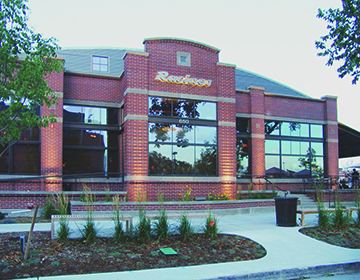
Neighborhood Icon: Racines restaurant had been a neighborhood and city icon for breakfast, lunch and dinner since 1983. It is proposed that the block on which it was located become another high-density apartment complex by the multi-billion-dollar REIT AvalonBay.
Experts indicate it is an apparent gross ethics violation for the mayor and his office to interfere with what should be a quasi-judicial process of granting or denial of a variance. Neighborhood groups are looking into it with attorneys whether criminal statues were violated.
Ultimately, the appeal was denied so Ragonetti and AvalonBay now seek to get approval without a variance. They plan to pour all of the traffic through the alleyway onto Grant Street. It is doubtful that project could or should be approved which would potentially destroy Grant Street’s traffic viability. With Ragonetti interfering with the process, with the backing of Mayor Hancock, anything is possible.
You can contact Citizens to Save Governor’s Park through its website savegovernorspark.org.
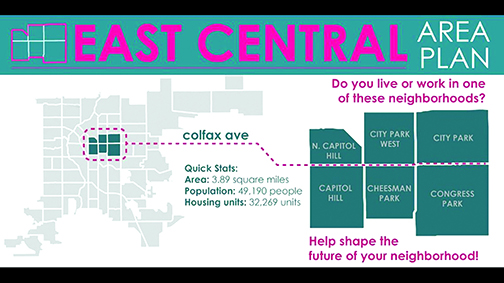
In October, city council adopted the East Central Area Plan (ECAP), a land use policy document authored by Community Planning and Development (CPD) that is meant to guide growth in the Capitol Hill, North Capitol Hill, Cheesman Park, Congress Park, City Park, and City Park West neighborhoods over the next 20 years.
ECAP: The East Central Area Plan is meant to guide growth in the Capitol Hill, North Capitol Hill, Cheesman Park, Congress Park, City Park, and City Park West neighborhoods over the next 20 years.
The area is comprised of more than 32,000 housing units, most of which are occupied by young renters, and runs between Broadway and Colorado Ave., from 7th Ave. up north to 23rd Ave.
And while the plan is supported by several neighborhood organizations, many residents feel left out, saying the plan doesn’t represent the needs their communities.
“We have serious concerns this plan was put together with a predetermined outcome in mind,” Jesse Morreale, president of the 7th Ave. Neighborhood Association (7ANA), told city council. “To us, this plan represents the city directing its agencies in ways that will harm our neighborhood.”
The plan makes six priority recommendations: strengthen the local economy through job training, increase affordable housing, improve services for people experiencing homelessness, make streets safer, expand historic preservation, and reduce carbon pollution.
District 9 representative Candi CdeBaca questioned the ability of the plan to accomplish the goals it sets out to accomplish.
Questioning: District 9 representative Candi CdeBaca questioned the ability of the plan to accomplish the goals it sets out to accomplish.
“We have multiple plans across the city that try to address the inequities in Denver’s zoning code, but when it comes to rezoning, our plans don’t come with any guarantee to achieve our goals, and they’re not yielding any results,” she said.
Left Out
Morreale and volunteer 7ANA board member Mark Spear both claimed CPD left their neighborhood in the dark about ECAP, even though the plan recommends several consequential changes for the area.
The 7th Ave. corridor is one of many streets classified as a transformative opportunity, a designation representing a need for increased multi-modal transportation in the area. Some ideas mentioned in the plan include building buffered bike lanes and other traffic calming designs that increase safety for pedestrians.
Morreale says these changes will increase density and property values in the area and thereby push out a lot of cost-burdened residents.
Concerned: Jesse Morreale, president of the 7th Ave. Neighborhood Association, has concerns the East Central Area Plan was put together with a predetermined outcome in mind.
“It’s amazing to me that city council would try to pass a plan of this magnitude without consulting all the people it affects,” Spear said.
Curt Upton, the principal city planner overseeing of ECAP, said CPD determined its outreach efforts by analyzing demographic trends in the comments residents submitted during community meetings.
Upton said CPD’s outreach meetings were primarily attended by property owners even though there are far more renters in the area. This fact alone made it necessary for CPD to focus its efforts on young renters, Upton said.
Other residents were concerned with the way CPD decided to define the neighborhoods ECAP will affect.
Instead of defining the plan area by the boundaries of neighborhood organizations, CPD used Statistical Neighborhood boundaries, which the agency created in the 1970s as a part of the Community Redevelopment Program.
Upton said CPD decided to use Statistical Neighborhood boundaries because they align with census tracts, thereby giving the agency access to data on the area’s demographic change.
“This plan is looking 20 years into the future, and hopefully by then we aren’t still in a housing crisis,” he added.
Historical Displacement
Many other residents believe ECAP will increase displacement because the plan’s transportation plans will increase investment and historic preservation in neighborhoods vulnerable to displacement like North Capitol Hill and City Park West.
“I remember a time when nobody cared about this neighborhood,” Julie Untiedt, volunteer president of the City Park West Neighborhood Association, told city council. “Now that the land is worth something, everyone wants to go changing the neighborhood.”
ECAP will focus on helping North Capitol Hill and City Park West meet Denver’s equity goals of providing multimodal transportation for residents and access to healthy food options. The plan also envisions high-comfort bike lanes running east-to-west through City Park West and North Capitol Hill along 16th Ave., and north-to-south along Franklin St. and Pennsylvania St., respectively.
As for the Colfax corridor, ECAP recommends rezoning the area to increase building height sizes up to eight stories. However, ECAP requires developers to provide a “community benefit” before they can build up. The plan does not specifically define what a community benefit is, but provides affordable business spaces, grocery stores, and daycare as examples. City council will have the authority to determine what benefit a developer must provide before approving a rezoning request.
The plan will also transform Colfax into a bus rapid transit system corridor, with stops at nearly every intersection between Broadway and Colorado Blvd. When combined with the historic preservation measures, some residents are concerned the cost of living will negatively impact the neighborhood’s small businesses.
“The thing that worries me the most is that small business owners will sell out, smart developers will scoop up their property, taxes will increase, and residents will face displacement for no reason whatsoever,” Dr. Giles Rafsnider told the Glendale Cherry Creek Chronicle in an interview.
Upton verified these fears when he told city council that Denver doesn’t have the policy tools to address displacement of minority groups or small businesses. And, even though CPD discussed ECAP alongside concurrent efforts like the Missing Middle Housing Initiative and the Affordable Housing Zoning Incentive, the agency doesn’t fully understand how ECAP will impact other plans or legislative efforts.
During the 2020 session, Democrats in the General Assembly introduced legislation to overturn the Telluride Decision, a state Supreme Court ruling that struck down rent control policies.
However, Upton says, CPD believes its plans are flexible and capable of being molded to fit modern needs.
“As additional tools like state laws change, it’s only going to accelerate our efforts to provide affordable housing,” Upton said.