by Mark Smiley | Sep 29, 2026 | Main Articles
Mill Levy Would Fund Employee Pay, Career Education, And Student Services As Voters Weigh Benefits Against Higher Property Taxes
by Mark Smiley
Tax Question: Denver Public Schools is asking Denver voters to approve an additional mill levy override in the November 2026 election. The measure would raise up to approximately $44 million annually, with much of the additional revenue directed toward employee compensation. DPS estimates the owner of a median valued Denver home would pay approximately $72 more per year.
Denver voters will decide this November whether to provide Denver Public Schools with an additional $43.9 million each year through a property tax increase, setting up a debate over employee compensation, student services, and how much more Denver property owners should be asked to contribute to the city’s public schools.
The Denver Public Schools Board of Education voted unanimously to place the mill levy override before voters. The proposal follows months of discussion about the district’s finances and recommendations from a citizen advisory committee assembled to consider both the need for additional revenue and how that money should be spent.
The largest share of the proposed revenue would go toward employee compensation. The advisory committee recommended approximately $25.8 million annually for salary increases for DPS employees. Another $4 million was recommended for career and technical education hubs, and $4.8 million for mental health and special education supports. Charter schools would receive approximately $9.3 million annually, reflecting requirements that charter schools receive an appropriate share of mill levy revenue.
For the owner of a median priced single-family home in Denver, DPS has estimated the measure would increase the school portion of the property tax bill by approximately $72 per year, or about $6 per month. Supporters argue that the relatively modest increase for an individual homeowner could collectively provide the district with meaningful resources to improve employee compensation, retain experienced teachers, and provide additional services for students.
Opponents and skeptical voters may view the question differently. Rather than focusing solely on the incremental cost of this particular measure, they are likely to consider the cumulative property tax burden Denver residents already face and ask whether a school district with a roughly $1.5 billion annual budget should find the money for its priorities within existing resources.
DPS officials have identified employee recruitment and retention as important reasons for seeking the additional revenue. The district has pointed to compensation gaps and difficulties filling certain positions, while educators have argued that competitive salaries are essential to keeping experienced teachers and other professionals in Denver schools. The issue also has roots in negotiations between DPS and the Denver Classroom Teachers Association. The teachers union and district previously reached an agreement to pursue additional compensation through a ballot measure after educators did not receive their full cost of living increase in 2024.

Students And Staff: Denver Public Schools Superintendent Alex Marrero visits a classroom. DPS says competitive employee compensation is necessary to retain staff, while voters will have to decide whether those needs justify another increase in property taxes.
From the supporters’ perspective, teacher compensation is not simply an employee benefit. They argue that it directly affects what happens in the classroom. Schools that struggle to recruit and retain experienced teachers may face greater turnover, more vacancies, and difficulty maintaining consistent instruction. Supporters contend that better compensation can help DPS compete with surrounding school districts and other employers for qualified workers.
There are similar arguments for spending additional money on mental health and special education. Educators have told the district that students have increasingly complex needs requiring additional support. The proposed mill levy would provide approximately $4.8 million for those services. Another $4 million would support career and technical education programs intended to provide students with pathways into skilled occupations, apprenticeships, and careers that may not require a traditional four year college degree.
District officials also point to broader financial pressures. DPS has experienced declining enrollment, which affects the amount of state funding it receives. Officials have warned that enrollment losses and uncertainty surrounding future state and federal funding could create increasingly difficult budget choices in coming years. DPS approved a balanced budget of approximately $1.5 billion for the coming school year, but district officials have said the longer term financial outlook presents challenges.
Supporters therefore see the mill levy as a way to provide a stable local source of recurring revenue. They argue that allowing salaries to become less competitive could ultimately cost the district experienced employees and make it more difficult to recruit replacements. They also contend that investments in mental health, special education, and career training can provide benefits that extend beyond traditional classroom instruction.
There are substantial arguments on the other side. Denver residents already pay significant property taxes to support DPS, and the district currently collects approximately $288.6 million annually through previously voter approved mill levy overrides. Denver voters have approved three such overrides since 2012, including a $32 million measure in 2020 that provided money for nurses, teacher compensation, and hourly employees such as bus drivers and custodians.
Critics may reasonably ask how often the district should return to voters for additional operating revenue. Each individual increase may appear relatively small when expressed as a monthly cost for the average homeowner, but taxpayers ultimately pay the combined cost of school district, city, county, and other taxing measures.
The timing of the proposal could also present a challenge for DPS. In 2024, Denver voters overwhelmingly approved a $975 million DPS bond, the largest in the district’s history. That money was designated for capital purposes including building maintenance, air conditioning, safety improvements, and technology rather than employee salaries or ongoing operations.
Bonds and mill levy overrides finance different types of expenses, making the current proposal substantially different from the 2024 bond. Nevertheless, some voters may look at the broader picture and question being asked to approve another significant school funding measure less than two years after authorizing nearly $1 billion in borrowing.
There is also a question of long-term sustainability. Employee raises represent recurring expenses. Once salaries increase, those higher costs generally remain in the district budget year after year. The mill levy would likewise produce recurring revenue, but critics may question whether increasing property taxes is the best long term method for financing employee compensation, particularly at a time when DPS enrollment has been declining.
The proposed $43.9 million represents only a relatively small portion of DPS’s approximately $1.5 billion annual budget, and that fact provides arguments for both sides. Supporters can contend that a comparatively small increase in overall district funding could produce meaningful improvements in compensation and student services. Critics can argue that a district with a budget of that size should be able to identify $43.9 million through reprioritizing existing spending.
The debate is further complicated by Colorado’s system for financing public education. Schools receive funding through a combination of local property taxes and state revenue, meaning decisions made at the state level can have significant effects on local school district budgets. DPS officials say the district has become increasingly dependent on local property taxpayers as the financial environment for public education has changed.
For voters, the November decision ultimately comes down to priorities and competing concerns. A yes vote would mean higher property taxes in exchange for approximately $43.9 million in additional annual school funding. The largest portion would be directed toward employee compensation, with additional money supporting career and technical education, mental health, special education, and charter schools.
Supporters will argue that approximately $6 per month for the owner of a median priced Denver home is a reasonable investment in attracting and retaining teachers, supporting students, and maintaining the quality of Denver’s public schools. They will also argue that failing to remain competitive on compensation could result in staffing shortages and greater turnover that ultimately affect students.
Opponents are likely to argue that Denver taxpayers have repeatedly supported DPS funding measures and that the district should demonstrate it can meet its priorities within the substantial resources it already receives. They may also point to the cumulative effect of property tax increases at a time when housing affordability and the overall cost of living remain concerns for many Denver residents.
The question does not offer voters an especially simple choice. Competitive teacher compensation and adequate student services are important to the quality of Denver’s schools. Property tax affordability, fiscal accountability, and careful use of public money are also legitimate concerns.
The November election will give Denver voters the final say on whether the benefits DPS says would come from an additional $43.9 million each year are worth the additional cost to property owners.

by Amber Wyatt | Sep 29, 2026 | General Featured
by Amber Wyatt
Abbas and Babbas participants meet on a Sunday at Zaidy’s Deli.
For many new parents, the first years of raising a child can be both joyful and isolating. While mothers often have access to a variety of support groups and parenting networks, fathers can find it more difficult to connect with others navigating the same stage of life. The Staenberg-Loup Jewish Community Center (JCC Denver), located at the intersection of Leetsdale Drive and South Dahlia Street, is working to change that with the launch of Abbas & Babbas, a free community program created specifically for dads of infants and toddlers.
The program is part of the JCC’s expanding First 36 initiative, which supports families from pregnancy through a child’s first three years. While many of the organization’s prenatal and postnatal offerings have traditionally focused on mothers and caregivers, Abbas & Babbas recognizes that fathers also benefit from dedicated spaces to build friendships, exchange advice, and navigate the challenges of early parenthood together.
The name combines the Hebrew word “Abba,” meaning father, with the familiar English word “Baba,” creating a welcoming title that reflects both Jewish tradition and the diverse families who make up the Denver community.
The program alternates between two types of gatherings every other week. Tuesday evening sessions feature facilitated conversations led by a licensed therapist, giving fathers an opportunity to discuss topics ranging from sleep deprivation and work-life balance to relationships and the emotional transition into parenthood. These conversations are designed to create a supportive, judgment-free environment where participants can openly share both successes and struggles.
On alternating Sundays, the group trades the meeting room for more casual outings. Fathers and their babies gather at parks, museums, restaurants, and other locations throughout the Denver metro area, providing opportunities to socialize while spending quality time with their children. Babies are welcome at all events, and no registration is required, although advanced sign-ups help organizers plan attendance.
The program reflects a growing understanding that fathers play an increasingly active role in raising young children and also benefit from meaningful peer support. Research has shown that strong social connections can improve parental well-being, reduce stress, and ultimately strengthen family relationships. By creating intentional spaces where fathers can connect with one another, the JCC hopes to foster lasting friendships that extend well beyond the early years of parenting.
Although rooted in Jewish values of community, kindness, and inclusion, Abbas & Babbas welcomes fathers of all backgrounds. The JCC has long positioned itself as a community resource serving the broader Denver population through educational, recreational, cultural, and wellness programming, regardless of religious affiliation.
The addition of Abbas & Babbas complements a growing lineup of family-focused offerings at the JCC, including prenatal education, breastfeeding support, caregiver-and-child classes, early childhood education, cultivating sleep routines, and the Community Baby Closet, which provides essential supplies to families without excluding fathers. Together, these programs aim to support parents through every stage of early childhood, from pregnancy through the toddler years.
As Denver continues to attract young families, initiatives like Abbas & Babbas demonstrate how community organizations are adapting to meet the evolving needs of modern parents. By recognizing that fathers also need connection, encouragement, and community, the JCC is helping ensure that no parent has to navigate the challenges of early childhood alone.
Abbas & Babbas meets every Tuesday evening at the JCC Denver, 350 S. Dahlia St., with alternating Sunday social gatherings held throughout the metro area. Participation is free, and fathers with babies or toddlers are encouraged to attend.
by Amber Wyatt | Sep 29, 2026 | Glendale City News
by Amber Wyatt
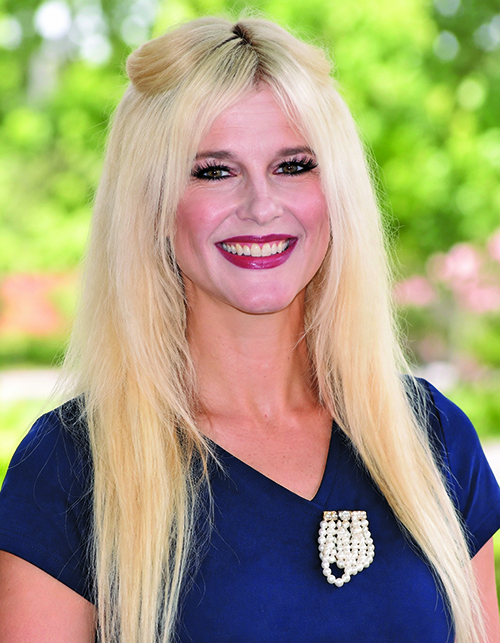
Republican Candidate for CD1: Christy Peterson
For the first time in nearly three decades, Denver voters will choose a new representative for Colorado’s 1st Congressional District this November. But the contest is about more than replacing longtime U.S. Rep. Diana DeGette.
It also raises a question that has dogged Republicans in overwhelmingly Democratic Denver for decades: Can Republicans, unaffiliated voters, and Democrats uncomfortable with their party’s nominee ever coalesce around a single alternative?
This year, they will not have only one alternative.
Democratic nominee Melat Kiros, Republican Christy Peterson, and unaffiliated candidate Dr. Shimon Blau headline a crowded November ballot that also includes Libertarian Chad Humphrey and Unity Party candidate Christopher “Critter” Milton. The multiple candidacies mean voters who do not support Kiros have several places to go — rather than a single challenger around whom they might consolidate.
That dynamic is particularly notable this year because Kiros is not a conventional establishment Democrat. The 29-year-old first-time candidate identifies as a democratic socialist and is a member of the Democratic Socialists of America. In June, she defeated DeGette, one of Colorado’s longest-serving elected officials, by more than 13 percentage points in the Democratic primary.
Kiros has said democratic socialism, to her, reflects a belief that government has a responsibility to meet people’s basic needs. Her platform includes Medicare for All, universal child and elder care, the Green New Deal, and making utilities publicly owned.
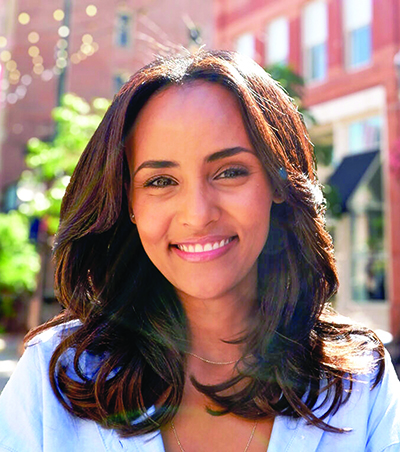
Democrat Candidate for CD1: Melat Kiros
International affairs have also become a significant part of the discussion surrounding her candidacy. Kiros has taken positions on Israel and Gaza that have drawn criticism, including from some Democrats. Axios reported in August that Democratic congressional nominees Dwayne Romero, Eileen Laubacher, and Jessica Killin said they would not endorse Kiros, while U.S. Rep. Jason Crow congratulated her on winning the primary but had not endorsed her campaign at the time of the report.
That makes the 2026 race an unusual test for Denver Republicans and political independents. A Democratic nominee well to the left of DeGette might appear to create an opening for voters looking for a more centrist alternative. Instead, those voters have multiple choices.
Peterson, 41, was the only Republican seeking her party’s nomination. The South Denver resident works in office management and accounting for a construction company and has centered much of her campaign on fiscal issues and public safety.
“I will work on reducing federal debt while helping our American farmers & ranchers sustain long-term production,” Peterson says.
“Supporting our local Police Departments with funding, training, and resources is my top priority,” Peterson says. She argues that improving public safety is important to Denver’s economic health and that a stronger business climate can create jobs and greater economic self-sufficiency. She also connects crime with some of the increasing costs confronting residents, including automobile and property insurance.
Her stated goal is “to make Denver a safer, more prosperous city for everyone.” But Peterson is not alone in trying to attract voters who want an alternative to Kiros.
The race changed significantly in July when Blau, a Denver physician specializing in pain management, qualified for the ballot as an unaffiliated candidate. Blau gathered more than 2,200 signatures in only a matter of days. State election officials determined that 1,918 were valid, comfortably exceeding the 1,500 required to qualify.

Independent Candidate for CD1: Shimon Blau
Born and raised near Sloan’s Lake, Blau is explicitly presenting himself as a more moderate alternative. He has described himself as leaning left on social issues and right on fiscal matters and has made affordability a central issue.
“Working families are being squeezed and having to make difficult choices between healthcare, housing, and food,” Blau told the Chronicle.
His platform also demonstrates why the contest does not break neatly along traditional partisan lines. According to Colorado Public Radio, Blau supports a long-term path toward universal health care, free childcare, and removing corporate money from politics, while saying he differs sharply with Kiros on other issues.
A Republican Drought Dating To Nixon
Perhaps the most striking historical fact about the race is just how long Democrats have controlled the 1st District.
A Republican has not represented Colorado’s 1st Congressional District since January 1973 — more than 53 years ago.
Republican Mike McKevitt won the seat in 1970 and served one term, from January 1971 until January 1973. Democrat Pat Schroeder defeated McKevitt in the 1972 election with 52% of the vote. She would go on to represent the district for 24 years.
When Schroeder retired, DeGette succeeded her. DeGette was first elected in 1996 and took office in January 1997. Thus, with the exception of McKevitt’s single two-year term, the district has been continuously represented by Democrats since 1951: Byron Rogers from 1951 through 1970, Schroeder beginning in 1973, and DeGette beginning in 1997.
That history helps explain the challenge facing anyone running without the Democratic nomination.
The district, which encompasses virtually all of Denver along with Glendale and portions of Arapahoe County, has become one of the most reliably Democratic congressional districts in Colorado. In 2024, for example, DeGette defeated Republican Valdamar Archuleta by 55 percentage points.
One Alternative, or Several?
That history also makes the presence of both Peterson and Blau particularly interesting.
Republicans seeking to compete in the district face a mathematical and political problem: Their traditional base alone has not been enough to win. Any serious challenge to Democratic control would therefore require support beyond registered Republicans, including unaffiliated voters and potentially Democrats dissatisfied with their nominee.
Yet the 2026 ballot provides those voters with several alternatives rather than one.
Peterson offers voters a traditional Republican candidacy emphasizing public safety, federal spending, and economic issues. Blau is trying to occupy a different lane, presenting himself as politically independent and more moderate while agreeing with Democrats on some social and economic policies. Libertarian and Unity Party candidates offer still more choices.
That leaves an unusual political picture: Kiros has critics to both her right and within the broader Democratic coalition, but those critics are not represented by a single opposing candidate.
Kiros, meanwhile, has demonstrated that her politics have substantial support among Democratic primary voters in Denver. Her victory was not merely the product of an incumbent stepping aside. She defeated DeGette, who had represented the district since 1997, after building a grassroots organization that her campaign said knocked on approximately 100,000 doors.
The primary also provided evidence of a broader progressive constituency in Denver. An analysis reported by Axios found significant support for progressive candidates across several Democratic primary contests, while candidates associated with the Democratic Socialists of America have increased their influence in the city’s politics.
So the general election presents competing political stories. One is the remarkable durability of Democratic control of Denver’s congressional seat. Another is Kiros’ successful challenge to Denver’s Democratic establishment and the ideological change her nomination represents. A third is whether voters who consider themselves somewhere between democratic socialism and traditional Republican politics see Blau’s independent candidacy as an alternative.
And hovering over all of it is 1972. Richard Nixon was president. The Watergate break-in had occurred only months earlier. “The Godfather” was in movie theaters. And Mike McKevitt was the Republican congressman representing Denver.
Pat Schroeder defeated him that November. No Republican has represented Colorado’s 1st Congressional District since.
More than half a century later, Denver voters will decide whether the district continues its long Democratic tradition under a very different kind of Democratic nominee, or whether one of the alternatives on a crowded ballot can break that streak.
Election Day is Nov. 3.
by Valley Gadfly | Sep 29, 2026 | Valley Gadfly
From Broadway’s Halloween Parade To A Fright Fest Plus Garden Ghosts, Scare Lurks
by Glen Richardson

Trick-or-Treat: Albeit traditional trick-or-treating is on the decline, many youngsters still go door-to-door collecting candy on Halloween.
Halloween 2026 lands on a Saturday — the first since 2020 and the last until 2037 —and Denver is treating it accordingly. Here’s a look at the haunts, the parades, the family nights, the bar crawls, ending with Ghosts in the Gardens, Victorian Horrors, BOO-lesque, and the Nightmare Before Christmas on Oct. 31.
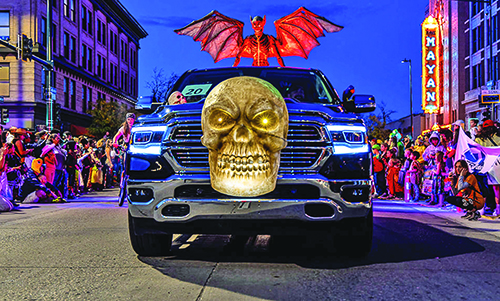
The tradition launches with the seventh annual Broadway Halloween Parade on Oct. 17, 6-9 p.m. Stretching from 5th to Alameda along Broadway, the Parade features various spooky floats, bands, and marchers. The floats that drift down Broadway aren’t typical parade floats, they’re labors of love, built by people who care deeply about bringing joy to the crowds lining the street. It’s magical fun, so bring the entire family.
Terrifying Traffic: The floats that drift down Broadway aren’t typical parade floats, they’re labors of love, built by people who care about bringing joy to the crowds lining the street.
Glow at the Gardens opens on Oct 15, it runs to Oct. 18, plus again Oct. 21-24. The Broadway Bar Crawl is Oct. 24, as is Dia de los Muertos at Civic Center Park. BOO-lesque is Oct. 23-31. Nightmare Before Christmas with the Colorado Symphony is at Boettcher Concert Hall, Oct. 29-30, 7:30 p.m., and in the afternoon at 2 p.m. on the 31st.
Halloween Balls

Paranormal People: Attend the Paranormal Palace at the Double Tree Tech Center, Oct. 31, and you’ll see people decked out in garments similar to this.
This year’s Paranormal Palace is at the Double Tree Denver Tech Center, Oct. 31, 8 p.m. to 1 a.m. The bash features 8,000 sq. ft. of decor and lighting, stage shows, a dance floor, interactive exhibits, and bars. The Dark Harvest Masquerade Ball is at the Castle Event Center in Northglenn, Oct. 31, 9 p.m. to 1 a.m. Plus, of course, there are bar crawls, family daytime events, and closing night for most haunts and patches.
Two of the most popular family Halloween attractions are the Elitch Gardens’ Fright Fest, and the immersive Glow at the Gardens in Denver Botanic Gardens. When the sun goes down, fear takes over Elitch’s Fright Fest. Haunted houses, terrifying scare zones, sinister live entertainment, and rides in the dark create an atmosphere of nonstop thrills
Want more? Then wander Botanic Gardens’ illuminated Glow at the Gardens. It’s enchanted landscapes animated by live performers, with hand-carved pumpkin displays around every bend. While most nighttime Halloween events feature foam “funkins,” every single one in the Gardens is grimacing jack-o’-lanterns and larger-than-life sculptures that are freshly carved from real, locally grown pumpkins. The Gardens also features Ghosts in the Gardens Oct. 9-10, Oct. 20, and Oct. 28-31. Storytellers share true staff experiences, security guard encounters with the unexplained, and the haunted history of the place once known as “The Boneyard,” 5:30-10 p.m. Oct. 8-10, and 20, 4:30-10:30 p.m. Then again on Oct.28-30, 4:30-9:15 p.m. p.m.
Trick-or-Treating

Night Fright: Elitch Gardens’ Fright Fest has haunted houses, terrifying scare zones, sinister live entertainment, and rides in the dark. Photo: Elitch Gardens
Families in many Denver neighborhoods say traditional door-to-door trick-or-treating is on the decline, albeit popularity varies by locations.
Trick-or-treating generally wraps up between 8 p.m. and 9 p.m. in most neighborhoods. There is no official or universal age limit to trick-or-treat, but most public surveys and social norms point to 12 to 14 years old as the age when kids start aging out. Traditional door-to-door trick-or-treating is declining in many neighborhoods, though popularity varies heavily by location
Finally, there’s a Trick-or-Treat Street on S. University Blvd. in Centennial with games, booths, and lots of candy. Hours are 4 to 5:15 p.m. or 5:15 to 6:30 p.m. Site is the Goodson Recreation Center parking lot, 6315 S. University Blvd., Centennial. All children must be accompanied by an adult age 18 or older.
Boo At The Zoo

Creepy Cavalcade: The seventh annual Broadway Halloween Parade is Oct. 17, 6-9 p.m. The Parade features spooky floats, bands and marchers.
Denver Zoo’s Halloween institution, Boo at the Zoo is Oct. 1-31, beginning at 4:30 p.m. It takes over a full month of evenings in 2026, not just the week before Halloween.
Kids work trick-or-treat stations through the zoo grounds after regular hours, and the run is long enough that a family can pick a weeknight instead of fighting the closing-weekend crowd.
The dated evenings are Oct. 2 and 3, Oct. 9 to 11, Oct. 16 to 18, Oct. 23 to 25, and Oct. 30, all 4:30 to 9 p.m. Oct. 31 is a sensory-friendly night with the same hours, built for guests who need lower stimulation.
Tours & Teas
Do you know what lurks beneath the surface of Denver’s beautiful Cheesman Park? Local tours — year around not just on Halloween — uncover the eerie history behind the park, Fact: It was Denver’s first city cemetery. During the tour, you’ll hear haunting tales and hair-raising firsthand accounts of paranormal activity.
You’ll also uncover the truth behind the spine-chilling process used to remove the bodies from the cemetery and learn about the haunted mansion homes of Humboldt Island. By the tour’s end, you’ll be able to determine for yourself if the park is truly haunted.
Or, consider attending a spirited and spooky tea at the Ellie Caulkins Opera House, Oct. 11. Event will feature a spooky and spirited tea featuring traditional tea service. You’ll enjoy hauntingly charming desserts, themed cocktails and beverages, interactive experiences, and a spellbinding live opera performance inspired by Shakespeare’s most infamous witches.
Daring Dashes
Call it a Monster Mash, Halloween 2026 in Denver features a “Thriller” list of eerie races — both 5K & 10K — to keep “Dem Bones” moving this holiday.
Start with the Spooky Spirit 5K & 10K, plus Half Marathon on Oct. 3 at Chatfield State Park in Littleton, 8 a.m. There’s a Kids Dash, a One-Mile, followed by the 5K & 10K. Results and awards presented immediately following the race.
Denver’s Sloan’s Lake 5K & 10K Monster Dash is Saturday Oct. 24, 9:30 a.m. There’s a mile and a mini loop for the kids. Stay after the race for BBQ, drinks for several sponsors, plus scary music. At the Goodson Recreation Center, 6315 S. University Blvd., participate in Hoofin’ It Through the Hallows 5k Oct. 24. It features a costume contest at 5 p.m. The race starts at 5:30 p.m.