by Mark Smiley | Jun 25, 2021 | General Featured
Denver Man Hopes Patriotic Art Project Sparks Unity
by Julie Hayden
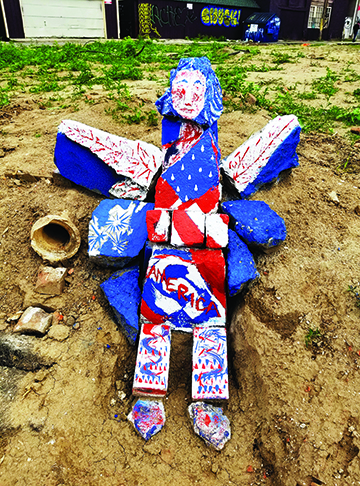
Finding The Way: Johnston created an angel Sacagawea from the rubble to symbolize Americans finding their way to common values and principles.
At first glance, it looks like a vacant lot in the middle of what Denver Police records show to be an area with one of the highest crime rates in North Capitol Hill. But a closer look reveals an island of unity and patriotic art, thanks to the efforts of one man and the support of the diverse community that makes up this neighborhood. “This is for the people and to remind us we have something more important that just partisan politics,” exclaims patriotic art creator Roy Johnston.
Johnston is an author who had just written a book and was searching for inspiration for a cover photo. “The book was titled ‘Brick By Brick, The Dismantling Of America’ because of all the chaos going on for the last five years or more.” He explains the book is about “how America is in decline so you could see how the building blocks of America are crumbling so to speak and I was looking for brick walls crumbling.”
That’s when he came upon the lot in the 1500 block of Pearl Street. “I got to this place where there were bricks just strewn over the ground.” Johnston reveals his research showed there used to be two lovely brick homes here, built in the mid 1930s. The property had been bought and sold over the years and eventually demolished, leaving a gaping hole on the lot. “There were two houses here, 1930s vintage brick houses. Beautiful but had gone into ruin and were actually crack houses.”
An idea began to grow to create something intended to be unifying out of the rubble, a map of the United States. “I thought what a great metaphor to take something like a crack house and the human tragedy that occurs there and take the rubble from that and rebuild the country.”
And that’s what Johnston proceeded to do. He took the bricks and debris from the demolished homes and used them piece by piece to create a sculpture of a map of America.
“Everything here is from this site. I have Styrofoam that I painted to be the ocean. There’s tree roots that make the Mississippi River, there’s metal that makes the Great Lakes. The idea is that red, white and blue, the United States flag brings the country together. That’s the message here.”
Not About Politics
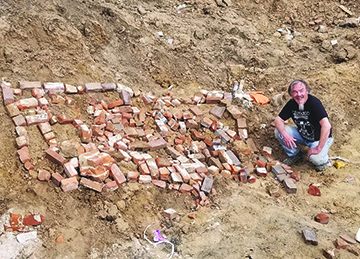
Patriotic Art: Artist Roy Johnston stands by a map of the United States created with the debris from a demolished building in North Capitol Hill.
As Johnston showed up to work regularly on his patriotic art, neighbors watched with curiosity. “People come by every day, They stop and they say what are you doing and I tell them and they love it.” He says people from the historic Denver Community Church across the street stopped by one Sunday to take a look.
It’s also across the street from one of Denver’s Safe Outdoor Spaces homeless encampments. Some of the people staying there help Johnston keep an eye on his artwork. “People stop by and take pictures and not a brick has been moved.”
Johnston is adamant this is not about politics. “This is about bringing the country together. I hate politics. This has nothing to do with Democrats, Republicans, or any fraction that is always saying ‘Me, me, me. Our way or the highway’. I’m saying let’s talk about us together as Americans.”
New Projects
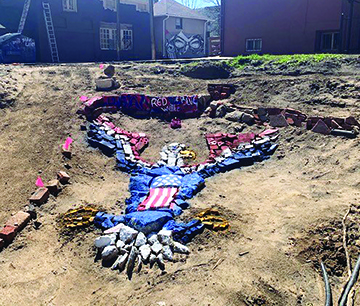
Rebuilding From The Rubble: Johnston hopes his patriotic art encourages people to rebuild togetherness out of the rubble of partisan politics.
The art project continues to grow. Johnston says a friend suggested he create a sculpture of an eagle. So Johnston gathered the pieces of brick and concrete, figured out how to put them together in the shape of an eagle and painted it with red, white and blue. The next project was an angel Sacagawea. The Lemhi Shoshone woman was an interpreter and guide for the Lewis and Clark Expedition in the early 1800s. “You see her arms spread wide and facing the map of America. She is
praying for America. Without her guidance, Lewis and Clark would likely have not made it to the Pacific. Now she is praying America finds her way back to its founding principles and values. That’s the symbolism I was going for.”
Johnston acknowledges his work is unique. But that’s the point. “It’s just that if everybody had these crazy ideas like this we would be a great country again. We would come together, we would solve our problems, solve our differences and that’s how every everybody can make a difference. We don’t need to rely on Washington DC, we need to rely on ourselves.”
Johnston hopes this is just the first of many of what he calls “patriotic art for free.” “I’m going to keep doing the patriotic art, “ he says. “And the rest is in God’s hands. I hope it brings people together.”
Johnston can be contacted at johnstini.com.

by Mark Smiley | Jun 25, 2021 | Travel
by Mark Smiley and Eleanore Smiley (10 years old)
Wave Pool: Catch a wave and splash and play as the swells sweep in from the five-foot deep end to the zero-depth-entry shallows. Wave pools are a fun family vacation favorite for kids of all ages. The rollers flow in every five minutes to lift and transport you on the surge of the ocean’s tide.
Great Wolf Lodge in Colorado Springs, has reopened after being closed due to the COVID-19 pandemic. The lodge, offers families a viable option for a “staycation.” The family vacation resort opened in January 2016, and features a 50,000-square foot indoor water park. The $100 million resort is situated North of Colorado Springs and is just over a one-hour drive from Denver making it a logistically simple getaway.
The check-in process was seamless with the exception of the room not being ready. However, there is plenty to do while one waits for their room. And, upon check in, all members of your party are given wristbands which serve as your room key.
The main attraction is the indoor water park which has slides and thrill rides for kids and adults of all ages as well as a wave pool. In addition, after checkout, guests can continue to enjoy the water park until it closes at 8 p.m. “In my opinion the water park is the best part of Great Wolf Lodge,” said Ellie Smiley, a 10-year-old guest of the hotel and this author’s daughter. “Once you walk in you will see Fort McKenzie which is fun for any age. There’s a bucket that fills up with water then dumps on your head.”
The surprising part for most guests is there is more to do beyond the water park. The resort features a climbing wall, ropes course, a digital scavenger hunt which electronically captures achievements of its participants with a tracked score, a Build-a- Bear workshop, mini golf, bowling, and an arcade.
In addition to the above offerings, the resort features dance parties and story time. It is an easy way to wind down while having the children in pajamas with a short elevator ride up to the guest room.

Wolf Tail: Once the floor drops out from under you on this adventure ride, you’re hurled into a nearly vertical, 20-foot free fall followed immediately by a 360-degree, high-speed loop.
Guest rooms range in size from a standard room to suites including a separate den for the kids to offer privacy for the parents. They include a separate television with plenty of kids’ programming offered. They all offer mini fridges and microwaves. “In my opinion the best room there is the Wolf Den because it has a tiny built-in room called Wiley’s Den for your kids with bunk beds, a TV, and decorated walls with all the Great Wolf Lodge characters,” said Smiley. “There’s also a window which you will find the remote to the TV. Next to Wiley’s Den is the bed for the parents and a TV for them. The room also has a microwave, a mini fridge, and a coffee maker. Though the Wolf Den room costs more money, ages 13 and under will have the best time at Wiley’s Den!”
There are ample dining options inside the resort including pizza, quick appetizers, and a buffet geared mostly to the younger population. Ben and Jerry’s and Dunkin’ Donuts are guest favorites located on the way to the water park. They are convenient options to grab a cup of coffee or a cold treat.
While convenience is one of the selling points to the Great Wolf Lodge, some guests opt to visit nearby restaurants for lunch and dinner for a change of scenery. There are a number of restaurants and businesses nearby including The Summit, Cheddar’s Scratch Kitchen, Parry’s Pizzeria & Taphouse, and Jersey Mike’s.
The most notable attributes of the resort are the friendly staff members, clean suites, and an immaculate lobby that also has a big fireplace. Big windows give guests nice views of the Rockies as well.
If a family is looking for a quick getaway offering convenience, fun, and thrills, it is tough to beat the Great Wolf Lodge. For more information, visit www.greatwolf.com/colorado-springs. Follow them on Twitter @GreatWolfLodge and Facebook @GWLColoradoSprings.

by Charles Bonniwell | Jun 25, 2021 | Editorials
If you enjoy only getting your news about local stories from the innocuous, politically correct viewpoint of today’s Denver Post you will be glad to know that may soon be essentially the only point of view available. The Denver Post was not always bland and politically correct and, in fact, it was just the opposite when it was owned and operated by two hustlers named Harry Tannen and Frederic Bonfils in 1895. The coverage was not exactly fair and balanced under their tutelage, but it was certainly sensational. It was an absolute must-read seven days a week.
Of course, not everyone enjoyed the coverage. One lawyer went to their offices and repeatedly shot both men. He was never convicted but Tannen and Bonfils were found to have jury tampered in the third trial. Another lawyer went to their offices and horsewhipped both men. A wonderful book on the glory days of the Post is Bill Hosokawa’s Thunder in the Rockies.
The paper did not get to its present emaciated state overnight, but it is now owned by a New York hedge fund, Alden Global Capital, that could care less about the content of the paper, and only cutting costs and squeezing every penny of profit possible.
A group of laid off reporters and editors started the digital Colorado Sun which, of course, reflects the viewpoint of the paper where they learned their craft. Now the Colorado Sun has a partnership with a new local non-profit, National Trust for Local Trust, has acquired 24 Denver metro newspapers including the 153-year-old Golden Transcript, as well as such other well-known local papers as Life on Capitol Hill, Washington Park Profile, Littleton Independent, and Englewood Herald.
Larry Ryckman, a former Denver Post editor and now editor-in-chief of the Colorado Sun told NPR that the “Colorado Sun . . . will drive [all 24] newspapers editorially” in what he and the other former Denver Post employees deem “the public good.” Oh, boy! We can’t wait for all 24 newspapers to be exactly the same editorially as the Colorado Sun and The Denver Post.
But wait you say? What about Colorado Politics and the Denver Gazette owned through a corporation by billionaire and Republican donor Phil Anschutz? Well, it appears that Mr. Anschutz believes that the only way to make money in the media business in this area is to mimic The Denver Post. So those sites, editor-at-large, Vince Bzdek, is a former Denver Post editor and its new managing editor, Linda Shipley, was, you guessed it, the managing editor for The Denver Post. Most of its reporters like Joey Bunch are also former Denver Post reporters.
The content of the Colorado Politics and Denver Gazette is basically identical to The Denver Post except for an occasional bland conservative op-ed or a puff piece on some has-been establishment Republican like Bob “Both Ways” Beauprez.
The homogenization of the news was recently highlighted when the annual Western Conservative Summit came back to town. Local self-identified communists and anarchist groups decided to have some fun punching out blue haired ladies, verbally harassing old men, and blocking downtown traffic. The Denver Post and its many offspring reported nothing as they know men and women of the Left only protest peacefully.
In the Denver market only Westword covered the mayhem having not yet been purchased by the Colorado Sun and its financing partner. Another independent paper The Villager appears to have survived the attempt to shut it down when its April Fool’s Day story was apparently not politically correct enough.
Below is a picture of the Western Conservative Summit outdoor festivities courtesy of the out-of-town news site, the Washington Times. There may come a time in the not-too-distant future where controversial stories will be covered, if at all, by only out-of-state news organizations.


by Laura Lieff | Jun 25, 2021 | Glendale City News
Two Players Signed By MLR Teams And New Docuseries Slated For Worldwide Distribution
by Laura Lieff
Athletic Prowess: Former XFL defensive tackle Gelen Robinson plays hooker for the Colorado XOs and has been signed to the LA Giltinis for the summer.(Photo by Seth McConnell)
In January 2021, Glendale formed the biggest, fastest, and most athletic rugby team in the world called the Colorado XOs. But instead of populating the team with athletes who have been playing rugby their whole lives, this team was comprised of elite American players from other sports. What these players lacked in rugby experience they made up for in size, strength, and speed as some played in the NFL, XFL, or CFL. The athletic prowess was definitely there but the question was whether or not these men could learn to play and excel at rugby.
“The US rugby player pool is pretty limited, so we believe the only way to add depth to that pool quickly is to recruit players from other sports,” explains Glendale City Manager Linda Cassaday. “That was the idea behind our Crossover Academy — find the best athletes from other sports and teach them the game of rugby.”
With the goal of finding American athletes whose talent outweighed their lack of experience, Glendale signed 30 players who showed enough potential to ultimately help the United States win the World Cup. When Glendale made the controversial decision to leave Major League Rugby (MLR) — due to the organization’s choice to use foreign players rather than American players — many naysayers scoffed at the strategy.
Introducing New Faces To Rugby

Standout Player: At 6’ 8’’, Shawn Clark shows off his natural aerial skills in the lineout. Clark will also play for the Giltinis this summer. (Photo by Seth McConnell)
Now, just a few months later, two of the crossover players — Gelen Robinson and Shawn Clark — have signed with the LA Giltinis, an MLR team based in Los Angeles, California. Giltinis General Manager Adam Freier says he was delighted to sign two promising American talents and strengthen the club’s links with the Colorado XOs.
“Gelen has a unique skill of multiple disciplines as an athlete, from wrestling, football and basketball, while Shawn is one of those athletes that has an incredible engine, who could play multiple positions,” Freier explains. “They are both great signings and young men, which is a real credit to the Colorado XOs coaching staff and officials.”
Both Robinson and Clark took their first strides in the game over the past 19 weeks in this unique crossover experiment to coach talented football, basketball, and track athletes into potential professionals for the USA Rugby player pool.
“We at the Colorado XOs and the City of Glendale are extremely proud of both Shawn and Gelen,” Colorado XO Director of Recruitment Peter Pasque says. “They’ve done everything we’ve asked of them and more. We also would like to thank the LA Giltinis for taking an early interest in our program.”
Although Robinson and Clark will be playing for the Giltinis this summer, Pasque makes it clear that the players are only on loan. “The reason we are releasing these athletes to play for other teams for two months is because it will be a positive experience for them which will work out in the long run for our team.” After spending two months in Los Angeles, both players will return to Glendale in August to train, practice, and play for the Colorado XOs.
Successful But Challenging Experiment
While a 5-5 record may not sound impressive on paper, the XOs spring season record is admirable considering this group of men had never played together before nor had they ever picked up a rugby ball.
“We’re trying to bring in the best athletes and teach them the fundamentals,” Pasque explains. “The fact that we have only been working with these guys for 19 weeks and already have interest from the United States National Team speaks for itself.”
But there are still a few issues to address. While many individual players are thriving, others have succumbed to various injuries that Glendale did not anticipate.
“Overall this recruiting experiment has gone well, but there have been some unexpected challenges,” says Cassaday. “The injury rate was astounding and definitely took a toll on the team but we’ve learned from that, analyzed the injuries, and are understanding how to avoid them in the future.”
One of the most significant adjustments some XO athletes, especially those who are former football players, had to make was learning how to play without a helmet or pads. Cassaday says that aspect has been a major part of the learning curve when it comes to tackling and overall movement.
“Initially, all we could evaluate was their physical stats,” she explains. “Some players were not invited back because they weren’t able to make the change to rugby so there are definitely recruiting changes that will be implemented for the fall season.”
Pasque adds that individually the majority of the athletes are doing well but there is significant work to be done in terms of the team as a whole. Of the 30 players recruited, he says that approximately one third were cut, one third are serviceable, and the rest have the potential to develop into elite rugby players that can make a difference in the World Cup.
“At the moment we’re seeing more individual successes than team successes but we’re going in the right direction and learning quickly,” he explains. “This whole thing, which was sponsored by the City of Glendale, has a great mission and purpose and we are taking steps to make it even better.”
Worldwide Docuseries Release

Film Crew: A behind-the-scenes look at the making of the docuseries that will be released to a global audience in the coming months.
Further exemplifying the significance of Glendale’s crossover experiment is the attention it has garnered from Spring Media, an international full-service sports media agency, along with Rugby Factory TV. The two entities have partnered in the worldwide distribution of a new documentary series about Glendale’s crossover program. Slated for global distribution this fall, the first season of the docuseries (appropriately called RugbyTown) will show how the Crossover Academy has been recruiting NFL-quality American athletes and training them full-time in a residential high-performance environment.
“RugbyTown USA’s mission is to help the United States win the Rugby World Cup within the next decade,” says Glendale Mayor Mike Dunafon. “The rugby world has long seen America’s greatest athletes on the football field or the basketball court, but now the RugbyTown Crossover Academy is training those athletes to play rugby at the highest levels internationally.”
He continues, “We are delighted to be working with Spring Media to offer the RugbyTown series to the world so that viewers can get to know the players and coaches who have set out on this incredible life-changing and historic journey.”
According to Spring Media Commercial Manager Craig Neilson, the docuseries is “tailored to both the global sports audience and those looking for high-quality entertainment in general.” The premiere season will feature 10 episodes ready for distribution on August 1, with season two dropping at the end of 2021.

Documenting The Action: Slated for release this fall, RugbyTown will showcase how Glendale broke new ground by training elite American athletes how to play rugby.
“With our embedded production team, we’ve captured the players’ transformation from individual athletes into a cohesive rugby squad,” says Patrick Guthrie, Co-Founder & Chief Content Officer at Rugby Factory TV. “RugbyTown is the story of these extraordinary young men, their coaches, their families, and their mission to win the World Cup, all told by the players and coaches themselves.”
Upcoming Season
Looking ahead to the fall, the focus of the XOs will be competing against teams in South Africa — a country where rugby is extremely popular and the competition is intense. The plan is to do a three-week tour, play as many games as possible, and train with high level clubs — especially the Sharks and Blue Bulls which are two of the top South African rugby teams.
Stateside, Glendale is working on compiling a fall schedule for rugby enthusiasts to look forward to at Infinity Park. Cassaday says they are hoping to play against D1 programs, MLR academies, and teams like the Blue Bulls who are willing to travel to compete.

Frontline Footage: Rugby Factory’s film crew has been documenting the Crossover Academy’s progress over the last few months.
Although rugby is clearly a significant part of the Glendale culture, Cassaday says that ultimately the program is part of the City’s economic plan to put Glendale on the map. By attracting visitors to enjoy all the bars, retail, restaurants, and hotels Glendale has to offer, she hopes that other rugby teams will want to visit and train here as well. Additionally, Cassaday says that the idea is that if Glendale invests in travel to play and train with foreign teams, the foreign teams will reciprocate.
Fans can look forward to watching the XOs play in the RugbyTown 7s tournament August 20-22 at Infinity Park. For more information and updates, visit www.infinityparkatglendale.com/colorado-xos.

by Mark Smiley | Jun 2, 2021 | Travel
Here We Are Stuck In The Middle
by Danny Foster and Bob Graham
Imagine, if you will, living in a time when you cannot express your political opinions, or any opinion for that matter, without being attacked, canceled, or dismissed. Imagine a time when loud demagogues control the Democratic Party and the Republican Party, and if you don’t walk in lockstep with the “leaders” of the Party, then you will be marginalized and called a racist or a socialist or an insurrectionist. Well imagine it no longer, this is America 2021, and pragmatism and thoughtful dialogue have left the building. We are all reaping what we have sowed by allowing the loudest voices to control our public discourse and policy. As much as we would like to blame the screeching voices on the Left, or the tin-foil hats on the Right, it is us, the majority of adults in this country, who are to blame. We are guilty of not standing up to the demagogues in the Democratic and Republican parties.

Danny Foster
The demagogues on the Left are no different than the demagogues on the Right. Sure, they have different political ideas, but their tactics are essentially the same. Viciously attack those whose opinions are different and embrace tribalism in its most visceral form. Nothing says “anti-fascist” like throwing bricks at your political opponents. There is great danger in assuming one’s side of an argument is free from fallibility or not otherwise open to question. We can only learn from each other if we are able to exchange ideas openly — without being shouted down by those with whom we disagree (after all we were both politically polarized, but through thoughtful discussion we have brought each other to the Center). When Rep. Ilan Omar and the rest of the Squad have become the loudest voices in the Democratic Party, and Reps. Lauren Boebert and Marjorie Taylor-Greene have become the loudest voices in the Republican Party, it leaves a wide gulf of unrepresented opinions in the middle. And on behalf of the Silenced Majority, let us just say that both Parties are collectively bumming out a large percentage of this country and we must stop being silent.
Common sense and maturity have long since abandoned the Parties and created a seemingly binary world. But it doesn’t have to be that way. A recent Gallup poll indicated that 40% of Americans consider themselves politically independent, the highest percentage ever recorded, while those holding themselves out as Democrats or Republicans has dramatically dropped in the past few years. That is because the majority of Americans are fed up with the extreme positions and tribalism sweeping our city councils, state legislatures, and the U.S. Congress. But unless the political mod-erates on both sides start exerting more political muscle and shutting down the polarizing rhetoric, the extremists will win. And we cannot let that happen.
We must refuse to let the fringes of these parties control our political dialogue. We should not be cowed into silence because we believe we will be attacked. If you are a Democrat, you shouldn’t be scared to say that you respect the police and that the De-fund the Police Movement is a terrible idea. Supporting our police doesn’t make you a bad Democrat, it makes you a grown-up. If you are a Republican, you shouldn’t be scared to say you are in favor of reasonable gun restrictions. That doesn’t make you a bad Republican, it makes you a good citizen. After all, 62% of all Americans favor a ban on semi-automatic weapons.

Bob Graham
What can you do? Don’t be afraid to state your opinion, even if your opinion is not the politically expedient one, and listen respectfully to those with whom you disagree. For example, when we see a tent city pop up in our neighborhood, we must treat the occupants of that tent city compassionately, but we also must strongly advocate for its immediate removal. And we shouldn’t feel guilty about saying this because tent cities are inhumane, dangerous, and the quickest way to decimate property values. Denver doesn’t want to be another San Francisco, Seattle, or Portland. Sure there are several local politicians on the Denver City Council who embrace homeless encampments to score political points, but at what cost? Don’t forget that over 80% of the voters in Denver voted to maintain the camping ban, not end it. So why are we all afraid to say it? Because so many are scared to be labeled insensitive, or even racist. If simply defending reasonable positions marks you as a bigot, then civic discourse becomes impossible and there is no way to compromise. You are entitled to your opinion and the Silenced Majority supports you.
We have enormous respect for Republican Congresswoman Liz Cheney and Democratic Senator Joe Manchin who have demonstrated true profiles in courage. Rep. Cheney had the guts to call out Donald Trump’s lie about the election being stolen even though it would have been much easier for her to toe the Republican line and Sen. Manchin has the guts to oppose extreme positions in the Democratic Party which has put him at odds with the Progressive wing of his Party.
Disagreements become insults when politics becomes a statement about who you are as a person. The children have been driving the bus long enough and they are steering us into on-coming traffic. It is time for the Silenced Majority to say Enough is Enough and take the wheel. (We’re sorry if this editorial “triggered” you, grow up.)
Danny Foster and Bob Graham have been law partners in Denver since 2000; danny@fostergraham.com, bob@fostergraham.com.
by Mark Smiley | May 26, 2021 | Travel
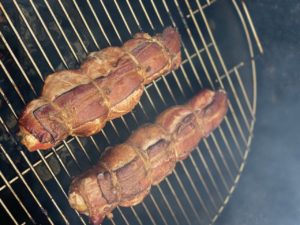
May 29 is Back to Barbecue Day, the official kickoff of grilling season.
(BPT) – The sound of the sizzle, the smell of foods cooking outdoors, the undeniable taste – it’s time to get back to the barbecue. For many people, a grill becomes a second kitchen. For others, it’s their primary way of cooking all year long.
“We need it more than ever after a year like this,” says Steven Raichlen, grilling authority, author and host of television’s “Project Fire.” “Grilling brings joy. Unleashing your inner pyromaniac is fun. Building a fire is fun. Waltzing the food from hot spots to cool spots is fun. Grilling is an interactive sport. Every grill session is different and that alone makes it joyful.”
More than just cooking good food, Raichlen says grilling is a bonding activity that focuses on a simple pleasure that everyone enjoys.
“It’s fun and uncanny how grilling brings people together. No one gathers around the stove to watch a pot of stew simmer. Light your grill, people congregate and you, the grill master, become master of ceremonies,” he says.
The appeal of grilling transcends generations, and many people are now shopping for new grills so they can enjoy cooking outdoors. The problem is there are many types of grills, different sizes and varying price points, so it’s difficult to know which is right for your needs.
Saturday, May 29, is National Back to Barbecue Day, one of the busiest shopping days of the year for new grills. For a grill buying guide, visit BBQ Outlets at www.bbqoutlets.com/grill-buying-guides. If you are looking to buy a new grill, the experts at the Hearth, Patio & Barbecue Association share some important things to keep in mind:
Types of grills to consider
Gas: For people who want convenience. Just like your kitchen stove, it can be ready to cook in 10 minutes, and it’s easy to regulate cooking temps.
Charcoal: For those who love being hands-on with the nuances of outdoor grilling. Some say charcoal provides the best flavor experience. Good for low and slow cooking and high heat searing.
Traeger
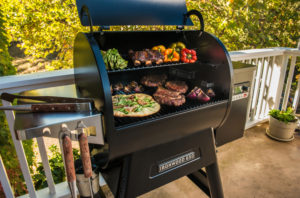
Pellet: For people who want the most in flavor. Wood pellet grills are among the most energy efficient and burn clean. Pellets come in varieties such as hickory, mesquite and oak, providing a truly flavorful cooking experience.
Electric: For people who love simplicity. Electric grills are designed to produce constant heat and operate without an open flame. Ideal for apartment or condo dwellers since they don’t require charcoal or propane.
Kamado: For people who love cooking all styles and seasons. Kamado grills’ excellent insulation is ideal for both grilling and smoking. They can use wood and charcoal and are ideal for roasting and baking.
Questions to ask before buying a grill
What do you love to cook? Many grills come with extra features ideal for certain foods, like rotisseries if you love a roasted chicken, side burners if you love soups and stews, or ample space for pizza stones if you frequently crave the ‘za.
How much time will you have to cook? If you’re hard pressed for free cooking time, consider the convenience of gas or electric grills. Love to pass the time cooking? A charcoal, smoker or kamado grill may be best for you.
How much space do you have? If you have a big backyard, consider a larger grill perhaps with a kitchen island to create a focal point for relaxation and entertaining. Premium portable or more compact grills are ideal for condos and apartments.
Once you have your grill at home and ready to go, it’s time to get cooking. Raichlen shares one of his favorite grill recipes below. Find more recipes, cooking tips and pledge to grill out at www.whyigrill.org.
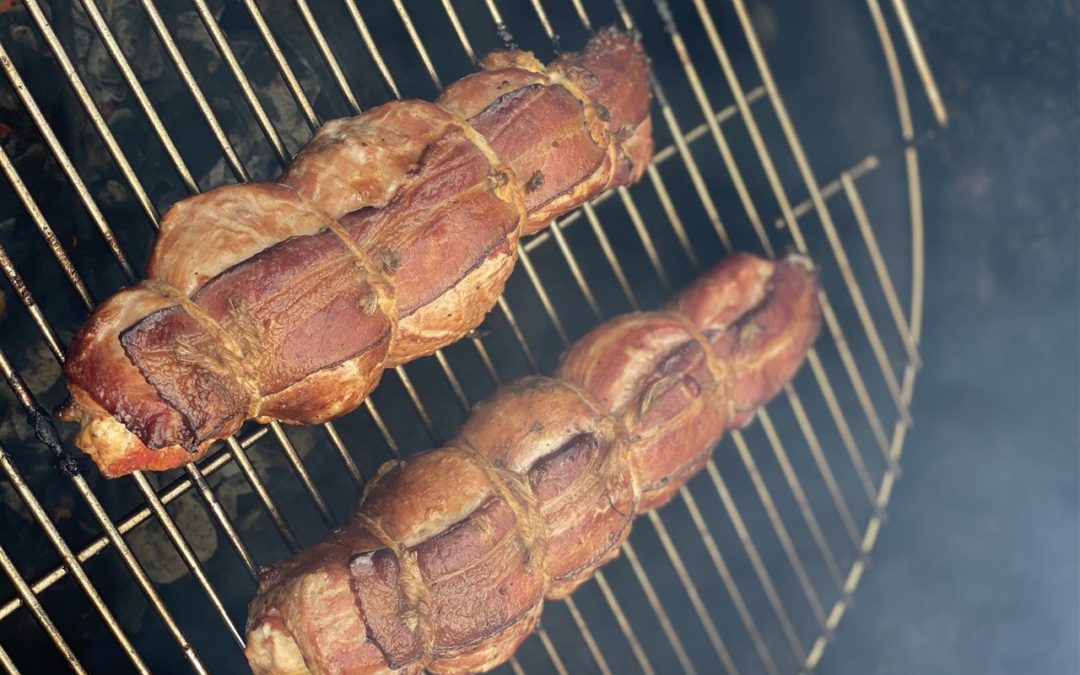
Pamplona of Pork
Ingredients2 pork tenderloins, each 1 to 1-1/4 poundsCoarse salt – sea or kosher – and freshly ground black pepper3 tablespoons Dijon mustard1 roasted red bell pepper, stemmed, peeled, seeded and sliced into 1/4-inch strips (see note below)3 ounces thinly sliced smoked ham, sliveredOne 5.2-ounce package Boursin cheese or other soft garlic and herb cheese, crumbled4 strips thin-cut baconVegetable oil for oiling the grateYou’ll also need: Butcher’s string; 1 or 2 hardwood chunks or 1-1/2 cups hardwood smoking chips. If using the latter, soak in water to cover for 30 minutes, then drain. Directions1. Set up your grill for indirect grilling and heat to medium-high, about 400 degrees.2. Meanwhile, cut a deep pocket in the side of each pork tenderloin. Season the inside of the pocket with salt and pepper and paint with mustard. Stuff the peppers, ham and cheese into the pocket. Season the outside of the tenderloins with salt and pepper.3. Lay four 10-inch pieces of kitchen string on and parallel to your work surface. Lay a strip of bacon on and perpendicular to the strings. Top with one of the tenderloins. Lay a second strip of bacon on top of the tenderloin. Bring up the ends of the strings and tie. Trim the ends close to the knots. Repeat with the remaining tenderloin.4. Brush or scrape the grill grate clean and oil it well with vegetable oil. If using a charcoal grill, add the wood chunks or chips to the coals. On a gas grill, place in the smoker box or under the grate directly over the burners.5. Indirectly grill the tenderloins until nicely browned and the meat is cooked through to 145-155 degrees or as needed, about 40 minutes.6. Let the meat rest for 5 minutes. Remove the strings, then, using a sharp knife, preferably with a serrated blade, slice the tenderloin crosswise into 1/2-inch medallions. Transfer to a platter or plates.Note: The pepper can be prepared at a previous grill session. Heat the grill to high then roast the pepper until the skin is blackened and charred, 2 to 3 minutes per side. Alternatively, roast the pepper over an open flame on your gas stove or the side burner of your grill. Cover and refrigerate for up to a day if not using immediately.