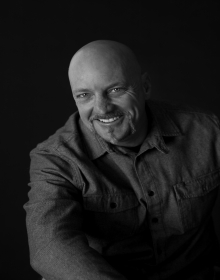
The year 2020 has brought a lot of misfortune to people all around the world, but John Larchick (JL) and his record label Time Stamp Records (TSR) have made good use of the time of solitude due to social distancing. Announcing the official start of the label on January 1, JL and his team have been busy in the lab making 2020 their year to emerge on the music scene with the release of their brand new music video and song Battle Royale.
“Battle Royale was an absolute gem to produce. I hate to say it, but my overgrown mustache may have taken the spotlight from even me on this one occasion. But honestly, from the beginning of the song’s inception, everything just started falling into place. From the creation of the beat and the vocal writing, down to the video concept and execution. It all just felt right. Those are the types of workflow that we as artists are searching for when we create,” stated JL, Owner and Producer of Time Stamp Records.
TSR, a childhood dream of JL’s, is a new indie record label out of Aurora/Metro Denver, Colorado. Time Stamp Records produces music and film. They also distribute and cultivate quality art, merchandise and music for film, radio, live events and television. And they have big plans for the future.
“Owning my own label has been a lifelong dream,” stated JL.
JL has been involved in the music industry from a very young age. At 17, he and his high school band, Reverend Orange Peel, sold out the Bluebird Theatre and earned the opportunity to play at the Ogden Theatre for New Year’s eve that same year. Both venues are icons in Denver. Ever since then he knew he had the knack for it and wanted a career in music.
“It wasn’t always glorious venues and big gigs though,” stated JL.
After high school, the band naturally dispersed to various colleges resulting in the dismantling of Reverend Orange Peel. “But I was still set on my musical quest. I was writing the music, learning to play instruments, and honing my craft virtually every waking moment. I started learning how to navigate all the facets of the ever-changing music industry. Everything from working with band members, writing songs, recording, booking, marketing to tours, videos, press releases, radio interviews and so much more.”
JL is no stranger to touring and has diligently booked gigs at countless venues across Colorado and surrounding states. “I’m super grateful for all of my past, present and future experiences, from the coffee shop gigs with no sound system to Boulder’s famous Fox Theatre. It’s my experiences as a musician and recording engineer that set me and this record label apart from others”.
JL has gone on numerous tours, occasionally accompanying some very notable artists. He has performed with acts such as Guru from Jazzmatazz, Fat Joe, Wu-Tang Clan, Ol Dirty Bastard, Pepper, the Pharcyde, Devin the Dude and others.
In addition, JL is the owner of a professional recording studio (Green Room Studios), the lead vocalist for JL Universe, a songwriter, multi-instrumentalist and a record producer. JL has released four albums and has helped a few fellow artists release albums of their own. His drive and motivation come from his love for music and the desire to create amazing art. He wants to encompass everything in the industry and assist other aspiring artists to reach their goals. Cultivating Time Stamp Records into a renowned success for all the artists signed under the label is where his sights are now set.
“Running this label, to me, it’s a really big responsibility and it’s a big honor. To be able to provide a service and to be able to put out people’s truths,” said JL. “Music and art are so personal and there are so many really dope artists that don’t get a chance to have a sounding board, to have somebody there to ricochet ideas and concepts, and grow a plan. That is what I am focused on when we sign artists. We are helping the artists generate their vision and then really feed that vision so it can grow and blossom into something bigger.”
JL is drawn to music that resonates with him, as opposed to claiming loyalty to a specific genre of music. He listens to and supports everything from electronic to funk to hip-hop to country. He has a hard time fitting Time Stamp Records into a specific category because he works with artists from across the board. When considering an artist for the label, JL really focuses on the quality of character and integrity presented in their work. He values artists with great work ethic, clarity, and dedication to their craft. He values artists with ambition and a drive to create something amazing for the world. Because of his familiarity with the industry, JL has a keen eye for the foundation required to establish a successful musical career.
“My goal is to become the record label that I always needed as an artist. To create a space and platform for artists and projects to fully develop. I have built, and I am still building, the frameworks and no one style or artist’s journey will be the same, but the process to get to our goals are similar,” said JL. “TSR is here to assist in that self-discovery and execution of plans. My dream is to make art that transforms time and space and that stamps the moment we are living in through expression and human connection. The end goal is to make creations that resonate, fulfill dreams and win Grammys.”
Sometimes all an artist needs is someone to give them a little nudge or to point them in the right direction for success. They can be filled with talent and musical genius, while struggling with the skill of getting noticed and releasing their art. They need a mentor or a leader. And that is precisely what JL and Time Stamp Records is. TSR is paving the way for musicians. He guides them on the path toward achievement. That way, everyone wins. In November, TSR plans to announce a statewide contest which is calling on artists to submit their work for the chance to win a single produced and released by TSR along with other great prizes.
Time Stamp Record’s song and video, Battle Royale was quickly followed by JL’s second single release of 2020, The Other Side. The single is paired with a creative and thought-provoking video and the song is seeing great success in just the first few days of release. In addition, JL Universe has several queued singles ready for release later this year and into 2021.
To listen to JL’s work and to follow JL Universe, Time Stamp Records or Green Room Studios (Colorado), search and find them on Facebook and Instagram. You can also find JL Universe’s video and single — Battle Royale on all digital streaming platforms like Spotify, Apple Music and Youtube.
Time Stamp Records’ long anticipated website has been revamped and reintroduced in an easy to use and enlightening format. Plus, the brand-new winter line of TSR merchandise will be available in November and contains fabulous new clothing styles.
For more news and exclusive music, art and culture, follow TSR on all social media platforms and sign up on the mailing list at www.timestamprecords.com. New artists, new songs, new videos, new merch, new inspirations and new beginnings are all happening, right now, at Time Stamp Records.
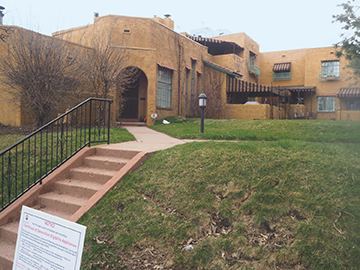
On the corner of Emerson and the 900 block of E. 1st Ave. in Denver’s Speer neighborhood sits Carmen Court — a 95-year-old piece of Denver history that is figuratively torn apart, a notion that could soon take place in the literal sense.
The forces at work here are three-fold, involving the will of the owner occupants, the wishes of the surrounding neighborhood and the financial leverage of an international real-estate development company.
From The Inside Out
The owners of the six condominium units at Carmen Court — a Pueblo Revival Style multi-family complex built in 1925 are looking at a financial windfall. According to an article by BusinessDen.com, the entire property has a list value of $5.5 million, indicating that the owners of each unit could anticipate an average payout of $916,000.
1925: Carmen Court as it appeared after its 1925 completion by builder Burt Rhoads, an engineer for the Gates Rubber Company.
The owner-occupants of Carmen Court recently aligned with the property owners of the three residential lots to the south in order to broker a deal to sell the dirt beneath the buildings to Hines, a Texas-based real estate investment, development and management firm that plans to erect a five+ story assisted living facility. One of the terms of this deal is that the owners will arrange to have the properties demolished before Hines will close on the contract. Upon applying for a permit to do so and then posting said permit as required by law, there was significant outcry among the area residents. This prompted neighbors to seek a preservation-minded approach by filing for Carmen Court to bear a landmark designation status.
The numerous “No Trespassing” signs made it apparent that knocking on doors for an interview was ill advised. Yet, numerous stories from other news sources confirm that Carmen Court residents are not interested in the preservation approach, citing a unanimous desire to sell rather than incurring the increasingly costly expense of upkeep on a century-old building.
From The Outside In
Neighbors, members of the West Washington Park Neighborhood Association, and an amalgam of Denver-based architects and preservationists, have come together to form Friends of Carmen Court (FoCC). Contrary to what the name suggests, members of FoCC do not share the same vision as the current owner occupants. From the FoCC’s perspective, however, the proposed nine-lot development plan represents a potential monstrosity that will further erase the heritage and identity of their community.
Vying For Historical Landmark: Proponents of historical landmark designation claim Carmen Court was built in the Pueblo Revival Style. Yet, it bears resemblance to Mediterranean villas and lacks the style’s signature round roof beams known as “vigas.”
While the residents of Carmen Court are obviously interested in selling and moving on, the FoCC have other motivations. Mark Harris, a group member and one of the three neighbors required for the filing of the landmark designation states via email: “We, the three near neighbors, have been in discussions with the owners and Hines on how the building can have an adaptive re-use within the new development. We are also trying to find another buyer to step in and develop the site while preserving the building. We are not trying to prevent density or new development in our neighborhood; we’re just trying to save an important building from ending up in the landfill. While some have painted the picture as an either-or, we see it as both-and. Hines can buy the building from the owners at their asking price, and still save the building by incorporating it into their new development. We have just all agreed on a 45-day extension to allow for time to reach an agreement before the issue is in front of City Council on Nov 2nd.”
Meanwhile, FoCC member Sarah McCarthy voices a community-wide aesthetic concern about the idea of losing Carmen Court, stating: “It’s really part of the neighborhood. It is truly unique in its landscaping and design. The owners may not be interested in (historical) designation, but we see the building as having a larger architectural and historical significance.”
From The Top Looking Down
The proposed compromise would require Hines to preserve the exterior integrity of Carmen Court, and perhaps repurpose the condos for reception areas, dining facilities or street-level storage while somehow erecting a multi-story assisted living facility around the existing structure. While this sort of a compromise sounds a bit farfetched, it is not unheard of in other redeveloping parts of Denver. Recently, similar historical landmark designations have been passed for places like Tom’s Diner on Colfax and the Howard Berkeley Park Chapel of Tennyson St. While both involved some level of compromise, neither included building a high-rise residential behemoth atop a century-old structure.
Signs: In addition to the red signs, Carmen Court is replete with “No Trespassing” signs to ward off nosy journalists.
Hines Managing Director Chris Crawford, while unavailable for comment, was recently quoted on the matter at Business Den.com. He indicated that Hines would consider walking away if another developer would agree to taking over the existing contract with the Carmen Court owners. This new developer, in the event of a historical designation being assigned to the property, would have to build around the existing structure while assuring that Hines be reimbursed for their out-of-pocket expenses incurred thus far.
While a land swap with another developer was discussed, the deal was turned down by Hines due to the location of the other property. At any rate, whether an historical designation is assigned to the property is up to what the Denver City Council decides when the 45-day extension is up in mid-October. If so, the next step is up to the willingness of the Development Industrial Complex to settle for a compromise. If there is no historical designation, you can bet there will soon likely be no Carmen Court.
At any rate, the fate of Carmen Court is yet unknown, but currently it appears to be in the hands of those who have the least to lose.
Multiple Sites Finishing Up But Only A Couple Commencing; Stunning Newly Built Structures Opening In The District For Fall
by Glen Richardson
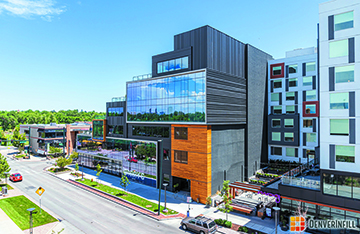
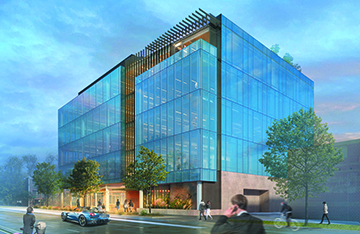
Reshaping Cherry Creek: Holiday shoppers-visitors in the district will be greeted by this new mixed-use retail-office building on the corner of 3rd. Ave. & Josephine. The structure is a standout as most new buildings are far from futuristic.
The pandemic and a weakening economy find Cherry Creek’s construction sites still turning shovels and swinging hammers, but the pace has slowed and few new projects are expected to sprout up. Following eight straight years of new construction, owners, developers, contractors, subcontractors and the supply chain are feeling the shock.
Normally it’s rare for district developers-builders to slow down construction activity. But these aren’t normal times, and the pandemic economy has given rise to a noticeable work cutback. The structure of demand is changing: Fewer hotels are being proposed due to less business-leisure travel. Online shopping is shrinking the demand for retail space and the need for offices is slowing because of remote working.
Multiple projects are finishing up in Cherry Creek plus a couple have commenced construction. Residents and district shoppers can expect those projects to be completed. It is new projects that have been proposed in the district that are likely to see terminations of parties or entire projects. Given the hotel outlook, the AC Marriott in Cherry Creek is likely to be delayed or the site could go up for resale. The Sunridge Hotel Group project is proposed for seven-stories, 150-rooms.
Westside Wait
Redevelopment of Cherry Creek’s west end has been the slowest to take off. Completion of the 260 North office-retail project at Josephine St. and East 3rd Ave. and makeover of the former Inn at Cherry Creek opening as The Clayton at 233 Clayton St. in March of 2021 are notable exceptions.
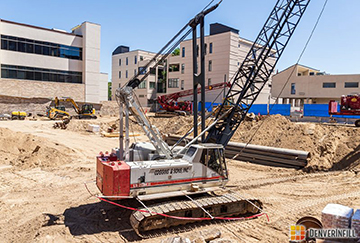
New Excavation: Despite Cherry Creek’s construction cutback, dirt work is underway at this 240 Saint Paul site. Building will be anchored across the first three floors by an Equinox Fitness Club.
Broe Real Estate Group which owns the bulk of the east side of Clayton St. announced a year ago it would demolish several structures to make way for two new office buildings. Existing two-story structures at 200 and 210 Clayton are to be replaced with an eight-story office building with ground-floor retail. The adjacent four-story building it owns at 216 Clayton would remain but the two-story parking garage to the north would be replaced with a seven-story office building and ground-floor retail. Broe’s headquarters is at 252 Clayton and the firm has deep pockets. Thus the massive project will likely come to fruition but demolition isn’t expected to begin until next year with completion two-five years away.
The promised Clayton Lane Investors redevelopment of the west end of Cherry Creek between 1st and 2nd Ave. from Josephine to Detroit St. is in limbo again. The Invesco Real Estate-Broomfield partnership project isn’t likely to break ground in the next 12-14 month. Completion that would include demolishing the former Sears store that has been vacant since 2015 isn’t likely in the next several years. Should the venture be terminated look for the Nichols Partnership — Clayton Lane’s original developer — who just bought back a portion of the Whole Foods Garage for $6 million — to take over the project.
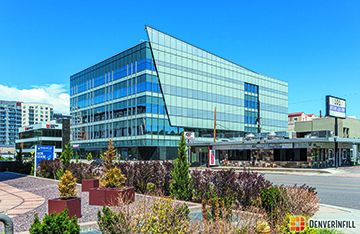
Boundary-Pushing: The just completed UC Health Cherry Creek has opened along East 1st Ave. Sleek all-glass structure creates a new footprint on the eastside as the surrounding buildings are heavy with earth tones and masonry.
New For Fall
Newly completed projects scattered through the fashionable neighborhood are beginning to open for fall. The project known as 260 North has finally opened, creating the west end’s first high-end, mixed-use space. Situated adjacent to the BMC built MOXY and Halcyon Hotels — the only other new westside structures — it is a compelling building with a stepped-up design. Located on the corner of 3rd and Josephine streets, it adds office, retail and parking space while allowing daylight into the streetscape.
On the east end, the just completed modernistic 88,000-sq.-ft. UC Health Cherry Creek has opened. With an all-glass façade, it stands out alone on East 1st Ave. as most of the surrounding buildings are heavy with earth tones and masonry. The health center offers primary care, state of the art imaging, a surgery center and comprehensive oncology treatment.
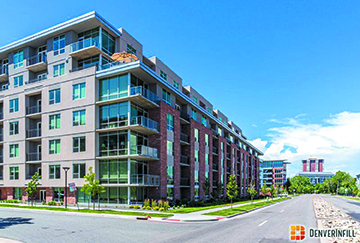
Over in the Cherry Creek Triangle, two major multi-family projects are also open. Between the step down, brickwork and landscaping, Gables Cherry Creek II helps reduce the harshness of East Alameda Ave. Gables Vista, rising 12-stories, is one of the tallest in the triangle. All together the three Gables projects have added 579 homes in the district.
On The Rise
Two projects, both BMC developments, are currently under construction in the district. Newest is the 240 Saint Paul project to be anchored across the first three floors by the Equinox Fitness Club. Most of the office space is pre-leased and at last report half of the 12,000-sq.-ft. of retail space had been rented. Construction is anticipated to take at least 14 months, with completion in summer-early fall of next year.
Urban Lifestyle: Gables Cherry Creek II in the Cherry Creek Triangle offers a walkable urban lifestyle with enhanced amenities. Step down brickwork and landscaping reduces the harshness of East Alameda Ave.
Renamed The Clayton, Matt Joblon signed a 99-year ground lease on the 233 Clayton St. property in the fall of 2017. Since renovation started a year ago, BMC is spending $30 million to add onto the property that’s expected to open next March.
What will make the project unique in Cherry Creek is Joblon’s goal to create a “real culture center.” In addition to 37 hotel rooms, the six-story building will feature 12,000-sq.-ft. of “hip retail” on the ground-floor plus scores of music, culinary and art venues for entertainment, exploration and enjoyment.
Projects On Horizon
Despite the district’s construction slowdown, there are several new projects on the horizon in Cherry Creek. They range from office buildings to apartment complexes, two potential hotels plus an independent living community for seniors.
More Glass: Construction could soon get underway on this proposed glass structure at 2nd Ave. & Adams. Retail-office site would extend the existing stretch of retail on East 2nd Ave further east.
Most likely to begin construction is the 2nd Ave. & Adams project where a two-story office building and a single-family home have already been cleared. Purchased by Blair Richardson, the 0.29-acre site would feature an all-glass building with ground floor retail plus four levels of office space. When it is developed it will extend the existing stretch of retail on East 2nd Ave. further east.
Due to the project’s nature, a proposed seven-story, 136-unit senior living project could also break ground next year. Named Solterra Senior Living, the site is near the intersection of Alameda Ave. and Colorado Blvd. A self-service car wash was recently demolished at the site to make way for the project. The infill site at 235 Fillmore that has set vacant for several years has been purchased by BMC, making development more likely. An office building with ground-floor retail is proposed.
Pumpkins: Pumpkins will be available for purchase from the 4MHP Pumpkin Patch.
Fall into some old-fashioned fun at Four Mile Historic Park’s annual Pumpkin Harvest Festival. The festival is set for Friday, October 2, and Saturday, October 3, from 9 a.m. to 8 p.m. and Sunday, October 4, from 9 a.m. to 6 p.m. Pumpkin Harvest will require advanced purchase, timed tickets. A ticket guarantees you a 90-minute experience in the 12 acre park.
Fun For All Ages: The annual Pumpkin Harvest Festival at Four Mile Historic Park will feature activities for all ages including craft kits, pioneer games, and pumpkin decorating. The festival is set for October 2-4 with a free preview for members on October 1, 2020.
Activities for all ages include craft kits, pioneer games, live music, photo booth, pumpkin walk, pumpkin decorating, demonstrations and more. Additional activities available for purchase include Pumpkins from the 4MHP Pumpkin Patch, Tasty Treats for Purchase from partnered Food Trucks, Fall-Inspired Beverages.
Sponsorships are still available and include a 10’x10’ tent, choice of location, access to power, listing on event collateral, and complimentary tickets to the festival. Visit FourMilePark.org for more information or to fill out a sponsorship form.
The Pumpkin Harvest Festival admission is $15 and Children 3 and under are free. Members have exclusive access to a free preview night on Thursday, October 1, 2020. There is still time to purchase a membership at www.fourmilepark.org/get-involved/membership.
The Chronicle is distributed in both Denver and Arapahoe counties. If you were alleged to have committed a crime it didn’t normally matter on which side of the county line it occurred, but today it can. Denver District Attorney Beth McCann is a longtime Democratic politician and she approached her job as D.A. with her political sensitivities very much intact. George Brauchler, the term-limited District Attorney for Arapahoe County, has been a Republican candidate for governor and attorney general and is considered a viable candidate for statewide office as a Republican in the future.
D.A. Beth McCann
McCann’s and Brauchler’s different views of what is a crime in Colorado has been on great display regarding political protests/ riots in both jurisdictions. In a May 28th protest at the State Capitol, demanding justice regarding the death of George Floyd at the hands of Minneapolis police, a group of protesters surrounded the car of Jennifer Watson, 37, who was on her way home. A protester jumped on her hood and smashed her windshield in two places which obstructed her view. She appears to turn and brush against the protester who was previously on her hood without real injury.
A petition on Change .org gathered 38,000 signatures demanding that D.A. McCann charge the driver with a crime. In response, two months after the incident Watson was charged by McCann with third degree assault for knowingly or recklessly causing bodily injury. She faces 6 to 24 months in jail on those charges. She was also charged with reckless driving. The person who jumped on the car, nor anyone connected to the May 28th events in Denver, was charged by McCann.
Over in Aurora on July 25th, protesters seeking justice in the death of Elijah McCain in the hands of that city’s police department, poured into the streets and sought to block traffic on Alameda Avenue and Interstate 225. A driver of a blue jeep sped through the protesters on I-225 while a protester apparently fired two shots at the vehicle, hitting two other protesters.
D.A. George Brauchler
Brauchler publicly declined to charge the driver stating that: “If this guy wants to run into people he had plenty of opportunity to do that [but didn’t].”
Brauchler did, however, file charges against four persons who organized the protest for rioting, and the attempt to commit first degree kidnapping. Dave Young the Democrat D.A. for the 17th Judicial District which includes that part of Aurora in Adams County also charged those four and two additional individuals.
In response to Brauchler’s actions, Aurora protester Rebecca Wolf declared: “It doesn’t surprise me, but it’s all nonsense. I’m pretty sure if it was my son driving, who is young and brown, he’d be behind bars already.”
We are not sure skin pigmentation is necessarily how D.A.s in Colorado charge in most cases, but the politics of the D.A. sure does make a difference. In the recent September 23rd Breonna Taylor protest, there was a driver going through the crowd that was blocking downtown and he was detained. His chances of getting charged are significantly greater in the City and County of Denver than they would have been in Arapahoe County.
May 28th protest at the State Capitol.
These days you can get the justice you want by voting for a D.A. candidate that reflects your values. If you identify with the protesters there are justice warrior D.A.s like Kim Foxx of Chicago, Kim Gardner of St. Louis, and Larry Krasner of Philadelphia. If law and order is your mantra there are viable candidates that fit that slot, except, of course, in Denver. Beth McCann knew the danger to her re-election this fall would be from the left and she shored up her support on the left with her charging decisions. Her only opposition is Libertarian William F. Robinson III which means she is a shoo-in.
However, it is a different story outside Denver. In the 18th Judicial District (Arapahoe, Douglas, Elbert and Lincoln) George Brauchler is term-limited and Amy Padden (D) and John Keller (R) face off, while in the 1st Judicial District (Jefferson and Gilpin counties) Democratic candidate Alex King is reputedly strongly supported by George Soros affiliated groups over Republican Matt Durkin.
July 25th protest in Aurora.
At one time Arapahoe and Jefferson counties were deemed Republican strongholds, but no longer. The two races should be close. Pick your D.A. and get the justice system you want. In Denver, you get Beth McCann and her politically oriented justice, for better or worse.
(BPT) – By Dr. Bela Sood, MD, child and adolescent psychiatrist and senior mental health policy professor at Children’s Hospital of Richmond at VCU.
This pandemic is unlike anything we’ve ever experienced, so how can we help our children cope, especially when we’re also feeling anxious? The key lies in acknowledging our own fears and concerns, while understanding how each individual child handles emotional challenges.
Parenting is hard. Parenting during a pandemic can feel especially challenging as you balance changes in work, home and school. Here’s how you can provide support and reassurance, whatever your child’s stage of development.
Start with yourself
Even infants pick up on their parents’ moods, so your emotional state will affect how your children cope.
As instructed on airplanes, during turbulence you should put on your own oxygen mask before helping others. The same is true of turbulent times: Take care of yourself first.
Reflect on how you feel: Are you angry about disrupted routines? Worried about the future? Missing loved ones? When you’re stressed, practice self-care: Exercise, meditate or talk with a friend. This will help you feel more “centered” so you can model calm, positive attitudes and behavior.
Limit media exposure
It’s easy to become overwhelmed by negative news. Stay with your children during news reports and encourage them to ask questions. Limit your own exposure too, as it can affect your mood.
Consider your child’s stage of development
Babies and toddlers won’t understand what’s happening, but they respond to emotional cues. Though it’s not always easy, if you can stay calm and positive, they’re more likely to relax.
Maintain routines, as all children thrive on predictable schedules. Knowing when to expect meals, playtime and bedtime helps them feel more safe and secure.
Preschoolers have many questions about everything, but keep your explanations simple. Discuss the virus as being like a very bad cold or flu when explaining why everyone is wearing masks or why they can’t go on play dates.
Validate your child’s feelings by saying, “I understand you’re upset right now,” or “It’s okay to miss grandma. I miss her too.”
Let your children connect with others safely. Make video calls to relatives or socialize with a small group of neighbors outdoors while practicing social distancing. Help your child write letters to friends.
School-aged children are more peer-oriented, but they still appreciate spending time with parents. It’s a great opportunity to start new hobbies together, while also letting them pursue their own interests.
If your children appear anxious, angry or sad, encourage them to talk about it. Share how you’re feeling, too. Establish a weekly “check-in” dinner where everyone has a turn to express their feelings.
Include children in chores and activities that give them a feeling of control. Let them assume responsibilities like folding laundry or cleaning, offering choices about what activities they prefer.
Teenagers are beginning to separate psychologically from their parents, so being forced to be together all day can be tough on them, as well as on parents! Older teens are missing out on significant milestones, like homecoming, sports or performing arts, which may be important parts of their identities.
Put yourself in your teen’s shoes. This period is hardest for teens who derive energy from peer interactions. Show empathy by saying, “This must be so disappointing for you.” Help them find creative ways to make this time memorable and connect with peers who practice social distancing. The weekly family dinner may be the perfect time to listen to your teen and problem-solve together.
Warning signs
It’s normal for kids to occasionally seem sad, anxious or angry. Encourage them to voice their feelings and acknowledge that it’s okay for them to feel that way.
If your child becomes increasingly withdrawn, disconnected or obsessed with video games or other self-isolating activities, it may be a signal that they’re preoccupied with worries about the future or other topics. Try drawing them out to determine whether you should seek their pediatrician’s advice. It’s challenging to keep children entertained at home 24/7, so don’t be too hard on yourself. Offer additional social support from close friends and relatives.
If you think it would help them to get counseling and they’re reluctant, tell them that when you’re in trouble, you seek help. Let them choose whether to participate or not. If your child is unwilling to talk to a counselor, you may find it helpful to see a therapist to share observations of your child, get a better understanding of what may be happening and develop strategies to support them.