(BPT) – Before COVID-19, you probably didn’t put much thought into washing your hands. A bit of soap and a quick lather seemed adequate. Now, hand washing is center stage as a main step to fight the spread of the virus and help people of all ages stay healthy.
Regular hand washing is one of the best ways to remove germs, avoid getting sick and prevent the spread of germs to others, according to the United States Centers for Disease Control and Prevention. This not only helps with the COVID-19 virus, but also helps protect you from other viruses, such as cold and flu germs.
COVID-19 is efficiently killed with soap and water, which is why the CDC recommends scrubbing your hands several times a day. However, parents and caregivers may struggle with getting their kids to wash their hands the right way. From impatient toddlers to distracted teens, hand washing may not be happening correctly.
To help your family wash their hands the right way and have fun while doing it, the health experts from Colgate offer some simple steps to consider:
Step 1: Have a family meeting
Talking about hand washing casually won’t make a lasting impression. Hand washing is important, especially during the pandemic, so give it the attention it needs by calling a family meeting. Talk about how hand washing kills germs and stay positive, saying how your family wants to be a part of the solution in preventing the spread of COVID-19.
Step 2: Discuss proper hand washing
Proper hand washing is simple once you know how to do it. First, wet hands with clean water. Apply soap and scrub the entire hand for at least 20 seconds, including between the fingers. Finally, rinse and air dry or use a clean towel. Availability of soap and washing correctly is essential. That’s why Colgate is donating 1.4 million bar soaps distributed in the U.S. as part of the #SafeHands challenge, featuring instructions for effective hand washing. The bar soaps, along with other health and hygiene products like toothbrushes, toothpaste, and body wash, will be delivered to food banks and school lunch programs nationwide via Colgate’s trademark Bright Smiles, Bright Futures mobile dental vans. In total, Colgate’s product donations across the country is valued at over $8MM.
Step 3: Make it fun
What’s typically the hardest part of proper hand washing is the length of time. To make hand washing fun, sing a tune for that length of time. For example, sing “Happy Birthday” twice to hit the mark. Or, customize a favorite nursery song and sing it for that length. To the tune of “Row your boat” sing: “Wash, wash, wash your hands. Wash them every day! Scrub with soap, rinse it down, wash those germs away!”
Step 4: Praise and rewards
Make hand washing a part of children’s responsibilities, much how they are expected to make their bed and read daily. You may want to add posters and other reminders to help the family remember the importance of hand washing. Remember, positive reinforcement and recognizing a job well done goes much further than scolding when stressing new habits. You may even decide to set up a rewards program; for instance, young children get a sticker every time they wash their hands.
Mixed race woman washing her hands
Step 5: Be a role model
When encouraging your family to adopt healthy habits, it’s best to lead by example. Wash your hands regularly using the correct procedures. Sing loud and proud so people know you’re doing it for 20 seconds. Show it’s a priority for you so your family knows it should be a priority for them.
For more information on Colgate’s support of the #SafeHands Challenge and their global impact of donation more than 25 million products globally, visit ColgatePalmolive.com.
Regular handwashing is one of the best ways to remove germs, avoid getting sick, and prevent the spread of germs to others.
“Civil service statutes establish a floor for police officer employment protections, which the unions can raise through collective bargaining.”
by Robert Davis
Imagine working in an office with 1,000 coworkers. Once every five days, you get a memo saying a coworker was accused of misconduct. One day you see a video from one incident — a coworker shooting someone in the back. You ask the coworker about it and they say the other person had a gun and they feared for their life. With those magic words, you know the shooting will be justified by the company, almost no matter what the video showed.
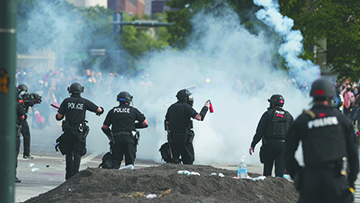
Backup: Denver Police Department called in 12 local agencies for backup amid protests.
Anywhere else and this would be unthinkable. For the Director of Denver’s public safety department Murphy Robinson and Police Chief Paul Pazen, this office is familiar. And it’s the storied history of the office that prevents police reform activists and police officers from reforming the mountain of legal protections afforded to police officers accused of misconduct.
Why? Because the city’s civil service laws were designed with a job description in mind. In turn, Denver’s police union — Denver Police Protective Association (DPPA) — learned how to coil its collective bargaining agreement around those laws to protect officer misconduct. And until this job description is reimagined, longstanding police misconduct reform seems ill-fated.
Director of Public Safety Murphy Robinson broached the topic with city council in June during a discussion on reforming DPD’s use of force policy. As a self-proclaimed student of history acknowledged that moving on from his department’s storied history is necessary to institute immediate reforms.
“We are at a place where we need to move the needle forward,” Robinson said.
His words rang hollow to protesters in attendance like Brian Hostraw, who witnessed police officers tear-gassing small children without warning, firing pepper balls and rubber bullets indiscriminately, and destroying the property of homeless individuals with impunity during the George Floyd protests.
“These are not the actions of people I trust to protect me or my family,” Hostraw said.
And there are plenty of police officers who side with Hostraw. Chief Pazen told lawmakers that a majority of his officers agree with the increased scrutiny placed on them by SB217.
But, the one reform activists are demanding most loudly in the wake of the George Floyd protests — easing the ability of police chiefs to fire officers for misconduct — is the most difficult policy to reform.
Denver began crafting legal protections for its police officers when the first settlements along Cherry Creek were staked out in 1858. Territorial governor John C. Moore organized the Rocky Mountain Rangers under a vigilante mandate to protect the miners from the prostitutes, gamblers, and thieves that followed them west. By the time the City & County was chartered in 1904, police officers were influential players in state sponsored corruption, and earned legal protections because of it.
Before being elected mayor, Robert Speer was a veteran member of the Police and Fire Board, which oversaw a diverse range of city operations from peace officer certification to public censorship. As such, he knew how to use Denver’s finest to serve his political ends and was willing to do so.
During his first two terms, Denver’s finest engaged in voter suppression, rigging elections, and shakedowns of casinos, brothels, and saloons. Speer’s motivation was obviously political — his administration of tolerated vice and honest corruption relied on an invisible hand used to ward off Speer’s competitors. Over time, Speer rewarded Denver’s finest with employment protections that unions would later use to thwart cases of police misconduct.
Clash With Police: Demonstrators clash with police at the Colorado Capitol on Saturday, May 30, 2020, during the third day of protests in Denver in response to George Floyd’s death at the hands of police in Minnesota. Photo Credit: (Joe Mahoney, Special to The Colorado Sun)
Realizing how important Denver’s finest were to his political success, Speer created the Civil Service Commission (CSC) during his third tour in office in 1916. The commission established a costly disciplinary and disqualification review processes that often incentivizes public officials to look the other way at police misconduct rather than pursue a moral victory of terminating a rotten officer.
Stephen Rushin, assistant law professor at Loyola University — Chicago, argued in his 2017 article in Duke Law Journal that police union contracts use civil service laws like a double-edge sword. First, they “establish a floor for police officer employment protections, which police unions can raise through collective bargaining.” Second, they tilt the political scales in favor of the unions during negotiations.
Employment protections are established through case law, which often results in costly legal bills for the city. In Denver, city representatives must present their entire case to officers accused of misconduct before the officer decides whether to fight it in arbitration. If arbitration returns an unfavorable result, the case is appealed through the courts, where it hopes to find a judge who will accept an assertion of qualified immunity.
Judge Carlton Reeves of the Southern District of Missouri described qualified immunity as “manufactured fiction” that has had a damning influence on how courts handle cases involving police officers in his decision in Jamison v. McClendon.
He cited a decision from the Fifth Circuit Court where qualified immunity was successfully asserted by corrections officers who were accused of keeping an inmate in a jail cell covered in fecal matter for a weekend before transferring the inmate to a cell in solitary confinement that didn’t have a working toilet or sink.
The Court’s reasoning? Qualified immunity can be asserted in cases where a law is not clearly established. In terms of the case from the Fifth Circuit, the court reasoned the timeframe in which the inmate was kept in unsanitary conditions was unsettled and, therefore, qualified immunity could be asserted.
Judge Reeves specifically addressed this logical quagmire in his opinion, stating “it is a fool’s errand to ask people who love debating whether something is debatable.”
University of Virginia law professor Rachel Harmon observed in her article The Problem of Policing in the Michigan Law Review that civil service laws empower frontline police officers “to challenge any internal managerial action that affects them on both substantive and procedural grounds in a formal adversarial process.”
In May, Denver paid $1 million to settle a case against two police officers who were terminated in 2013 after they lied about assaulting two club-goers in downtown four years earlier. Over the past three years, the city has coughed up over $14.5 million to settle cases involving officer misconduct, according to an investigation by The Denver Post.
Moral Hazard
Because of the cost of disciplining police officers, departments where misconduct is rampant are thus incentivized to withhold information unless an incident rises to a level warranting action. Whistleblower Brittany Iriart revealed in June that DPD, in fact, alters information on its internal misconduct reports to protect its officers before she was fired for violating the confidentiality clause of her employment contract.
DPD: Denver Officers clear a man who fell to the street after they used tear gas and rubber bullets to disperse the crowd of protestors on May 28, 2020.
Politically, Rushin says, because municipal expenditures such as court settlements can dominate local headlines, the result for lawmakers is a moral hazard. On one hand, they are tasked to upholding the law, yet rely on a third party who is prone to turning the other cheek to prosecute miscreant police officers.
“Municipal leaders may be incentivized to offer concessions on police disciplinary procedures because they are less likely to bear the costs of those concessions in the immediate future,” he wrote.
This issue is further complicated by the political activities of DPPA and its members individually. Since 2012, DPPA has donated over $200,000 to city council candidates, according to the city’s campaign finance data. Over the same time frame, more police officers reported donating to Mayor Michael Hancock than any other candidate for office.
Likewise Denver’s statewide union, Fraternal Order of Police Lodge #27, contributes to General Assembly candidates as in local District Attorneys races.
In her Iowa Law Review article titled Who Shouldn’t Prosecute the Police, law professor Kate Levine argues that a “structural conflict of interest arises when local prosecutors are given the discretion and responsibility to investigate and lead cases against the police,” because “prosecutors rely heavily on the police for their success.”
Levine acknowledges that no criminal case would exist without first contact from a police officer and officers can create and control facts by collecting evidence from the crime scene, interviewing witnesses, or through undercover work, all of which prosecutors can admit in court.
But, the relationship between prosecutor and officer doesn’t end when a case is closed.
DA’s need campaign donations to be elected to office. Then, they rely on police officer conduct to determine negotiating leverage during grand jury cases. The Department of Justice estimates approximately 90 percent of prosecutions end with a plea bargain.
“While cases of police brutality are unlikely to go completely unnoticed, issues of “testifying” by the police, as well as evidence planting, tampering, or withholding, and illegal intimidation tactics will never emerge unless another officer or a prosecutor addresses them,” Levine wrote.
Meanwhile, even though DPPA is a public-sector union, its negotiations with city council are kept confidential. This puts councilmembers at a political disadvantage by keeping them from crowd-sourcing reform ideas from their districts.
Councilmembers also cannot negotiate with union representatives. Instead, they must negotiate through an intermediary. This year it is Legislative Services Director Linda Jamison. Denverite reported that Jamison was not invited to the meetings until three weeks after they began.
Police unions also create leverage vicariously through local news reports on crime rates. Crime statistics from DPD show that violent crime and property crime were all higher in the previous five negotiation years. Last year’s annual report by the Office of the Independent Monitor confirmed officer complaints were higher in these years as well.
Denver City Councilmember Candi CdeBaca, District 9
According to a statement by District 9 Denver City Councilperson Candi CdeBaca, the current CBA negotiations include a measure protecting police officers from furloughs as Denver faces a budget crisis caused by the coronavirus pandemic and a two-percent salary increase.
Meanwhile, other government employees covered by career service mandates may be subject to budget-required furloughs. Currently, city projections estimate it will suffer a $226 million shortfall, of which $10 million will come out of DPD’s budget.
“This contract amounts to a uniquely beneficial agreement for DPD in the midst of hundreds of excessive use of force investigations and against a background of nationwide calls for police accountability and transparency,” CdeBaca said.
Violent crime is up 11 percent this year compared to last, according to city data.
Why Reform Hasn’t Worked (Yet)
Police reform activists currently can’t decide whether they advocate for completely tearing down the Denver Police Department or reimagining the role of police officers as a community support role, and this impasse is hindering their overall goal of easing restrictions and procedures for firing police officers for misconduct.
In August, Councilperson CdeBaca introduced legislation to abolish DPD and replace it with a peacekeeping department, a policy she claimed on social media was supported by thousands of Denverites.
Mayor Hancock called the legislation “reckless and irresponsible” in a statement shortly after it was introduced.
“The Councilwoman should exercise greater transparency and public accountability before putting something of this magnitude forward for a vote again instead of springing it on the public. I firmly stand by the men and women of our Police Department and will continue to hold accountable those who step over the line when dealing with the public,” he said.
The proposal lost at the Council level with only CdeBaca supporting it.
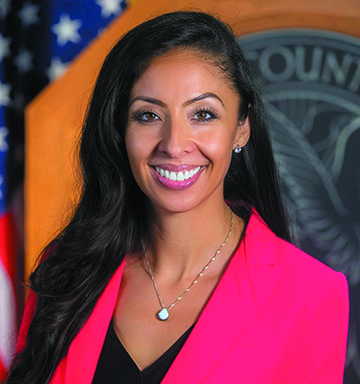
Others taking a community-centric approach include the newest appointee to the Citizen Oversight Board (COB), which oversees the body responsible for officer investigations, forensic psychologist Dr. Apryl Alexander.
As an academic, Alexander hopes to use her background to help forge new ways of thinking about community policing that doesn’t include excessive force, but includes accountability and restorative practices.
“People are looking for change in this moment,” she told Colorado Politics.
Councilwoman Candi CdeBaca is a favorite of ours on the Denver City Council. It is not that we agree with all of the positions or actions of the self-identified Marxist, but she actually tries at times to make a difference in improving the lives of everyday Denverites. Over half of the City Council is owned and operated by high-density developers who, of course, also control Mayor Hancock.
CdeBaca is leading the fight to save Park Hill Golf Course as open space against Council members like Kendra Black, Chris Herndon and Stacie Gilmore who can’t wait to turn Denver into a fully paved urban jungle for the fun and profit of high-density developers.
Thanks to CdeBaca’s unwavering support, Councilwoman Amanda Sawyer’s proposal that the City Council must approve mayoral appointments will go to ballot this fall, a badly needed reform we strongly endorse.
CdeBaca has many other ideas and reforms and she is the exact opposite of the do-nothing City Council members during the first eight years of Hancock’s maladministration. One idea of CdeBaca is to replace the Denver Police Department with an unarmed “Peace Force” without the power to arrest. That idea went down by an 11 to 1 vote, most Council members giving their usual excuse that they had not had enough time to consider the same.
For decades the Denver City Council has approved paying out tens of millions to settle police excessive force lawsuits without ever considering what could be done to remedy the problem. As reporter Robert Davis points out in this issue [Deep Roots: Why It’s So Hard To Fire A Police Officer For Misconduct In Denver, starting on page 5], the problem goes way back in Denver’s history.
Getting rid of the police may sound nice to some, but the actual results would not be pretty. In Seattle’s so-called “Chop Zone” this summer there were no Seattle police, but that did not result in a “Summer of Love” as predicted by Seattle Mayor Jenny Durkan, but rather a melee with plenty of violence. We doubt that CdeBaca’s “Peace Force” will bring peace, but rather privatized violence which will drive the average citizen out of Denver.
But that does not mean we should do nothing. The reforms instituted by the State legislature this past summer are a good start, but are not enough to solve Denver’s police brutality problems. Some huge percentage of the brutality cases come from an amazingly small number of police officers in Denver. Everyone knows who they are, but no one can drive them out of the police force.
The solution is surprisingly simple. Change the City Charter and abolish the “Civil Service” system which only apples to the Denver police and fire departments. All other city employees come under the regular “Career Service” system. The Civil Service system was put into the City Charter in 1904 by then Mayor Robert Speer to protect all of the brutal and corrupt police and fire employees that he once was in charge of as police commissioner and fire commissioner. He depended upon them to become mayor. So he wanted to make sure they could not be fired.
Get rid of the 116-year old Civil Service system and put it under the Career Service system and abracadabra the entire extremely expensive Rube Goldberg contraption to protect corrupt and brutal cops goes away. Of course, firing a bad average Denver employee is not easy, but is comparatively simple compared to getting rid of a bad cop under the Civil Service system. The reform will save millions in lawsuit settlement costs.
Will any Council member dare to take on the relatively simple solution. Well certainly not the Mayor’s cronies on the City Council, but Council members like Candi CdeBaca and Amanda Sawyer just might have the guts to do so. Here’s hoping.
Jayson Penn Indicted By Federal Grand Jury In Denver; Feds Find A Chicken Conspiracy At Greeley-Based Firm
by Glen Richardson
A federal grand jury in Denver has indicted Jayson Penn, the CEO of Greeley-based Pilgrim’s Pride, and three other current or former chicken industry executives for price fixing. The grand jury in U.S. District Court here indicted all four with one count of conspiring to fix prices for broiler chickens from at least 2012 through 2017. A trial is scheduled to begin this month (August).
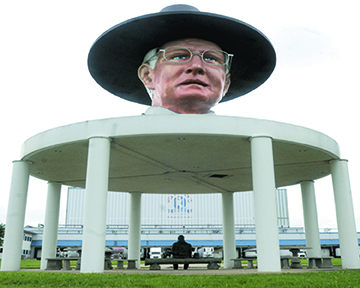
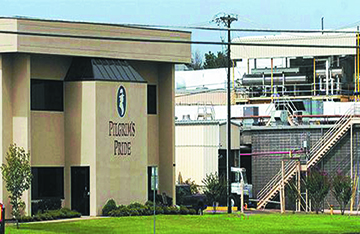
Scratching Out A Living: Headquarters of the second-largest U.S. chicken company Pilgrim’s Pride is in Greeley. The entrance includes a bust of founder Lonnie “Bo” Pilgrim. The firm reported annual revenue last year (2019) of $11.41 billion.
The indictments came after grocers, retailers and consumers accused Pilgrim’s Pride, Tyson Foods Inc., and other poultry processors in a lawsuit of conspiring since 2008 to inflate prices for broiler chickens. Fabio Sandrio, chief financial officer, is serving as interim president and CEO.
The other executives allegedly involved in the scheme include former Pilgrim’s Pride vice president Roger Austin, Claxton Poultry Farms President Mikell Fries, and Scott Brady, a former Pilgrim’s Price executive who joined Claxton in 2012. Pilgrim’s Pride supplies chicken for Costco and Yum Brands’ KFC, while Claxton is a supplier for Chick-fil-A.
$11.4 Billion Income
Pilgrim’s Pride is the second-largest U.S. chicken company, with reported annual revenue last year (2019) of $11.41 billion. It is majority-owned by Brazilian meat giant JBS. Tyson Foods Inc. — the largest U.S. poultry processor by sales — meanwhile says it is cooperating in the Justice Department’s probe into the matter, under a leniency program that will let Tyson avoid criminal prosecution.
Penn pleaded not guilty to the federal charges, while a judge barred him from contacting poultry buyers allegedly victimized by the scheme. He also agreed to surrender his passport and not leave the country.
U.S. Magistrate Judge Kristen Mix said at the hearing that Mr. Penn can remain free on personal recognizance, and can travel. She imposed conditions on his actions while he awaits trial, most notably that he can’t contact employees of eight companies that are customers of Pilgrim’s and are alleged victims of price-fixing by Mr. Penn and co-conspirators. The Judge also said Mr. Penn couldn’t contact price negotiators at other chicken suppliers who allegedly participated in the price fixing.
Penn On Paid Leave
Jayson Penn joined Pilgrim’s in March of 2011 as Senior Vice President of the Commercial Business Group. He moved up to President of Pilgrim’s USA in 2017 and was promoted to President-CEO in March of 2019.
Indicted CEO: Jayson Penn, the CEO of Greeley-based Pilgrim’s Pride, has been placed on paid leave following pleading not guilty to the federal charge.
Pilgrim’s Board placed Penn on leave with pay following the hearing. He makes $4,418,340 as President-CEO at Pilgrim’s Pride.
“The Board takes the recent allegations very seriously and believes it is in the best interest of both Jayson and the company that he is given the opportunity to focus on his legal defense at this time,” Board Chairman Gilberto Tomazoni said in a statement.
Ruffled Feathers
“After years of talk, the feds finally pounced,” observe legal experts familiar with how the Department of Justice executes prosecutions of business organizations. They say it is one of the stranger examples of alleged market-rigging in a long history of cases, made more unusual in that the chief executive of a company that big is actually facing criminal charges and as many as 10 years in prison. The maximum fine may be increased to twice the gain derived from the crime or twice the loss suffered by victims if either amount is greater than $1 million, according to the Department of Justice.
Chicken House Pride: Founder Bo Pilgrim, at right, performed in ads dressed in pilgrim garb with a pet chicken named “Henrietta.” His Texas mansion was nicknamed “Cluckingham Palace” by neighbors. He sold the company to JBS in 2009 and it was moved to Greeley.
The charges the U.S. Justice Department laid out in its indictment appear to document executives at competing companies colluding to share pricing and bidding information from 2012 through 2017 in the cut-throat world of commodity chicken. Makan Delrahim, the head of the government’s antitrust division, said in a statement: “Executives who cheat American consumers, restaurateurs, and grocers, and compromise the integrity of our food supply, will be held responsible for their actions.”
Vertically integrated, Pilgrim’s Pride is involved in breeding, hatching, raising, processing and distributing chicken. The company produces some 11 billion pounds of chicken products annually and serves more than 6,000 retail food outlets, distributors and food service operators.
Chicken Feed Start
Pilgrim’s Pride traces its roots to Pittsburg, Texas, where Lonnie Alfred “Bo” Pilgrim opened a chicken feed store in 1946 with his older brother, Aubrey. They grew the fledgling company by handing out free chicks along with purchased bags of feed sold to customers.
Bo Pilgrim would often dress in pilgrim garb, complete with a pet chicken named “Henrietta,” to perform in advertisements. The extravagant Texas mansion where he lived was dubbed “Cluckingham Palace.” Set on 43 acres, it had 10 bathrooms, an indoor pool, cinema and gymnasium.
He sold the international poultry operation to Brazilian company JBS in 2009, and its headquarters was moved to Greeley. He died in 2017 at age 89.
“I am still making order out of chaos by reinvention.”
— John le Carre
by Luke Schmaltz
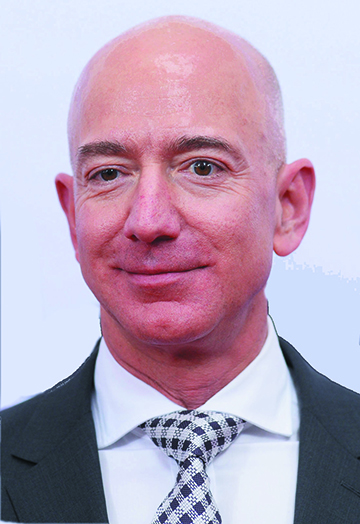
Jeff Bezos’ Amazon has prospered greatly from the Covid-19 shutdown along with McDonald’s, Walmart, Target, and many other wealthy Fortune 500 corporations.. Conversely, many of the most unfortunate economic casualties of the Covid-19 shutdown are small businesses — a staggering percentage of which will not recover. Among these, many of the hardest hit are family-owned food and beverage establishments and independent retailers.
Currently, the nation’s financial spine appears to be either broken or at the very least severely out of alignment. Unfortunately, the middle class can’t just go hobbling down to the economic chiropractor and get its mangled column of vertebrae snapped back into place. Rather, the health of each small yet crucial section is going to have to be nurtured back to solvency one joint at a time.
Jeff Bezos
A Personality Crisis
Doing this is going to require innovation, experimentation, and the willingness to abandon some elements of the old fiscal paradigm. The Washington Post recently reported that over 100,000 small businesses have closed down permanently due to the Coronavirus fallout, and more are expected. This year’s decimation of small business has created a massive void in the marketplace as a whole. The character and warmth of family-owned and operated businesses that are no longer there has left consumers with an ever-dwindling set of bland, prefabricated cookie-cutter options. As most folks with even a fraction of personality will agree — that will not do.
The independent entrepreneurial spirit is strong in many Americans, and some would rather work for themselves 80 hours a week than clock in and out of a regular job and toe the line to the corporate status quo. Independent mom and pop businesses can and will etch their place in the economic landscape once again. If you are willing to step out onto shaky ground, there are a few takeaways from the current crisis you can arm yourself with so that the next stay-at-home order will not mean curtains for your piece of the American Dream.
Brass Tacks Of Business
Boarded Up: Bracing boards on windows does not brace the backbone of the economy.
Retail shops and dine-in restaurants carry the always present, ever-increasing burdens of rent, insurance, property tax, loan payments, utility bills and on and on. Before dollar one can be considered profit, these costs must be met. If your passion is preparing delicious food or supplying people with items they need, consider operating from modest digs for starters or better yet, skip the storefront altogether and set up shop from home. Rather than wait for random foot traffic to wander through the door, you might consider marketing to your immediate community and perhaps to an extended clientele within reasonable, deliverable radius. Plus, if your business is non-perishable goods, there’s always the good ol’ United States Postal Service.
Interact With Your Neighbors
Neighbors: Communities are built on relationships between neighbors.
By creating commerce and delivering value to your community, you are playing an important role in bolstering your small section of the backbone. In this scenario, your neighbors and fellow Denverites are your clientele, and developing relationships with them is crucial to your success. For this to happen, however, there must be a general consensus that fast food and big box stores are not the only options when it comes to enjoying professionally prepared meals and purchasing clothes, accessories and gifts. With the unfortunate dwindling of mom and pop places to frequent, people are eventually going to get sick of unhealthy fast food, generic products and soulless interaction. This newly-emerging niche is where small, home-based and low-overhead businesses owners can step in and make a living — and perhaps a difference in their community.
Reach Out In Old And New Ways
Spread the word about your products and services by talking to people in your immediate community. If the quality you present is on par with your passion for your business — those you serve will almost certainly tell their family, friends and neighbors about you. Also, the internet, despite its flaws, is still a powerful tool for doing business — perhaps now more than ever. You can cheaply and effectively build and maintain a clientele via internet marketing — specifically by email. You will need a basic website, an on-page email capture feature and an email management service. All can be acquired and maintained for a few dollars a month. The scope of this article is not broad enough to go into all of the nuts and bolts of this, but please know that for the curious, there are volumes of free information available about every facet of online marketing.
Subvert The Supply Chain
Locally sourcing raw materials is an essential component of a community-focused, small business resurgence. Large agricultural distributors are in the same category as fast food chains and corporate retailers. They are only concerned with numbers and have no contingency in their business plans for building and sustaining communities. On the other hand, according to farm flavor.com, there are 36,180 farms and 156 farmers markets in the state of Colorado. Plus, delivery services such as Grub Hub, Door Dash and Uber Eats are available to deliver just about anything edible you may produce to your local customers. As the locally-sourced, delivered inventory model grows, so too will regional services designed to meet that demand. Currently, Coloradofreshproduce.com and Farmtoforkcolorado.com are serving the entire Denver metro area and surrounding suburbs.
While some of what is presented here is speculative, the fundamentals of what make small businesses volatile are definite: high overhead, a disconnect with the community and outdated marketing strategies. What makes them invaluable, however, is that they are run by human beings who share the same aspirations, concerns and neighborhood as you.
The Gaylord Rockies Resort & Convention Center reopened for reservations on June 25, 2020, after being closed due to the Covid-19 pandemic. Staff members, wearing masks and having been retrained for enhanced cleaning technologies, were eager to greet guests as they checked in for the first time in months.
Outdoor Pool: The Arapahoe Springs pool now requires reservations. Each guest can choose between an 8 a.m. to 2 p.m. or 3 p.m. to 9 p.m. slot for each night of their stay. A limited number of guests are allowed in for each time slot.
The reopening comes with limited capacity and strict social distancing measures. The resort has set up directional arrows for walking throughout the resort, hand sanitizing stations throughout, and limited restaurant availability. The Mountain Pass Sports Bar, which features a 75-foot viewing screen, the largest in the state, is the only restaurant open. In addition, the Arapahoe Springs Bar & Grill near the pool, Rockies Marketplace, and the taco bar near the Pinyons bar are other options. The Pinyons bar now forms a single file line to order drinks which allows for social distancing. For the time being, the other restaurants are closed. However, the resort does allow outside food to be brought in. Convenient options are services such as Uber Eats or GrubHub.
The Arapahoe Springs pool area is now under a reservation only system. Guests can choose either an 8 a.m. to 2 p.m. or 3 p.m. to 9 p.m. slot. The pool closes from 2 p.m. to 3 p.m. every day for enhanced cleaning measures. These reservations allow staff to monitor how many people are in the pool for each time slot and limit the number of guests there at once. For guests with younger kids, it is recommended to reserve the 8 a.m. to 2 p.m. shift as the pools and lazy river are less crowded during that time slot.
The pools are definitely the resort’s main attraction. There is an indoor and outdoor pool (which includes an infinity pool), an outdoor lazy river, and three water slides. This water park is spread out over 22,000 square-feet which allows for proper social distancing. The entire resort is situated on 85 acres of land, so it never feels crowded even under normal circumstances. Guests can reserve a cabana if they want their own dedicated space. Or they may snag a chair by the lazy river and relax.
Every night at 9 p.m., the resort plays a kid-friendly movie on the lawn with plenty of room for families to spread out. They also have games such as bingo on the lawn. The activities are less than usual but it is still a nice getaway if families feel the need to get away for a couple of days yet are not ready to jump on an airplane.
Gaylord Rockies is near Denver International Airport and is a Marriott property that opened in December 2018. The 486,000 square feet of convention space makes it the largest combined resort and convention center in Colorado. It is the fifth Gaylord property to open with the others located in Washington, D.C, Nashville, Orlando, and Dallas.
The Gaylord Rockies Resort & Convention Center is located at 6700 North Gaylord Rockies Boulevard. For more information about the resort or to make a reservation, visit www.gaylordrockies.com.