by Mark Smiley | Sep 29, 2014 | Travel
by Glen Richardson
Glendale staple Shotgun Willie’s is now open and will be serving liquor until 4 a.m. on Friday and Saturday nights thanks to a new Common Consumption law (C.R.S. 12-47-103 et seq.) passed by the legislature in 2011.
State Senator Pat Steadman, a sponsor of the 2011 law that paved the way for Glendale’s extended drinking hours said, “Local governments should be allowed to set the hours of their establishments.” After the law was passed, the Glendale City Council approved the extended hours by a unanimous vote.
Shotgun Willie’s is the first establishment to get approval under the new law although casinos in Black Hawk and bars and restaurants in Morrison are considering it. “Now that casinos are allowed to stay open 24 hours, there is a lot of interest in Black Hawk of having later drinking hours,” said Steadman.
It is perhaps not surprising that Shotgun Willie’s was the first business to utilize the new law as Glendale was one of the prime backers of the new legislation.
The new hours brought the club to the attention of Brian Maass the investigative reporter for CBS4 Denver News. Maass, throughout his career, has made a living on doing specialty pieces on Shotgun’s and Glendale, usually in a negative light, and the latest story was no exception. Maass brought hidden cameras into the club for no apparent reason other than to have an employee on camera confirming the new hours which Maass acknowledged were wholly legal. On camera Maass made a Freudian slip first saying “wholly illegal” before correcting himself.
Westword’s Michael Roberts, in an article on the matter, made fun of Maass’ use of “hidden camera techniques even though everything the club has done is completely overboard [meant ‘aboveboard’].”
Maass then had the male executive director of the Colorado chapter of Mothers Against Drunk Driving Fran Lanzer, predictably declare that they were against extended hours. He stated what’s happening with Glendale in his opinion is a risky proposition. “If we have a uniform statewide cutoff limit, then every bar has to close by 2 a.m. and that means there is no incentive to leave one bar to try and get to another bar that is going to close later. If there is an option where people could go and potentially continue drinking and continue their night, that would be an incentive for people to drive drunk and take that risk,” said Lanzer.
On his 710 KNUS morning show, Dan Caplis then praised the Maass piece and took calls on the subject. Michael Brown also covered the topic on his drive time radio show on 630 KHOW.
The net effect of the publicity was packed crowds now on the weekends after 2 a.m. “It’s incredible,” said Marguerite Lucas, Shotgun Willie’s spokesperson. “Brian Maass really knows how to gin up business for the club and we are very grateful.”
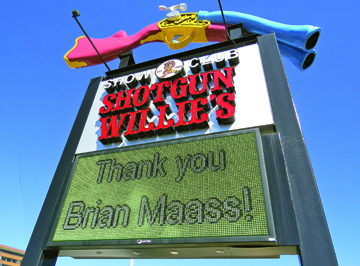
The club even put in huge letters on their marquee on Colorado Boulevard, “Thank You Brian Maass.” The club indicated thanks to the boost given to it by Maass and the related publicity, they may consider adding some other days of the week to the extended hours program.

by Mark Smiley | Sep 29, 2014 | General Featured
by Mark Smiley
It is the fastest, coolest, most beautiful trike in the history of trikes and it turns out that it is perfect for community policing according to the Glendale Police Department. The Department has already purchased and is employing one of these beautiful vehicles in day-to-day police work. It’s called a Can-Am Spyder Roadster and it goes up to 125 miles per hour and performs 0-60 mph in just 4.5 seconds.
The three-wheeled motorcycle is manufactured by Canadian company Bombardier Recreational Products better known for their work with snowmobiles and jet skis. The vehicle has a single rear drive wheel and two wheels in front for steering, similar in layout to a modern snowmobile. In fact, it rides more like an ATV or snowmobile rather than a typical motorcycle. The futuristic-looking three-wheeled vehicle, equipped with state-of-the-art radar and camera systems, has been on the prowl since April. More are on the way.
Residents love to stop Glendale police officers riding the Can-Am Spyder to admire the vehicle and talk about its attributes. Just don’t call the vehicle a “trike” to an officer’s face as the Glendale Police are a little touchy about what they deem is a pejorative word for their pride and joy.
With the Riverwalk concept on the horizon (now known as Glendale 180), Captain Mike Gross looked for alternative ways to patrol the area which will be heavily pedestrian. The department has bicycles in its fleet but needed something faster that could still maneuver through tricky terrain, especially from Colorado Boulevard to Cherry Street. After testing a variety of different modes of transportation including electric motorcycles and segways, Gross found a rental company in Sheridan that had the Can-Am Spyders.
The time required to train the officers in the operation of the vehicles is less than traditional motorcycles. The training is held at the Arapahoe County Sheriff’s track. The motorcycle license endorsement is still required in order to ride these new vehicles. “This gives us an alternative to a patrol car,” said Chief William Haskins, Glendale Police. “We train our officers in one half day as opposed to the two weeks of motorcycle training.”
The normal two-wheel motorcycle became a hazard to police officers in Glendale. Approximately 50 percent of officers going through the two-week training would “graduate” and become certified. Chief Haskins points out that shorter statured officers could not place their feet firmly on the pavement with the motorcycles. A fair amount would sustain injuries that would shelve them for an indefinite period of time. In contrast the anti-lock braking system allows the Spyder to stop on a dime making it safer for officers to ride.
The Police Department has sold its last motorcycle and you will not find any more on the streets. Currently, there are 27 sworn in officers on the force and 23 of them are eligible to ride the new Spyder.
Glendale is the only police department to have such a vehicle in Colorado, and is one of only a handful in the entire country to utilize them. Branson, Missouri, has two in their fleet and they are the only department in Missouri with them. The police chief in Branson, Kent Crutcher, says the vehicles “offer better stability on the hills of Branson, and better safety ratings than traditional two-wheeled motorcycles.” Glendale’s police chief’s main focus and mantra is to “take officers out of the metal box and have them be more approachable.”
“O.K., O.K.” Police Chief Haskins conceded at the end of the Chronicle interview. “If you want to call it a ‘trike’ you can call it a ‘trike.’” He went on to explain, “It was Shakespeare who correctly noted in Romeo and Juliet that a rose by any other name still smells just as sweet.”

by Mark Smiley | Sep 29, 2014 | Glendale City News
by Marco Cummings
Writer for and on behalf of the City of Glendale

Casey Rock
The Glendale Raptors fell short of their summertime goals in 2014, falling a game short of Club 7s Nationals with a loss at the Omaha 7s qualifying tournament and falling short of hardware with a loss to the Northeast Olympic Development Academy with a 35-7 loss in the Plate (second tier) Final at the annual Serevi RugbyTown Sevens tournament hosted at Infinity Park.
Yet neither defeat was the biggest blow to the Raptors during a grueling 7s season. The team’s biggest loss was that of longtime team member Casey Rock to injury.
Suffering a blown knee in the Denver 7s tournament which started off the Raptors’ 7s campaign in 2014, Rock was tackled by an injury which not only prompted an early end to his season, but also forced the lock forward into a premature retirement from playing a game he has grown to love.
“I tore my LCL, MCL, ACL, patella tendon, all of my meniscus, and shredded all of the cartilage in my tibia and femur.” Rock said of the gruesome injury. “The doctor told me that because of all the bone damage, contact sports are done for me.”
Ironically, Rock’s injury came not from contact but from an awkward landing while chasing down an opponent.
An injury involving damage to the primary ligaments within the knee is sometimes referred to as an “unhappy triad” in the medical field, and for good reason.
“My spirits are pretty low,” Rock laments. “I wasn’t ready to stop playing and it’s been a real challenge to deal with that premature end to it all.”
At age 27, Rock seemed primed for many more seasons playing with the Raptors in both the 7s and 15s variations of Rugby. But it also ends the long journey he has experienced alongside the club, having joined the Raptors as one of the team’s original members back in 2006.
A Colorado native, Rock played both soccer and rugby at Denver’s East High School. In college, he focused on soccer with a scholarship to Metro State, but was lured back to Rugby when the Raptors began recruiting players at the club’s inception.
“I always thought that soccer players made a better transition to rugby because you’re used to running around for 90 minutes,” Rock explained. “You’re used to the game’s flow because soccer has so much change of direction and constant movement.”
His time with the Raptors eventually led to additional opportunities within the sport, including stints abroad with clubs in Australia and New Zealand as well as stints with the Collegiate All-Americans and USA Eagles. But his fondest memories remain with the Raptors.
“Winning the National Championship in 2011 was really fun,” Rock recalls. “We had a great team of guys that year. We had guys who weren’t necessarily stars but it was a great team.”
Rock continued his path to become a better rugby player while the Raptors became a bigger and better club.
“It’s been fascinating to watch the club grow. From being a 19-year-old practicing behind the Goodwill to playing for a Springbok legend in one of the greatest facilities in the Nation has been really great,” Rock said.
The “Springbok legend” Rock refers to is current head coach Andre Snyman. While Rock has only spent a few seasons under the South African, Rock explained that Snyman’s experience, particularly in the 7s game, had helped him become a more complete player.
“His knowledge of the game is so vast,” Rock said. “He’s really helped me develop my ball handling skills and vision for the game. I learned how to look at the game differently with him and see how the game was developing to put myself in a better place on the field.”
But even though Casey Rock’s time on the field has come to an end, he assures that he will continue to maintain a role with the Raptors and a relationship with the sport of Rugby.
Shortly after his injury, Rock was offered the position as coach of the Raptors Division II forwards. He’s also spearheading the movement to create an “Old Boys” organization for the Raptors. Not often seen with rugby clubs in the United States, an Old Boys organization is a way for former players to give back time and resources to their former club.
“Having played overseas, I’ve been part of clubs that have been around for hundreds of years. When guys retire they don’t just disappear. They tailgate or run a training session for the younger players. I see myself bringing the boys back in an organized fashion and being more visible,” Rock explained. “I feel really proud and humbled at how much the club still wants me around and to be involved.”
Outside of rugby, Rock has also gained time to focus himself on his new career as a first year language arts teacher for middle school students.
Unfortunately, no lesson plan could have prepared him for the challenges he has faced this summer while dealing with the devastating knee injury.
“The lesson I’ve learned is that all good things come to an end. It’s put some things in perspective for me. It’s reinforced the belief that you can’t spend all your time and energy on one thing.”

by Mark Smiley | Sep 29, 2014 | Editorials
Bob Coté the founder of the alcohol and drug rehabilitation center Step 13 was truly one of a kind as was the charity he founded. A former boxer from the mean streets of Detroit he knew what it was to be an alcoholic and homeless in Denver. He had been a white collar salesman who was able to hide his addiction for a while before spiraling down into alcohol dependence and hopelessness. He was at heart a “street fighting” man who took no gruff from anyone no matter how important or mean they were.
Having saved himself from addiction and despair he walked the alleys and byways of pre-yuppieized downtown Denver carrying a baseball bat searching for souls to save from the hell he personally knew all too well.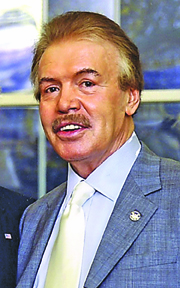
Even the name of the charity he founded “Step 13” was as idiosyncratic as its founder. It is almost universally initially assumed that it refers to a proposed next step after the 12 step program of Alcohol Anonymous, but instead it is homage to the original 13 colonies of America and Jesus and his 12 disciples. He quickly found out that modern American governmental agencies (federal, state and local) wanted absolutely nothing to do with any charity whose name was picked to honor patriotism and Christianity. They would do whatever they could to destroy a man who was quickly succeeding in making a real difference in lives of homeless drug and alcohol addicted men in Denver.
He said he knew what these men needed, as he had needed it so badly in his time of despair — “A hand up, not a hand out.” He wanted for those he helped what all men wanted (including himself) — dignity and self respect. He believed that only came from work and self reliance. He could never figure out why people like John Hickenlooper for all his purported concern about these men never got it. In his mind all that the Hickenloopers of the world offered these men was dependence and suffering or as he called “suicide by the installment plan.”
He viewed most of the members of the Denver City Council as “jackals” and “hyenas” who poured money into programs like the “Ten Year Plan to End Homelessness” (now known as “The Road Home”) which in his mind were simply bureaucratic sinecures for those who have never actually helped another human being in their entire lives. He viewed the Coalition for the Homeless as little more than the “Coalition to Exploit the Homeless” where the top personnel pay themselves handsome six figure salaries on the backs of the homeless.
That his charity Step 13 succeeded without ever taking any money from the government was amazing to him. He saw himself as a type of rough-hewed Forest Gump. More by accident than design he found businessmen like Bill Daniels and Cortlandt Dietler who were will willing to support and fund his vision while he worked tirelessly to make Step 13 a self-sufficient enterprise.
When he died last September replacing him seemed impossible. But the individuals who are on the Board of Directors had seen with their own eyes how Step 13 had literally saved men from their own destruction and that for such an organization to die while the harmful and invidious government funded programs lived on to exploit and destroy the lives of the humans they purported to help was too much to bear.
After months of fruitless efforts they found a man who seemed to be just the type of person they were looking for — Peter Droege. He was not in any sense a younger Bob Coté — that mold had been broken and thrown away when Coté came into the world.
Moreover, Peter Droege is most definitely not a “street fighting” man but rather the son of two artists who went to Central City to escape the real world and open up a gi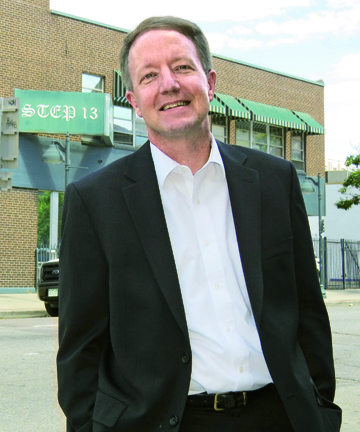 ft shop to display and sell artistic items. He attended the University of Wyoming and then headed out to California to be a journalist in Los Angeles. He returned to Colorado to work on various local publications. He joined the Daniels Fund, the billion dollar legacy of cable pioneer and Step 13 supporter Bill Daniels, where he rose to Vice President of Communications before coming over to Step 13 as its executive director.
Droege has had his own battles with “demon rum” and knows what addiction can do to you. He met Coté in 2001 and helped co-chair the 25th Anniversary of Step 13 held at Infinity Park just prior to Coté’s death.
Bob Coté made it abundantly clear to you whether he liked you or not. His magnetic personality attracted many people, but he also repelled more than his share of individuals sometimes unnecessarily. He just couldn’t help himself when he found himself in the presence of someone he believed to be a self important phony whether or not the person could have been of great aid to his enterprise.
Peter Droege on the other hand is a uniter. Quickly after meeting him, he makes you feel that you have known him your entire life and the two of you are the closest of friends. His infectious, positive enthusiasm makes you feel that just about anything can be accomplished.
He has already made important alliances including one with Goodwill Denver. He has adopted as his own the mantra “Get a job, get a better job, get a career.” He believes to his core, like Coté before him, that finding jobs and careers for the men who Step 13 assists is the key to making them whole again. Goodwill Denver’s Career Connection Centers are one-stop shops for career developments that work perfectly with Step 13’s mission.
He has also been successful in getting more and more people to contribute cars, boats, motorcycles etc. to Step 13 for them to repair, fix and resell while making sure the donor gets the highest allowable tax deduction for his or her donation.
The unique Step 13 organization appears in good hands with Droege, although when you refuse all governmental funds you are constantly going to be challenged in obtaining necessary funding.
If you want to give to a charity to make yourself feel good there are lots of organizations out there with which you can accomplish your goal. If you want give to an organization that really does make a life-changing difference in the lives of others, Step 13 has proved to be just such a charity, first under Bob Coté and now under Peter Droege.
— Editorial Board

by Mark Smiley | Sep 17, 2014 | Glendale City News
Denver Public Works plans to close some lanes near Cherry Creek Mall at 7 p.m. on Saturday, September 20. The intersection of University Boulevard and 1st Avenue will be fully closed by 10 p.m. that night.
During the closure, crews will work to complete the storm sewer and street reconstruction projects.
“A full closure of the intersection will allow the work to be completed more quickly in one single phase instead of in multiple phases as originally planned,” DPW spokeswoman Nancy Kuhn wrote. “I think it will be less impactful than doing it in several phases.”
The intersection will reopen on Tuesday, September 23, by 7 a.m.
The University/Josephine improvement project began in January 2014. With the new plan, the project is now expected to be completed on November 1.
During the closure, access to homes, businesses and the mall will be maintained throughout the closure.

by Mark Smiley | Aug 29, 2014 | Travel
by Mark Smiley
The award-winning Bella Diva Dance is moving from Cherry Creek North to Glendale after four years at 3rd and Clayton. “It was great working with th e city of Glendale. Obtaining permits is easier in a smaller city. There was not a lot of red tape,” said Caitlin Brozna-Smith, owner and founder of Bella Diva Dance Studio. They have invested over $10,000 in building a brand new dance studio in the Glendale Center located at 4309 E. Mississippi Avenue.
They are situated in the same shopping center where longtime Glendale businesses, Bistro Boys Catering, The Bo okies, and Dr. Proctor’s Lounge are located. Brozna-Smith’s business partner Erin Anderson shares the space with her business, Communitas.
The two met four years ago while Anderson was taking one of Brozna-Smith’s classes at the Cherry Creek Athletic Club. Communitas focuses on creating a healing space which includes massage therapy and extensive body work.
The Bella Diva Dance Studio, founded in 2010, does not focus on the traditional ballet or tap dance. Bella Diva Dance offers a unique blend of modern Egyptian, American and Lebanese style dance technique. Particular emphasis is placed on body awareness, proper alignment and clean movement execution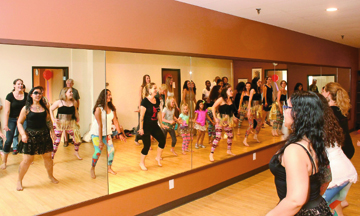 . They are a company dedicated to creating a community for belly dancers and samba dancers while elevating the art of both dance forms. They dance to share the joy and beauty of Middle Eastern and Brazilian dance through artistry, thoughtful innovation and quality classes.
“Bella Diva Dance is a female empowering experience. Whether it’s attending one of the classes that push you physically to try new and exciting movements with your body, or attending a show, BDD always does a great job. I would highly recommend the classes or the shows to everyone I know,” said Valley resident Kara Thomas.
Class structure is based on a Western format of beginning with a thorough warmup including isolations and stretching, and then moving on to clear movement breakdowns, drilling the basics, hands-on corrections and integrating movements through combinations, choreography and improvisational exercises. Above all else, Bella Diva Dance celebrates the joy, femininity and individual expression inherent in Middle Eastern & Brazilian dance. Classes are taught on a monthly series-based curriculum, either being four or five classes per month. New series start the first Tuesday and Thursday of each month.
Members of the Bella Diva Dance Performing Company regularly perform at private parties, birthday and bachelorette parties, weddings, and festivals, throughout the Denver metro area. “We love to get out in the community and perform. We get an incredible response from spectators who love the uniqueness of the performances,” said Brozna-Smith.
In addition to being the owner and founder of Bella Diva Dance, Brozna-Smith is currently on faculty at the University of Denver as an Adjunct Professor of Dance and Stage Movement in the Theatre Department and Lamont School of Music. The Lamont School of Music is widely recognized as a premier university music performance school with a long-standing tradition of excellence.
This September, Bella Diva Dance will be pioneering a kids dance program offering Children’s World Dance for children ages 7-12, on Mondays, Tuesdays, and Thursdays from 4:30 p.m. to 5:30 p.m. Also in September, Bella Diva Dance is bringing in Afro-Caribe dance founder Eulanda Shead Osagiede from London to conduct an Afro-Caribe Unleashed Dance Fitness workshop during the World Dance Workshop Weekend. Afro-Caribe dance is typically joyful and free-spirited, and is often performed to Caribbean, Jamaican, highlife, jazz or soul music. The workshop will be held on Sunday, September 14 from 1 p.m. to 3 p.m.
For more information on any workshops or classes, visit Bella Diva Dance’s website at belladivadance.com or call them at 303-359-9414.