by Jessica Hughes | Jan 21, 2022 | Main Articles
by Jessica Hughes
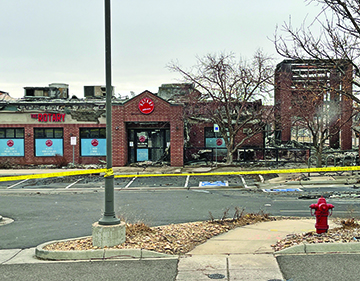
Out front, the day after the fire. Photo provided by Scott Boyd
Local Denver restaurant, The Rotary, first opened its doors in January 2021, at the corner of Holly Street and Cedar in the Hilltop neighborhood. They opened during the pandemic, and now, almost exactly a year later, are recovering from the Marshall Fire that recently scorched parts of Boulder County.
The Rotary’s second location in Louisville opened on December 15, 2021. But two weeks after opening, the wind-fueled Marshall Fire ignited on December 30, quickly ripped through the towns of Louisville and Superior, destroying nearly 900 homes in the short time of six hours.
Scott Boyd, a Louisville resident and co-owner of The Rotary, remembers that day looking out the window of his home as he headed to work at the restaurant. The first thing he noticed was a bunch of smoke and wind. When he arrived at work, there was even more smoke and the same wind intensity, plus ash inside the restaurant. Soon, the smoke and wind became bad enough that he decided to close for the day and sent everyone home.
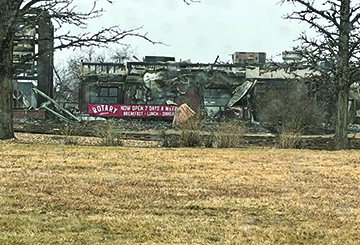
As he was shutting down the restaurant, Scott peered across the parking lot in amazement as nearby bushes rose in flames
Fire damage seen from the backside of the restaurant. Photo provided by Scott Boyd
and watched as the fire quickly advanced toward his restaurant. Locking the door behind him, he fled and went home to grab his wife, kids, and pets.
Boyd and his family evacuated to a friend’s house in nearby Niwot, where they watched the destruction of the restaurant through the surveillance cameras. “It was so surreal,” says Boyd. “To watch in real-time as the flames tore through the restaurant.” But as he watched with his wife, kids, and friends, he knew he wasn’t alone in this. “It was nice to know I had support.”
Fortunately, Scott’s home was not one of the ones destroyed. He says he feels fortunate to only have lost a business and not his family’s home and belongings.
“Now begins the challenge of rebuilding,” Boyd says as he describes the mess that was left after the fire. Between the fire sprinklers that soaked everything and then the snowstorm that followed the next day, freezing almost everything, including pipes, there are many factors to consider in terms of the damage. The process to rebuild will take some time with COVID and current supply chain issues, but nonetheless, they do plan to rebuild in Louisville.
Boyd says so many people have reached out to see how they can help, but he says, “Find a family that lost everything and give them the help. We’ll be fine.”
The Rotary was started by Scott, his
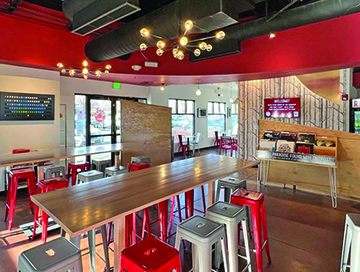
Inside The Rotary before the Marshall Fire. Photo provided by Scott Boyd
brother Brian, and their life-long friend Don Gragg, a celebrated chef. What began with a space inside the Avanti Food and Beverage in Denver, quickly required its own space as the COVID pandemic made it hard to sustain a seat at the table inside a food hall.
Eventually opening a standalone establishment in Denver’s Hilltop Neighborhood, the three owners saw their life-long dream of owning and operating a restaurant realized, all in the middle of a pandemic. What was a real hustle to stay afloat during 2021, they knew they had something special and forged on. “We’re like the little restaurant that could,” Boyd chuckles.
“We’ll come out stronger on the other side of this,” says Boyd, who feels the community has done an excellent job of coming together with donations and volunteering to help clean up the affected areas.
You can help Boyd and others affected by the Marshall Fire by donating at:www.commfound.org/grants/get-grant/Boulder-County-Wildfire-Fund.
by Mark Smiley | Jan 21, 2022 | Main Articles
Two New Developments Begin To Shift Shopping To Colorado Blvd. Corridor As Downtown Retail Struggles
by Glen Richardson

Multiple Housing Styles: Boulevard One is known for numerous types of bungalows, apartments, townhomes, and condos. Photo is of project’s Modern Row Homes.
Two of the Valley’s high-profile retail projects along the Colorado Boulevard corridor — the 9th & Colorado and Boulevard One at Lowry developments — have hit major milestones as they near completion, ramping up the shift in shopping dynamics away from downtown Denver.
Denver workers were thrust into a sudden, chaotic experiment in working from home when the pandemic shut down the city’s urban nucleus known as downtown. Moreover, as 2022 begins, that experiment isn’t close to ending.
The downtown real estate market remains in turmoil. Covid has dealt a huge blow to its vibrancy, destroying office and restaurant business that served as its lifeblood. When the pandemic is finally over, one in six workers are projected to continue working from home or co-working at least two days a week, according to a survey by the Harvard Business School.
Covid Is Culprit
Covid-19 was already shifting shopping eastward along the Colorado Blvd. corridor. As more Valley shoppers decamp from downtown to retail sites along the corridor, they are already stimulating the addition of new shops and restaurants.
The Chronicle looks at the status of the two retail undertakings nearing completion that are already drawing retail away from Denver’s downtown core as new businesses rush to open:
9th & Colorado
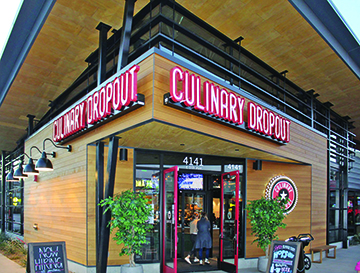
New Restaurant: Culinary Dropout’s first Colorado location opened in November at 4177 E. 9th Ave. in the 9+CO development. The restaurant is known for its hearty and classic American-fare, with options ranging from sandwiches and burgers, to fried chicken and 36-hour pork ribs.
The redevelopment of 9th and Colorado has been moving forward. Most of the blocks now have completed projects on them, leaving only a few open parcels left. Overall, this 26-acre development provides over 2-million-sq.-ft. of infill making this a major mixed-use urban center in the Hale neighborhood.
While only being a single-story structure, Block-1 contains seven retail pads, with considerably more than half of them filled. A 10-screen movie theater has moved in on Block-2, anchored by AMC. In addition to the movie theater, more retail resides around this block totaling 44,000-sq-ft. Dubbed Ella CityHomes, 35 for-sale townhomes occupy Block-3. Most of the homes have already sold.
Block-4 contains a seven-story parking garage, providing most of the structured parking for the redevelopment. The garage is partially wrapped, with a 64,000- sq.-ft. office building to the south. Ground-floor retail also wraps around the entire ground floor.
There are no concrete proposals on Block-5, however, earlier master plans envisioned a hotel and more mixed-use buildings. Block-6 contains the nurses’ dormitory from when this area was a medical campus. Currently, there are plans to rehabilitate the building while adding additional residential units toward Ash St. plus additional open park space.
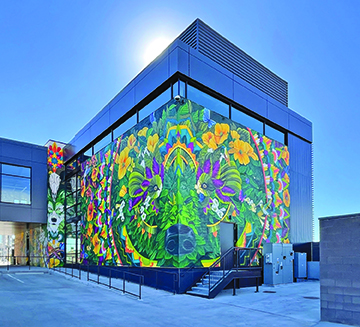
Art Of The Draw: Project draws retailers by adding art such as the piece above titled “A Living Wall” by Kiri Leigh Jones.
Now named Theo, Block-7 South was the first project to be completed in the redevelopment providing 275 apartment homes plus 40,000-sq.-ft. of ground-floor retail. One of the few existing structures in the Block-7 wrap is the north parking garage. The east side of this garage is wrapped with a three-story structure containing 17 townhomes-apartments. Milo Apartments occupy Block-7 East. This project provides 319 homes in an eight-story building.
Blocks 8-10: In blocks 8-10, only Block 8 is currently under construction. Most of the block is complete with the new Hale Park. The other portion is near completion with two single-story retail spaces. Preliminary plans for Block 9 call for a condo building. Greystar recently finished Overture, an eight-story building providing 208 age-restricted homes in Block 10. Residents over 55-years-old are moving into this building.
A variety of restaurants surround the 9+CO development including Postino, Pizzeria Locale, Frank & Roze Coffee, Hopdoddy Burger Bar, and Gelato Boy. The latest additions are Culinary Dropout and its new, next-door sister restaurant Blanco Cocina + Cantina which opened late last year and are owned and operated by Fox Restaurant Concepts, a company based in Arizona.
In addition, retail is popping up including CVS, M. Vince’ Nail Spa, Chase Bank, and Elevation Cycles. When completed, there will be close to 50 retail shops and restaurants occupying the former home of the University of Colorado Health Sciences Center which originally opened in 1924.
Boulevard One
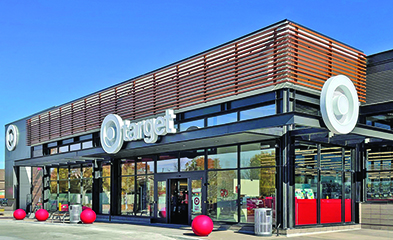
Lowry On Target: Retail seems to be on target, with the grand opening of Boulevard One planned for the first half of this year. Development has signed about 20 retailers including a small-format Target.
The grand opening for Boulevard One at Lowry is planned for the first half of this year (2022). Shopping, dining, and entertainment are designed to be a local affair at this site, with a major retailer and grocer already announced. Residents can walk or cycle on neighborhood paths to their favorite hotspots within the Exchange Building, the shopping space in the development.
Kelmore Development — in collaboration with Confluent Development — planned and built the mixed-use retail area at the northwest corner of E. Lowry Blvd. and Quebec St. The five-acre site contains 175,000-sq.-ft. of commercial space designed by Norris Design and Open Space Architecture. The Exchange Building — with 20 retailers already signed — features restaurant, retail and office space, plus a restaurant sitting on the community park across Lowry Blvd.
About 500 parking spaces, 231 of them in an underground parking garage, are at the site. Woven among the boutiques and entertainment venues, there are inviting outdoor seating areas, shared courtyards and landscaping, with the community park directly across the street.
A small-format Target is the anchor tenant for the development, occupying approximately 30,000-sq.-ft. of custom-designed space. The store is about one-quarter the size of a traditional full-sized Target and offers a shopping experience to meet the needs of Lowry residents, including same-day pick up and drive up.
Grocer Is Co-Anchor
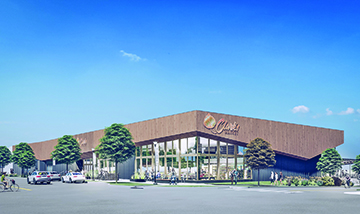
Exchange Building Co-Anchor: Boulevard One development will feature Denver’s first Clark’s Market.
Colorado-based specialty grocer Clark’s Market is the co-anchor in the Exchange Bldg. Located at Lowry Blvd. and Pontiac St., the 25,000-sq.-ft. store is the seventh Colorado location but the brand’s first in Denver. The store is expected to open in the first half of this year.
Shoppers can look forward to natural, organic, and gourmet foods, including artisan baked goods, beef, a fresh fish ice table, chef-prepared meals, specialty cheeses, stone-fired pizza, a circular gelato wheel, plus a liquor store. Envisioned as a gathering hub for Lowry residents, Clark’s Market plans to pour draft beer for shoppers on site.

by Mark Smiley | Dec 17, 2021 | Main Articles
FAA Warns Rollout Of 5G Network Could Also Affect Air Safety Including Flights From DIA
by Glen Richardson
Denver’s cellphone carriers are set to begin shutting down their older networks as 2022 gets underway. If and when they do and you have an older device you won’t be able to text, phone friends or make an emergency 9-1-1 call.
The shutdown dates were set to start Jan. 1, 2022, and continue throughout the year. Verizon says their 3G CDMA network will go away no later than the end of 2022. T-Mobile plans to retire all its 3G networks, including those obtained through its merger with Sprint, as quickly as possible as this year begins.
The changeover dates initially appeared to be confirmed. Phone carriers here and elsewhere have been proceeding as if they were permanent and established.
Air Safety?
However, the FCC warned as 2021 was coming to an end that the 5G rollout would impede air safety for pilots and slow airline travel, including traffic at DIA in Denver. Just after mid-November, carriers agreed to delay their launch of 5G C-band spectrum licenses until Jan. 5, 2022, due to the FAA concerns.

DIA Delays: FAA says the rollout of 5G may affect air safety, including at DIA. Pilots apparently will also tell passengers that new 5G devices should be turned off or switched to airplane mode during flights.
In a special information bulletin released at the time, the FAA said operators “should be prepared for the possibility that interference from 5G transmitters and other technology could cause certain safety equipment to malfunction, requiring them to take mitigating action that could affect flight operations.”
The bulletin said “there have not yet been proven reports of harmful interference,” but recommended pilots also remind passengers that all portable electronic devices equipped with 5G be should be turned off or switched to airplane mode during flight.” Following Thanksgiving, however, The Wall Street Journal reported that, “AT&T Inc. and Verizon Communications Inc. said they would limit some of their fifth-generation wireless services for six months while federal regulators review the signals’ effect on aircraft sensors.”
Definitive Dish Deal: Colorado dropped out of the T-Mobile-Sprint merger lawsuit to allow Littleton-based Dish Network to create nation’s fourth wireless provider. Dish is attempting to build a cloud-native 5G network.
Rollout Impact
The slowdown or even a longer delay may yet occur as the two government agencies — the FAA (Federal Aviation Agency) and FCC (Federal Communications Commission) — feud over nationwide safety. The Wall Street Journal said the compromise was proposed in a letter sent to the agencies by the carriers.
If and when the rollout begins, here’s what to expect: Your older phone(s) will no longer take phone calls; furthermore, apps and websites will no longer work over a cellular connection.
Killing off the slower networks, moreover, will upset much more than just your cell phone: older cars have 3G systems, as do security cameras and other systems. Examples include medical alert devices plus e-readers like the Kindle.
New Nightmare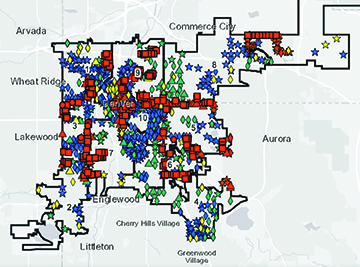
Denver is one of the first major U.S. cities where telecommunications companies sta rted installing the super-powerful cell towers. Companies providing 5G service here — AT&T, Verizon and T-Mobile — are doubling the number of 5G towers around the Mile High City.
Valley residents were told they were the beginning of, “a new era of digital interconnectedness.” Cell phone carriers even claimed, “It was the beginning of the “Fourth Industrial Revolution.”
Over the past couple of years, however, residents in neighborhood after neighborhood have found them to be an infrastructural nightmare.
Poles A Drawback
Homeowners say the poles are ugly, spoiling the scenery and harming their property values.
As time has gone by, residents in several locations have uncovered additional problems but contend they can’t get the cell phone companies to fix them or even acknowledge problems exist. The city, however, can’t stop the carriers from installing the poles, thanks to a 2017 state law that says companies should generally be allowed to build them on the public right of way along city streets.
Furthermore, many families remain uneasy that the poles could also cause adverse health effects. Will the added small cells mean there are higher amounts of RF-waves surrounding people? Bottom line: Nothing conclusive has been ruled out or in and the long-term effects remain unknown.
Colorado Deal
Colorado, as many local residents likely recall, was originally one of 12 states that joined a lawsuit to stop the merger claiming it would hurt consumers and cut competition.

Changeover Collision: Rollout of 5G technology by Denver’s cellphone carriers this month will shut down older cellphones (pictured). If you have a Samsung Galaxy S4 or older it is also a 3G device, but newer models may still need an update to work.
The state pulled out of the lawsuit, however, when T-Mobile agreed to sell its subsidiaries Boost and Virgin Mobile to Colorado-based Dish Network for $5 billion. The deal allowed Dish to take over T-Mobile and Sprint’s service bands, creating the nation’s fourth wireless provider.
Eventually the compact will create, “thousands of new jobs,” the state said when announcing the deal. Potential job estimates according to carrier sources, are currently slightly more than 2,000. To date, Dish is still building the network in conjunction with more than 35 other companies. When completed it will link about nine million customers of Boost plus cable companies Comcast and Charter by relying on Verizon’s network.
T-Mobile Tactics
Meanwhile, in what some industry insiders are calling “double-dealing,” some observers are insinuating that T-Mobile is trying to crush the Dish deal.
Prior to the close of 2021, T-Mobile launched substantial promotions intended to get back the very customers it was required to sell to Dish as part of the Sprint merger. Even without the T-Mobile promotions, Dish was expected to lose more than 8.9 million wireless subscribers.
T-Mobile is the brand name used by the mobile communications subsidiaries of the German telecommunications company Deutsche Telekom AG. The brand is active in the Czech Republic, the Netherlands, Poland, along with the U.S.
by Charles Bonniwell | Dec 17, 2021 | Main Articles
So Why Are We Still Wearing Masks? Mask Mandates Cause End Of Tri-County Health
by Charles Bonniwell
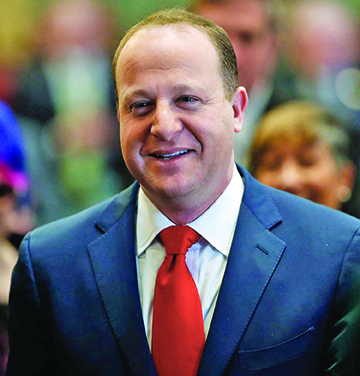
Canny Politician: Colorado Governor Jared Polis has gone on a national media tour receiving praise for declaring the COVID-19 medical emergency over and the lack of any need for mask mandates while 75% of the state’s population still remain under local mask mandates.
Colorado Governor Jared Polis made national news by appearing on Colorado Public Radio and declaring that after 16 months since he issued a medical emergency, the emergency was “over” and that there would be no statewide or vaccine requirements. He opined that:
“You don’t tell people to wear a jacket when they go out in winter and force them to (wear it). If they get frostbite, it’s their own darn fault. If you haven’t been vaccinated, that’s your choice. I respect that. But it’s your fault when you’re in the hospital with COVID.”
It was quite a reversal from just a few weeks earlier when he halted elective or cosmetic procedures to try to save hospital beds for COVID patients.
So why then are people in Metro Denver still wearing masks? Polis had stated that, “Public health [officials] don’t get to tell people what to wear; that’s not their job.” That is apparently not what some local health officials in Colorado believe.
On November 23, 2021, Denver Mayor Michael Hancock reinstated mask mandates requiring all indoor Denver businesses and venues “mask up” unless they choose to require proof of vaccination. Hancock followed the lead of Jefferson, Adams, and Arapahoe counties.
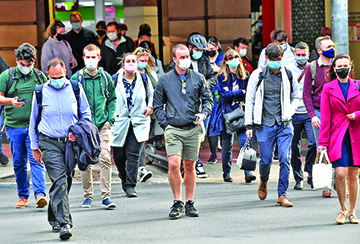
Still Under The Mask: Notwithstanding Colorado Governor Jared Polis declaring the COVID-19 pandemic emergency over and there being no need for statewide mask mandates, 75% of the population of the state are under some form of a mask mandate.
Tri-County Health Acts
Tri-County Health Department had preceded Hancock after waiting in vain for Polis to impose new statewide mask mandates. “If the state is unwilling to act, metro-wide action to implement mask mandates can provide some benefit given the size of our population and number of hospitalizations,” said Dr. John Douglas, executive director for the Tri-County Health Department, which covers Adams, and Arapahoe counties.
Other counties in Colorado that also presently have mask mandates are Boulder County, Larimer County, Pitkin County, and San Miguel County. In fact, notwithstanding the lifting of the state emergency by Polis, over 75% of the population of the state still live under mask or vaccine mandates.
Polis was not going, however, full Governor Ron DeSantis, who banned all local mask mandates in Florida.
While Polis received generally positive press nationally on his declaration that the COVID-19 emergency is over, not everyone in Colorado was thrilled. The editorial board of the Aurora Sentinel criticized Polis saying his action was “a grave disservice” to the state and that “the pandemic emergency in Colorado and across the nation is not over. It is far from over.”
The Destruction Of Tri-County Health
Local mask mandates are also not popular in Colorado in some circles. The Tri-County Health Department was until recent ly considered the premier and most respected health department in the state covering 1.3 million people (25% of the state population) in Adams, Arapahoe, and Douglas counties with 431 employees. Founded in 1948, it will be totally dismantled in just over one year due almost solely to mask mandates. Many blame Dr. John Douglas, the 69-year-old executive director of the department, and his insistence on mask mandates.
The Tri-County Health mask mandates, first ordered in July of 2020, allowed municipalities and counties to opt out. Those mask mandates preceded those that Polis issued statewide. At the time, Polis announced: “Wearing a mask is not a political statement. I don’t know how, in anybody’s mind, this became a political football.”
Douglas County, all of whose county commissioners are Republicans, balked and threatened to leave Tri-County Health when Tri-County decided to prevent counties from opting out from its mask mandates. Douglas County formalized its withdrawal in September of 2021. At the time, Tri-County also imposed the mandate for all people above the age of two in all schools and childcare facilities.
Adams County, all of whose county commissioners are Democrats, had also opted out of the Tri-County Health mask mandates. When that option disappeared, on October 19, 2021, the commissioners elected to leave subject to the mandatory one year notice.
That only left Arapahoe County whose county commissioners are split between Republicans and Democrats. On December 14, 2021, Arapahoe County, after over 60 minutes of public testimony demanding that the county get out of and remove the mask mandates and other COVID-19 restrictions, the commissioners voted to say goodbye to Dr. Douglas and his Tri-County Board.
Douglas Views The Wreckage
When interviewed by The Denver Post on the dissolution of a 74-year-old institution like Tri-County Health over mask mandates, Dr. Douglas stated:

Clueless: The executive director of the Tri-County Health Department, Dr. John Douglas, is blamed for the demise of the 74-year-old institution with mask mandates of dubious value. If the 400 plus workers of Tri-County’s Health Department who are losing their jobs are looking for a mea culpa from him they will be disappointed as he doesn’t appear to see what he might have done differently.
“If you had asked me to take a multiple-choice test three years ago about what would be the most controversial issues if we were to have a pandemic, and mask-wearing was one of my options, it would have been last on whatever list you gave me. I could just not have imagined that this would have become so.”
Given that the efficacy of non-surgical masks in preventing COVID-19 is a matter of dispute particularly as it applies to children, it does not appear to occur to Dr. Douglas that perhaps he should have given some credence himself to listening to all of the people who went before the various county commissioners demanding to leave Tri-County Health over mask mandates.
The question remains, given all that has happened, why most Coloradans are still required to wear masks. As a practical matter, the mandates of Tri-County Health are still law until the end of 2022 when the entity dissolves. Of course, people want to wear masks for health or political reasons. Enforcement of mask mandates, however, won’t be a law enforcement priority so many who do not enjoy wearing masks will flout the applicable law and that will certainly not help the moral authority of future local health directives.
by Mark Smiley | Dec 17, 2021 | Main Articles
by Mark Smiley

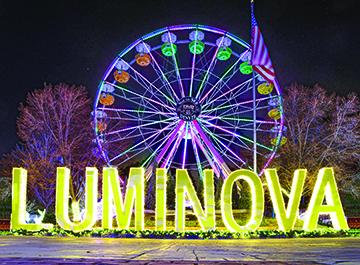
Candy Cane Tunnel: The candy cane tunnel is a must see when visiting Elitch Gardens this holiday season.

Rides: A limited amount of rides are open at Elitch Gardens during the Luminova Holidays event.
 Luminova Holidays at Elitch Gardens premiered on November 26, 2021, and runs through Sunday, January 2, 2022. For the first time ever, the park transformed into Luminova Holidays and delivered a winter wonderland experience with larger-than-life holiday displays featuring over three million lights and more.
The immersive family experience features a display of glittering lights, fun rides, memory-making moments, and visits with St. Nick. Reservations are required. The event will run evenings from 5 p.m. to 10 p.m.
“We truly are proud and excited to introduce the first-ever holiday event at the Park,” says David Dorman, Elitch Gardens General Manager. “Luminova Holidays promises to be a must-see, sensational, and sophisticated spectacle, and a must-do for Coloradans of all ages to make lifelong memories at Elitch Gardens.”
Luminova Holidays featured at Elitch Gardens includes a 65 ft. Christmas tree, 25 ft. snowman that never melts, 200 ft. candy cane tunnel, ornaments and presents scaling over 16 ft. tall, rides on limited Elitch Gardens attractions, strolling holiday entertainers, and interactive activities, including light-up hopscotch.
Three Million Lights: Luminova Holidays features over three million lights throughout the park.
“This year more than ever we want families and friends to create memories that will last well beyond the holiday season,” says Dixie Baker, co-producer of Luminova Holidays. “We are extremely excited to be making our Colorado debut and to share with Denver the joy and holiday cheer that thousands have experienced when coming to see Luminova! We are thrilled to be partnering with Elitch Gardens and look forward to brightening up your holidays for years to come.”
President and CEO of VISIT DENVER, Richard Scharf, further adds, “We are thrilled that Luminova Holidays has chosen Denver and Elitch Gardens for their newest attraction. The holiday season in the Mile High City is always an exciting time with shopping, festive attractions, performances, and displays, and we look forward to adding another unique tradition for families to enjoy downtown.”
Visit ElitchGardens.com/Luminova to reserve your visit and purchase tickets. Follow them on Facebook and Instagram – @LuminovaHolidays and @ElitchGar dens, and Twitter – @LuminovaHoliday and @ElitchGardens.

by Charles Bonniwell | Nov 19, 2021 | Main Articles
Developer Still Seeks Commercialization With Help Of Hancock Administration
by Charles Bonniwell

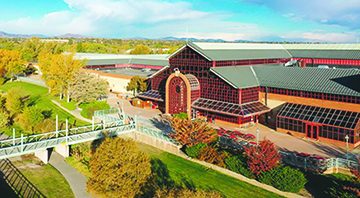
From Above: An aerial view of the entire 155-acre Park Hill Golf Course area under threat of commercialization from developer Westside Investment Partners and the Hancock Administration.
The voters appeared to overwhelmingly state that they wanted the 155-acre Park Hill Golf Course area to remain green space. By an almost 2-to-1 margin, voters approved Initiated Ordinance 301 which required citywide voter approval to build on the land. The initiative and the campaign were headed up by former mayoral candidate Penfield Tate III, who headed up Save Open Space Denver (“SOS Denver”), and former Denver mayor and Park Hill resident Wellington Webb. The slogan of the campaign was “Green over Concrete.”
Tate indicated that the message hit home for residents who have seen massive new density across Denver, supported with the direct and indirect support of Denver Mayor Michael Hancock. The developer, Westside Investment Partners (“Westside”) bought the property in 2019 for $24 million from Clayton Early Learning. Westside put up its own Initiative 302 which was almost exactly the same as 301 but exempted golf courses from the definition of a conservative easement. The net effect of 301 and 302 passing would allow the developer to proceed with development of Park Hill, notwithstanding the passage of 301. Tate indicated that he was pleased that the voters were not fooled by Westside’s tricky, similar sounding Initiative.
Visioning Process
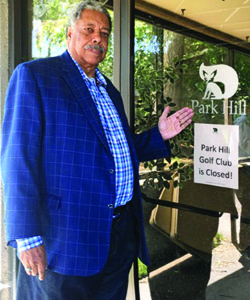
Still Leading: Former Denver mayor Wellington Webb, a Park Hill resident, has help to lead the fight to stop the commercialization of the Park Hill Golf Course area.
Still Under Threat: Notwithstanding an overwhelming 2-to-1 vote in Ballot Initiative 301 and 302 to require a city-wide vote before lifting a conservation easement on the 155 acre Park Hill Golf Course, developer Westside Investment Partners with the strong backing of the Hancock Administration and taxpayer dollars is moving full steam ahead to try to commercialize the green space.
The battle continues with Hancock and Westside trying to figure out how to outmaneuver Webb and Tate and the citizens who want more and not less open space. Some say the Hancock Administration has gone to extraordinary lengths to help Westside. In what critics contend was a contrived lawsuit, Westside sued the city over a drainage easement on the land. In settlement, the city provided an enormous war chest of $6 million for Westside to fight citizen groups like SOS Denver. That agreement gives Westside a three-year window for a public engagement process (i.e., a public relations campaign).
The city set up an expensive Denver taxpayer funded “Park Hill Golf Course Area Visioning Process” which basically plans the commercial development on behalf of Westside with a 27-member Park Hill Steering Committee. It appears that the Steering Committee is largely composed of apparently pro-development members.
Another Lawsuit
SOS Denver’s response was to file a lawsuit against Mayor Hancock and the City and County of Denver in June 2021 that alleges the public planning process is illegal until the conservation easement is lifted.
“The city has to follow the law. That’s the whole point of our lawsuit,” declared Tate. He stated the entire public engagement process was a sham and a waste of taxpayer dollars. The city issued a statement that the Park Hill planning process was a very standard one and that gathering community input for future use did not in any way interfere with the conservation easement.

The Good, The Bad, And The Ugly: Attorney and former mayoral candidate Penfield Tate Hill III, below, headed up Save Open Space Denver and helped win Ballot Initiative 301 and defeat Ballot Initiative 302 proposed by Westside Investment Partners (“Westside”) whose public face is Kenneth Ho, above. Ho was supported by Park Hill Steering Committee member Pastor Del Phillips, right, who claimed green open space in Park Hill is somehow racist and who is considered by his critics to be little more than a shill for Westside.
Holleran Group’s (Westside’s partner) CEO & Managing Partner Norman Harris indicated that it was not slowing down due to the overwhelming vote of Denver’s citizens. With a massive fortune to be made if the conservation easement on Park Hill can be eliminated, Holleran proclaimed it to be a visioning process, in a story published by The Denverite:
“We are going to double down on our community outreach to assure that we are bringing the right folks to the table and truly achieve an equitable outcome,” Harris said. “We’re very confident that we are going to be successful, and we just really look forward to the opportunity to bring more people into the conversation.”
Park Hill Steering Committee head Pastor Del Phillips indicated that preventing the commercial development was racist in nature given the history of Park Hill. He stated at a rally in October:
“I think it is highly unusual how people say this is about saving green space… This is really about people who believe they have the right to choose where other folks want to live.”
Kenneth Ho of Westside did not see the 2-to-1 vote against its initiative as a loss for the commercial development of Park Hill but rather: “We understand that residents want to hear more details about what this can be.” He went on to declare: “I think what the initiative does is it now says we need to come up with a plan for the voters to vote on. I think the next step is to develop that and put some specifics around the plan.”
What’s Next

Pastor Del Phillips
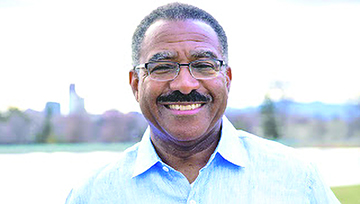
Penfield Tate Hill III
The Steering Committee is expected to provide the city its recommendations by Thanksgiving in the form of a Vision Summary which is expected to be very pro developer and little more than a glossed over version of what Westside wants. It will be used to give pro developer recommendations to the Denver City Council by the Community Planning and Development department which is controlled by the Hancock Administration.
SOS Denver indicates it is ready for the fight first at the City Council level and if that fails on a second ballot measure now required by Initiative 301 to lift the conservation easement.
Wellington Webb declared: “For me, what’s next is to get reengaged with my Nuggets tickets. Then we go back and look at what are the areas for reconciliation to some degree.”