by Heather Brecl | Nov 17, 2025 | Main Articles
Cherry Creek North Residents Fight Government Overreach
by Heather Prochnow Brecl
Councilwoman Sawyer and GID Consultant Jamie Giellis present the proposed GID to CCN residents.
Cherry Creek North (CCN) residents successfully blocked the proposed General Improvement District (GID) for their neighborhood, keeping it from advancing toward the 2026 ballot. Their victory came after months of mounting opposition and culminated at a late-September meeting with consultant Jamie Giellis, representing Councilwoman Amanda Sawyer’s office, where residents made it clear they would not support the plan with the Cherry Creek North neighborhood in it. Their victory was reported in the Chronicle’s lead story last month, “Citizens Win! Neighbors Halt The Cherry Creek GID Takeover.”
But Giellis’ sudden and unexpected concession at the meeting without even the need to consult with the person who was purportedly heading the effort, Councilwoman Amanda Sawyer, left open many unanswered questions. What was the real genesis of this unwarranted and unwanted GID plan? What persons or entities were really behind the proposed Cherry Creek GID? Who were to be the real beneficiaries of the new GID?
The Official Story

CCN residents and activists Dana Busch, Wayne New, and Greg Jenkins battle to defeat the GID.
The story told to residents in Cherry Creek North by District 5 Councilwoman Amanda Sawyer was that numerous “constituents” had come to her requesting her aid in how to effectuate unspecified improvements in the Cherry Creek area. The story was spun that Swayer then consulted and engaged former Denver mayoral candidate and special district expert Jamie Giellis of Centro, Inc. to see what could be done to assist the constituents in their desire to improve the Cherry Creek area.
Councilwoman Sawyer went to Denver City Council and was awarded $15,000 to pay for a “feasibility study” regarding forming a General Improvement District for the entire Cherry Creek Statistical Area running from 6th Avenue to the North, Cherry Creek to the South, University Boulevard to the west, and Colorado Boulevard to the east. It is an unusually large GID with residential areas of Cherry Creek North and Cherry Creek East (containing 9,500 residents), the Cherry Creek Mall, and the Cherry Creek North Business Improvement District.
Neighborhood Disbelief
Sawyer’s initial problem was that no one believed her, or Giellis. The residents included in the Cherry Creek GID are many highly sophisticated individuals who know how government actually works and the feel-good cover stories, such as those being peddled by Sawyer and Giellis, are seldom the true motivations behind a project.
Cherry Creek resident Frank Ooms and other residents believe that the special districts like the Cherry Creek GID were examples of gross overstepping by the Denver City government and its complete lack of fiscal responsibility and policy. Ooms emphatically stated that the proposed GID was “a quick money grab for the City to raise funds for carrying out their own agenda for what they determine are needed improvements rather than actually representing the needs or wishes of Cherry Creek residents.”
By statute, a GID is supposed to be initiated by residents according to their needs as it is in essence an additional self-imposed expense on top of property/co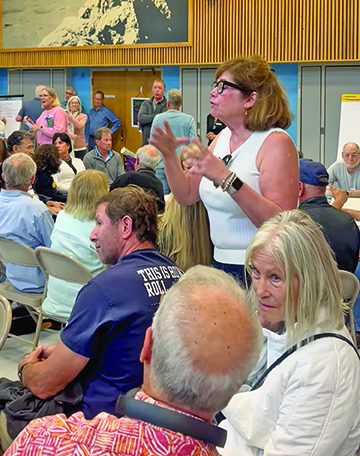 mm
mm
ercial taxes they owe each year. Ooms, an architectural photographer for commercial projects and resident of Cherry Creek North, in tandem with other CCN residents, stood firmly in their position that the GID that Sawyer and the City were pushing did not represent the wishes of the majority of residents and was instead a front for picking the pockets of residents who live in well-established upper-class neighborhood.
Dana Busch, a vocal CCN resident and leader in the efforts to stop the GID, stated that “the residents of CCN are outraged that the City would try and impose these additional funds and that it is an excuse used to compensate for the City’s gross overstepping of government and complete mismanagement of funds.” She continued, saying that “the City of Denver so grossly mis prioritized and mismanaged their finances and policies that they attempted to use the residents of CCN to fix their budget problems and serve their own agenda further increasing the City’s debt and more problems, not to mention violating due process with a complete lack of transparency.”
The City Of Denver
 Tells A Different Narrative
Nick LeMasters, the respected and well-liked head of the Cherry Creek North Business Improvement District, appeared to be virtually the only business leader in the Cherry Creek area to admit what the GID was really about. When asked what the actual motivation of the City of Denver is for a GID in Cherry Creek, he described many critical areas of development that need to be addressed in Cherry Creek, such as public safety and mobility, including restoration of the Cherry Creek waterway, and an enhanced bikeway between University and Colorado which has become increasingly important for bikers. These are among the “shovel ready” proposed projects to maintain the elevated standard of living that residents of Cherry Creek expect and pay so dearly for.
Astro-Turf Survey
But, of course, residents were told nothing of the preplanned, “shovel ready” projects, that they were necessary since the city was bankrupting itself on the mayor’s homeless and “new comers” initiatives. The progressive City government was not going to spend money on what was viewed as the posh Cherry Creek area even if the area provided the second greatest amount of sales tax revenues to the City, surpassed only by downtown Denver.
Moreover, under the rubric of mobility (called “Denver Moves — Cherry Creek”), the City wanted to take out a driving lane for automobiles on Speer/1st and make it a bus lane which was not likely to be something that Cherry Creek residents wanted or were willing to pay for themselves. The businesses in Cherry Creek also did not want to pay for all of these shovel ready projects themselves. But the key to the project was to get residents to believe that they came up with the idea for more taxes to pay for vague and generalized improvements in Cherry Creek.
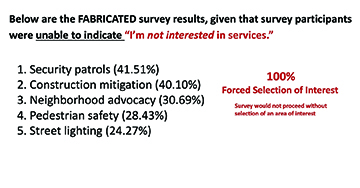
The gaslighting of the Cherry Creek residents was commenced with postcards sent out by Giellis last spring offering three improvement options — security, lighting, and beautification — and the results would later be presented as proof that residents supported forming a GID.
“The survey was designed to produce the answer the City wanted. It was a boondoggle, completely unscientific, and statistically meaningless,” says Dana Busch, CCN resident and entrepreneur.
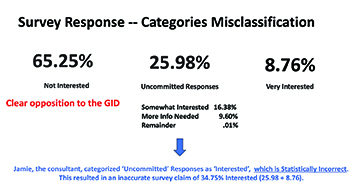
Busch called the survey “a weaponized mechanism used to fabricate consent.” Residents note it failed to include a fourth option which was “no need for improvements,” creating a false narrative from the options that were included. Busch continued, saying that there was no credible demographic data, response rates, or cost transparency. Crucially, the City never disclosed how much a GID would cost homeowners, how assessments would be calculated, or that rates could increase over time without another vote. Furthermore, out of the almost 9,300 registered voters in the proposed GID area, only 200 votes are needed to get on the ballot. And, as is with other measures on the ballot, to pass the measure requires only a majority of those who actually end up voting.
“The City used bad statistics, omitted financial consequences, and spun the results as if residents were asking for services having no proof that they actually did,” Busch said. “That’s not just misleading, it’s manipulative.”
CCN resident Greg Jenkins, who has extensive experience with feasibility studies as an energy executive, pointed out that the survey that Geillis sent out falls far short of an actual feasibility study, noting that it is simply not possible to do a study when they do not even know what projects they are planning to do.
Denver’s Debt Habit
Continues with GIDs
As a whole, Denver has a lengthy track record for supporting bond measures, rapidly increasing the amount of debt that the City has in order to provide what they deem to be necessary services and what the people want. On the heels of defeating the proposed GID in CCN, Denver got the approval of a GID on Broadway and voted to pass the five “Vibrant Denver” Bonds in the amount $950M which will allow debt-funded construction.
Dana Busch expressed her disgust for the City’s overall irresponsible fiscal management. “They keep finding new ways to raise money instead of fixing the fiscal mess they already have. The City’s mismanagement is not our responsibility to underwrite. The CCN GID is a perfect example of going back into the pockets of residents to try and correct their gross misappropriation of funds to fix projects which are their responsibility to handle in the first place.”
How The CCN Neighborhood
Association Turned A Blind Eye
Initial discussions of the GID in CCN began with Councilwoman Amanda Sawyer and GID expert Jamie Geillis going first to sell developers like East West Partners and the Broe Group, and eventually the CCN Neighborhood Association (“CCNA”). Gradually CCN residents themselves were brought into forums. However, as discussion heated up and the City’s survey was sent out, the CCNA unexpectedly took a “neutral position” on the GID. CCN residents like Greg Jenkins became increasingly agitated by what they view as the unwillingness of their very own CCNA Board to protect the residents’ real interests.
Residents like Busch, Ooms, and Jenkins felt that their int erests were not represented by the City or their own neighborhood association that was once the vanguard of advocating for responsible development under the direction of Wayne New. Jenkins in particular felt that the CCNA was allowing the City to “pick their pockets” and slowly saw a pattern of change over the last year or so leading up to the GID battle. He noted that the neighborhood bylaws slowly allowed for more decision-making of the CCNA Board without participation of others. Furthermore, he recognized the involvement of individuals on the Board who he believes compromised the ability to represent CCN fully with their own agenda. “There are three things that motivate people to do things — they are power, prestige, and money. Falling short of demonstrating that money was the motivator, it is clear that power and prestige is causing certain Board members to wander away from their moral compass. Their naïveté and irresponsible behavior created great distrust with the Board.”
GIDs — Curse Or Saving Grace?
“GIDs are supposed to be put in place for emerging neighborhoods to solve specific problems that they deem are of necessity to their neighborhood — this does NOT apply to CCN,” noted Jenkins.
As downtown Denver continues to struggle to rebuild after decades of problems like safety, budgets, and failed businesses, there are a number of existing GIDs like in RiNo (Riverfront North) and Ballpark, including the formation of the Broadway GID, formed to raise additional funds for so-called necessary improvements. While on the surface, this appears to be a saving grace with increased funding for safety measures and development, Jenkins and other neighborhood colleagues are of the opinion that the GIDs are, in actuality, simply convenient tools for the City to patch holes in the tremendous mess that the City created over decades with no safety mechanisms in place to control what the GID can actually do with the funds they collect. Jenkins believes that the GIDs “are the proverbial nose under the camel’s tent and that once they are in there is no stopping them.”
In an attempt to get more clarity on the motivation of the City for forming a GID, residents of CCN opposed to the GID put in a formal request for public information through CORA to which the City refused to respond.
Jenkins pointed out that the future GID Board will not be people in the area but is the City Council itself and they in turn appoint an “advisory board” whose powers and authority can be taken away at any time. Since GID’s take on debt they are almost impossible to ever terminate.
“The GID Board may adjust the annual assessment rate or expand services as necessary… GIDs may issue debt to pay for capital projects.” — City and County of Denver, Guide to GID Creation.
That language confirmed residents’ fears that the Board could raise assessments, redirect funds, or incur debt with minimal resident oversight.
“Once the GID is in place, there’s nothing stopping the City from raising assessments or repurposing funds,” said Jenkins, energy consultant.
“It’s a blank check with no accountability.”
For example, in May of 2025, Denver City Council voted to renew the RiNo GID for another 10 years.
Wolf At The Doorstep
While the City of Denver claims that the GID is NOT another tax, but rather just an assessment intended for their own good, CCN residents see it as another tax adding onto what is already one of the highest property taxes in Denver. Jenkins said “if it looks, sounds, and smells like a tax” — it is. This is just another example of pulling the wool over people’s eyes and moving it along the road until it’s too late to stop it.”
Hidden Costs And Unchecked Authority
“The residents have no idea of the financial implications of imposing a GID with layers upon layers of costs to homeowners. City Hall has neglected to share that critical part of the dialogue and instead focuses on a warm and fuzzy narrative of improvements. The City has yet to actually tell anyone how they plan to fund the projects and what the real projects even are,” declared Dana Busch.
When the idea of the GID was first introduced in initial conversations between the City of Denver and residents, the City proposed that a mill levy would be used to assess the cost of the GID to each of the residents and that this levy would be based on property values at three price points $750,000, $1.5M, and $3M. Residents believe that the mill levy proposal did not actually align with the actual property values in CCN that are much higher than $1M nor was it a fair way to assess fees. Busch commented that homeowners will pay vastly different amounts for the GID to receive the same services.
The one person who would clearly benefit from the GID’s formation would be Jamie Giellis, who would earning up to $149,000 for working on the CC GID, one of many special districts she would oversee. As stated in the agreement between the City and Centro, Inc.
“4.4. Maximum Contract Amount
4.4.1. “the City’s maximum payment obligation will not exceed $149,000”
“CCN would simply be used as a piggy bank to fund the needs of the City, which are in actuality the inherent responsibility of the City. It is not the responsibility of CCN residents to carry those financial burdens simply because the City did not handle business and development responsibly.” — Dana Busch.
Busch goes on to say that the only possible way for the GID to be effective would be for a complete overhaul of the formation of the GID to happen with a new system of checks and balances.
Lessons In Accountability
The defeat of the proposed GID was more than a neighborhood win, it was a stand for civic accountability.
By exposing the misuse of data, the failure to disclose financial impacts, and the City’s attempt to bypass resident consent, CCN homeowners believe they forced transparency back into the process.
“Cherry Creek isn’t against improvement — it’s against being exploited,” Ooms said.
This neighborhood’s revolt the residents believe, ensures that for now, that City Hall’s playbook of quiet but endless tax hikes stops at least temporarily at the edge of the Cherry Creek area.

by Valley Gadfly | Nov 17, 2025 | Main Articles
They Can Capture Audio, Video Images; Denver Police To Use As First Responders
by Glen Richardson
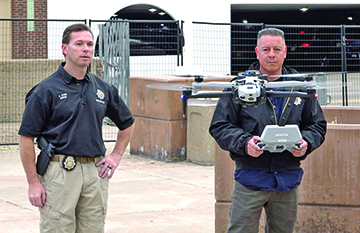
Drone Duo: Denver Police Sgt. Jeremy Cain (left) and Det. Jeremy Casias fly a drone outside of the Cherokee St. headquarters.
Already using Flock license plate cameras at intersections, the Denver Police Department appeared set to launch Flock’s “Aerodome” flying drones by December. Neither Denver nor Colorado regulates how police use drones.
The Denver Police Department has signed a free trial contract with Flock to use the company’s Aerodome flying drones — a “fully automated air support system” — that can reach crime scenes faster than police can often arrive. By deploying a drone to an incident scene ahead of ground units, it can provide real-time information.
Should you call 911, a drone would likely show up before an officer does. That’s especially true if the scene is being managed or secured by officers. Police drones are also used in specific scenarios, such as monitoring large events or providing aerial support in ongoing operations.
First Responders
The Denver Police Department has been exploring the utility of drones as a “First Responder” program. The department wants to improve its capacity to provide public safety services to the Mile High City.
“We saw benefit in these opportunities and have entered into a no-cost contract with Flock for a pilot package to evaluate its program,” according to a department spokesperson. The Denver Police Department is also in contract discussions with other venders to support a pilot program.”
The Flock drones are capable of capturing audio, video images, and other data that will be retained for 30 days. They look similar to consumer drones, with four propellers and a camera unit.
Dashboard Data
According to the contract, recorded images will be subject to Colorado Open Records Act requests. Once the police begin using the drones, the department plans to create a dashboard showing data about drone flights. Drones can be used to search for missing persons, respond to emergencies, document crime and crash scenes, and assist with bomb threats or “high-risk tactical situations,” among other uses. In some cases, they might be used to chase suspects.
In addition to surveillance, police can use drones for monitoring large crowds, assist in search and rescue operations, and gathering evidence. Federal and state laws govern the legality and extent of surveillance use. A warrant is often required for targeted surveillance, but permitting can be crucial in many circumstances, and state laws play a significant role in defining limits.
Thus far, about 65% of drone deployments are to assist in searches for suspects and during investigations. They have also been used in searches for missing people about 12% of the time.
Privacy Concerns
According to information obtained through an open records request by Denverite — Colorado Public Radio’s news website — the most recent contract with Flock will run through next August. If the city likes the product, it would begin to pay for Flock drones starting in 2026.
The company claims the technology makes policing more efficient and safer. However, advocacy groups argue the use of drone first responders — especially connected to a network of license plate readers — raises privacy concerns.
Moreover, the Electronic Frontier Foundation — a non-profit digital rights group based in San Francisco — argues that “integration of Flock’s ALPR technology with its Aerodome drone equipment is a police surveillance combo poised to elevate privacy threats to civilians.”
Sound, Lighting
Homeowners can often identify a police drone by its maneuverability, quieter, higher-pitched sound, and specific lighting. Police drones can make sudden, sharp movements, unlike planes and helicopters.
They often have a single, less-visible anti-collision light compared to the standard flashing lights on manned aircraft. In high-tech situations, police may also be using specialized equipment, and you might see them using a “Drone as First Responder” program, where the drone is deployed to a scene before officers arrive.
Police drones may be equipped with specialized payloads like thermal cameras or high-resolution zoom lenses for specific tasks like crime scene mapping. These programs deploy a drone to an incident scene ahead of ground units to provide real-time information.
Night Identity

Unmanned Aircraft: Remotely piloted police drones can make sudden, sharp movements, unlike planes and helicopters. Photo: Denver Police Department
At night, surveillance drones can look like moving lights, sometimes with steady white lights or flashing red and green ones. They may also appear as a heat signature to thermal cameras, even in complete darkness.
Drones can be distinguished from stars and planes by their movement patterns. They may hover, move in strange ways, or follow specific, repetitive paths that aircraft cannot.
Some drones can hear conversations, especially through an open window or with specialized equipment, but most standard drones cannot eavesdrop through walls and have difficulty recording clear audio over their own rotor noise. Some commercial drones can record audio. Police or military drones may use advanced directional microphones to listen in, though these are not common.
Data Sharing?
Denver Police Drone: These small, unmanned, weapon-free aircraft support a variety of missions in Denver.
Earlier this year, Denver City Council refused to renew a contract with Flock after members raised concerns about the company’s data-sharing policies. Flock’s CEO came to Denver to lobby lawmakers about the technology.
However, Mayor Mike Johnston’s administration renewed the contract for less than the monetary amount that triggers a council vote, and the council may yet reconsider the larger contract.
Some groups — including the Party for Socialism & Liberation — have been rallying for the city to cut contracts with Flock, citing civil liberties concerns. Supporters, however, say they appreciate how police can use the technology to solve crimes. Arvada police officers recently used Flock cameras to track a stolen car after a carjacking and shooting.

by Valley Gadfly | Nov 17, 2025 | Glendale City News
District Is Bustling With Fun, Excitement; Santa’s In The Loop For Saturday Night Lights
by Glen Richardon

Santa Sightings: Santa and local landmarks are among the sights you’ll see as drones soar across the sky all month long, 7 p.m.
There’s no place like Glendale-Cherry Creek North, and the Mile High City during the holidays. Cherry Creek’s over-the-top festivities are bright and jolly enough to convert even the biggest grinch.
With a cup of hot chocolate or mulled wine in hand, take in the decorative window displays, dazzling lights, holiday markets, and family-friendly activities happening in Cherry Creek and throughout the Mile High City.
Whether you’re indulging in festive Cherry Creek dining, cozying up with a cocktail at the Mistletoe Lounge on Fillmore Plaza, or simply taking in the view, the district is a must-see holiday destination. A million dazzling lights are wrapped around more than 600 trees, illuminating the entire neighborhood.
Holiday Market
Creek Magic: Take the family to Cherry Creek North to see the decorative window displays, dazzling lights, and holiday market.
As December blankets Cherry Creek in a frosty glow, the district comes alive with the spirit of the holidays. Christmas, Hanukkah, and New Year’s celebrations that are nothing short of magical. Experience the joy of the season with Winter Wanderland, a collection of free outdoor events for all to enjoy.
The Cherry Creek Holiday Market is open on Fillmore Plaza through Dec. 24. Spend the day shopping under dazzling lights, listening to live music, and getting into the seasonal spirit.
You’ll discover one-of-a-kind pieces from 50+ local makers, designers, and creators. There’s also “Giving Machines” through Jan. 4 that don’t dispense snacks or drinks, but instead, opportunities to donate to those in need. It’s also where the Mistletoe Lounge — a Christmas bar with festive drinks — is located.
Festivities also include “Saturday Night Lights,” Dec. 6, 13, and 20. On those dates you can enjoy complimentary treats, and the kids can meet Santa and Mrs. Claus. There’s also a Chanukah Celebration on Sunday, Dec. 14 hosted by Chabad of Cherry Creek. Families and guests of all ages will enjoy a fun “festival of lights” with face painting, fire juggling, festive treats, and crafts.
Blossom Of Lights

Bright Nights: Blossoms of Light at the Denver Botanic Gardens through Jan. 11 is one of the nation’s top light shows.
While in the Cherry Creek area, don’t miss the Blossoms of Light at the Denver Botanic Gardens, Nov. 21-Jan. 11. It’s consistently lauded as one of the top holiday light shows in the nation. Wander a mile-long path through immersive, luminous displays that accentuate and highlight the plant collections. A cherished holiday tradition for nearly four decades, Blossoms of Light is constantly evolving to inspire wonder and delight for visitors.
Zoo Lights, the Denver Zoo’s 30th annual “wildest winter wonderland” is Nov. 23-Jan. 5. A holiday treat for the kids and grown-ups alike, the zoo has some 3,500 animals, including almost 650 species. During the festival, the zoo is decorated as a winter wonderland where you can stroll illuminated paths enjoying holiday entertainment, music corners, warming stations, plus food and drinks.
Stroll over to the City & County Building in Civic Center Park to watch the lights display running all season long! The light and music show repeats nightly from at 5:45 pm and 6:45 pm, except for December 6 and December 21. Added dazzle: Look up in the sky now through Dec. 31 for this year’s Mile High Drown Show “Grand Illumination.” The display of 400 drones will soar across the sky every night from the Tivoli Quad at 7 p.m. You’ll see everything from Santa and his reindeer, to iconic Denver landmarks like the Mile High Tree and Union Station.
Dashing Thru LoDo
Just steps apart, Dairy Block, McGregor Square, and Union Station are brimming with festive activities, dazzling lights, and family fun. Celebrate the magic of the season with Holiday on the Block, an extensive line-up of festive events on the Dairy Block including a local makers market, entertainment, live music, plus winter art installations.
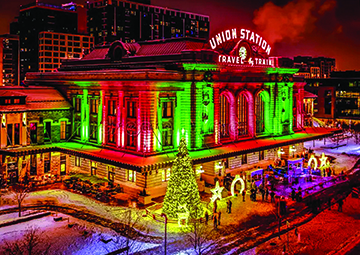
Festive Sights: With a 40-ft.-tall Christmas tree out front, Denver’s Union Station is a popular holiday destination.
Over at Union Station, the Grand Illumination is a can’t-miss spectacular, lighting up the historic landmark. The sparkling displays are perfect for capturing holiday memories, and the ongoing lights make every night feel like a celebration.
McGregor Square is also a winter wonderland this season, offering ice skating under the twinkling lights, festive cocktails to warm your spirits, and special visits with Santa himself. It’s an ideal spot to soak up the holiday magic with friends and family.
Hanukkah
The Jewish holiday “Festival of Lights” known as Hanukkah — also spelled Chanukah — is December 14 to 22 this year.
The Jewish Community Center’s annual “Latkes & Lights” is Dec. 7, 10 a.m. to 1 p.m. The event will feature themed games, jamming to live music, and tasting latkes from Denver restaurants, plus those made by community members. There will also be voting by attendees on handmade menorahs.
Chanukah @ The Capitol is also on Dec. 7, 5 p.m. to 11:50 p.m. The event features a 10-foot Menorah, a Dreidel Drop, plus free barbecue. Temple Emanuel hosts Hanukkah Hoopla Dec. 27, 5 p.m. to 8 p.m. There’s a community menorah lighting followed by service, a dinner, and a concert. Finally, Chabad of Cherry Creek is hosting a second Chanukah Celebration Dec. 29, 3:30 p.m. to 5:30 p.m. There will be Chanukah activities at participating neighborhood stores, a Grand Menorah lighting, plus Fire Show.
New Year’s Eve
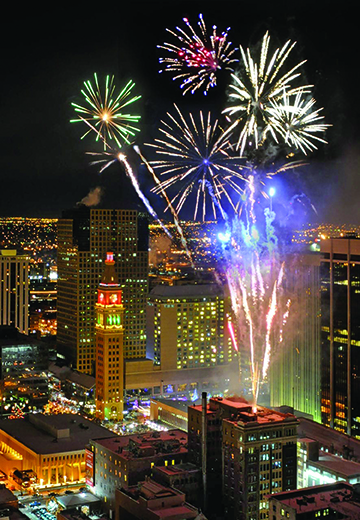
Mall Fireworks: See fireworks on the 16th St. Mall New Year’s Eve, 9 p.m. and again at midnight.
The two-night electronic dance music festival Decadence is at the Convention Center Dec. 30 and 31. Zeds Dead, Subtronics, and Tape B will perform together for the first time ever Dec. 30.
Noon Year’s Eve returns to the Children’s Museum featuring the glitz and glam of New York City’s Times Square before bedtime! There’s a ball drop at the top of every hour from 10 a.m. to 3 p.m., plus music, and treats. Dazzle’s New Year’s Eve extravaganza “Nostal-Jazz” rings in the New Year at the Performing Arts Complex downtown 10 p.m.
The New Year’s Eve bash “Fire & Ice” is at the Fire Restaurant’s outdoor rooftop patio in the Art Hotel, Dec. 31, 8 p.m. A Night in Vienna returns to Boettcher Concert Hall New Year’s Eve playing rousing polkas, waltzes, and marches, 7 p.m. See the New Year’s Eve Fireworks on the 16th St. Mall Dec. 31 at 9 p.m. and again at midnight.
by Elizabeth McCubbins | Nov 17, 2025 | Main Articles
by Elizabeth McCubbins
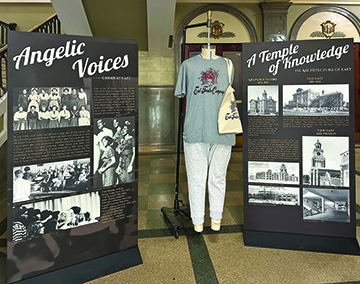
East Theatre History: While waiting for the play to begin, patrons could peruse posters of East’s past and buy merchandise to support the arts.
East High School (EHS) observed 150 Years of Excellence this September, marking the sesquicentennial milestone with a weekend of celebration. Founded in 1875, EHS claims the title of Denver’s original high school. Beginning Thursday, September 18, the 150th Committee held a re-dedication to kick off the remembrance. Followed by Homecoming, a breakfast, and an open house, students, staff, and alumni joined together to honor the history of the building and its community.
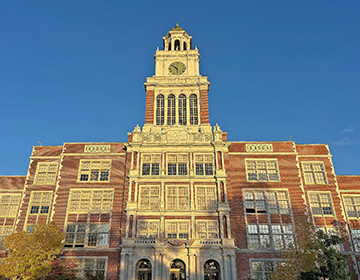
150 Years is a big accomplishment, and the occasion brought together decades of Angels to commemorate the legacy. In a modern society that is ever changing, East has clung to its traditions and honored the history well. Along with the foundation of the school, 2025 marks 100 years of the building itself. Constructed in 1925, the Jacobean architecture aimed to aesthetize the neighborhood, and in 1991 was declared a Denver Historic Landmark.
In celebration of the anniversary, East Theater Company put on a special play of their own creation. Written by the cast performing it, “Study No More” is a one-of-a-kind look into the history of the school.
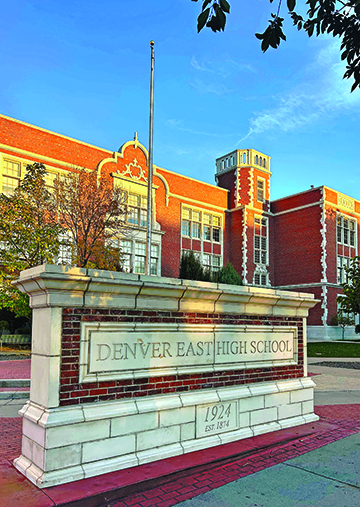
History Of The Building: Former East student George Williamson designed the building, which was completed in 1925, and has been a beauty of the City Park neighborhood ever since.
The artistic director, Deborah Voss, conceptualized the idea last spring to chronicle the history of EHS. with a piece that told a story and moved throughout the actual building. About 20 theater students worked collaboratively to write the script, with the senior students claiming most of the work.
Relying on records, the East’s past was researched for the production. Luckily, historians have analogued the accounts for today’s society. “Flights of Angels: A History of Denver East High School” by Richard Nelson was relied on in the writing process of this play. Nelson, now retired, wrote the book after teaching English at East for 31 years. Along with his book, the students used the library of records at East and yearbooks from school years past.
Though the play narrates true historical events, the students used some creative liberties: fictionalizing characters and plot points to tell a cohesive story. With two main characters acting as a guide for the audience, together they travel back in time on a journey through the decades of East. Senior Mira Ghosh, one of the tour guides in the show, explained that there were no main characters, rather, everyone contributing equally to the production as a team. “We cast as an ensemble,” said Ghosh, “not individual characters.”
This performance was a special experience for the seniors who had the chance to direct individual scenes and revise the script as a team. Running from October 21-30, the ensemble put on four shows a night to audiences sized of 25 people. The nature of the show had audience members moving from classrooms to various spaces throughout the school, following the guides back into history through each scene.
Beautiful Architecture: East High School’s beautiful 100-year-old building shines on Colfax. The historic clock tower, which stands over 100 feet tall, was the location of the play’s final act.
It was a really unique show for the cast and audience members alike. East Theater Company delights in the arts promoting togetherness, which is the overall goal of the theater experience. This anniversary has brought the student body and neighborhood together, and through the immersive play, the crowd was connected to the cast in a feeling of community.
The show was an ode to the legacy we leave behind. The actors played high school characters who learned to embrace their current day experiences through inspiration from the past. As the audience was taken on a tour through the school building and previous decades, we watched and learned along with our navigators that it is possible for high school students to have an impact. And while progressive change is always important, the story also reminds us that the relationships we form and the memories we make along the way should never be forgotten.