We at the Glendale Cherry Creek Chronicle received the great tidings that Colorado’s Governor Jared Polis had magnanimously decided that our “frontline journalists” would be part of the frontline for COVID-19 vaccinations. The definition of a “frontline journalist” is so loose that almost anyone working at the Chronicle qualifies. How glorious! We in the media have, of course, thought of ourselves as more special and better than the people we report on and if you have any doubts just ask Channel 9’s Kyle Clark. It is just so wonderful that Governor Polis has recognized the same. One of these days you too may be eligible for this life saving vaccine, but there is no great urgency on that front.
It is also great that the governor gets to make those life and death decisions. He has been ruling by proclamation for close to an entire year now with no end of the emergency in site. We, in theory, have a pesky election for the office in November of 2022, but why go to the annoyance of that charade. Polis spent over $23 million of his money in the last election and it is said he is willing to double that next time to harvest ballots.
Polis helped push campaign finance reform laws which make it impossible for anyone who is not extremely wealthy to win the governorship. It is amazing how laws that the purported purpose was to eliminate big money out of politics, in fact, allow only the wealthy to hold the top statewide office.
The COVID-19 emergency has worked out wonderfully for some. Many government workers and public school teachers have had a very nice, long vacation and are in no hurry to get back to full-time work anytime soon. Big box retailers and Amazon have grown wealthy on the backs of small businesses. Restaurants and bars have been decimated despite recent studies showing they do not particularly spread COVID-19. It just does not matter.
It also does not matter that highly effective treatments for COVID-19 exist if you’re wealthy and know the right doctors. During the pandemic the rich have gotten richer and the poor poorer but is not that the way it always works? The rich are in no hurry to end the emergency here in Colorado or anywhere else for that matter.
No, just sit back and enjoy the second year of the COVID-19 emergency. You cannot do anything about it even if you wanted to. The governor will one day make you eligible for the COVID-19 vaccine just like us “frontline journalists,” just not anytime soon.
Editorial Board
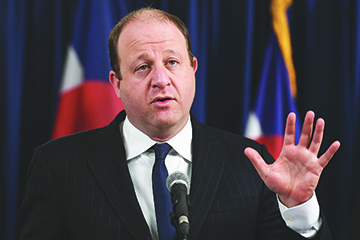
You are so “special” Kyle. Governor Jared Polis (left) deemed “frontline journalists” like Channel 9 News anchor Kyle Clark (below) as so special as to deserve front of the line treatment for the COVID-19 vaccine.
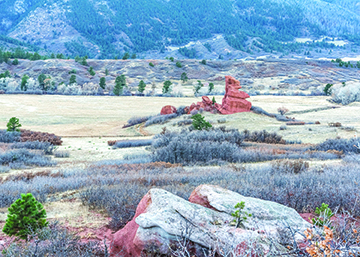
Red rock formations at Sandstone Ranch. Photo by Jessica Hughes
With what seems like a continuous stream of high-end condos and apartment homes making their way across the Front Range, Coloradans can breathe in a breath of fresh air with Douglas County’s newest open space. As one of the largest purchases made by Douglas County, Sandstone Ranch Open Space was bought for nearly $19 million dollars. What was once slated for development is now protected land that everyone can enjoy for years to come.
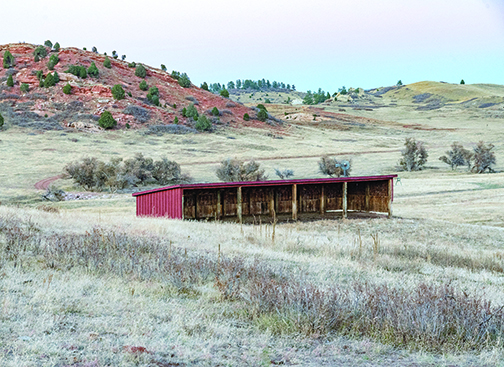
Sandstone Ranch Open Space is located near the town of Larkspur, 53 miles south of Denver, providing a convenient location between Denver and Colorado Springs. In operation since the 1870s, Sandstone Ranch still runs today with a small cattle herd roaming the pastures. Remnants of the working ranch are seen throughout including, several historic buildings that date back to the original owners.
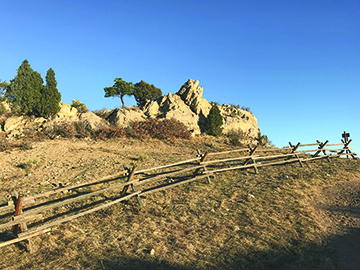
Hiking along the Juniper Valley Loop. Photo by Jessica Hughes
The ranch’s 2,083 acres rests along the slopes of the Rampart Range, opening to hillsides covered in Gambel Oak, expansive green meadows, a forested canyon, and riparian land surrounded by West Plum Creek. Met with the Pike National Forest, the land is home to a variety of wildlife including, deer, elk, bears, and mountain lions. But what takes center stage are the brightly colored rock formations. The ranch’s gigantic outcrops are the same Fountain Formation that gave rise to the Garden of the Gods, the red rocks of Red Rocks Amphitheatre, and the outcroppings at Roxborough State Park.
Historic barn from the original owners of the ranch. Photo by Jessica Hughes
The 12-mile trail system is open to hikers, mountain bikers, and horseback riders. In the winter visitors can explore by snowshoeing, fat biking, or cross-country skiing.
The trail system is divided into two sections, with two main loops. At the parking lot, the trail to the left will lead you to the north end of the ranch. Here, visitors can explore the Juniper Valley Loop, the Red Rock Vista, all within a roughly four-mile walk. The Juniper Valley loop drops hikers down into a low-lying valley where juniper forests are abundant. For vista-like views of the red rock formations, take the off-shoot trail to the Red Rock Vista.
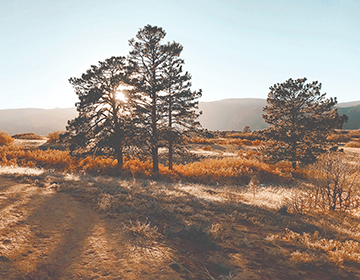
Sunset at Sandstone Ranch Open Space. Photo by Jessica Hughes
The trail to the right at the parking lot leads visitors to the wildlife overlook, the Sandstone Meadow Trail Loop, and the Ranch Overlook. The Sandstone Meadow Trail Loop is 3.7 miles, round trip, with an additional 2.2 miles to the Ranch Overlook. The wildlife overlook is anchored by two massive red rock formations and an information kiosk about how both cattle and wildlife co-exist at the ranch.
Park information
• Pets are allowed but must be on a leash.
• Open to hikers, bikers, horseback riders, snowshoers, and cross-country skiers.
• Trails are well-marked with signs.
• 12 miles of designated trails.
• Covered pavilion with picnic tables and benches.
• Benches are located throughout the trails.
• Parking is available.
• Restrooms and trash receptacles available.
• Open seven days a week, one hour before sunrise and one hour after sunset.
Directions From Denver
From I-25, north or south, take the Larkspur exit 173. Continue to Spruce Mountain Road for nearly one and a half miles. Upon reaching the stop sign in Larkspur, turn right onto Perry Park Avenue. Where Perry Park Avenue dead ends, take a left onto CO-105 E. Sandstone Ranch is approximately one half mile ahead, on the left.
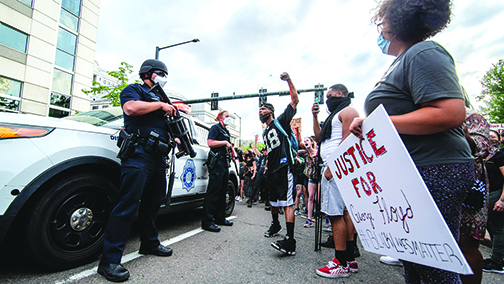
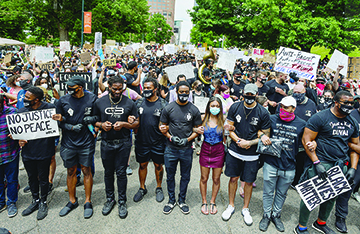
Denver’s Office of the Independent Monitor (OIM) released a long-awaited report on the actions of Denver police officers during the first five days of the George Floyd Protests, saying the officers’ lack of communication, excessive force, and scant documentation are “extremely troubling.”
The report specifically addresses several gaps in the Denver Police Department’s (DPD) use of force policy, crowd control measures, and less-than lethal weapons policies which “could have played a role in command review of force while events were unfolding.”
In all, OIM made 16 recommendations, including updating DPD’s crowd control policies to track which officers are assigned the duty, issuing multiple dispersal orders before using force, and disallowing the use of rubber-ball grenades.
DPD did not respond to request for comment from the Glendale Cherry Creek Chronicle.
Monitor Nick Mitchell said the recommendations are the result of a six-month investigation that considered both the unprecedented size of the crowds and the injuries suffered by both law enforcement officer and community members.
“Welcoming this level of scrutiny is not easy, and it demonstrates a strong commitment to public safety and building community trust,” he wrote in a letter presenting the report’s findings to City Council, the Mayor’s Office, the Department of Public Safety, and the Citizen Oversight Board.
“DPD officer and command staff demonstrated a similar commitment by responding thoroughly to our extensive document requests, and volunteering to participate in interviews,” Mitchell said.
Documentation And Policy Gaps
Between June and November, OIM reviewed DPD policies as well as over 200 hours of video and audio recordings and 25 hours of video recordings from DPD’s helicopter. The OIM team then compared their findings with academic literature on law enforcement best practices.
However, several encumbrances arose during OIM’s investigation, according to Mitchell. A prime example is DPD’s after-action reports — which are supposed to be filed every time an officer uses force — were often vague and documented only a fraction of the incidents.
Department policy requires police officers to file timely Use of Force Reports that include a description of the incident and a detailed recounting of the officer’s observations and actions. However, the agency’s crowd control manual is silent on these matters, which could have led to the delayed and vague incident reports OIM reviewed. Many officers did not fill out reports until 12 days after a use of force incident occurred, the investigation found.
A “footage gap” also arose during the investigation because gaps in DPD’s body-worn camera (BWC) policy resulted in several officers failing to record footage during the protest. DPD policies state BWCs must be activated by officers during “any encounter that becomes adversarial.” This practice is meant to shield officers from false accusations of excessive force.
OIM was able to identify over 150 officers who were assigned to the protests from a roster created on June 1, the only roster received from DPD. Of this total, only 38 officers produced BWC video files.
That same day, DPD officers made 124 arrests for curfew violations, carrying a concealed weapon, burglary, and felony menacing, among other charges. Department policy notes the core purpose of the BWC policy is “to capture crimes in-progress” and that “all arrests/citations” must be recorded. DPD did not provide OIM with a reason why these 124 arrests were not recorded.
Similar comparisons for the other four days the report covers were difficult because DPD did not record the number of officers assigned to the protest. DPD estimated between 150-200 officers worked the protect on May 30, but when OIM asked to see the BWC footage, it only produced videos from 75 officers.
Lawmakers addressed this issue when they passed SB217, also known as the “Law Enforcement Integrity Act” on June 10. The bill requires officers to record all interactions with the public and the footage of which may be available to the public within 21 days of the incident. Officers may also be decertified for failing to produce BWC footage in court.
Denver City Council finalized the purchase of new BWCs that automatically begin recording when an officer draws their firearm on December 7.
Use Of Force Against Protesters
OIM also said DPD inconsistently documented its crowd dispersal orders and less-than lethal munition deployments. The Department could not assess the total number of munitions deployed during the protests even though it produced a pre-protest inventory of its less-lethal munitions. Instead, OIM found that DPD asked the Aurora and Englewood police departments for supplies before spending $202,431.50 on munitions. The Colorado State Patrol even flew a plane to Wyoming to pick up the munitions.
Some officers who deployed these munitions were not certified to do so, OIM found. DPD certifies officers to use pepper ball and 40mm rubber bullet launchers through a four-hour training course. However, OIM discovered reports from officers who claimed to receive training when they arrived to work the protests given the emergency at hand.
One potential reason for the documentation gaps, according to the report, is that DPD officers reacted to the protest emotionally rather than professionally. The report cites a 2018 study published in the Journal of Social Movement Studies that concludes “police tend to respond to demonstrations about police brutality more aggressively than to protests with other messages.”
“The challenges presented by policing mass protests are magnified exponentially when the demonstrations concern police conduct itself. Police must still balance First amendment guarantees with the need to protect life and property, but they must do so under sustained criticism from protest participants,” OIM’s 94-page document reads.
The report also mentions “sustained criticism” of DPD officers may have accelerated the use of force against George Floyd protesters. Given the caustic nature of the protest, OIM said DPD should have instituted tighter internal controls over its use of force policy and added stricter reporting requirements but failed to do so.
“When a protest is about the police, officers may be insulted, threatened, or even targeted with thrown projectiles or other improvised weapons,” the report reads. “This behavior will naturally provoke a more forceful response from the police.”
Mutual Aid
While DPD was the main respondent to the protests, 18 other law enforcement agencies provided mutual aid. They include local police departments from Arvada, Thornton, and Westminster as well as the US Federal Bureau of Investigations and the Colorado Rangers.
Mutual aid is common in police work. Departments regularly sign agreements with each other outlining the scope of the aid to be provided and the resistance thresholds to abide by. However, several of the responding departments neither negotiated nor signed mutual aid agreements with DPD prior to the protests.
Without an aid agreement in place, assisting officers were required to follow their own department’s use of force policies rather than DPD’s policy. Many of the assisting agencies had less restrictive policies than DPD, which “may have impacted the kinds of force used by officers and in what amounts,” the report reads.
This created a situation where assisting departments had varying levels of involvement. Some were tasked with crowd control while others were asked to manage traffic. Meanwhile, several agencies fired less-than lethal munitions at protesters, resulting in several complaints for excessive force against DPD. Internal investigations that determined complaints to be about assisting officers were rerouted to the appropriate agency.
During interviews, DPD officers expressed concerns about requiring mutual aid officers to follow DPD’s use of force policy because other officers are trained under different policies. OIM said the concern is understandable but can be overcome through joint periodic training and proactively negotiating mutual aid agreements.
Going Forward
OIM stopped short of sweepingly rebuking the department. However, it said DPD’s actions signaled it was caught off guard by the protests. Even so, the agency commended the leadership of Police Chief Paul Pazen and Executive Director of Safety Murphy Robinson for their commitment to reform and rebuilding community trust.
“We have full confidence in their commitment to learning from these events and making the changes necessary to prevent similar outcomes in the future,” the report concludes.
However, some community members aren’t sold on the OIM’s rosy outlook. The Citizen Oversight board, which is tasked with reviewing DPD’s disciplinary and use of force policies, said “law enforcement or the preservation of order should ever come at the expense of transparency or accountability.”
“These are military grade munitions being used against citizens expressing their First Amendment rights,” Al Gardner, COB Chair, said in a statement. “The OIM’s report raises important questions about what is appropriate use of force in response to protests and demands a closer look at what institutional accountability should look like in these circumstances.”
“Against the assault of laughter, nothing can stand.” – Mark Twain
by Luke Schmaltz
Perhaps the lowest blow Covid-19 has thrust into the guts of live entertainment is the crippling assault on the art form that thrives within kissing distance of society’s face.
Live comedy shows are casualties of circumstance, as there is too great a price to pay when large crowds of people gather in compact spaces and let loose with the explicit purpose of opening up and laughing out loud.
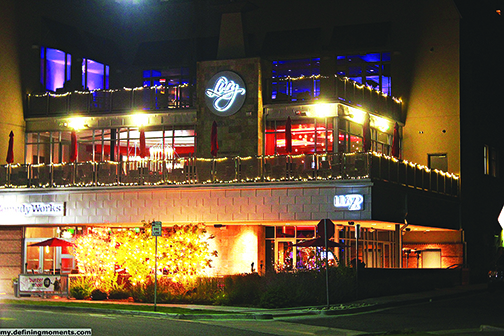
Comedy Works (Landmark location) is a Denver institution and a live comedy mecca; currently shuttered by Covid-19.
The essence of effective live comedy is the proximity of the artist to the audience. It’s an intimate affair, wherein spectators willingly subject themselves to carefully crafted webs of cunning that twist their wits into coils of suspense and then snap the tension with an unexpected conclusion. The result: uncontrollable laughter.
Social distancing and the complete shutdown of indoor venues has put a detrimental damper on this dynamic, placing comedy venues, promoters, managers, booking agents and the essential engine upon which the industry runs — the comedians — in peril. Currently, the world that hawks hilarity is stagnating, yet the resilient nature of the art form pushes on like a river smothered by a landslide — looking for other ways to reach its destination. And, while some do not deem laughter as an “essential” industry, those who create it think otherwise, and are reacting to 2020 in various ways.
An Unfortunate Setup
Comedy Works is widely regarded as one of the finest institutions in the live comedy business, but their business is currently paralyzed. Longtime owner/operator Wende Curtis explains: “Our downtown club closed on March 15 and has never been able to re-open. We were unable to get 50% or even 100 people in to maintain the social distancing requirements. Our south location reopened in late July but was closed again with the recent mandates.”
With no options for operating in an outdoor space, they are looking to the powers that be for assistance. “We are hoping government officials see the impact on live entertainment venues, restaurants and all businesses impacted and will appropriately accommodate us in the stimulus package,” Curtis explains.
Curtis, a universally respected comedy promoting legend, is critical of the government’s role thus far: “These venues and businesses should not have to bear the burden of this pandemic. The government should have stepped up and helped these businesses sooner. The Paycheck Protection Program (PPP) was meant to suffice for eight weeks. It’s been nine months. Without small businesses, we [live comedy] will be a couple of ugly big box companies. A truly sad state.”
Promise Of The Real
Despite the detriments of 2020, comic Christie Buchele is still hopeful — hanging onto the idea that venues, and more importantly comedy fans, will hang on too. The relative newcomer to the jokester trade has quickly blazed a trail to the forefront of the new faces set, earning a reputation for being hardworking and fiercely funny. Staying busy during 2020 hasn’t been easy, she describes performing live after the shutdown: “My first show was a zoom show for a producer in Austin, the first week of April. I didn’t do a live show until Mid-May. We did the show in the parking lot of a brewery with tables spread out and comics all wearing masks when they were off stage. The crowd size was maybe a little smaller than average but it’s hard to tell with everyone spread out.”
Denver comic Christie Buchele is doing everything she can to keep her chops up during indoor venue shutdown.
The experience of performing under these conditions makes Buchele pine for the good old days of clubs full of patrons packed in sardine-tight. “Before COVID-19 an outdoor show felt like a real pain in the ass. Keeping attention was tough, keeping up your energy and dealing with any distractions was terrible. I do think that audience members are just so happy to have something to do that now when they go to an outdoor show, they are much more attentive and excited. And they realize we are rusty but just so excited to do comedy again.”
Buchele urges comedy fans to stay tuned and support independent venues by subscribing to streaming content and buying tickets for future shows. Of all these, she laments the temporary loss of Denver’s finest room the most: “Of all the venues in Denver, I miss Comedy Works Downtown. It’s the best place in the world to do comedy and I hate not being able to go down there every week and see everyone and have the best time onstage. I never thought I would go this long without stepping foot in that building. I imagine I will cry happy tears the first time I get back up there.”
The Show Must Go On
Ben Kronberg is a Denver comedy stalwart, having begun his performance tenure in the early 2000s with no end in sight. His straight-out-of-left-field-blink-and-you’ll-miss-it style is inimitable and unmistakable. Kronberg’s comedy blurs the line between traditional set-up / punchline joke telling and abstract mentalist conjecture, which seems to have seeped into his perception of linear events in general. When asked to compare his comedic experience post and prior to the shutdown, he says: “I have what you could call a memory blend with shows now. After doing comedy for over 15 years, all the shows seem to blend together and fade together. I have been running shows at The Denver Comedy Lounge for about a year so it [last indoor show] was one of those to be uncertain.”
Ben Kronberg has been performing in Denver and beyond for 15 years and is keeping things light.
Once social distancing regulations were in place, Kronberg adapted and kept forging forth. “We kept doing shows however we could, moving to the alley behind the lounge and trying to comply with all of the regulations. When you go to a strip club you want to be close to the performer, and comedy is no different so it gave a cold medicine vibe to the whole thing with the laughter vaporizing because of being outside. We could fit maybe 30-ish people in this situation. People who came out were receptive, but this muted version of a comedy show could be felt by all. But it was better than nothing.”
Kronberg sees virtual shows as a band-aid over an axe wound type of remedy but participates nonetheless — if only for something to do. “The most fun I had [virtually] was probably doing a zoom talent show. Most [attendees] were performers and a few pervy, lonely audience members. It was better than nothing but not a proper substitute for the real thing. Kind of like a homemade fleshlight.”
Troy Baxley is a Mile High comedy legend and may or may not see stage time again.
Give ’Em Hell
Of all the unsung heroes in the Denver comedy scene, Troy Baxley is at the top of the list, having begun performing in the 1980s and since played just about every comedy stage in North America. He ran one of the first open mics in Denver at the Lions Lair on East Colfax and, of late, has taken to mentoring an onslaught of young comics determined to get on the fast track to funny.
Baxley sees the current shutdown as a great equalizer, serving to weed out what he calls “water cooler comics” while testing the endurance and mettle of those who are truly in it for the long haul. “The thing is,” he begins, “most are crumbling under the weight because there’s no end in sight. If you’re a hacky comic, the allure of doing the same two-minute set falls away, and since you aren’t disciplined to be constantly developing new material your skills get rusty fast. With open mic nights gone [for now] you can’t just go tell a couple zingers one night and then go to work the next day announcing yourself as a comedian.”
Unfortunately, Baxley was recently diagnosed with onset Parkinson’s disease, perhaps hindering his ability to perform once clubs are open again. Yet, Baxley shrugs off the shutdown like he’s shutting down a heckler. “I can tell by a heckler’s tone how long they have before I get the room to turn on them. I can tell by Covid-19 that, eventually, things will bounce back and once we all work the rust off, we’ll be cracking wise better than ever.”
In Denver, these days you get a choice between the “Corporatists” like Mayor Hancock and former mayors Federico Peña and Wellington Webb, and the “Radicals” like Candi CdeBaca and the majority of the newest Denver School Board. There is, these days, no other viable alternative. Neither group is all bad or all good but together they are helping to destroy the city. Back in his first run for Denver mayor, Federico Peña’s slogan was “Imagine a Great City.” Today the slogan appears to be “Imagine a Really Crappy City.”
The Corporatists under Mayor Hancock have made their contribution to a crappy city by destroying as many open spaces and parks as humanly possible. Denver has gone from one of the leading cities in percentage of open space and parks per resident to one of the worst in the United States. The Corporatists, of course, wish to exploit any city asset built up over generations to make money for themselves and their friends, like high-density developers and lobbyists/lawyers. To the credit of the Radicals, they are not on board with this grotesque program and are the ones fighting the mayor and his friends to preserve what is left.
The Radicals on the Denver Board of Education, on the other hand, are doing there best to destroy quality education in the City and County of Denver, aided and abetted by Denver’s teachers’ union. The teachers’ union in Chicago has declared that in-school learning is “rooted in sexism, racism and misogyny,” and many of Denver’s unionized teachers would certainly agree.
The Radicals on the Denver Board of Education are led by none other than Tay Anderson who won an at-large seat in 2019. He is not a big believer in education, having barely gotten out of Manual High School himself in 2017. He demands that if you talk to him that you address him as “Director” Anderson. More recently he has been nicknamed “The Round Mound of Flop Downs.” Mr. Anderson does not appear to have any means of support. The Board job is without compensation. His Board bio shows no present employment. But there are other ways to make money.
Back in July, he was at the homeless encampment by the State Capitol when he said he was pushed by the police, although video appears only to show him flopping down. He claims he went to a hospital, but the hospital was never identified. He set up a Go Fund Me Page for “medical expenses” without ever identifying what those expenses were. Nonetheless he took in over $13,000. He also hired a lawyer and presumably got a payday from the city.
But money never lasts long. In December, he did another flop down at an unidentified Target, this time claiming severe chest pains caused his collapse. He had previously tapped Target, claiming that he and his brother had been racially profiled at another unidentified Target, and received a swift apology from corporate headquarters and who knows what else. Why you want to continue to shop at a store that you claim racially profiled and harassed you is a little strange, but we are sure Mr. Anderson has his reasons. It has not been disclosed whether he has hired legal counsel for his latest flop down.
What Mr. Anderson and his fellow Radicals want to end is children having any choice on where they go to school, an idea on which the Denver teachers’ union heartily agrees.
The word “competition” is an anathema to them. The schoolteachers’ union opposes charter and magnate schools, and the Radicals ran on limiting, or even getting rid of, educational opportunities for kids in the City and County of Denver. The Corporatists, including Mayor Hancock, had strongly supported school choice with money coming in for school board races by developers and others. This support for school choice was not out of any eleemosynary belief in education, but they realized with only lousy, non-competitive schools in Denver, less people would be willing to move to Denver and fill up all those high-density condos and apartments. But the corporate support largely dried up in 2019 leaving only the money from the schoolteachers’ union for the 2019 election which resulted in the Radicals winning.
The Radicals relatively quickly drove out widely praised school superintendent Susana Cordova who is a child of Mexican American immigrant parents and the first college graduate in the family. She went to Denver schools and began teaching in them starting in 1989. She is leaving Denver for a much less prestigious and lower paying job in the Dallas Texas Independent School District. She stated she is leaving Denver because Dallas “reminds her a lot of the Denver I grew up in.”
Obviously, today’s Denver does not remind her of the Denver she grew up in. Moreover, she also does not believe the present “Imagine a Crappy City” contest between the Corporatists and the Radicals will improve matters any. Will there ever be a movement for something other than the Corporatists and the Radicals? Ms. Cordova does not believe anything will develop anytime soon and unfortunately neither do we.
“Repeat after me: real estate provides the highest returns, the greatest values and the least risk.” — Armstrong Williams, entrepreneur
by Luke Schmaltz
As of February 25, 2020 — according to Forbes and WalletHub — Colorado had one of the lowest residential property tax rates in the nation — just 7.15% — third to only Hawaii and Alabama.
As of November 3, 2020 — according to some fiscal experts — that glowing statistic may gradually begin to fade.
An Uneven Keel
Consistent with the year’s underlying theme of division and disparity, the commercial tax rate sits at an inverse position at 29% — making the terrain for independent, small businesses especially rough, and increasingly so as Covid-19 looms on. Before the election and the ensuing repeal of the Gallagher Amendment, anyone keen on owning a home, as well as commercial property in Denver, was privy to staggeringly different tax bills — even if their residential property was right next door to that of their business.
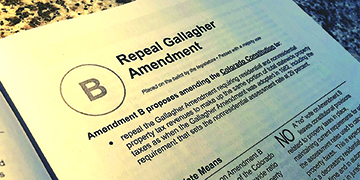
In an election that was overwhelmingly characterized by close races and slim margins, Amendment B (repealing Gallagher) passed in a landslide vote of 57.4% to 42.6%. This means that the low property tax rates Colorado homeowners have enjoyed for decades will, according to opponents of the measure, begin to increase the tax burden homeowners are forced to bear — especially those in the urban middle-class sector.
Wide Appeal
For the uninformed, property taxes are collected in order to pay for local government services that benefit the immediate district. These include schools, fire departments, infrastructure, water, libraries, recreation and county road maintenance.
Tax Increase?: With Gallagher repealed, some say taxes will go up while others say they will not.
As all property owners quickly discover — residential and commercial alike — taxes are determined by complex formulas, dreaded by many and resented by all for their unrelenting consistency. In this election cycle, the convoluted nature of taxes seemed to have influenced the diverse interest in Amendment B vs. the Gallagher Amendment — perhaps the only refreshing thing about the issue in general.
Amendment B garnered a patchwork of varied bipartisan support, both for and against the measure. Proponents included former U.S. Senator Hank Brown (R), current Republican state senators Bob Rankin of Carbondale, and Don Coram of Montrose, current House Representative Daneya Esgar (D) and former Colorado Secretary of State Bernie Beusher (D). Naturally, the measure was opposed by the author of the Gallagher Amendment, former Senator and career public servant Dennis Gallagher (D) along with the right-leaning head of Colorado Rising Action, Michael Fields, as well as with former House Speaker Dickey Hullinghorst (D).
An Outdated Formula?
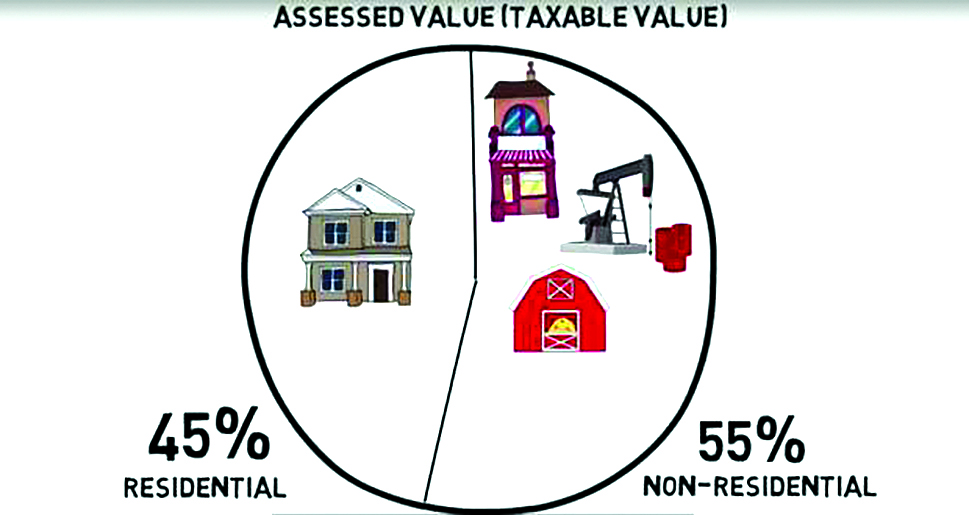
For nearly four decades, Colorado residential property owners have enjoyed consistent tax cuts supplied by the Gallagher Amendment which, until November 3, had rates locked in at 7.15%. The disparity here is stark, however, as commercial property owners were “stuck with the bill” as it were and foisted with tax rates consistently ringing in around 29%. Under Gallagher, residential taxes could only allot for 45% of the total tax base, with nonresidential properties such as retail businesses, factories and farmland making up the remaining 55%. As rising residential property values skyrocketed, the inherent complexity of the tax formula resulted in an unbalanced scale — with the heavy end tipping toward commercial property holders.
While this lopsided provision was great for homeowners in high-growth areas along the front range, owners in rural areas suffered — as their property values were not accruing at nearly the rate of their urban counterparts. Simply put, with Gallagher in place, the more the value of a property increased, the less percentage of tax the owner had to pay. With this protection removed by Amendment B, critics of the measure are predicting that residential property taxes will rise drastically. Meanwhile, supporters of the measure contend that removal of the Gallagher Amendment will leave current rates frozen in place — for now.
Too Much Too Soon?
The recently-televised Colorado Decides: Amendment B debate hosted by PBS 12 featured outspoken public figures weighing in on both sides. Representative Esgar (D) championed the effect a repeal would have on small businesses: “ … right now 20% of the taxpayer base (commercial property owners) are paying 55% of the tax [revenue]. These are small businesses … right now they are being hit the hardest … they want to know, right now, why they are paying four times what [the] residential property tax rate is …” Esgar explained further that leaving the Gallagher Amendment in place would result in commercial property taxes ballooning to up to five times that of the residential rates.
Meanwhile, in opposition to Amendment B, Michael Fields (Colorado Rising Action) explained that a statewide repeal is far too drastic, and rather, measures should be taken to amend the tax code in certain districts who are suffering from loss of revenue. In the aforementioned televised debate, Fields contents that: “ … a solution needs to be more regionally based or county based … I think that makes a lot more sense because there are areas of our state that are either less commercial property or their (residential) values aren’t going up as much …overall, this is a regional problem and there should be a regional solution.
Upwardly Mobile
As fate would have it, the Gallagher Amendment is no more. Without another policy in place, according to TABOR, residential property taxes will rise as the property values increase. So, as Denver renters have recently seen in vivid detail, this could mean yet another rent hike as landlords pass the overall cost of owning property onto their tenants.
The Gallagher Amendment was a major ballot issue in 1982 and again in 2020. It was designed to evenly spread the tax burden between residential and commercial properties.
While proponents of Amendment B downplay the severity of repealing the Gallagher Amendment, others like Fields are quick to point out the costly implications. An October 26, 2020, article published on coloradopolitics.com contends that a repeal leaves no protections in place for property owners. This means that — as required by TABOR — property taxes would increase to the tune of $203+ million and keep climbing — a fact that lawmakers like Daneya Esgar seem to have forgotten to disclose whilst selling this new piece of legislation to an uneducated and most likely distracted public.
Others contend that tax rates that are applied according to the rapid rise of property values, while being inconvenient for owners, can spell ample funds for public services — especially in rural and economically challenged areas. At any rate, the varied implications of how things may play out are a fitting reflection of the complex nature of property tax formulas. To find out what the repeal truly means (just like everything else this year) folks are going to have to just wait and see.

 We at the Glendale Cherry Creek Chronicle received the great tidings that Colorado’s Governor Jared Polis had magnanimously decided that our “frontline journalists” would be part of the frontline for COVID-19 vaccinations. The definition of a “frontline journalist” is so loose that almost anyone working at the Chronicle qualifies. How glorious! We in the media have, of course, thought of ourselves as more special and better than the people we report on and if you have any doubts just ask Channel 9’s Kyle Clark. It is just so wonderful that Governor Polis has recognized the same. One of these days you too may be eligible for this life saving vaccine, but there is no great urgency on that front.