by Mark Smiley | Jan 29, 2016 | Travel
56 Units And ‘ZERO PARKING’
by Glen Richardson
The City and County of Denver has become nationally known for approving apartment projects with extremely low parking requirements under the apparent theory that it will force its residents to walk, ride a bike, take public transportation or utilize taxi cabs/Uber vehicles. Families with kids are apparently not deemed likely to want to move to Denver anytime in the immediate future, just young single members of the millennium generation.
Denver is also believed to be the only major city planning department in the United States that as a matter of public policy refuses to consider the impact of increased traffic because of a development. Real estate developers are said to control both the office of the mayor of Denver, Michael Hancock, and the majority of the 13 member Denver City Council which must approve real estate projects according to the City Charter. Most developers want as little required parking as possible since it significantly increases the price of a project. Often the lack of parking becomes a major problem in the future for such projects, but the developer is usually long gone from the scene.
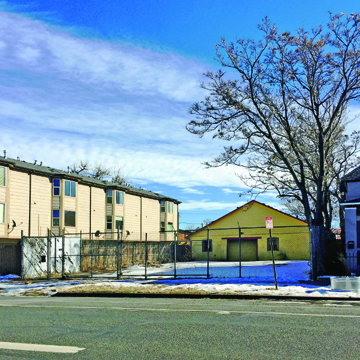
One of the newest projects in one of Denver’s oldest neighborhoods, Curtis Park, is slated to have 56 micro-units of 300 square feet each and no parking to the outrage of Curtis Park residents. The on-street parking in the area, according to neighborhood residents, is already extremely tight.
Apparently there is not a plan filed with the Denver City Planning and Development Department for the project. However, there have been numerous meetings between the developer, Gaddis Properties, and Councilman Albus Brooks who, according to insiders, has all but given a green light to the project.
The small property is located at 32nd and Stout Street and the residents indicate that a purported exemption for parking was intended for a small commercial business and not a 56 unit apartment house. City records indicate that the property was once used for an auto service garage. In fact residents also indicate that six more square feet and the exemption would not even apply to a small commercial business.
At a heated and angry meeting between Doug Gaddis and resident Andrew Kowalyshyn, reports are that Gaddis stated the residents were lucky he didn’t build a 70 unit building and that no parking was needed anyway as none of the future tenants or their visiting friends or family would ever use a car, a proposition met with incredulity with the people at the meeting. Summing up the feelings of the neighborhood Kowalyshyn stated of Gaddis, “This guy is just a complete bullshit artist.”
Councilman Albus Brooks told local television stations that neither he nor the city could force Gaddis to provide parking. City insiders indicate that virtually any development in Denver requires some variances and waivers by a city and the city could refuse to grant the same without Mr. Gaddis providing some parking, but is simply unlikely to do so.
Neighborhood activist David Johnson noted, “The fix is in, as always. The Planning Department does not plan and Denver councilmen like Albus Brooks don’t represent the residents. There is no part of the city that the epidemic of overdevelopment corruption is not affecting and destroying our neighborhoods. With Gaddis we are evolving from the ‘limited parking’ stage to the ‘absolutely no parking’ stage. How to change a beautiful city with wonderful neighborhoods to an overcrowded dump.”

by Mark Smiley | Dec 17, 2015 | Glendale City News
by Kurt Woock
Writer for and on behalf of the City of Glendale

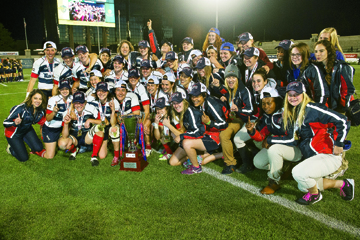
GLENDALE, CO – NOVEMBER 15: Lady Raptors vs New York Rugby Club during the semi-finals at Infinity Park in Glendale, Colorado on November 15, 2015. (Photo by Seth McConnell)
If a successful season is defined as one in which a team improves from where they started, then the women of the Glendale Raptors didn’t disappoint. If it’s defined as one in which the team’s fan base continues to support the team and grow ever larger, then 2015 was a good year. If to have a successful season a team must bring home a championship trophy, well, the Glendale Raptors did that, too. 2015 was great. And so are the Raptors.
The Raptors began 2015 as the defending Women’s Premier League (WPL) champions. The road to the championship in 2014 went through a game forfeited by the opposing team. Narratives in sports often fall outside the bounds of what teams are capable of controlling, and this was no different. However, teams don’t get to choose their challenges. They just need to overcome them. So, in 2015, the Raptors set out to show the country they’ve earned their spot at the top.
The 2015 regular season finished with the Raptors atop the Blue Conference. The Raptors brought a balanced attack, finishing the season second in the league in point differential. The only loss on their record came on the road at the hands of the Berkeley All Blues, who narrowly beat the Raptors in early October. But, in a moment that encapsulated the entire season, the Raptors rose to the challenge when, a few weeks later, they defeated the Blues in another close game.
The Raptors muscled their way into the championship with a few statement wins. Their opponent in the match was a familiar foe — the Blues. “Based on the last two times these are two pretty even teams,” coach Mark Bullock said before the game. “They’re a heavyweight and we’re a heavyweight.” Bullock said that, in order to win, his team needed to be “physical and relentless.” They were just that. Up 15-5 at the half, the Raptors never looked back, winning the game and the WPL trophy, 26-17. The Raptors were led by the outstanding defensive play of Joanna Kitlinski, who was named MVP.
The championship was the cap to a season that was successful in many respects. Total attendance approached 4,000 in Infinity Park, and the Raptors continued to attract huge crowds online, with more than 25,000 people from more than 90 countries tuning in. Between games, fans followed the t
GLENDALE, CO – NOVEMBER 15: Lady Raptors vs New York Rugby Club during the semi-finals at Infinity Park in Glendale, Colorado on November 15, 2015. (Photo by Seth McConnell)
eam, as the Raptors’ website saw over 72,000 views during the season.
As they continue to build a winning tradition in Glendale, the Raptors have shown they’re not afraid to set the bar high, and they have the dedication and passion needed to reach it. Their fans — and opponents — are taking notice. As the Glendale Raptors set their sights on 2016, eyes from around the world will be watching.

by Mark Smiley | Dec 17, 2015 | General Featured
by Phil Kummer
2015 has been called the year of the “unmanned aerial vehicle” better known as “drones.” One of President Obama’s primary weapons in the Middle East to fight jihadists is a veritable army of military drones. Delivery firms and retailers like Federal Express and Amazon are going through final tests to use commercial drones to make deliveries. Moreover, this Christmas and holiday season drones are one of the most sought after toys/recreation devices on the market.
A top FAA official said as many as one million small unmanned aerial vehicles (UAVs) could be sold during the upcoming U.S. holiday season. “The talking point is that there will be a million drones under people’s Christmas trees this year,” FAA assistant administrator-policy, international affairs and  environment Rich Swayze said, adding that he has heard the one-million figure “from several sources.”
The range of cost and sophistication of drones is amazing. For as little as $30 you can get a low-end drone, but don’t ask it to do much, or you can spend up to $3,000 or more for a top of the line recreational drone which will have an impressive array of capabilities.
One of the leading stores for recreational drones in metropolitan Denver is Colpar’s HobbyTown USA located at 1915 S. Havana St., Aurora, CO 80014, as well as 3355 S. Wadsworth Boulevard, Lakewood, CO 80227. The owner of Colpar’s, Fred Beardslee, recommends among the best of th e beginner level drones is the Eothos QX130 which goes for about $100. It is fun to fly around and is a sturdy unit.
On the more sophisticated end Beardslee likes, among other units, the Blade Chroma which sells fully loaded for about $1,300. It will provide an HD quality camera platform and will even return to home base once it detects that its battery is low.
Accessories, which are purchased separately, include a winch, camera — both video and still, squirt gun, rocket and bubble machine — obviously an assortment that would keep both youngsters and oldsters busy for a long time.
Although drones have become more sophisticated and have much more capabilities than previously they are not just for the technoids or geeks any more. The vast majority of drones have very efficient electric motors and lightweight batteries, which make them very flight worthy.
They go further, higher, have more stability, use more technology such as GPS systems and can carry larger payloads than ever before. They have become much more durable than earlier versions but due to crashes and wear and tear chances are your drone will need either some parts replaced or be repaired over time. Having a store like Colpar’s HobbyTown to help out will be critical in keeping your drone flying.
Although drones can be flown both indoors and out, you might want to consider who is the pilot when indoors. They are restricted from some areas such as airports and high security areas. Just recently the FAA announced they now consider operators of drones weighing between .55 lbs and 55lbs to be aviators and therefore all drones that meet those specs need to be registered with the FAA starting December 21, 2015. Registration is mandatory for all aircraft. More information: www.faa.gov/uas.
As drones become more popular, both commercially and recreationally, it is inevitable that new regulations will play an important role in drone use. Colorado recently defeated a bill that would have restricted police use of drones because of privacy concerns. Privately owned drones equipped with advanced cameras could be a threat to everyone’s privacy if used by unscrupulous individuals or businesses. Privacy concerns will definitely be considered as drones are used more.
Safety is another concern that will cause regulations to proliferate as more drones take to the sky. Between June and November of 2015 air-traffic controllers and pilots reported at least 25 episodes in which drones interfered or came close to interfering with larger aircraft during takeoff and landings. If there is ever a major incident between a drone and a plane we can expect to have a thorough r eview of drone use. If a drone were ever used in a terrorist attack and especially if that attack were successful, we could expect a lot more government rules and regulations as to how one can use a drone.
In the meantime, here are a few safety tips to follow: fly below 400 feet and remain clear of surrounding obstacles like telephone lines and poles; keep your drone in sight at all times; stay well clear of and do not interfere with manned aircraft operations; don’t fly near people or stadiums and don’t be careless or reckless. Remember you can be fined for endangering people or other aircraft. By following some basic common sense rules of the road, as it were, you and your family can have hours of fun and entertainment.
Colpar’s HobbyTown USA is located at 1915 S. Havana St., 303-341-0414, and 3355 S. Wadsworth Blvd., 303-988-5157.
If you have any interesting, creepy, scary, exciting drone stories you can email the Chronicle website at newspaper@glendale cherrycreek.com.
by Mark Smiley | Dec 17, 2015 | Travel
 Residents Hate The Iconic Structure Designed To Gain Political Favor
With Bike Advocacy Groups
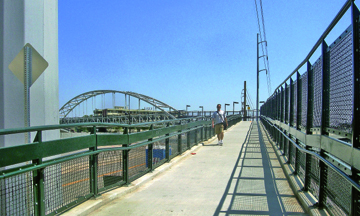
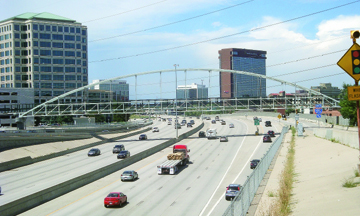
A pedestrian and bicycle bridge that crosses over I-25 at Colorado Blvd. linking the area to the light rail station opened 16 years and $8 million after Denver initially contemplated the project. Since opening in July 2015 many are asking if the bridge is a benefit or boondoggle to an area that grew up in the golden age of automobiles?
As the neighborhood and surrounding business community has matured many are unsure whether being retrofitted for pedestrians, bicycles and public transit is a blessing. Developed mostly during the 1950s and 1960s, this established neighborhood is an eclectic mix of single-family ranch homes, apartment buildings and townhomes, along with shopping centers and mid- to high-rise office buildings.
The initial reaction of many: They hate it! They are displeased and disturbed with the lack of parking spaces and believe the ramp is ugly. They are also unhappy with the increased noise and activity created by bicyclists and people going to and coming from work. Someone even wrote on the DownhomeDenver blog that there’s no reason for the bridge that was paid for with $4 million in City Capital Improvement Funds and $4 million in Federal Transportation Funds. Others, however, believe that the vast majority of residents other than the four or five buildings’ worth living at the base of the access ramp, approve of the bridge or have no opinion.
Taken For A Ride?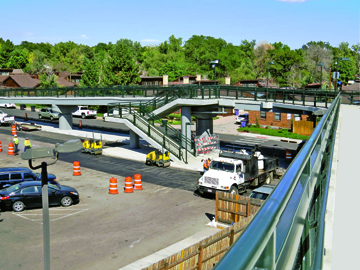
The north-south freeway previously separated inhabitants from the light rail link known as the Colorado Station. Now, however, the bridge connects the transit hub with Cherry St. and the Virginia Village neighborhood to the east. Access over I-25 is in the vicinity of Colorado Blvd. and East Evans Ave.
The bridge spans I-25, landing at Cherry St. to the north and RTD’s Colorado Station (light rail transit) to the south. The bridge was built to provide a safe way for bike riders and walkers to cross over I-25 without using Colorado Blvd., a street filled with rushing cars day and night. A biker named Bob stopped on the bridge by the Chronicle refused to give his last name but said he believes the bridge is worth every penny. He uses it fairly frequently now that he’s discovered it but can’t believe how few others do use it.
The bridge was theoretically built to increase connectivity to the Colorado Station, which boasted 5,600 arrivals and boarding per day prior to the bridge opening. That number hasn’t increased dramatically in the months since the opening. Only 2% of RTD’s ridership is by bike and at the Colorado Station that number hasn’t yet jumped appreciably. Most of those walking to the station don’t cross the bridge but are walking from the nearby parking lot.
Bicker With Bikers
For many the bridge also symbolizes the 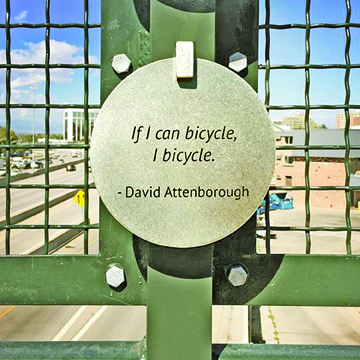 increasing squabble between motorists and bikers due to Denver’s policy of being hostile to automobile drivers and friendly to bikers. Denver drivers are constantly in a state of irritation due to the City’s implementing of Denver Moves Bicycles, a network plan of installing protected bike lanes, installing bicycle detection and signal upgrades that speed cyclists ahead while slowing down auto traffic.
Road Diets — a plan being advanced by Denver’s Planning Department — entails converting four-lane undivided roadways to two-lane roadways. Furthermore the plan provides for a two-way left turn lane by removing a travel lane in each direction. The remaining roadway width is converted to bike lanes. Staunch bicycle supporters argue that these road diets actually reduce overall traffic. Bicycling is growing beyond just being a part of Denver Public Work’s and Parks & Recreation programs. Denver added three full-time individuals to the bike program in 2014 to help implement bicycle projects and improvements.
Motorists complain that cyclists ride on their merry way oblivious to drivers, don’t obey traffic lights or anything or everyone else that get in their way. “They don’t look around, don’t care about their own safety or those of the people they are distracting,” says Cherry Creek resident Latasha Curry.
Engineering & Art
Work on the bridge began on March 17, 2014, with initial construction focusing on fabrication and installation of the steel pedestrian railing on the main span over I-25 and the approach spans on either side of I-25. The arch was successfully set into place on the night of Jan. 16, 2015. The installation of the railing on the main span started on the west side of the bridge and progressed to the east. Project lighting followed the progress of the steel railing.
The high point to completion of the bridge was construction of the concrete deck. The concrete was poured into a 309-foot long truss — a little longer than a football field — and weighed close to 200 tons. That’s equivalent to about 18,700 gallons of concrete and required 10 concrete trucks and two big “pumpers” to pour concrete into the truss. The work often required full overnight closure of I-25 from Colorado Blvd. to Evans Ave.
Artwork titled A Mindful Bridge by North Carolina artists Jim Hirschfield and Sonya Ishii was installed on the bridge during the week of Sept. 29-Oct. 3, 2015. They are an array of shimmering circular stainless steel disks attached to the interior of the bridge. The disks contain quotes about the experiences of people walking or cycling while crossing a bridge. A Denver ordinance enacted in 1991 directs that 1% of any capital improvement project over $1 million undertaken by the City be set aside for the inclusion of art in the design and construction of those projects.
Catalyst For Growth
Construction of the bridge has become a catalyst for new development within the area and more is anticipated. Lincoln Property Company and ASB Real Estate Investments are building a new mixed use development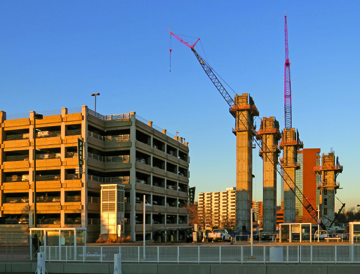 , adding more than 450,000 square feet of commercial and residential space to the nearby Colorado Center.
Real estate professionals suggest that the site has the potential to become Denver’s largest transit oriented development (TOD). Their point: With the light rail station plus the pedestrian-bicycle bridge, access to the site is unprecedented, creating a community center for the surrounding neighborhoods and I-25 corridor.
At the intersection of I-25 and Colorado Blvd. the additions will add 210,000 square-feet of office buildings plus a residential tower containing 189 apartments and 80 loft-style units. A 40,000 square foot Main Street retail section is also planned. The Center already features three office buildings plus the Dave & Busters-United Artists complex. New office space will add eight stories over five levels of parking. Retail space will be located within the residential development. Construction of the office space is expected to be complete in Dec. 2016 and the residential portion in mid-2017.

by Mark Smiley | Dec 17, 2015 | Editorials
 The Denver Community Planning and Development Department under Brad Buchanan repeatedly has publicly declared that its overarching goal in planning and zoning for the City and County of Denver is “transparency, partnership and meaningful public involvement.”
Denver neighborhood leader and attorney Greg Kirwin, however, described what actually happens “as anyone with experience trying to shape their neighborhood knows, the land use process is primarily a collaboration between planning staff and consultants for the developers who cherry-pick language from Denver’s Plans and Zoning Code to build whatever kind of new development they want.” He went on to note, “The playing field is tilted in favor of developers throughout the planning process despite the illusion of ‘outreach’ to residents.”
Neighborhood activist Chris O’Connor was even more brutal declaring, “Mayor Hancock and his planners are trying to jam high-density, high-rise buildings into every Denver neighborhood without regard for thriving, existing communities and without adequate infrastructure . . . The entire process must be reformed.”
How does Mayor Hancock, Planning Director Brad Buchanan and the thoroughly compromised Denver Planning Board get away with such a perverted and corrupt system? First, of course, is the fact that the Denver City Council is also controlled by real estate developers and their friends. While three pro neighborhood candidates won this last election they are still only less than one-fourth of the entire 13 member council.
Another problem, of course, is that the paper of record for the city, The Denver Post, has generally buried the story of how real estate projects actually get approved and are helping to destroy the city’s neighborhoods in order to not anger the Hancock administration or its allies. Moreover the local state courts have refused to address concerns when presented with lawsuits by angry citizens. The local courts and judges similarly refused to address the brutality and corruption in the Denver Jail and City Attorney’s Office. Only when a courageous federal district court judge, John Kane, refused to look the other way were any reforms undertaken. Unfortunately, planning and zoning questions normally do not involve federal questions of law.
Finally, the zoning and planning process is highly complex and knowing how to reform the corrupt system is not easy. Fortunately, the Inter-Neighborhood Cooperation (INC) has set forth the principles for an honest system in a seven page “Platform for Denver Planning and Zoning,” which is available at the entity’s website. INC is the umbrella group for Denver’s myriad neighborhood groups called Registered Neighborhood Organizations or RNOs.
Many of the principles are just common sense and it is shocking that many of them are not included in the present broken system. The platform urges the mayor and other city officials to appoint representatives of RNOs to all city boards, commissions, advisory committees, etc. Presently only shills for developers need apply for positions on the Denver Planning Board or the Parks and Recreation Advisory Board. At one time an appointment to one of these boards was a badge of honor while today it is a mark of shame. In many sections of the city if an individual has been appointed to either board by Mayor Hancock, he or she is highly unlikely to be able to successfully run for an elective office in the future.
INC’s Platform has many important provisions but perhaps its greatest guiding principle is that “higher density development, zoning or projects should not be approved unless it can be shown that adverse traffic and parking impacts on the neighborhood will not result or will be mitigated. Traffic and parking impacts can cause serious harm to the quality of life and economic vitality in a neighborhood.” Under the present system parking ratios have been steadily decreased and the city literally declares that it will not ever consider traffic impacts. It is not clear if any other major city in the country refuses to consider traffic impacts when approving major real estate projects.
City planners have publicly stated that they want to make Denver less automobile friendly and force residents to ride bikes and take public transportation. Unfortunately, the public transportation system in Denver generally stinks and while a single millennial might be happy to take a bike around town, a mother with three small children might find such a dictate from a planning official ludicrous, particularly during the winter season.
Any future candidate for City Council should be asked to adopt and approve INC’s Platform for Denver Planning and Zoning. Any candidate who does not is probably not someone one would want on the City Council. More boldly, neighborhood groups might want to ask existing city councilmembers if they will adopt the INC’s Platform. If they refuse, some may begin to wonder whether they want those persons on the City Council at all. The City Charter provides a method by which citizens can undertake to remove from office a person who ceases to represent their interests and that method, recall, is being increasingly used throughout Colorado by angry citizens of all different political stripes. No city councilmember has ever been recalled in the history of Denver, but there is always a first time for everything.
— Editorial Board
by Mark Smiley | Nov 23, 2015 | Glendale City News
by Kurt Woock
Writer for and on behalf of the City of Glendale
 The Denver Metro area is undoubtedly in the midst of a major growth spurt. Economic indicators back up what countless construction sites suggest: People want to do business here. According to a market report produced by Colliers International, nearly 500,000 square feet of office space went online during the second quarter of 2015, and developers broke ground on 1.1 million square feet of new office space, bringing the total commercial space under construction to about 3.3 million square feet.
Despite all the added space, the overall vacancy rate in the metro area has fallen for at least four consecutive quarters. Leading this growth has been the southeast suburbs, which was accountable for about 70 percent of the absorbed sublease space. Glendale’s ideal location and its long tradition of being a business-friendly city bodes well for the future. And businesses like the Hyatt Place don’t just have a front-row seat — they are the ones on the field, making this happen.
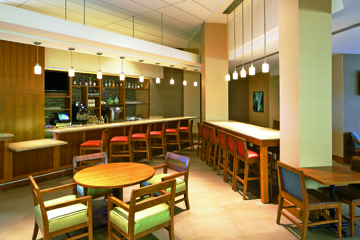
The Hyatt Place saw this coming. Before Denver’s boom truly took off, it began a $10 million renovation of the building it currently occupies near the intersection of Colorado and Mississippi. Keeley Bogenschutz, the Hyatt Place’s director of sales, said the new building represents a new approach for the modern traveler, foregoing the old “full-service” hotel model to a “flex service” hotel.
Despite the designation change, the Hyatt Place has made a name for itself precisely because of the extra services it provides to all guests. It offers complimentary wi-fi, breakfast, and parking. No extra charges or confusing protocols to go through. Bogenschutz said Hyatt is especially adamant that Internet at its locations should be free. Food is available 24/7, and a coffee-and-cocktail lounge keeps guests going day and night. Essentially, the Hyatt Place takes care of its guests by making it effortless for today’s traveler to get all the details he or she needs. It’s working, as Bogenschutz said the Hyatt Place concept has led to new locations popping up all over the country.
The Hyatt Place’s partnership with the Glendale Raptors is just another example of its forward-thinking approach to business. It demonstrates both its commitment to the community around it and the hab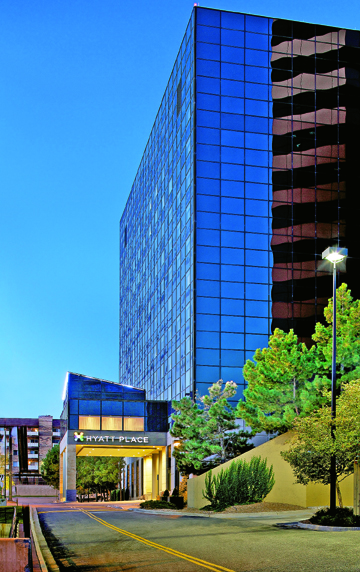 it of getting in on the ground floor of growth opportunities. Bogenschutz calls the partnership a “no-brainer.” The two organizations also have the benefit of calling each other neighbors: Infinity Park is only a block away from the Hyatt Place.
As Infinity Park is a destination for teams and fans traveling from all over the country and world, it’s the perfect spot for spreading the word about the Hyatt Place. During major events, such as the annual RugbyTown 7s Tournament, the Hyatt Place probably holds more rugby players and fans than any other Glendale location outside Infinity Park itself. And, when travelers come to Glendale and ask the front desk for a recommendation of something to do, one of the first responses is always, “go to a Raptors game!”
Bogenschutz adds that rugby’s future in the United States is compelling, giving it a high potential of being a beneficial partnership for years to come. “It’s a growing sport — it really gives us the opportunity to put Glendale on a global stage. It’s great to be getting into it now and being able to watch it grow.”
Both have the advantage of being located in Glendale. Bogenschutz said that the city is “business oriented,” which was a major reason they decided to make such a significant investment in it. Its central point between downtown Denver and the Denver Tech Center makes it an ideal spot to stay for those doing business anywhere in the region. The Hyatt Place’s 3,000 square feet of meeting space, A/V capabilities, food-and-beverage service, and Glendale’s myriad dining opportunities make Glendale a popular site for meetings. Nearby residential areas, along with the entertainment options of Cherry Creek, make it a go-to spot for people visiting family.
The future looks bright for both organizations. “We’re living in an exciting time for Glendale, this area in particular,” Bogenschutz said. The development of new com-
mercial spaces, in addition to the investments existing businesses make as they grow, bolster the area. In particular, Bogenschutz is looking forward to the construction of Glendale 180, an entertainment complex that will become a regional destination, attracting thousands of people every night.
In a sense, places like the Hyatt Place are ambassadors for Glendale as they serve as the gateway to the area for travelers. “More and more, guests are looking for local experiences,” Bogenschutz said. “We help direct them to having a good time by recommending local business.” The opportunities to give exposure to the area will only increase over time. Because, as Bogenschutz said, “The City of Glendale is becoming its own destination.”