by Mark Smiley | Aug 29, 2014 | General Featured
Rules Hatched By City Council Also Allow Homegrown Sales In Kitchens, Yards Until Dusk
by Glen Richardson
Have you heard the buzz?
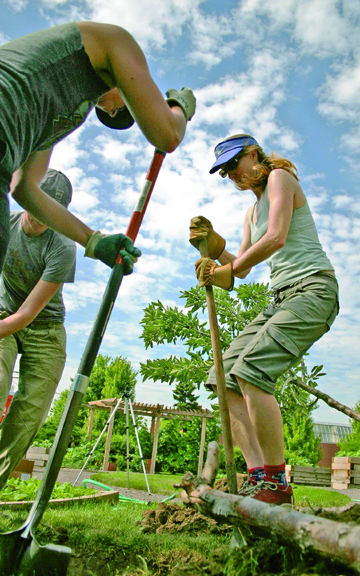
If not, step into your backyard and listen for the hum of bees. If you pay close attention you may also hear the sounds of chickens, ducks and goats! They’re some of the reverberations to expect as the Cherry Creek Valley rototills into full-fledged backyard farming. What’s more, anticipate that your street will also become one big Farmers’ Market as neighbors begin to sell their farm produce in their kitchens and from their front yards.
In July the Denver City Council approved a new law that allows residents to both raise and sell fresh produce they have grown themselves and “cottage foods” such as jams and honey they have made themselves in their home kitchens. Under the new law which took effect July 18, residents are required to purchase a permit but then will be able to sel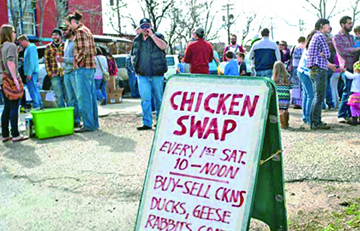 l from home raw and uncut fresh fruit, vegetables and herbs that were grown by the seller either on site or in a community garden.
City Farming Rules
Urban farmers will now be able to sell whole eggs produced by chickens or ducks kept by the seller at home or as un-refrigerated food products made on-site such as spices, teas, honey, jams and certain baked goods made themselves in their home kitchens. Under the law people can sell from inside or outside their home from 8 a.m. to dusk and can sell up to $5,000 worth of goods and produce a year.
The city requires that urban farmers apply for licenses to sell their food. The city charges a one-time fee of $20 for the license. Urban farmers setting up indoor or outdoor farmer markets are not required to provide parking spaces. No sales tax is required and the seller determines the sales prices. For neighborhood farmer markets only temporary, portable furniture is allowed — tables, stands and umbrellas — for outdoor sales and they must be taken inside between dusk and 8 a.m. daily. Signs for home sales must be flat, attached to a wall or window of the home, and cannot be more than 100 square inches in size. One sign is allowed per street front (one sign for most lots, two signs for a corner lot). No moving signs and no lit sign(s) are allowed.
Several city restaurants currently grow produce in gardens and farms they own and sell them in their local eateries. Now those plus other restaurants that don’t have gardens and farms will be able to buy vegetables, eggs, jams, and fruits being grown in the neighborhood by backyard farmers.
Hatching Big Ideas
As the backyard chicken craze spreads like wildfire it’s beginning to seem like the chicken coop is the new doghouse. Increasingly Valley fidos will have to share the yard with the ladies. But before getting in a flap with your pup be aware that sales of whole, fresh chicken eggs are limited to less than 250 dozen per month.
According to rules hatched by the city, egg cartons must include the origin of the eggs and the packing date. Unless the eggs were treated to prevent salmonella, the label must include safe handling instructions: To prevent illness from bacteria, keep eggs refrigerated, cook eggs until yolks are firm, and cook any foods containing eggs thoroughly. Cartons must be labeled: “These eggs do not come from a government-approved source.”
Eggs, produce and other products sold by urban farmers must have a label and be traceable to the seller. Labels must list the name of the product, the producer’s name address, telephone number and email. Items must also include where the food was prepared or grown, the date the food was produced and a complete list of ingredients. If a product was produced in a home kitchen that is not subject to state licensure or inspection and that may also list common food allergens such as tree nuts, peanuts, eggs, soy, wheat, milk, fish and crustacean shellfish, labels should read: This product is not intended for resale.
Who’s Digging In?
Who are these upstart urban farmers with enthusiasm for having dirt under their finger nails, bees and chickens in their backyard, and fresh food in their bellies? It’s locals like Brenna Brooks-Larson, a Valley elementary school teacher who helped launch Celebration Community Farm in the Virginia Village neighborhood on the corner of Iowa and Birch. She grew up in Denver and is now a board member of UrbiCulture Community Farms. Her love for farming began in Nicaragua as a Peace Corps volunteer where she managed three school gardens. Or gardening volunteers like Maggie Rice, the second woman in Colorado to become a Certified Working Chef. She is building a Permaculture Institute on 1.5 acres 10 minutes from downtown Denver.
Also among the back-to the-land group is James Bertini, a lawyer turned farmer whose backyard on Fourth Ave. and Kalamath has chickens, rabbits and a garden plot. His interest in farming began with his wife Irena’s dissatisfaction with the prevalence of processed foods. The pair own and operate Denver Urban Homesteading — a year-round farmers market on Santa Fe — selling locally grown produce and foodstuffs. A horde of backyard farmers can be found buying chickens, rabbits and other backyard critters at a livestock exchange sponsored by the couple each month.
Many like Jason Plotkin — Farm Manager at Lowry’s Ekar Farm & Community Garden — got into farming to help neighbors and society in general. The farm hosts 50 community garden plots within the diverse Lowry neighborhood. Ekar engages 1,000 community volunteers in growing 25,000 pounds of urban organic vegetables. The farm donated 85 percent of the vegetables grown — with a market value of $95,000 — to Jewish Family Service, Weinberg Food Pantry and other food relief agencies that feed 2,500 people a month during the harvest season.
Cultivating Change
The Valley’s backyard farming boom began more than 25 years ago when the nonprofit Denver Urban Gardens (DUG) began working with the community to build and support gardening. The organization currently organizes and manages well over 100 community gardens, including 35 at Valley schools. By 1993, DUG was coordinating 21 local gardens, and by 1997, 32 new gardens and DeLaney Community Farm were established. Within the past decade it has created multiple ongoing youth and community education programs designed to assist community involvement and long-term garden sustainability.
Another significant backyard farming venture is the community farm at Valley-based Denver Green School, run by Sprout City Farms. It is a one-acre organic farm located along East Virginia Ave. Produce from the farm is used for the school salad bar as well as in cooked meals for about seven out of the nine months during the school year. The farm is able to meet nearly all the produce needs for the school kitchen from August to October. Sprout Farms believes the future of urban agriculture requires a shift in thinking, eating and acting.
Even the city has gotten into the backyard-farming act with a plot on the grounds of the Colorado Convention Center. Known as Blue Bear Farm, the 5,000-square-foot farm is located on the sunny south side of the convention building. Beds bloom with crops of fresh fruits, vegetables and herbs that are used by Centerplate chefs at the Convention Center. Basil, beans, peppers and parsnips plus radishes and raspberries are among crops grown. The farm has two beehives providing fresh honey to convention attendees.

by Mark Smiley | Aug 29, 2014 | Glendale City News
 by Marco Cummings
Writer for and on behalf of the City of Glendale
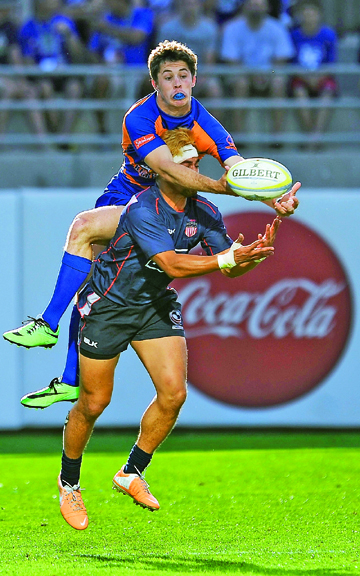
One of the biggest sporting events in Glendale in the month of August, if not the entire year, took place last month when Infinity Park hosted the Serevi RugbyTown Sevens international rugby tournament.
Needless to say, the event left its mark on the City of Glendale, as 17 teams from around the United States and the world convened to compete for the $10,000 prize awarded to the tournament’s winner along with a berth in the Bayley’s Fiji Coral Coast Sevens tournament, a rugby tournament hosted in the homeland of Serevi namesake Waisale Serevi, known as the “King of Sevens,”
“It’s truly an international event, people from all over the world are coming out,” commented Glendale Mayor Mike Dunafon, prior to the event.
This year’s competition came from locales as far away as England and the Caribbean, but prior to the tournament’s conclusion, Serevi was “keeping an eye on” the USA Falcons.
As it turns out, it was the Falcons that took home this year’s Serevi RugbyTown Sevens Cup Championship, defeating the Denver 7s All Stars 36-19 in the tournament final.
A familiar face helped guide the Falcons to the championship as former Raptors fly-half Valenese “Nese” Malifa made his return to Infinity Park.
“I don’t miss the altitude,” Malifa joked.
But what he did miss was the experience Infinity Park offered to thousands of rugby fans and teams from around the world over the three-day weekend of events.
“It’s a good show they put out here. It’s family,” Malifa said.
The Denver 7s All Stars also brought familiarity to this year’s SRS tournament. The team featured a mix of players including some from Glendale’s rival, the Denver Barbarians.
“It’s a great tournament, we can’t wait to come back next year,” Denver 7s and Barbos fullback Maximo De Achaval said.
“It is a community building sport. It is played all over the world, and now we’re being recognized for it,” Mayor Dunafon added.
Unfortunately, the tournament hosting Glendale Raptors were unable to bring home hardware in this year’s tournament, after making a finals appearance last year alongside the USA Collegiate All-Americans.
After an undefeated start in pool play, injuries started to pile up for the Raptors, eventually losing 35-7 to the Northeast Olympic Development Academy in the SRS Plate Final.
“With the new/reserve players coming in, we broke the continuity and needed to build confidence but it was too late to try and do it in a final,” Raptors head coach Andre Snyman said. “The reserves played really well and I’m grateful for their attitude and commitment to help the team at such a short notice.”
In addition to the Cup and Plate Finals, hardware was also contested in the SRS Bowl and Shield Finals as well as a third place match.
In the third-place game, Austin, Texas, area club Negro y Azul, defeated the crowd favorite U.S. Army. Azul defeated the Raptors 28-21 on Day Two of the competition in the Cup Quarterfinals.
Army was defeated in the third place match, but put together a strong tournament, winning the Military Championship with a 26-15 defeat of Air Force on Day Two of the competition. It’s the second Military Championship in three appearances for Army, who has defeated Air Force both times.
Another fan favorite throughout the years has been the Royal Air Force Spitfires. The RAF entered SRS having won hardware in each of their previous tournaments in 2014, but fell short in RugbyTown with a 19-12 loss to 2013 SRS Cup Champions, the Collegiate All-Americans in the Bowl Final.
Nevertheless, the Spitfires were ever grateful for what has become a yearly trip across the pond to Glendale.
“It’s brilliant coming here, it’s our third trip here. We love the city,” remarked RAF coach Tim Barlow, adding, “The tournament has grown over the last three years, the standard has gotten higher, the teams are better and more ranging.”
Although this year’s competition was largely dominated by American competition, one dark horse from an exotic locale was able to bring home hardware.
After failing to record a win over the first two days of the tournament, Bermuda was able to put together two wins on Sunday, concluded by a 29-14 win over the U.S. Coast Guard in the Shield Final.
“We were delighted to play and be back again this year, it’s a big step forward for our development,” Veteran Bermuda scrum half Tom Healy said following the win.
The competitive action on the field was certainly a sight to behold, but what also made this year’s SRS tournament a rousing success were the weekend’s off-field events, which included a “Bruises and Brews” beer fest on Day Two of the competition and a “Taste of Glendale” on the final day of the competition.
“The participation of people locally is fantastic,” praised Mayor Dunafon. “Combine it with the beer festival and the Taste of Glendale it’s over the top. It’s really what this is all about, introducing Colorado to the sport of rugby.”
It’s another reason to check out next year’s edition of the Serevi RugbyTown Sevens tournament in addition to a chance to see the Glendale Raptors strive for another chance at glory.
“We can take a lot from this tournament and some of the younger players got a taste of what it’s like to play at the next level.” Coach Snyman said. “We look forward to regroup and get ready for next year’s tournament.”

by Mark Smiley | Aug 29, 2014 | Editorials
The Denver City Council was once a political body that the news media in Denver, including newspapers and television stations, regularly covered. John Hickenlooper’s rise to the office of mayor changed all of that. His approval ratings stayed well into the 70s for his entire two terms in office and that cowered many City Council members. Hickenlooper privately would mock how supine and powerless certain individual council members were. He would note that all he had to hang on to was five council members as it took nine votes out of 13 to overturn any veto the mayor might come up with.
However, the City Council as a relevant political entity may be returning as a result of the Denver Sheriff Department scandal. While Hickenlooper keeps his contempt of the individual members of the City Council private, a less adept Mayor Hancock has made it publicly obvious. He appointed a Sheriff Department Executive Steering Committee to hire an outside firm to review the Sheriff Department and recruit candidates for the sheriff’s position. He chose six people, all of whom were appointees he controlled, such as City Attorney Scott Martinez and Chief of Staff Janice Sinden.
The City Council has been under a lot of public pressure for simply rubber stamping multi-million dollar settlements with jail inmates and not being more involved in demanding reforms. The City Council reasonably requested a representative on the steering committee. Hancock, incredibly, stiff armed them declaring he would update them at the weekly meeting he and his staff have with the City Council.
When the first such meeting occurred Mayor Hancock didn’t even bother to attend saying he needed to spend more time with his family. He was, in fact, inside the City and County Building when the meeting occurred.
The City Council had finally had enough. The usually meek and compliant Jeanne Robb erupted at David Edinger, who is overseeing the steering committee, and Stephanie O’Malley, Denver’s public safety director: “What are you thinking. I am astonished. You’ve set up council to be included to question every move. The public is upset, and I’m very upset.”
The mayor’s representatives had come to the meeting unprepared with no reports or materials for the council to review emphasizing how little they thought of the City Council. Councilman Charlie Brown was incredulous stating, “Let’s be more professional about how we are treated here.”
Mayor Hancock was informed by his staff that it was actually possible to offend Denver City Council members. Hancock relented and added two members of the City Council, Jeanne Robb and Paul Lopez, to the committee. Hancock, of course, did not want council members to think that they were all that important so he also added four regular citizens to his committee. The 13 person committee is now as large as the Denver City Council itself.
Denver has the so-called “strong mayor” form of government. Notwithstanding the same, City Council has a great deal of power under the City Charter if it elects to exercise it. The City Council is the only branch of government that can adopt or revoke legislation. It also controls all budgetary matters. The mayor’s staff wrote on the City’s website describing how the City Council actually performs its critical role in the budgetary process as follows: “to date, council modifications of the budget have been relatively minor.” It is an unintentional, but damning, critique on how the City Council members as a whole have undertaken their statutory obligations to the public in recent years.
It is about time City Council members start acting like real elected officials with constituents and not simply potted plants. There is more to being a Denver City Council member than simply approving by large margins every ill conceived real estate project that comes along. The Sheriff Department Executive Steering Committee debacle shows that City Council members can make a difference if they choose to do so.
— Editorial Board

by Mark Smiley | Aug 22, 2014 | Glendale City News
Company to perform natural gas line upgrade Aug. 26-28
Xcel Energy crews will be installing a major natural gas service line for a customer Aug. 26-28 in the Cherry Creek area; the project will impact traffic in the area as the company completes its work.
Xcel Energy will begin work for an underground boring operations beginning Aug. 26. On that day, the company will close one lane of eastbound traffic in the 2900 block of East First Avenue from 8:30 a.m. to 3:30 p.m. MDT. On Aug. 27-28, the company will close two lanes of westbound traffic along the same street, also from 8:30 a.m. to 3:30 p.m. MDT.
Motorists should expect significant congestion and delays during these lane closures. Alternative routes are suggested. Xcel Energy already has begun notifying local and commuter traffic in the area, through traffic message boards, of its work next week. On the day of the lane closures, barricades and traffic signs will be used to redirect traffic.
by Mark Smiley | Aug 1, 2014 | Travel
by Mark Smiley
Ken Horwege is a legend in the local newspaper scene in the Cherry Creek Valley having started with the iconic Up the Creek newspaper in 1974, as one of publisher Stan Janiak’s first employees. Utilizing his skills learned as an Air Force captain in charge of public affairs he became the newspaper’s illustrator, photographer and column writer. In 1977 he shifted over to Southeast Denver Graphics where he has worked on dozens of publications from Rocky Mountain Christian to Colorado Country Music and for the last two decades on the Glendale Cherry Creek Chronicle as photographic and artwork enhancer.
A free spirit, Horwege has never married despite a lifetime of flings and at age 72 it does not look like will ever become the “marrying kind.” He has filled his free time with an incredible array of activities from being one of the state’s top clog dancers to attending conventions and historical re-enactments in full regalia. He has a room full of authentic uniforms and costumes which allows him to time travel from the American Revolution to World War II and out into space to Star Trek’s Klingon planet of Kronos.
Ken Horwege was born May 30, 1942, at Ft. Benning, Columbus, Georgia. Ken attended grade and high school in St. Francis, Kansas, graduating in May 1960. He attended college at the University of Kansas, graduating in May 1964 with a Bachelor of Fine Arts, Commercial Art degree.
At KU, he was in the Air Force Reserve Officers’ Training Corps; he was named as a distinguished AFROTC Graduate, and commissioned as a second lieutenant, Air Force Reserve. In October 1968, he was assigned as a Public Affairs Officer at Cannon Air Force Base in Clovis, New Mexico. Ironically, this is the base where my dad, Paul Smiley, served from 1968 to 1972. Ken wrote the public relations operations plan for the base conversion from F-100 to F-111 aircraft operations.
Ken was honorably discharged from the Air Force in October, 1970. “I was too outspoken. I think I pissed off one too many colonels.” Upon his discharge, he moved to Colorado to become a ski bum. From 1971-74, Ken drove a taxi.
His many hobbies keep him fit and healthy. Into his eighth decade, Horwege doesn’t show any signs of stopping. He indicates he has never been sick a single full day in his entire adult life. “I have my annual medical check once a year and otherwise I don’t see a physician any other time during the year,” declares Horwege.
As far as retiring, he declares “You’ve got to be kidding. Retire to what. I love my life and I love working at Southeast Denver Graphics. I have never been a person who likes to sit still and do nothing. The only time I plan to stop working is when they put me six feet under the ground.”
Horwege became interested in dancing in 1979, when he won the dance contest at his 20th high school reuni 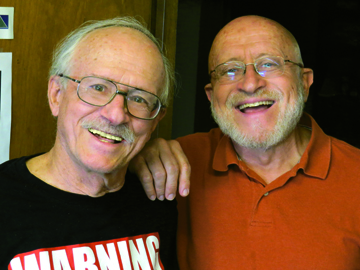 on. After winning, he decided he needed more formal lessons to continue. He took classes at Colorado Free University. In 1983, Horwege joined the Hoofin’ High Country Cloggers, a group founded in February 1979. His first performance was that same year for the People’s Fair at East High School.
The Hoofin’ High Country Cloggers performs all across the country at festivals and private events, including conventions, weddings, and other gatherings. Routines vary from intricate four-person dances to spectacular six- and eight-person dances. Clogging is a type of folk dance in which the dancer’s footwear is used musically by striking the heel, the toe, or both against a floor or each other to create audible percussive rhythms, usually to the downbeat with the heel keeping the rhythm.
The group has performed at the People’s Fair, Taste of Colorado, and Rocky Mountain Bluegrass Festival, among others. Perhaps one of their most notable performances was at the Walnut Valley Festival in Winfield, Kansas, in 1991. They danced to the music of the original Dixie Chicks who had been playing together for just two years at the time. The band was formed in 1989 by Laura Lynch on upright bass, 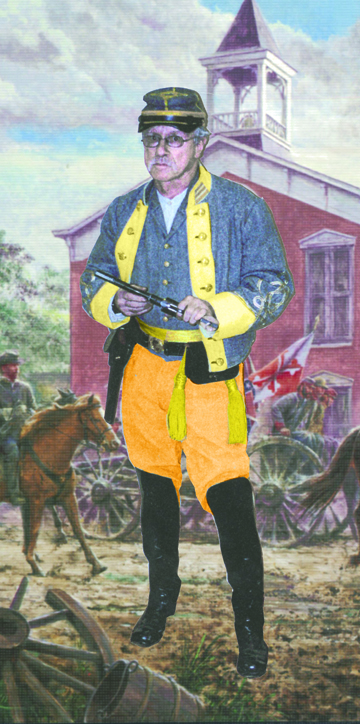 guitarist Robin Lynn Macy, and the multi-instrumentalist sisters Martie and Emily Erwin.
In addition to performing with the cloggers, he is also part of the Denver and District Pipe Band, a group of musicians and dancers enjoying the music from Scotland, Ireland, and beyond.
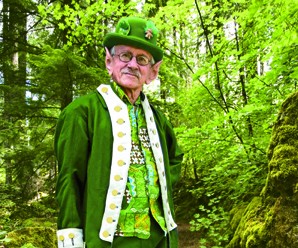
Another interest for Horwege is dressing up in costumes. His favorite holiday since he was a kid is Halloween. He has always been fascinated with it. In 1985, Horwege met Rocky the Leprechaun in Telluride which inspired him to dress up as a leprechaun. Since 1982, Rocky (Brougham) has been the Luck Leprechaun at all Bronco home games and five Super Bowls.
Since his days as a unit historian in the Air Force, Horwege has been interested in old war uniforms. He dresses in full uniforms that date back to the American Revolutionary War, World War I, and World War II, to name a few. In fact, when he attends military balls and other individual vignettes, he corrects others who may not be completely authentic in their dress code. “If I see stripes on a uniform that are not accurate, I correct them,” said Horwege.
Horwege also enjoys dressing as a Klingon from the Star Trek series and attending conventions such as Comic-Con. The biggest thrill for Horwege has been meeting William Shatner (Captain Kirk), Leonard Nimoy (Mr. Spock), Peter Mayhew (Chewbacca from Star Wars), and David Prowse (Darth Vader from Star Wars). He would most like to meet Patrick Stewart someday, who played Captain Jean-Luc Picard on Star Trek the Next Generation and Professor Charles Xavier in the latest X-Men movies.
Horwege is an advocate for being social but you won’t find him connected to any social media platforms. He enjoys traveling and performing with his groups. He doesn’t have to answer to anyone and he likes it that way. His strongest advice is to stay fit, healthy, and active and “if it ain’t broke, don’t fix it.”
by Mark Smiley | Aug 1, 2014 | General Featured
by James Bowie
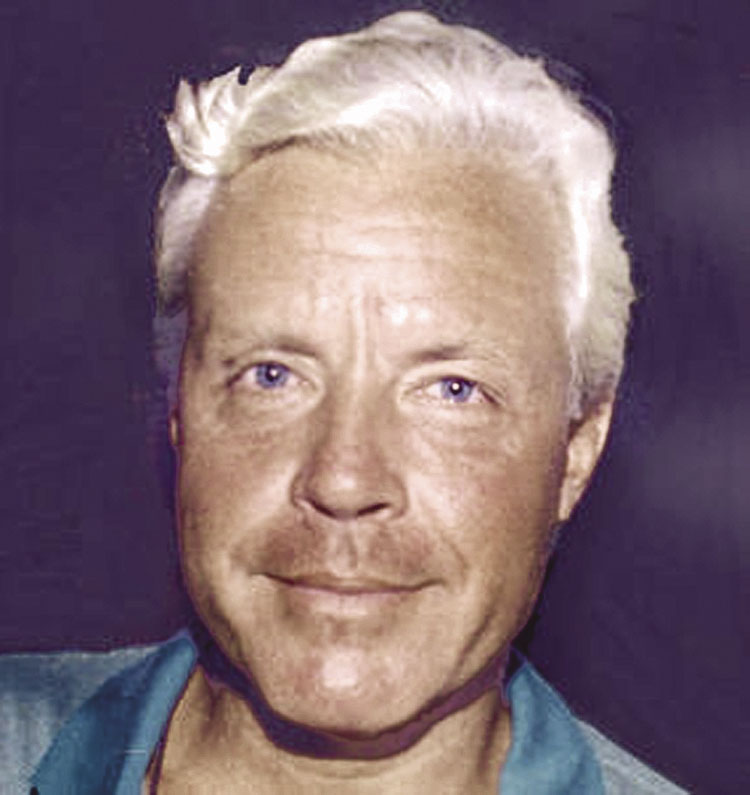
Former Glendale City Manager Veggo Frederick Larsen II died at age 61 at his residence in Palmetto, Florida. The cause of death was not reported other than it was “unexpected.” He was city manager of Glendale in tumultuous times from October 1999 to May 2002. After leaving Glendale he joined a recycling firm in Texas. It does not appear that he was employed at the time of his death.
Larsen was born to a prominent family in Hamden, Connecticut, and was a graduate of the Wharton School of Business at the University of Pennsylvania. He had two brothers and two sisters. The sibling he was closest to, Eric Larsen, passed away several years ago. His grandfather and namesake, Veggo F. Larsen, was president of the Connecticut State Golf Association in 1956 and 1957 and helped to instill a love of the game of golf into his grandson. His father, Edwin Veggo Larsen, was a real estate developer and predeceased his son by less than two years. Prior to becoming the city manager of Glendale, Larsen was in the real estate business in Colorado and then the New York area.
In the spring of 1998 the Glendale businesses and residents formed a political group called the Glendale Tea Party and swept its slate of candidates to office in the City Council. That fall a new city manager was to be chosen. Chuck Bonniwell (publisher of the Glendale Cherry Creek Chronicle) was an old friend of Larsen and proposed him for city manager.
Larsen described his selection in an article in Westword concerning the initial get-together of the six city manager candidates and city officials: “When Chuck’s girlfriend shows up and gives me a big hug. Oh, they knew. They knew there was a rat in the woodpile — they just didn’t know which one.”
Bonniwell’s remembrance of the event was somewhat different. “I supported him along with a majority of the City Council. They were not really any hidden agendas. He was the leading candidate for the city manager position, but he certainly could have unimpressed the council members in which case they would have chosen someone else. Veggo always had a wonderful way of making the mundane seem very fun and dramatic.”
Larsen later led a highly publicized revolt against his original supporters. In 2002 Bonniwell and other members of the Glendale Tea Party supported a new set of candidates who prevailed at the ballot box in 2002 and fired Larsen. Bonniwell noted, “Veggo was an immensely engaging and intelligent individual who could have been an extraordinary city manager in Glendale or anywhere else. But he never wanted to be beholden to anyone, which is fine, but in the end it meant he never worked for or with anyone for very long. He had a job he could have retired at many years later. Instead he was on the street once again looking for employment after just three plus years.”
Former Glendale Mayor Mark Smiley remembers Larsen’s extraordinary gift with words, “He was a National Merit Scholar in high school and was always making up palindromes [words or sentences read the same forward or backward, i.e. civic] when he got bored at City Council meetings. He could be wonderfully fun.”
Present mayor of Glendale and Colorado gubernatorial candidate Mike Dunafon remarked, “I always liked Veggo even after he stabbed everyone in the back. He had everything going for him, but could never quite put it all together. He was missing that piece that makes very talented people successful, which is to see things from more than one’s own limited perspective, no matter how bright you are.”
One of Larsen’s accomplishments while city manager of Glendale was to establish a relationship with the city of Playa del Carmen, Mexico, which became the official “Sister City” of Glendale in 2004. He got the then Glendale Fire Department to donate a fire engine, that the department was in the process of decommissioning, to Playa del Carmen. He even drove the truck down to the Mexican city, a distance of almost 1,700 miles.
Bonniwell summed up, “Veggo was a little like Andy Dufresne in the movie Shawshank Redemption with Playa del Carmen being his Zihuatanejo. Unfortunately, like all of us to a certain extent, the bars of his Shawshank Penitentiary were imposed on him by his own mind. Unlike Andy Dufresne he never really escaped that self imposed prison.”
Larsen left 75 percent of his estate to the “Make a Wish” Foundation.