by Valley Gadfly | Nov 17, 2025 | Glendale City News
District Is Bustling With Fun, Excitement; Santa’s In The Loop For Saturday Night Lights
by Glen Richardon
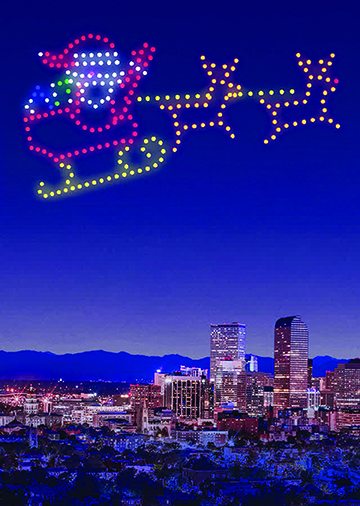
Santa Sightings: Santa and local landmarks are among the sights you’ll see as drones soar across the sky all month long, 7 p.m.
There’s no place like Glendale-Cherry Creek North, and the Mile High City during the holidays. Cherry Creek’s over-the-top festivities are bright and jolly enough to convert even the biggest grinch.
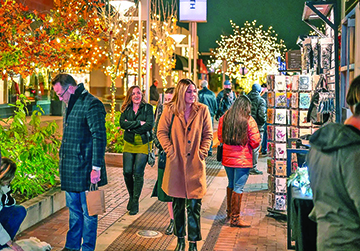
With a cup of hot chocolate or mulled wine in hand, take in the decorative window displays, dazzling lights, holiday markets, and family-friendly activities happening in Cherry Creek and throughout the Mile High City.
Whether you’re indulging in festive Cherry Creek dining, cozying up with a cocktail at the Mistletoe Lounge on Fillmore Plaza, or simply taking in the view, the district is a must-see holiday destination. A million dazzling lights are wrapped around more than 600 trees, illuminating the entire neighborhood.
Holiday Market
Creek Magic: Take the family to Cherry Creek North to see the decorative window displays, dazzling lights, and holiday market.
As December blankets Cherry Creek in a frosty glow, the district comes alive with the spirit of the holidays. Christmas, Hanukkah, and New Year’s celebrations that are nothing short of magical. Experience the joy of the season with Winter Wanderland, a collection of free outdoor events for all to enjoy.
The Cherry Creek Holiday Market is open on Fillmore Plaza through Dec. 24. Spend the day shopping under dazzling lights, listening to live music, and getting into the seasonal spirit.
You’ll discover one-of-a-kind pieces from 50+ local makers, designers, and creators. There’s also “Giving Machines” through Jan. 4 that don’t dispense snacks or drinks, but instead, opportunities to donate to those in need. It’s also where the Mistletoe Lounge — a Christmas bar with festive drinks — is located.
Festivities also include “Saturday Night Lights,” Dec. 6, 13, and 20. On those dates you can enjoy complimentary treats, and the kids can meet Santa and Mrs. Claus. There’s also a Chanukah Celebration on Sunday, Dec. 14 hosted by Chabad of Cherry Creek. Families and guests of all ages will enjoy a fun “festival of lights” with face painting, fire juggling, festive treats, and crafts.
Blossom Of Lights
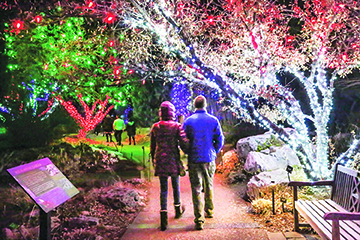
Bright Nights: Blossoms of Light at the Denver Botanic Gardens through Jan. 11 is one of the nation’s top light shows.
While in the Cherry Creek area, don’t miss the Blossoms of Light at the Denver Botanic Gardens, Nov. 21-Jan. 11. It’s consistently lauded as one of the top holiday light shows in the nation. Wander a mile-long path through immersive, luminous displays that accentuate and highlight the plant collections. A cherished holiday tradition for nearly four decades, Blossoms of Light is constantly evolving to inspire wonder and delight for visitors.
Zoo Lights, the Denver Zoo’s 30th annual “wildest winter wonderland” is Nov. 23-Jan. 5. A holiday treat for the kids and grown-ups alike, the zoo has some 3,500 animals, including almost 650 species. During the festival, the zoo is decorated as a winter wonderland where you can stroll illuminated paths enjoying holiday entertainment, music corners, warming stations, plus food and drinks.
Stroll over to the City & County Building in Civic Center Park to watch the lights display running all season long! The light and music show repeats nightly from at 5:45 pm and 6:45 pm, except for December 6 and December 21. Added dazzle: Look up in the sky now through Dec. 31 for this year’s Mile High Drown Show “Grand Illumination.” The display of 400 drones will soar across the sky every night from the Tivoli Quad at 7 p.m. You’ll see everything from Santa and his reindeer, to iconic Denver landmarks like the Mile High Tree and Union Station.
Dashing Thru LoDo
Just steps apart, Dairy Block, McGregor Square, and Union Station are brimming with festive activities, dazzling lights, and family fun. Celebrate the magic of the season with Holiday on the Block, an extensive line-up of festive events on the Dairy Block including a local makers market, entertainment, live music, plus winter art installations.
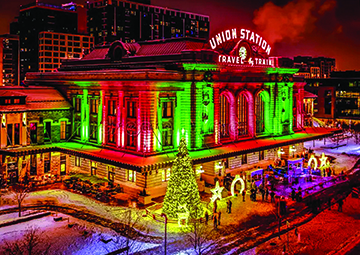
Festive Sights: With a 40-ft.-tall Christmas tree out front, Denver’s Union Station is a popular holiday destination.
Over at Union Station, the Grand Illumination is a can’t-miss spectacular, lighting up the historic landmark. The sparkling displays are perfect for capturing holiday memories, and the ongoing lights make every night feel like a celebration.
McGregor Square is also a winter wonderland this season, offering ice skating under the twinkling lights, festive cocktails to warm your spirits, and special visits with Santa himself. It’s an ideal spot to soak up the holiday magic with friends and family.
Hanukkah
The Jewish holiday “Festival of Lights” known as Hanukkah — also spelled Chanukah — is December 14 to 22 this year.
The Jewish Community Center’s annual “Latkes & Lights” is Dec. 7, 10 a.m. to 1 p.m. The event will feature themed games, jamming to live music, and tasting latkes from Denver restaurants, plus those made by community members. There will also be voting by attendees on handmade menorahs.
Chanukah @ The Capitol is also on Dec. 7, 5 p.m. to 11:50 p.m. The event features a 10-foot Menorah, a Dreidel Drop, plus free barbecue. Temple Emanuel hosts Hanukkah Hoopla Dec. 27, 5 p.m. to 8 p.m. There’s a community menorah lighting followed by service, a dinner, and a concert. Finally, Chabad of Cherry Creek is hosting a second Chanukah Celebration Dec. 29, 3:30 p.m. to 5:30 p.m. There will be Chanukah activities at participating neighborhood stores, a Grand Menorah lighting, plus Fire Show.
New Year’s Eve
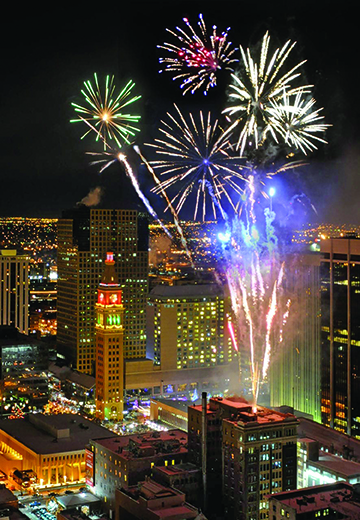
Mall Fireworks: See fireworks on the 16th St. Mall New Year’s Eve, 9 p.m. and again at midnight.
The two-night electronic dance music festival Decadence is at the Convention Center Dec. 30 and 31. Zeds Dead, Subtronics, and Tape B will perform together for the first time ever Dec. 30.
Noon Year’s Eve returns to the Children’s Museum featuring the glitz and glam of New York City’s Times Square before bedtime! There’s a ball drop at the top of every hour from 10 a.m. to 3 p.m., plus music, and treats. Dazzle’s New Year’s Eve extravaganza “Nostal-Jazz” rings in the New Year at the Performing Arts Complex downtown 10 p.m.
The New Year’s Eve bash “Fire & Ice” is at the Fire Restaurant’s outdoor rooftop patio in the Art Hotel, Dec. 31, 8 p.m. A Night in Vienna returns to Boettcher Concert Hall New Year’s Eve playing rousing polkas, waltzes, and marches, 7 p.m. See the New Year’s Eve Fireworks on the 16th St. Mall Dec. 31 at 9 p.m. and again at midnight.
by Jessica Hughes | Nov 17, 2025 | Editorials
by Jessica Hughes
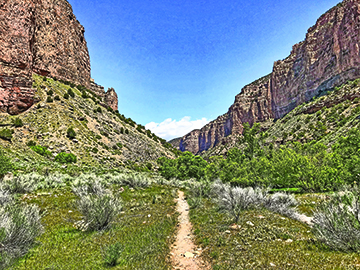
Dinosaur National Monument is one of many national parks experiencing severe budget cuts and staff shortages. Photo credit: Jessica Hughes
Often referred to as “America’s best idea,” our national parks are what many consider a national treasure, not only loved for their beauty and recreational access, but for their commitment to conservation, culture, and collective heritage.
Yet, now more than ever, our national parks are in crisis. Since the beginning of this year, they have become political pawns in a larger agenda that seems intent on undermining their mission. Behind the scenes, the foundational work of protecting landscapes and preserving cultural history is under attack.
National parks have struggled under a severe staffing crisis, losing roughly one quarter of their permanent workforce. This loss has made it increasingly hard to keep gates open, deliver basic visitor services, or carry out vital maintenance. It has also caused delays in research and critical maintenance, putting the long-term protection of America’s most iconic landscapes and cultural resources in jeopardy.
But the threats extend far beyond shrinking budgets and empty positions. Park leadership has been pressured to strip climate change information from official webpages and to remove references to slavery and LGBTQ+ history. Staff were also directed to inventory interpretive signage and museum content, and flag so-called “negative information” about past or living Americans via QR-code reporting and submit content for review. These requests are not isolated efforts, rather they reflect a sweeping effort to reshape our national park system and how American history is told.
All of this comes at a time of heightened pressure. Visitation has surged since the COVID era. Climate change is accelerating. And now, with cuts and mandates, national parks are being squeezed from every angle.
In Colorado, where more than one-third of the land is federally owned, roughly 24 million acres, parks were the busiest ever this year, with record-breaking visitation, all forced to operate with minimal staff. “The Administration ordered all NPs to remain open to maintain the appearance of a park visitor experience,” notes Tracy Coppola, the Colorado Program Manager at the National Parks Conservation Association. “It’s been tough this year.”
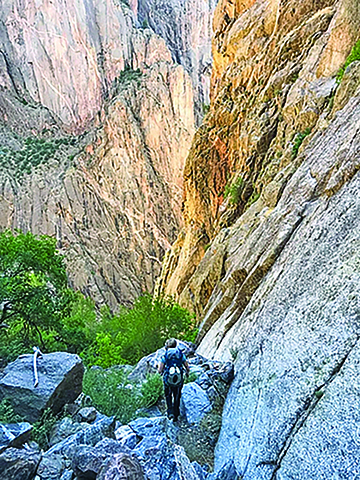
Black Canyon of the Gunnison National Park is currently operating with no maintenance crew and half its staff. Photo credit: Jessica Hughes
The Black Canyon of the Gunnison National Park was forced to operate with no maintenance crew and half of its staff. “That means Black Canyon of the Gunnison National Park is unable to fill 24 of the park’s 74 positions – a 1/3 reduction in staffing,” says Caitlyn Burford, the NPCA Senior Communications Manager. In other instances, this past summer, the park operated without rangers at the park’s North Rim, requiring signs to be posted telling visitors that search, and rescue would be slow or unavailable. And because all custodial staff had been terminated, higher-grade employees were being directed away from their regular duties to perform custodial functions.
Even amidst the government shutdown, most parks remain open with fewer amenities, and to the public, no real change is seen. But Coppola points out the front-facing staff shortages and closures aren’t the real issue.
“The challenge with the current narrative is that parks behind the scenes are scrambling. Visitors aren’t really seeing it out front; it is more behind the scenes,” explains Coppola. “It’s the scientists, conservationists, all those behind the scenes are where the parks are feeling it the most.”
Coppola refers to the staff who are hired to help protect the park’s natural and cultural resources. But with the recent cuts, places like Dinosaur National Monument, where its Cultural Resources person was fired, aren’t allowed to replace or rehire this position. And because administrative and maintenance staffing at the park is down 40%, those who remain behind the scenes, such as the park’s archeologist, are jumping in to help where they can, taking them away from what they were hired to do.
“We’re at a place where the parks are being put in an impossible situation,” says Coppola. “The future is uncertain. It is terrifying. We never thought the administration would come for the parks like they have; the parks are becoming politicized more, and we’re losing the reason why parks were created in the first place.”
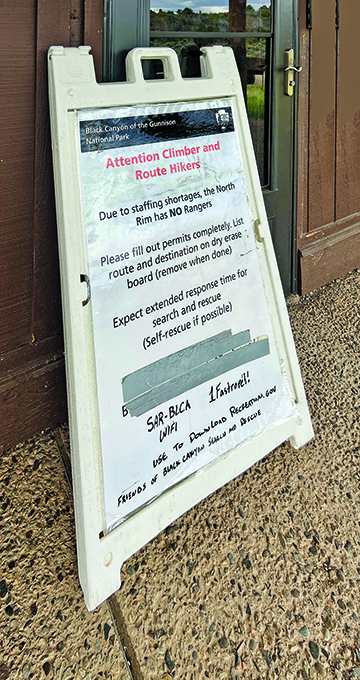
Staff shortages at national parks have led to visitors exploring at their own risk. Photo provided by National Park Conservation Association
The National Park Conservation Association is the only independent, nonpartisan organization dedicated to protecting and advocating for America’s National Park System. This year, Coppola has seen a huge pivot in the organization’s focus, most of which has been voicing how critically important park staff is, and how these cuts have put a huge strain on the park system.
“We estimate that at least 24% of park permanent staff is gone across the board,” says Coppola. “So, we’ve been using our voice to stand up for park staff.” Another big focus for the organization is the sweeping changes that could come with president’s most extreme proposed 2026 budget.
The harshest budget proposal asks Congress to cut more than $1 billion to the National Park Service, which includes a $900 million cut to the operations of our national parks. According to the NPCA’s calculations, “achieving a $900 million cut to operations would require eliminating funding and staffing for roughly 350 park sites from the smallest to some of the largest.”
The NPCA also goes on to list other Park Service-related budget cuts proposed in the President’s budget, including:
- $73 million cut to park construction funding
- $77 million cut to recreation and preservation funding
- $197 million cut to the Historic Preservation Fund
“This is the most extreme, unrealistic, and destructive National Park Service budget a president has ever proposed in the agency’s 109-year history,” according to a statement issued by National Parks Conservation Association chief executive Theresa Pierno. “It’s nothing less than an all-out assault on America’s national parks.”
It’s clear, no matter how you slice it, the future of America’s national parks is on the line.
by Mark Smiley | Nov 17, 2025 | Travel
by Mark Smiley

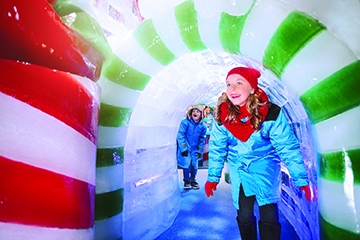
Ice Slides: Guests can take rides down the two-story-tall ice slides, traverse through ice tunnels and arches, and visit the carver showcase to watch artisans perform live carving demonstrations.
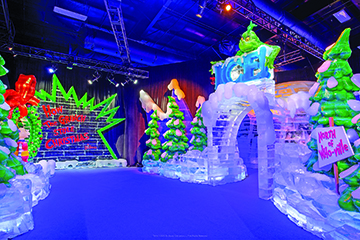
Ice Sculptures: Colorful ice sculptures recreate scenes from Dr. Seuss’ How the Grinch Stole Christmas! inside the ICE! exhibit at Gaylord Rockies Resort.
A team of 40 master ice artisans from Harbin, China, has arrived at Gaylord Rockies Resort in Aurora, to transform two million pounds of ice into a breathtaking winter wonderland. The group has spent more than 12,000 hours hand-carving intricate sculptures for this year’s ICE! experience, themed around Dr. Seuss’ How the Grinch Stole Christmas!
Hailing from Harbin — famously known as “Ice City” and home to the world’s largest ice and snow sculpting festival — the artisans have traveled more than 5,700 miles to Colorado. Since 2001, Gaylord Hotels has partnered with these highly skilled carvers to bring their centuries-old craft to life for American audiences.
Using tools such as chisels, tongs, hand saws, grinders, and chainsaws, the team begins with over 6,000 blocks of ice, each weighing about 300 pounds. Working from a 300-page design book, the artisans sculpt everything from coin-sized details to 30-foot-tall scenes inspired by Dr. Seuss’ beloved holiday tale.
Guests visiting ICE! at Gaylord Rockies will be transported through the classic story — journeying from the Grinch’s snowy mountaintop lair and his sneaky sleigh ride into Whoville, to the Whos’ joyful celebration and the Grinch’s heartwarming transformation. Brilliant colored ice, dazzling LED lights, and a precisely maintained 9-degree environment combine to create a mesmerizing display. Visitors can borrow signature blue parkas to stay cozy during the experience.
The attraction also includes two-story ice slides, sparkling tunnels, and live carving demonstrations in the Carver Showcase. ICE! concludes in a serene Nativity scene, sculpted entirely from crystal-clear ice. The display runs from November 24, 2025, through January 2, 2026.
While ICE! is the crown jewel of Christmas at Gaylord Rockies, the holiday spirit extends throughout the resort, which features millions of twinkling lights and more than 200 decorated trees. New this year is the Sugar Snow Station, a whimsical area featuring Candy Cane Mountain Indoor Snow Tubing, Gumdrop Gliders Ice Puck Challenge, and the Sugar N’ Spice Bar offering festive treats.
Ice!: Guests will embark on a journey through hand-carved ice sculptures depicting iconic scenes from Dr. Seuss’ How the Grinch Stole Christmas!
Other seasonal highlights include:
Feast with the Grinch, a family dining event where guests can meet the famously grouchy green guest of honor and his dog, Max.
Sippin’ Santa, a tropical tiki pop-up bar serving island-inspired holiday cocktails in collectible mugs.
Gingerbread Mountain Cabin, a life-sized (12 foot high) creation built from over 1,400 pounds of gingerbread, icing, and candy.
Festival of Trees, an annual fundraiser benefiting Lantern (formerly Bright by Text), supporting early childhood development.
Guests can also enjoy festive favorites like the Grinch’s Wonderful Awful Idea Scavenger Hunt, the Gingerbread Decorating Corner, Photos with Santa, the Elf Training Academy, Mrs. Claus’ Christmas Traditions, and the Yuletide Street Market in Mistletoe Village.
For those looking to extend the holiday magic, overnight guests receive special perks such as “Chill Pass” front-of-line access to ICE! and entry to the resort’s indoor Arapahoe Springs Waterpark.
Tickets for ICE! and other Christmas at Gaylord Rockies attractions must be purchased in advance, as peak weekends often sell out. For details, overnight packages, or reservations, visit ChristmasAtGaylord Rockies.com.
by Jessica Hughes | Oct 20, 2025 | Glendale City News
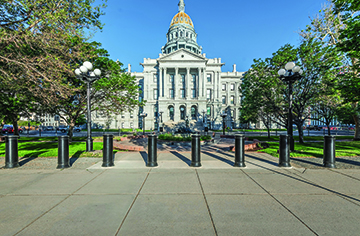
Photo taken by Jessica Hughes with Mountain Light Photography Denver City Council approved the Vibrant Denver bond package and will appear on the November ballot.
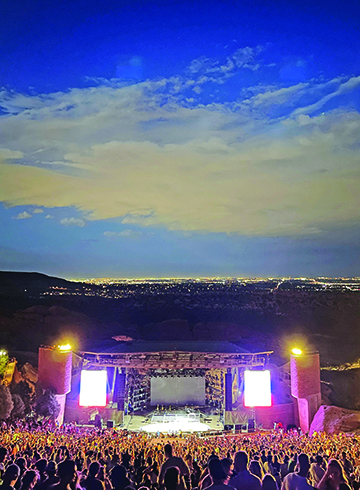
The Vibrant Denver Bond addresses infrastructure needs to some of the city’s most iconic places such as Red Rocks Amphitheatre. Photo taken by Jessica Hughes with Mountain Light Photography
by Jessica Hughes
In November, Denver voters will be able to vote on the $950 million “Vibrant Denver” bond package that was recently approved unanimously by the Denver City Council.
Mayor Mike Johnston’s ambitious bond is the largest bond ever put forward in the city’s history and proposes “to repair and improve Denver’s infrastructure and community space — including roads, bridges, parks, playgrounds, recreation centers, and libraries.”
This comes on the heels of several recent moves to improve Denver’s downtown, including the 16th Street Mall Project, which celebrated its completion this summer, as well as rejected city improvements, such as Governor Polis’s $29 million pedestrian bridge project. At the same time, Trump threatens to decrease federal funding for some programs, the city also faces massive budget cuts worth $250 million, which recently included firing nearly 170 employees and eliminating hundreds of vacant positions. But when you add all of this up, can the city really afford nearly $1 billion in debt?
Johnston says the bond would be fully funded from property tax income, without adding any new taxes. “The Vibrant Denver bond package allows us to come together to decide our priorities for our neighborhoods and families,” said Mayor Johnston. “This bond will help us build the Denver of the future, without raising taxes, while also ensuring the protection and preservation of critical infrastructure already in place. It will also allow us to control our own destiny by creating a local funding source for needed local projects.”
According to the City of Denver, they “set general obligation (GO) bond programs intentionally every 4-10 years so that as previous bonds are paid down, new bonds can be issued without new taxes — allowing the city to keep pace with infrastructure improvements.”
Th
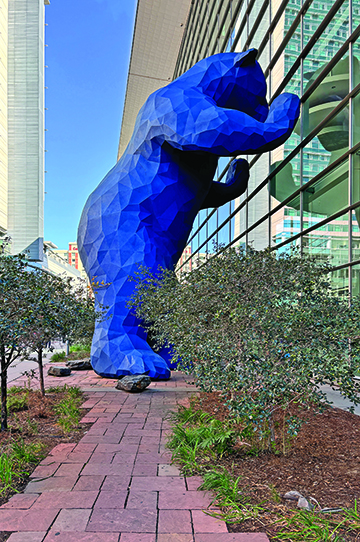
The Vibrant Denver Bond is the largest bond ever proposed in the city’s history. Photo taken by Jessica Hughes with Mountain Light Photography
e mayor’s office said each of the approximately 60 projects can be completed over the next six years within the city’s existing bond capacity, since previous bond programs are almost complete. According to the city’s 2024 comprehensive financial report, the city has about $1 billion in existing debt from previous bond packages voters approved, including the Elevate Denver, a 10-year, $937 million general obligation bond program approved by voters in 2017, and RISE Denver, a five-year, $260 million general obligation bond program approved by voters in 2021.
“In North Denver over the past several years, we’ve seen improvements to recreation centers, parks, fire stations, libraries, playgrounds, and less noticeable but equally important infrastructure like irrigation, street repairs, and bridges. Almost all the infrastructure we rely on daily is built or maintained through our bond programs — critical investments that do not raise taxes but create lasting, tangible benefits for our communities,” said City Council President Amanda P. Sandoval. “General Obligation Bonds allow us to build and maintain the spaces that define our city, ensuring Denver’s legacy of strong, community-driven infrastructure continues for generations to come. The 2017 GO Bond included funding for pedestrian safety improvements along Federal Boulevard, an issue I advocated for, to make one of our city’s busiest corridors safer for everyone. I look forward to working with residents to shape our next bond program and invest in the future of our neighborhoods.”
But before Denverites vote no to avoid adding more debt, it’s important to note the city can only use property tax revenue to fund GO bonds and pay off bond debt. If Vibrant Denver isn’t approved, the city will have a surplus of property tax revenue in the coming years, since it’s on schedule to pay off its current debt, and bonds cannot be used to pay for any operational costs like staffing or services, only for the construction of public infrastructure and facilities. Ultimately, the city would be left with a surplus of money that they couldn’t use for any other cause. So, while it may seem like bad timing, the City of Denver is keeping up the pace of regularly scheduled bond issuance and maintenance.
Each of the bond projects is categorized into five separate sections, which voters will be able to approve or reject. Nearly half of the funding will be allocated toward transportation and mobility, including streets, bridges, and traffic safety improvements. Here is a snapshot of the five categories voters will get to vote on, with the top few most expensive projects within each category.
Transportation and Mobility —
the largest category by far at $441 million
- 8th Avenue Viaduct & Multimodal Improvements | $89,200,000 — The most expensive item on the ballot at almost $90 million is the repairs to the 8th Avenue bridge near Burnham Yard. Despite the City of Denver’s claims that repairs are long overdue, it seems coincidental with the recent rumors of the new home of the Denver Broncos stadium.
- Globeville Elyria-Swansea Connections: Marion Underpass | $75,000,000 — this plan completes the final connection linking Globeville to Elyria and Swansea. It also provides Globeville direct access to the RTD N Line station and several other structural improvements.
- 6th Avenue Viaduct Repairs & Mobility & Access Improvements | $50,000,000 — This project addresses one of the busiest roads in Denver, 6th Avenue, by completing the critical structural repairs, additional access points and a complete re-design for the future replacement of the bridge.
City Facilities
- First Responder & Public Safety Training Center | $75,000,000 — This project would combine the sheriff, fire, and police training needs into one facility to provide greater efficiencies in training recruits, expand the number of trained public safety personnel, and bring training resources up to competitive standards.
- Red Rocks Backstage Expansion and Accessibility Improvements | $35,100,000 — The backstage renovation and expansion would address ADA accessibility (which has been a hindrance to growth for Red Rocks in recent years), additional parking, as well as facility improvements backstage.
Parks and Recreation
- Park Hill Park Buildout | $70,000,000 — After the city announced, earlier this year, its plans to acquire the former Park Hill Golf Course, it comes as no surprise that there is a proposal to build out the park’s new facilities. The plans include steps to ready the park with proper irrigation, landscape, walkways, and parking lots.
- Southeast Recreation Center & Skate Park | $20,000,000 — Money for this project would support acquisition ONLY for the SE Skate Park Hub, which would provide access to skateboarding, roller-skating, etc., to the existing DPR Sports Complex. Development of the recreation center would require additional funding.
Housing and Sheltering
- Affordable Housing Project Development | $45,000,000 — Money for this project allows the city to invest in land, buildings, and/or site preparation to provide affordable housing and to mitigate displacement.
Health and Human Services
- Denver Health Sam Sandos Westside Family Health Center Replacement | $20,000,000 — If approved, the money would support construction of a new clinic in the Westside neighborhood that will increase access to healthcare for the people of Denver. This comes as the Big Beautiful Bill is set to slash healthcare funding in Colorado. The bond is only expected to provide funding for a portion of the entire project.
For more about what’s included in the Vibrant Denver bond, visit Denvergov.org
by Amber Wyatt | Oct 20, 2025 | Travel
by Amber Wyatt
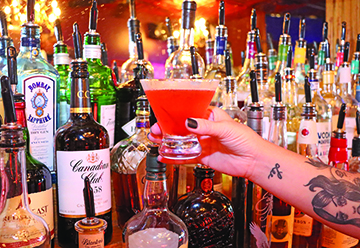
The Skinny Dip: A classic cocktail with a lemon twist, known as The Skinny Dip, awaits at The Bar Car, where the vintage ambiance and neighborhood camaraderie make every sip feel like home, no matter where you’re from.
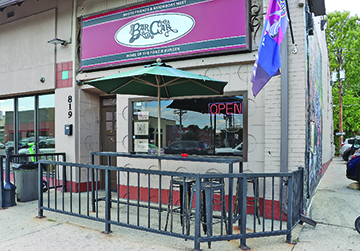
Cozy Patio: The Bar Car at 819 Colorado Blvd. welcomes locals with its cozy patio, signature menu, and the promise of good times where “friends and neighbors meet.”
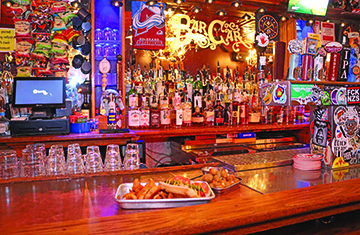
Neighborhood Favorite: With a lineup of craft beers, top-shelf spirits, and hearty pub fare, The Bar Car continues to be a favorite neighborhood stop for both drinks and bites.
On a stretch of Colorado Boulevard better known for fast traffic than lasting community, BarCar has carved out something rare: a true neighborhood bar that doubles as a second home. For majority owner Victor Muñiz and part-owner Andrew Callahan, the mission is clear — create a space where locals feel seen, safe, and connected.
“Working at BarCar is working at a neighborhood spot that is truly a neighborhood spot,” Callahan said. “It is for the neighborhood, by the neighborhood. Most of us live close by.” For Callahan, who has lived in the neighborhood for over a decade, the bar is both a livelihood and a love letter to the community.
That grassroots spirit is built into the very structure of the business. Unlike most establishments, BarCar is largely employee-owned. “We are a mostly employee-owned bar,” Callahan explained. “Almost all of the investors, except for I think one right now, are employees of the bar. We’ve told our entire staff that if they work with us for a couple years and want to become an investor, we’re open to that. That is a path they can take.”
This model has given the bar an unusually high level of buy-in from its team, especially from veteran bartenders who appreciate the stability and the opportunity to shape the place where they work. “Having the opportunity to become financially invested is a big plus,” Callahan noted. “Not a lot of places always offer that.”
That sense of ownership translates directly to hospitality. Muñiz, who also owns the Owl Saloon, describes BarCar as nothing short of a dream realized. “It’s my dream come true,” he said. “Everything about it — friends, family — it’s just a great place to be all the time.”
For Muñiz, the family feel isn’t a metaphor. It’s the guiding principle. “We created a community where we have your makeshift family here,” he explained. “That’s what it’s about. That’s what bars are about in my opinion.”
That philosophy manifests in everyday moments. Neighbors use BarCar as a meeting place before concerts, after games, or just to catch up on life. “A lot of people come before they do other things in life and meet up here or afterwards,” Muñiz said. “Honestly, I think that’s the best thing we do — we keep the neighbors together.”
The idea of BarCar as a community hub is reinforced by personal milestones. When Callahan married his wife, who also works in the hospitality industry, they hosted their wedding reception at another venue — then, naturally, the celebration moved to BarCar. “At around 9:30 or 10, most of the people at our wedding, who were industry workers as well, showed up here,” he recalled. “It became quite a big party to have the neighborhood people getting married, you know?”
Muñiz, who spent years as a bartender and server before stepping into ownership, says that lived experience informs his leadership. “I believe in a bartender-driven industry,” he said. “I know we could have extra staff, but at the end of the day, it’s a staff of people that care and like doing what we do.”
That tight-knit crew has weathered challenges together, particularly during the pandemic. “Coming out of COVID, we had a lot of employees that we needed, and we’re back to the hardcore seven,” Muñiz said. “That’s how we built this bar before COVID, and then we’re back to that again. It’s seven people that give a shit.”
And that’s exactly the vibe patrons notice. BarCar feels less like a business transaction and more like a gathering in someone’s living room — with better cocktails. “We want to be there for everybody that’s looking to have a good time in a cool, comfortable environment,” Muñiz said. “We’re all about being a safe place for people to come and hang out and not worry about the bullshit life has.”
The menu reflects that same spirit of neighborhood hospitality. During my visit, longtime bartender Brandy mixed me a Skinny Dip — a smooth, subtly sweet cocktail built with Deep Eddy sweet tea vodka, a squeeze of lemon, and just enough water to keep it light. It was the kind of drink made for conversation, and sure enough, I enjoyed it while chatting with Callahan and the cook, Will, who proudly shared that the kitchen rotates its cheese curd flavors. The current favorite? Dill pickle. Naturally, I had to try them. Crisp, golden, and tangy, the curds carried just enough bite to spark a round of laughter as the basket quickly disappeared among us.
That theme of comfort and camaraderie carried right into lunch. I went for a proper Chicago dog, stacked with the traditional fixings, and paired it with sidewinder fries that were as hearty as they were shareable. To balance it out, Brandy slid across the bar a Jabroni Negroni — the house’s playful take on a classic. Made with Hendrick’s gin, Campari, and sweet vermouth, the cocktail leaned pleasantly bitter and sour, a bold counterpoint to the rich food and the easy banter flowing through the room.
As Callahan put it, “This neighborhood bar — we focus on just making sure everyone’s taken care of. Everyone knows each other around here. And everyone that’s new to the neighborhood, we always welcome them in.”
On Colorado Boulevard, where strip malls often outnumber handshakes, BarCar has become something enduring: a place where the beer is cold, the people are warm, and the neighborhood spirit is alive and well
by Editorial Board | Oct 20, 2025 | Editorials
Editorial —
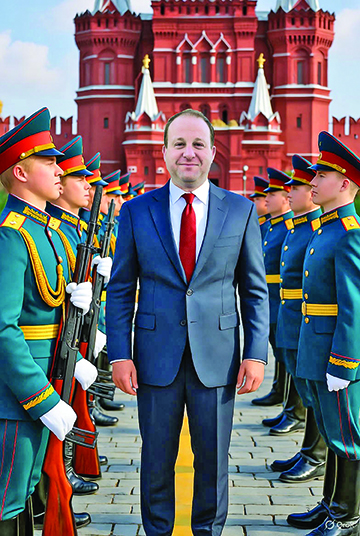
Comrade Polis
One of the keys to progressive left policies is to make sure people do not have any alternatives. When the Soviets imposed their form of communism on East Germany, it had to build the Berlin Wall to prevent the masses from escaping the workers’ paradise to West Germany. The progressives of North Korea attempted to prevent its citizens from escaping not only to South Korea but also to slightly less oppressive China.
Denver has decided it loves maximum density and a minimum number of cars. Afraid that not all Coloradans may want to live in Denver’s “affordability paradise,” the state legislature, as well as Governor Polis, have begun imposing Denver inspired restrictions and mandates on towns and counties across Colorado.
As a practical matter, progressives intensely dislike single family homes and, for that matter, nuclear families. The new law (HB 24-1152) prohibits local jurisdictions imposing mandatory owner occupancy laws and specific minimum square footage for residencies. No more single-family homes with those lots potentially becoming mini apartment buildings with streets jammed with cars. Since progressives can’t just say they hate nuclear families, they say what they are doing is make housing more “affordable” and fighting against “climate change.”
Housing will undoubtably become more affordable due to the legislature’s and the governor’s actions as fewer people will want to live in Colorado. The price of what were once called single family homes will plummet.
Next the state legislature adopted HB24-1313 which prohibits municipalities from adopting or enforcing parking requirements within a quarter mile of various transit stops. The legislature mandated that municipalities allow high density high rises near transit stops. The urbanization of Denver suburbs will, if successful, overwhelm infrastructure, strain schools, and destroy community character. In Polis’ mind what is there not to like?
Unfortunately, the proletariat outside of Denver have not been enamored by the Polis vision. Many communities refused to implement the necessary ADU regulations/ordinances. Moreover, six cities — Glendale, Greenwood Village, Arvada, Aurora, Lafayette, and Westminster — sued the state to stop the implementation of the legislation.
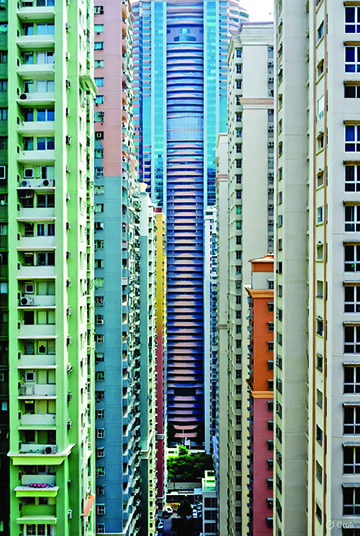
Polis’ vision of what suburbs in Colorado should look like.
Watching the peasant revolt, Governor Polis looked to President Trump’s authoritarian tactics for inspiration. Polis elected to issue an executive order that the rebel cities either comply or face losing out on $277 million in housing grants. Of course, there is nothing in the State Constitution or state statutes giving him the power to do so, but then again where does Trump get the authority for many of his executive orders.
The rebel cities in their lawsuit rely on the over century-old Article XX, Section 6, allowing home-ruled cities to operate free of state control on matters of local concern including zoning and land use. There are no exceptions for affordability and/or climate change. While on the surface the rebel cities appear to have a slam dunk case, Polis knows he has appointed many of the judges who will hear the case at the district court level and on appeal. Colorado courts have already largely gutted large parts of the citizen adopted constitutional amendment called the TABOR amendment. The Colorado Supreme Court was also happy to try to deny Republican voters the right to vote for Trump for President until the U.S. Supreme Court intervened. As a result, few people these days have any trust in the Colorado courts to fairly adjudicate the meaning of the state Constitution or Colorado laws.
It is well known that Polis is seriously looking at running for U.S. president in 2028. He would appear to be a worthy successor to the power-hungry Donald Trump.
— Editorial Board