
The Wall Rebuilders



Jim Gaffigan performs at the Paramount Theatre on January 24, 2026.
By Mark Smiley
On January 24, 2026, the historic Paramount Theatre in downtown Denver was filled with laughter as one of America’s most beloved stand-up comics, Jim Gaffigan, brought his Everything Is Wonderful! tour to a sold-out audience.
Gaffigan’s appearance, part of a highly anticipated continuation of his 2026 tour, delivered the warm humor and sharp observational wit that has made him a fixture in comedy for decades. The Paramount’s ornate 1920s interior provided an ideal backdrop for an evening of accessible, family friendly entertainment that kept the crowd laughing from start to finish.
From the opening moments, Gaffigan displayed his characteristic ease onstage. His delivery was unhurried yet razor sharp, with each punchline landing precisely. True to form, he mined everyday life for laughs, touching on food obsessions, parenting mishaps, and the small absurdities of modern living. The material felt fresh for longtime fans while remaining instantly relatable for newcomers.
Highlights of the evening included Gaffigan’s playful routines about culinary indulgences and his self-deprecating takes on family life. His comic timing never faltered, and his ability to shift smoothly between quick one-liners and longer narrative bits kept the energy high throughout the set. The entire show ran about an hour and a half which included an opener, typical for a headlining performance, yet there were moments when it felt like the laughs could have continued well into the night.
The Paramount audience was fully engaged, capturing the communal joy that only live comedy can create. Even the familiar challenges of Denver traffic an d crowded parking did little to dampen spirits, as fans arrived with a shared sense of anticipation.
At a time when stand-up comedy often leans toward the abrasive or confrontational, Gaffigan’s easygoing, conversational style stands apart. His humor is clean without being timid and sharp without being cynical. For audiences seeking a night of laughter that feels both comforting and clever, Jim Gaffigan’s performance at the Paramount Theatre delivered exactly that.
by Mark Smiley
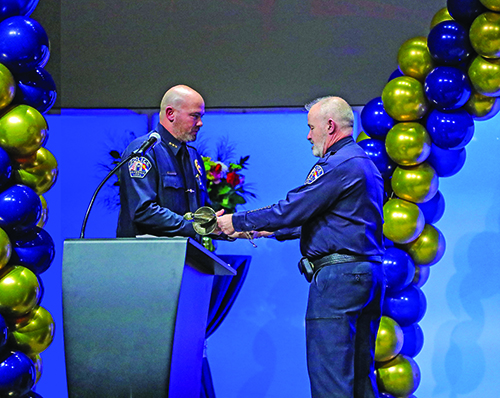
Retired Glendale Police Chief Joe Haskins (right) passes along a ceremonial sword bearing the engraved names of past chiefs to new Glendale Police Chief Justin Haynes, an enduring tradition that has remained in the chief’s office for decades. Photo credit: Colton Strickler
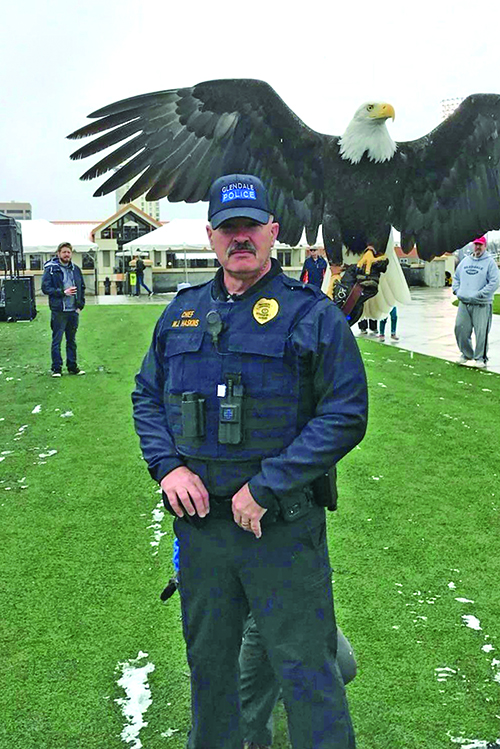
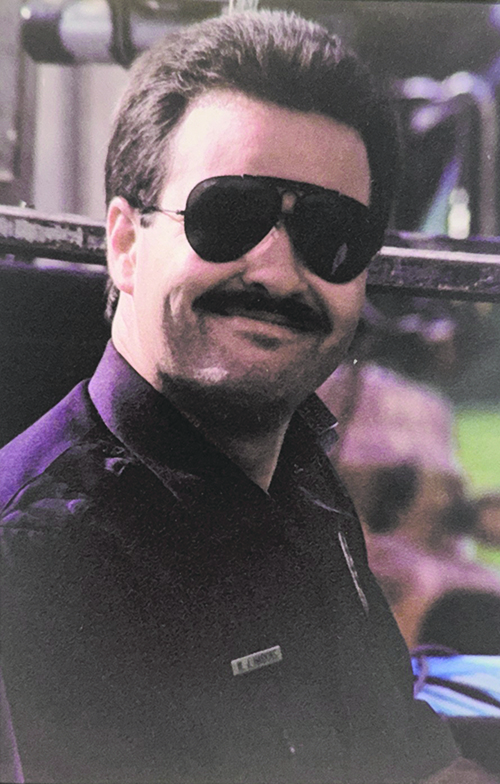
Retired Glendale Police Chief Joe Haskins is pictured in vintage photos, remembered for his decades of service and leadership in the Glendale community.
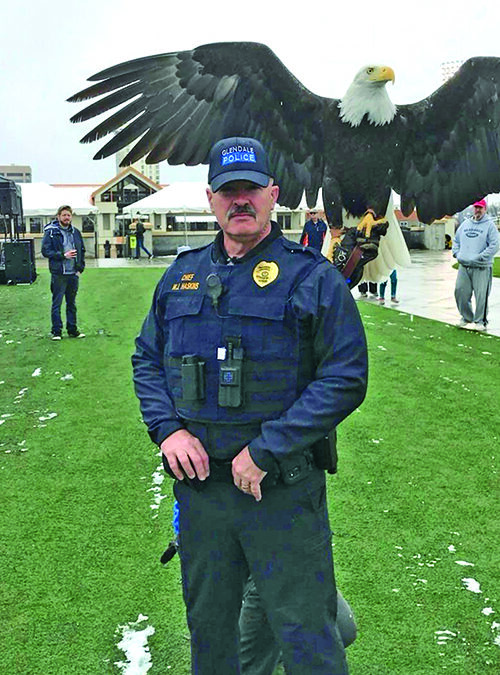
 After 38 years in law enforcement, including almost 13 years as Glendale’s police chief, Joe Haskins is stepping away from the badge, leaving behind a department he helped fundamentally reshape and a legacy defined by service, accountability, and cultural change.
Haskins’ career with the Glendale Police Department began in 1994, after six years with the Sheridan Police Department. Like many officers of his era, he entered policing with what he describes as an “enforcement-first” mindset, an approach that would later evolve in response to a pivotal moment in the department’s history.
In October 1999, Glendale police were involved in a serious incident during a contact with a man believed to be intoxicated in his vehicle. The situation escalated, and the individual was assaulted by an officer who was later convicted of a crime and permanently removed from law enforcement.
“That incident made it really clear, to the mayor, City Council, and certainly to the police department, that things needed to change,” Haskins said. “We recognized there was a big shift that had to happen.”
The department began moving away from an enforcement-first philosophy toward a model emphasizing judgment, restraint, and decision-making under stress. That cultural shift, Haskins said, did not happen overnight.
“It took years,” he said. “By 2006 or 2007, we were really well on our way, but this is never something that’s ‘done.’ You’re always working at it.”
As he rose through the ranks, promoted to sergeant in 2002, lieutenant several years later, and ultimately police chief in 2013, Haskins became closely involved in training and policy reforms. One of the initiatives he helped pioneer was Glendale’s force-continuum training program, a hands-on simulation designed to replicate the stress and unpredictability officers face in real-world encounters.
“You can teach policy in a classroom and pass a written test,” said Haskins. “But how are you really going to act at three o’clock in the morning when no one is watching?”
The program placed officers in realistic scenarios using protective gear and non-lethal training weapons, allowing supervisors to observe how officers responded under pressure and intervene with retraining when necessary.
“That was one of the key things about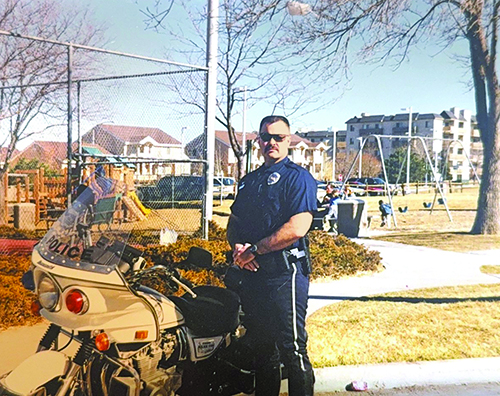 changing the culture,” Haskins said.
In 2013, following the resignation of then-Chief Ross, Haskins was appointed interim chief and later named permanent chief by City Council. His tenure would become the second-longest in department history.
Despite leading a relatively small department, Haskins emphasized that Glendale officers face big-city challenges, from high call volumes to nightlife related incidents, and that proactive policing has long been a hallmark of the department.
“Our officers are busy,” Haskins said. “I’d put their activity level up against anyone in the metro area. They’re proactive, not just waiting for the radio to go off, but making contacts, trying to solve problems, and figuring out whether someone needs help or accountability.”
Throughout his career, Haskins often returned to the idea of policing as a calling rather than a job.
“I’ve always believed law enforcement is a noble profession,” he said. “The nobility comes from the self-sacrifice. You give up some of your rights. You place the will of the public ahead of your own.”
As chief, he reminded officers that the uniform itself symbolized service over self.
“I take away your first name. Your first name is ‘officer,’” he said. “Because it’s not about you, it’s about the service you’re providing.”
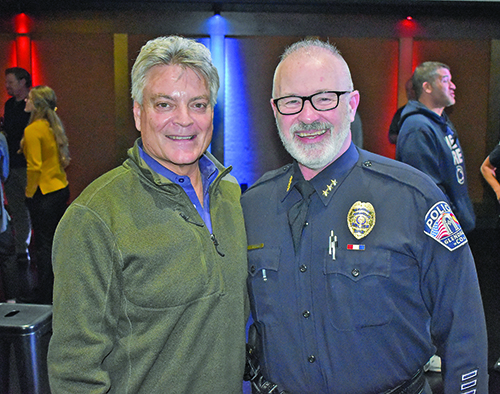
Barret O’Brien (left) poses with retired Glendale Police Chief Joe Haskins, lifelong friends whose bond has remained strong through the years of service and community involvement.
While Haskins is retiring as chief, he is not fully stepping away. He plans to continue consulting for the city and police department, offering institutional knowledge built from decades of experience.
“I don’t want to just abandon the cops over there,” Haskins said. “I care deeply for the department and every single member of staff.”
More than anything, Haskins said retirement will allow him to make up for time lost with his family, particularly his wife, Rochelle, who endured years of late nights and constant worry.
“Every night I went to work, she had a pit in her stomach until I got home,” he said. “She lived that life with me.”
Reflecting on his career, Haskins expressed gratitude rather than pride.
“I was trusted with an incredible responsibility,” he said. “It was always a privilege, and I tried very hard to live up to that.”
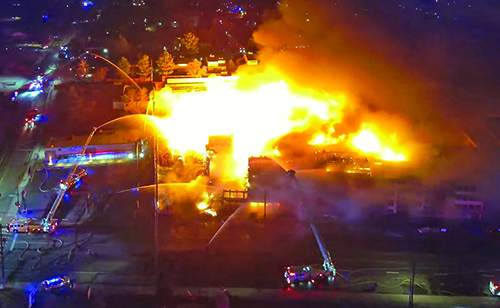
Fire Threatened Historic Inga’s Alpine Tavern
by Amber Wyatt
Blazing Inferno: The Leetsdale Drive fire was the largest in Denver for decades but fortunately resulted in only one fireman being injured
A five-alarm fire tore through the Harker Heights apartment complex under construction along Leetsdale Drive along the Glendale-Denver border on Friday evening, January 3, sending thick black smoke into the sky, knocking out power for nearby blocks, and forcing evacuations on the border of Denver and Glendale.
The 283-unit development was scheduled to open in May, but officials said the building had not yet been outfitted with a sprinkler system or interior drywall, allowing flames to spread rapidly through exposed construction materials. At one point, the fire sparked a smaller blaze behind the neighboring Sherwin-Williams paint store, which crews quickly extinguished.
Individual Arrested

Suspect: Convicted felon Tony Becerra of Aurora was arrested in connection with the five-alarm fire on Leetsdale Drive.
It was the largest fire in Denver in decades and encompassing an area equal to four football fields. With unusual alacrity the Denver Fire Department (DFD) announced on January 14, 2026, that they had arrested Tony Becerra, 38, of Aurora as a result of a joint arson investigation of the DFD and the U.S. Bureau of Alcohol, Tobacco, Firearms and Explosives.
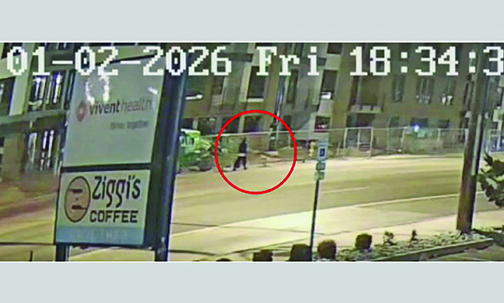
Surveillance footage has the suspect entering and leaving the construction site shortly before the fire started and other cameras tracked his movements after leaving the site. He is shown carrying a black bag. The exact origin and cause of the fire have not yet been determined.
Becerra had been previously convicted of felony trespassing and had an active warrant from June 2025 for failing to appear for another trespassing charge. In keeping with Denver city policy his immigration status was not revealed.
Evacuations And Power Losses
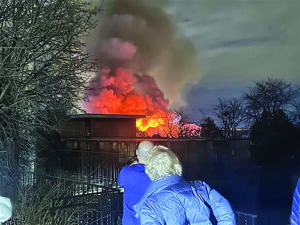
Neighborhood Watch: Homeowner watched and worried as the fire roared. Homes on East Dakota Ave. on the north were noticeably damaged.
Roughly 1,000 Xcel Energy customers lost power as firefighters battled the flames, and the Glendale Police Department opened an overnight shelter at the Glendale Event Center for people displaced by the evacuation orders and outages.
Denver Police issued evacuations for residents of about 10 to 15 homes behind the construction site, where residents watched the fire climb high above rooftops.
“It looked like the building was blowing up,” said South Hilltop resident Caitlyn Molner, who lives directly behind the site. “I saw the flames in the reflection of my refrigerator.”
Molner said she and her husband fled with their four-month-old baby and dogs within minutes as the heat intensified near their home.
“I was afraid our house was going to burn down,” she said. “The firefighters did an incredible job keeping it out of our home.”
Historic Tavern Narrowly Spared
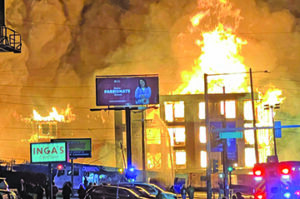
Photo by: Caitlin Spano
For many neighbors, the fire carried an additional fear: that it might destroy Inga’s Alpine Tavern, a longtime community fixture next door to the burning complex. The tavern sits in a building that dates back to 1954 and has served multiple generations of residents as both the neighborhood and the surrounding business corridor evolved.
“I’ve never seen one like it in Denver,” said Jeff Hansen, whose family built the structure in the 1950s and now owns it. “We’re just grateful Inga’s made it.”
The restaurant’s owner, Mary McKnabb, said she was not on site when the fire broke out, but her son Peter, the manager on duty, called her shortly after flames erupted nearby.
“About 10 minutes later the police showed up and told them they had to evacuate immediately,” McKnabb said. “Fire trucks were blocking Leetsdale. The parking lot was almost inaccessible.”
McKnabb said her son secured the business quickly before leaving, unsure what would remain by morning.
“He told me, ‘Mom, I thought the place wouldn’t be here tomorrow,’” she said.
Although the building survived, smoke and disruption have affected business operations in the days since. Inga’s lost power and connectivity, forcing the tavern to operate on a limited basis.
“We have a backup internet that sort of works,” McKnabb said. “We can run credit cards, but we can’t print receipts or kitchen tickets. We’re handwriting everything.”
Residents Describe Intense Heat, Smoke Damage
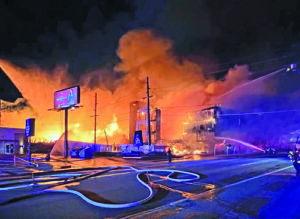
Hose Deployment: Fire engines capable of pumping 1,000 gallons of water a minute had to be refueled at least four times during the night of the fire.
In the South Hilltop neighborhood behind the construction site, residents described flames reaching an estimated 100 feet and heat strong enough to threaten nearby homes. Alan Rivoir, who lives just behind the site, said he was away in Littleton when his landlord called to warn him.
“He said, ‘The building behind us is burning down and the heat is intense,’” Rivoir said.
Rivoir rushed to make arrangements for his three dogs as evacuation orders spread. He said his home did not catch fire, but smoke from burning construction materials caused significant damage and required full remediation.
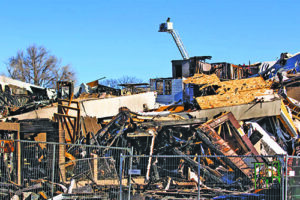
Fire’s Remnants: Residue from the five alarm Leetsdale fire highlights the destruction and loss brought about by the event. Photo: Kevin J. Beaty
“The wind saved us,” Rivoir said. “If it had shifted, those 100-foot flames would have wiped out our whole block.”
Fire Contained After Heavy Response
Firefighters used heavyweight equipment to move debris as crews worked to fully extinguish hot spots. Officials reported that 156 firefighters responded and that several engines capable of pumping 1,000 gallons of water per minute had to be refueled at least four times overnight due to the scale of the blaze.
Hose Deployment: Fire engines capable of pumping 1,000 gallons of water a minute had to be refueled at least four times during the night of the fire.
Following the fire, nearby businesses began reopening as conditions improved. Inga’s reopened to serve residents returning from evacuations who did not want to cook.
The Jewish Community Center remained closed through January 4 to prevent smoke from entering the building, while air purifiers ran throughout the facility. In a statement, the center thanked first responders and said it was collecting items of appreciation for nearby fire stations, including fresh challah bread.
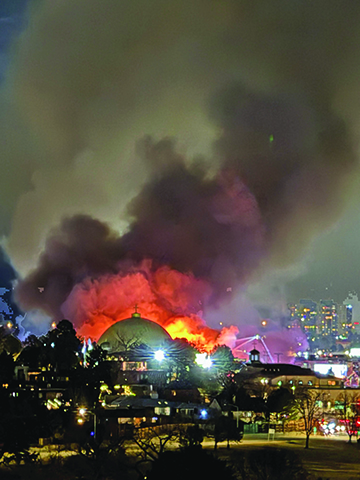
Frightful Flames: Flames from Leetsdale Drive apartment construction site fire flare above the nearby Greek Orthodox Cathedral
The Assumption of the Theotokos Greek Orthodox Metropolis Cathedral, located nearby, said it did not sustain smoke damage.
Questions remain as investigation continues
The cause of the fire has not been officially determined. Investigators said they were considering all possibilities, including reports of fireworks in the area.
The property is owned by Embrey, a Texas-based real estate investment company. Federal investigators from the Bureau of Alcohol, Tobacco, Firearms, and Explosives are assisting, deploying a National Response Team that includes certified fire investigators, explosives specialists, engineers, and forensic chemists, along with an accelerant detection canine.
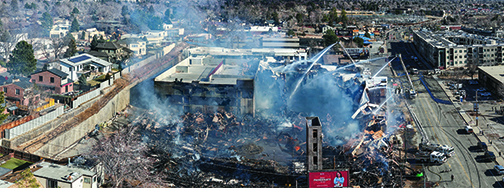
Photo by: Zachary Roulier
Despite the destruction of the unfinished apartment complex, many residents expressed relief that the fire did not spread further into surrounding businesses and homes.
“Thank you to the firefighters, because I don’t know how all of these homes aren’t burned down,” Mark Lampert told Denver7. “I mean, seriously, it’s a miracle.”
For Molner, the memory of the night still feels unreal.
“We were lucky,” she said. “So lucky. And we owe everything to the firefighters who kept it from getting worse.”